Results by title
4038 books match the query 'Social aspects' and 118 start with g
Gravity's Ghost and Big Dog
Scientific Discovery and Social Analysis in the Twenty-First CenturyHarry Collins
University of Chicago Press, 2013
Gravity's Ghost
Scientific Discovery in the Twenty-first CenturyHarry Collins
University of Chicago Press, 2010
In theory, at least, gravitational waves do exist. We are constantly bathed in gravitational radiation, which is generated when stars explode or collide and a portion of their mass becomes energy that ripples out like a disturbance on the surface of a serene pond. But unfortunately no gravitational wave has ever been directly detected even though the search has lasted more than forty years.
As the leading chronicler of the search for gravitational waves, Harry Collins has been right there with the scientists since the start. The result of his unprecedented access to the front lines of physical science is Gravity’s Ghost, a thrilling chronicle of high-stakes research and cutting-edge discovery. Here, Collins reveals that scientific discovery and nondiscovery can turn on scientific traditions and rivalries, that ideal statistical analysis rests on impossible procedures and unattainable knowledge, and that fact in one place is baseless assumption in another. He also argues that sciences like gravitational wave detection, in exemplifying how the intractable is to be handled, can offer scientific leadership a moral beacon for the twenty-first century. In the end, Gravity’s Ghost shows that discoveries are the denouements of dramatic scientific mysteries.
Gray Matters
Finding Meaning in the Stories of Later LifeEllyn Lem
Rutgers University Press, 2020
Finalist for the 2021 American Book Fest Best Book Awards
Aging is one of the most compelling issues today, with record numbers of seniors over sixty-five worldwide. Gray Matters: Finding Meaning in the Stories of Later Life examines a diverse array of cultural works including films, literature, and even art that represent this time of life, often made by people who are seniors themselves. These works, focusing on important topics such as housing, memory loss, and intimacy, are analyzed in dialogue with recent research to explore how “stories” illuminate the dynamics of growing old by blending fact with imagination. Gray Matters also incorporates the life experiences of seniors gathered from over two hundred in-depth surveys with a range of questions on growing old, not often included in other age studies works. Combining cultural texts, gerontology research, and observations from older adults will give all readers a fuller picture of the struggles and pleasures of aging and avoids over-simplified representations of the process as all negative or positive.
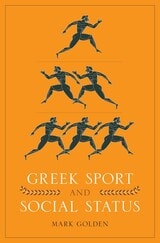
Greek Sport and Social Status
By Mark Golden
University of Texas Press, 2008
From the ancient Olympic games to the World Series and the World Cup, athletic achievement has always conferred social status. In this collection of essays, a noted authority on ancient sport discusses how Greek sport has been used to claim and enhance social status, both in antiquity and in modern times.
Mark Golden explores a variety of ways in which sport provided a route to social status. In the first essay, he explains how elite horsemen and athletes tried to ignore the important roles that jockeys, drivers, and trainers played in their victories, as well as how female owners tried to rank their equestrian achievements above those of men and other women. In the next essay, Golden looks at the varied contributions that slaves made to sport, despite its use as a marker of free, Greek status. In the third essay, he evaluates the claims made by gladiators in the Greek east that they be regarded as high-status athletes and asserts that gladiatorial spectacle is much more like Greek sport than scholars today usually admit. In the final essay, Golden critiques the accepted accounts of ancient and modern Olympic history, arguing that attempts to raise the status of the modern games by stressing their links to the ancient ones are misleading. He concludes that the contemporary movement to call a truce in world conflicts during the Olympics is likewise based on misunderstandings of ancient Greek traditions.

Gridiron Capital
How American Football Became a Samoan GameLisa Uperesa
Duke University Press, 2022
Duke University Press Scholars of Color First Book Award recipient

Gridiron Gourmet
Gender and Food at the Football TailgateMaria J. Veri
University of Arkansas Press, 2019
Tailgating, which began in the early 1900s as a quaint picnic lunch outside of the stadium, has evolved into a massive public social event with complex menus, extravagant creative fare, and state-of-art grilling equipment. Unlike traditional notions of the home kitchen, the blacktop is a highly masculine culinary environment in which men and the food they cook are often the star attractions.
Gridiron Gourmet examines tailgating as shown in television, film, advertising, and cookbooks, and takes a close look at the experiences of those tailgaters who are as serious about their brisket as they are about cheering on their favorite team, demonstrating how and why the gendered performances on the football field are often matched by the intensity of the masculine displays in front of grills, smokers, and deep fryers.

Gringo Gulch
Sex, Tourism, and Social Mobility in Costa RicaMegan Rivers-Moore
University of Chicago Press, 2016
Rivers-Moore situates her ethnography at the intersections of gender, race, class, and national dimensions in the sex industry. Instead of casting sex workers as hapless victims and sex tourists as neoimperialist racists, she reveals each group as involved in a complicated process of class mobility that must be situated within the sale and purchase of leisure and sex. These interactions operate within an almost entirely unregulated but highly competitive market beyond the reach of the state—bringing a distinctly neoliberal cast to the market. Throughout the book, Rivers-Moore introduces us to remarkable characters—Susan, a mother of two who doesn’t regret her career of sex work; Barry, a teacher and father of two from Virginia who travels to Costa Rica to escape his loveless, sexless marriage; Nancy, a legal assistant in the Department of Labor who is shocked to find out that prostitution is legal and still unregulated. Gringo Gulch is a fascinating and groundbreaking look at sex tourism, Latin America, and the neoliberal state.

Gringolandia
Lifestyle Migration under Late CapitalismMatthew Hayes
University of Minnesota Press, 2018
A telling look at today’s “reverse” migration of white, middle-class expats from north to south, through the lens of one South American city
Even as the “migration crisis” from the Global South to the Global North rages on, another, lower-key and yet important migration has been gathering pace in recent years—that of mostly white, middle-class people moving in the opposite direction. Gringolandia is that rare book to consider this phenomenon in all its complexity.
Matthew Hayes focuses on North Americans relocating to Cuenca, Ecuador, the country’s third-largest city and a UNESCO World Heritage Site. Many began relocating there after the 2008 economic crisis. Most are self-professed “economic refugees” who sought offshore retirement, affordable medical care, and/or a lower–cost location. Others, however, sought adventure marked by relocation to an unfamiliar cultural environment and to experience personal growth through travel, illustrative of contemporary cultures of aging. These life projects are often motivated by a desire to escape economic and political conditions in North America.
Regardless of their individual motivations, Hayes argues, such North–South migrants remain embedded in unequal and unfair global social relations. He explores the repercussions on the host country—from rising prices for land and rent to the reproduction of colonial patterns of domination and subordination. In Ecuador, heritage preservation and tourism development reflect the interests and culture of European-descendent landowning elites, who have most to benefit from the new North–South migration. In the process, they participate in transnational gentrification that marginalizes popular traditions and nonwhite mestizo and indigenous informal workers. The contrast between the migration experiences of North Americans in Ecuador and those of Ecuadorians or others from such regions of the Global South in North America and Europe demonstrates that, in fact, what we face is not so much a global “migration crisis” but a crisis of global social justice.
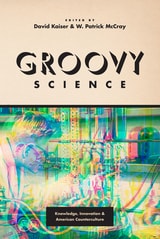
Groovy Science
Knowledge, Innovation, and American CountercultureEdited by David Kaiser and W. Patrick McCray
University of Chicago Press, 2016
Such a view is far too simple, ignoring the diverse ways in which the era’s countercultures expressed enthusiasm for and involved themselves in science—of a certain type. Rejecting hulking, militarized technical projects like Cold War missiles and mainframes, Boomers and hippies sought a science that was both small-scale and big-picture, as exemplified by the annual workshops on quantum physics at the Esalen Institute in Big Sur, or Timothy Leary’s championing of space exploration as the ultimate “high.” Groovy Science explores the experimentation and eclecticism that marked countercultural science and technology during one of the most colorful periods of American history.

Grounded Literacies in a Transnational WAC/WID Ecology
A Korean-U.S. StudyJay Jordan
University Press of Colorado, 2022
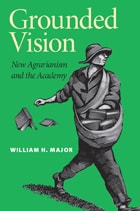
Grounded Vision
New Agrarianism and the AcademyWilliam H. Major
University of Alabama Press, 2011
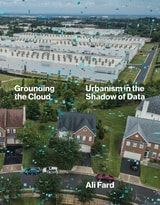
Grounding the Cloud
Urbanism in the Shadow of DataAli Fard
University of Minnesota Press, 2026
A detailed foray into the material and spatial realities of cloud computing
Since the 1990s, technologists have promoted a vision of the “cloud” as a shapeless and intangible entity. Grounding the Cloud peers through this hazy façade to reveal the earthly material foundations of global computing and data extraction. Tracing the historical and technological development of the cloud computing paradigm, Ali Fard exposes an ever-evolving project in which ideologies, economic models, and marketing images collude to shape our shared urban environments.
Demonstrating how technology’s spatial footprint now stretches to nearly every corner of the globe, Grounding the Cloud analyzes the often-hidden infrastructures that facilitate platform capitalism—from the mines extracting rare earth minerals in remote regions to the vast global network of fiber-optic cables at the bottom of the oceans to the nondescript data centers that sit on the peripheries of major urban areas. Meanwhile, with compelling examples of smart-city initiatives and corporate campuses, Fard shows how the future of urbanism is deeply intertwined with the growing economies of data extraction.
Breaking down the myth of a clean and efficient tech urbanism, this book makes visible the complex material geographies and geopolitics that undergird today’s most powerful and omnipresent corporations. A timely critique of the growing agency of tech platforms in determining the future of urban space, Grounding the Cloud offers an essential framework for understanding the shifting relationship between technology and urbanization.
Retail e-book files for this title are screen-reader friendly with images accompanied by short alt text and/or extended descriptions.
Growing Old in a New China
Transitions in Elder CareRose K. Keimig
Rutgers University Press, 2021
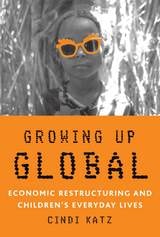
Growing Up Global
Economic Restructuring and Children’s Everyday LivesCindi Katz
University of Minnesota Press, 2004
Growing Up Global examines the processes of development and global change through the perspective of children’s lives in two seemingly disparate places: New York City and a village in northern Sudan. At the book’s core is a longitudinal ethnographic study of children growing up in a Sudanese village that was included in a large state-sponsored agricultural program in the year they were born. It follows a small number of children intermittently from ten years of age to early adulthood, concentrating particularly on their work and play, which together trained the children for an agrarian life centered around the family, a life that was quickly becoming obsolete.
Shifting her focus to largely working-class families in New York City in the 1980s and 1990s, Katz is able to expose unsuspected connections with the Sudanese experience in the effects on children of a constantly changing, capitalist environment—the decline of manufacturing jobs and the increase in knowledge-based jobs—in which young people with few skills and stunted educations face bleak employment prospects. In teasing out how “development” transforms the grounds on which these young people come of age, Cindi Katz provides a textured analysis of the importance of knowledge in the ability of people, families, and communities to reproduce themselves and their material social practices over time.
Growth Machines
On the Hollow Joys of Consumption in the Desert of Economic LifeMark Joseph Stelzner
University of Chicago Press, 2026
A provocative look at America’s compulsion to consume and our obsession’s surprising—and strange—origins.
In a capitalist society, people sell their labor to purchase staples like food, shelter, and anxiety medication. That’s the equation of everyday economic life that we’ve always been told is true. Except, is it really that simple anymore? No matter how unmaterialistic you may think you are, odds are that deep within is a drive to consume because it feels good: books you won’t read, clothes you won’t like and might wear even less, a replacement phone whose novelty runs out as quickly as its upgrade hits the market. But what drives this impulse?
In Growth Machines, Mark Joseph Stelzner shows how today’s consumers are now programmed by a US economy intent on infinite growth to work for goods they’ve been convinced they need and conditioned to want. Stelzner establishes the gaps between economic thinking and economic reality, arguing that consumption is no longer just a reflection of needs, but rather, it reflects a need for transaction—in many cases, a treat we seek out because it feels good. We work not only to be able to consume the essentials for living, but also to consume for consumption's sake. Yet such consumption doesn’t make us happier. Stelzner traces this strange nature of consumption to an environmental source: an economy that demands growth. To keep its economy pumping, the US must keep Americans consuming. This makes Stelzner’s book an uncomfortable reflection on how we internalize our economy. To be an American is to consume; to consume is what makes America.

Guerrillas, Unionists, and Violence on the Confederate Home Front
Daniel E. Sutherland
University of Arkansas Press, 1999

Guide to Smart Homes for Electrical Installers
The Institution of Engineering and Technology
The Institution of Engineering and Technology, 2021
Gurus, Hucksters, Entertainers
How Influencers Reshaped Social MediaAngèle Christin
University of Chicago Press, 2026
An illuminating investigation of the complex work of social media content creators—their lives, conflicts, and controversies.
In this eye-opening book, digital studies scholar Angèle Christin demystifies the content creator economy, explaining its long history and the pitfalls of its professionalization. Drawing on in-depth fieldwork with digital creators as varied as vegan YouTubers, dads of Instagram, and self-described drama commentators, Christin shows how individuals enter social media creation, how they make money, and how their online environments shape their content.
Aspiring creators often dream of a better life in social media careers. Yet these dreams soon turn into exhaustion as influencers try to meet the contradictory demands of platforms, brands, and audiences. Over time, Christin shows, creators cluster into three types: hucksters, who work on behalf of brands; entertainers, who chase virality and platform payments; and gurus, who monetize the loyalty of their fans. Platform dynamics push entertainers and gurus to create extreme and incendiary content to maintain audience engagement, while brands and marketers nudge hucksters toward repetitive, staid commercial performances. Concerns about algorithmic manipulation and conflicts between creators further lead to reputation-damaging, harassment-laden scandals. Christin reveals how platform labor repeatedly—and structurally—fosters precarity and inequality, destructive drama, and inflammatory content online.