Results by title
3703 books match the query '19th Century' and 102 start with h
HAWTHORNE AND THE REAL
BICENTENNIAL ESSAYSMILLICENT BELL
The Ohio State University Press, 2005
Contributors:
- Millicent Bell
- Nina Baym
- Michael T. Gilmore
- Leland S. Person
- David Leverenz
- Larry J. Reynolds
- Lawrence Buell
- Rita K. Gollin
- John Carlos Row
- Brenda Wineapple
HEARTS OF GOLD
a novel by J. McHenry Jones, edited by John Ernest and Eric Gardner
West Virginia University Press, 2010
J. McHenry Jones’s Hearts of Gold is a gripping tale of post-Civil War battles against racism and systemic injustice. Originally published in 1896, this novel reveals an African American community of individuals dedicated to education, journalism, fraternal organizations, and tireless work serving the needs of those abandoned by the political process of the white world. Jones challenges conventional wisdom by addressing a range of subjects—from interracial relationships to forced labor in coal mines—that virtually no other novelist of the time was willing to approach. With the addition of an introduction and appendix, this new edition reveals the difficult foundations upon which African Americans built a platform to address injustice; generate opportunities; and play a prominent role in American social, economic, and political life.

HISTORY OF ILLINOIS
FROM ITS COMMENCEMENT AS A STATE IN 1818Thomas Ford
University of Illinois Press, 1995
studies of Illinois during the Jackson period. His account is balanced
and critical while at the same time recognizing the value of Ford's book."
-- Robert W. Johannsen, J. G. Randall Distinguished Professor of History,
University of Illinois at Urbana-Champaign
Both cynical and self-serving, Illinois's seventh governor Thomas Ford
also possessed an unrivaled sensitivity to the dynamics of frontier life.
He reveals these and other qualities in his classic A History of Illinois,
which covers the state's first thirty years.
Ford writes with candor of the lengthy "Hancock County difficulties"
and the ouster of Mormons from the state. His treatment of the Black Hawk
War and his writings on the slavery controversy in the state, the murder
of Elijah Lovejoy, and the larger issues of violence and vigilantism help
show why this volume has been called the outstanding early survey of Illinois
history. This reissue of Ford's book includes an introduction by Rodney
O. Davis and a publication history by Terence Tanner.
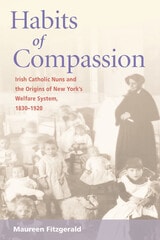
Habits of Compassion
Irish Catholic Nuns and the Origins of New York's Welfare System, 1830-1920Maureen Fitzgerald
University of Illinois Press, 2006
The Irish-Catholic Sisters accomplished tremendously successful work in founding charitable organizations in New York City from the Irish famine through the early twentieth century. Maureen Fitzgerald argues that their championing of the rights of the poor—especially poor women—resulted in an explosion of state-supported services and programs.
Parting from Protestant belief in meager and means-tested aid, Irish Catholic nuns argued for an approach based on compassion for the poor. Fitzgerald positions the nuns' activism as resistance to Protestantism's cultural hegemony. As she shows, Roman Catholic nuns offered strong and unequivocal moral leadership in condemning those who punished the poor for their poverty and unmarried women for sexual transgression. Fitzgerald also delves into the nuns' own communities, from the class-based hierarchies within the convents to the political power they wielded within the city. That power, amplified by an alliance with the local Irish Catholic political machine, allowed the women to expand public charities in the city on an unprecedented scale.
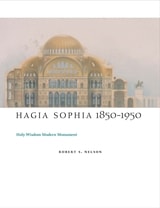
Hagia Sophia, 1850-1950
Holy Wisdom Modern MonumentRobert S. Nelson
University of Chicago Press, 2004
Built from 532 to 537 as the Cathedral of Constantinople, Hagia Sophia was little studied and seldom recognized as a great monument of world art until the nineteenth century, and Nelson examines the causes and consequences of the building's newly elevated status during that time. He chronicles the grand dome's modern history through a vibrant cast of characters—emperors, sultans, critics, poets, archaeologists, architects, philanthropists, and religious congregations—some of whom spent years studying it, others never visiting the building. But as Nelson shows, they all had a hand in the recreation of Hagia Sophia as a modern architectural icon. By many means and for its own purposes, the West has conceptually transformed Hagia Sophia into the international symbol that it is today.
While other books have covered the architectural history of the structure, this is the first study to address its status as a modern monument. With his narrative of the building's rebirth, Nelson captures its importance for the diverse communities that shape and find meaning in Hagia Sophia. His book will resonate with cultural, architectural, and art historians as well as with those seeking to acquaint themselves with the modern life of an inspired and inspiring building.

Hamlet Vocation Coleridge And Wordsworth
Martin Greenberg
University of Iowa Press, 1986
Handwriting in Early America
A Media HistoryEdited by Mark Alan Mattes, Foreword by Karen Sánchez-Eppler, Afterword by Christopher Hager
University of Massachusetts Press, 2023
As digital communication has become dominant, commentators have declared that handwriting is a thing of the past, a relic of an earlier age. This volume of original essays makes it clear that anxiety around handwriting has existed for centuries and explores writing practices from a variety of interdisciplinary fields, including manuscript studies, Native American studies, media history, African American studies, book history, bibliography, textual studies, and archive theory.
By examining how a culturally diverse set of people grappled with handwriting in their own time and weathered shifting relationships to it, Handwriting in Early America uncovers perspectives that are multiethnic and multiracial, transatlantic and hemispheric, colonial and Indigenous, multilingual and illiterate. Essays describe a future of handwriting as envisioned by practitioners, teachers, and even government officials of this time, revealing the tension between the anxiety of loss and the need to allow for variations going forward.
Contributors include James Berkey, Blake Bronson-Bartlett, John J. Garcia, Christopher Hager, Desirée Henderson, Frank Kelderman, Michelle Levy, Lisa Maruca, Christen Mucher, Alan Niles, Seth Perlow, Carla L. Peterson, Sarah Robbins, Patricia Jane Roylance, Karen Sánchez-Eppler, and Danielle Skeehan.
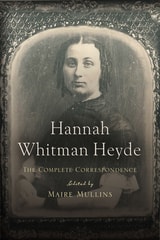
Hannah Whitman Heyde
The Complete CorrespondenceMaire Mullins
Bucknell University Press, 2022
Haphazard Families
Romanticism, Nation, and the Prehistory of Modern AdoptionEric C. Walker
The Ohio State University Press, 2024
There are no provisions for adoption in English common law, and adoption wasn't legally formalized in England and Wales until 1926. But a century earlier, untimely adoptions navigated the new exceptionalism of childhood in Romanticism. In Haphazard Families, Eric C. Walker explores the history of the adopted child in Romantic-era England. Taking up the stories of both fictional and historical adoptees, he demonstrates how these children, diminished to nonpersons, shouldered the burden of social constructs of nation, family, gender, and class. Walker further demonstrates how Rousseau’s infamous failure to follow his own ideals of parenthood shaped British reactions in famous texts such as Frankenstein and Emma. Incorporating perspectives from Romantic scholarship and critical adoption studies and examining the stories of adopted children associated with Queen Caroline, Anna Letitia Barbauld, Jane Austen, the Wordsworth siblings, Mary Shelley, Charles and Mary Lamb, Letitia Landon, and others, Haphazard Families considers how Romantic constructions of childhood supply foundational structures of modern adoptee subjectivity.
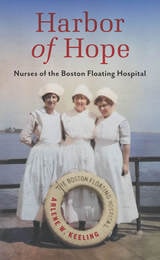
Harbor of Hope
Nurses of the Boston Floating HospitalArlene W. Keeling
University of Massachusetts Press, 2026
The untold story of Boston’s Floating Hospital and the nurses whose work redefined infant care
In late nineteenth-century Boston, nearly one in five babies did not survive infancy. Each summer, outbreaks of “summer complaint”—a deadly gastrointestinal illness caused by contaminated cow’s milk—swept through the city’s poorest neighborhoods. Infants born to immigrant families were especially vulnerable, trapped in stifling tenements with poor sanitation and little access to safe nutrition. Searching for a solution, reform-minded Bostonians looked to New York City’s hospital boats, which offered sick children relief from the heat. In the summer of 1894, Boston launched its own bold experiment: the Boston Floating Hospital.
What began as a modest charitable venture in Boston Harbor soon transformed pediatric care. While physicians have long received credit for the Floating Hospital’s success in reducing infant mortality, Harbor of Hope tells a deeper story. Historian Arlene W. Keeling reveals the essential and often overlooked role of nurses. It was nurses who translated medical theory into lifesaving practice: feeding and bathing fragile infants, administering treatments, calming anxious mothers, and carefully observing each child’s response. Serving as the vital link between doctors and families, they became the heart of the Floating Hospital’s mission.
Tracing the hospital’s story from its first voyage to its tragic destruction by fire in 1927, Harbor of Hope situates these nurses within a city undergoing dramatic change. Against the backdrop of rapid industrial growth, mass immigration, and emerging movements in public health and social reform, Keeling shows how skill, compassion, and persistence reshaped the fate of Boston’s most vulnerable children. Set afloat on Boston Harbor, this is a powerful story of caregiving, innovation, and the women who fought day after day to save babies’ lives.

Hard Aground
The Wreck of the USS Tennessee and the Rise of the US NavyAndrew C. A. Jampoler
University of Alabama Press, 2023
Three intertwined stories that reveal the challenges faced by the US Navy in its evolution between the Civil War and the First World War
Hard Aground brings together three intertwined stories documenting the US Navy’s strategic and matériel evolution from the end of Civil War through the First World War. These incidents had lasting consequences for how the navy would modernize itself throughout the rest of the twentieth century.
The first story focuses on the reconstruction of the US Navy following the swift and near-total dismantling of the Union Navy infrastructure after the Civil War. This reconstruction began with barely enough time for the navy’s campaigns in the Spanish-American War, and for its role in the First World War. Jampoler argues that the federal government discovered that the fleet requested by the navy, and paid for by Congress, was the wrong fleet. Focus was on battleships and cruisers rather than destroyers and other small combat vessels needed to hunt submarines and serve as convoy escorts.
The second story relates the short, tragic life of the USS Tennessee (later renamed Memphis), one of the steel-hulled ships of the new Armored Cruiser Squadron that was a centerpiece of the navy’s modernization effort. The USS Tennessee was ordered on two unusual missions in the early months of the First World War, long before the United States formally entered the war. These little-known missions and the ship's shocking destruction in a storm surge in the Caribbean serve as the centerpiece of the story. Threaded through the narrative are biographical sketches of the principal players in the drama that unfolded following the ship’s demise, including two of Tennessee’s commanding officers: Vice Admiral Sims, who commanded the US Navy squadrons deployed to Europe in support of the Royal Navy; Rear Admiral William Caperton, who commanded the Caribbean squadron before the Memphis (formerly the Tennessee) was lost; Charles Pond, squadron commander during the wreck; and the American ambassador to the Ottoman court, President Wilson’s enthusiastic supporter, Henry Morgenthau.
Jampoler rounds out this fascinating account with the story of how the USS Tennessee’s destruction prompted fierce deliberations about the US Navy’s operations and chains of command for the remainder of the First World War and the high-level political wrangling inside the Department of the Navy immediately after the war, as civilian appointees and senior officers wrestled to reshape the department in their image.
Hard Road West
History and Geology along the Gold Rush TrailKeith Heyer Meldahl
University of Chicago Press, 2007
“Alternates seamlessly between vivid accounts of the 19th-century journey and lucid explanations of the geological events that shaped the landscape traveled. . . . The reader comes away with both an appreciation for the arduous cross-continental wagon journey and an understanding of the events that created such a vast and difficult landscape.”—Library Journal
Harmonic Function in Chromatic Music
A Renewed Dualist Theory and an Account of Its PrecedentsDaniel Harrison
University of Chicago Press, 1994
One of Harrison's central innovations is his reconstruction of the notion of harmony. Harrison understands harmonic power to flow not from chords as such but from the constituents of chords, reckoned for the most part as scale degrees of a key. This insight proves especially useful in analyzing the unusual progressions and key relations that characterize chromatic music.
Complementing the theoretical ideas is a critical history of nineteenth-century German harmonic theory in which Harrison traces the development of Hugo Riemann's ideas on dualism and harmonic function and examines aspects of Riemannian theory in the work of later theorists. Combining theoretical innovations with a sound historical understanding of those innovations, Harmonic Function in Chromatic Music will aid anyone studying this pivotal period of Western music history.

Harriet Bosse
Strindberg's Muse and InterpreterCarla Waal
Southern Illinois University Press, 1990
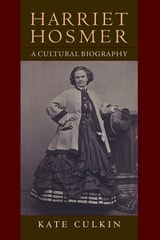
Harriet Hosmer
A Cultural BiographyKate Culkin
University of Massachusetts Press, 2010
In 1852 Hosmer moved from Boston to Rome, where she shared a house with actress Charlotte Cushman and soon formed close friendships with such prominent expatriates as Robert and Elizabeth Barrett Browning and fellow sculptors John Gibson, Emma Stebbins, and William Wetmore Story. References to Hosmer or characters inspired by her appear in the work of Nathaniel Hawthorne, Louisa May Alcott, and Kate Field among others. Culkin argues that Hosmer's success was made possible by her extensive network of supporters, including her famous friends, boosters of American gentility, and women's rights advocates. This unlikely coalition, along with her talent, ambition, and careful maintenance of her public profile, ultimately brought her great acclaim. Culkin also addresses Hosmer's critique of women's position in nineteenth-century culture through her sculpture, women's rights advocates' use of high art to promote their cause, the role Hosmer's relationships with women played in her life and success, and the complex position a female artist occupied within a country increasingly interested in proving its gentility.

Harvester of Hearts
Motherhood under the Sign of FrankensteinRachel Feder
Northwestern University Press, 2018
In the period between 1815 and 1820, Mary Shelley wrote her most famous novel, Frankenstein; or, The Modern Prometheus, as well as its companion piece, Mathilda, a tragic incest narrative that was confiscated by her father, William Godwin, and left unpublished until 1959. She also gave birth to four—and lost three—children.
In this hybrid text, Rachel Feder interprets Frankenstein and Mathilda within a series of provocative frameworks including Shelley’s experiences of motherhood and maternal loss, twentieth-century feminists’ interests in and attachments to Mary Shelley, and the critic’s own experiences of pregnancy, childbirth, and motherhood. Harvester of Hearts explores how Mary Shelley’s exchanges with her children—in utero, in birth, in life, and in death—infuse her literary creations. Drawing on the archives of feminist scholarship, Feder theorizes “elective affinities,” a term she borrows from Goethe to interrogate how the personal attachments of literary critics shape our sense of literary history. Feder blurs the distinctions between intellectual, bodily, literary, and personal history, reanimating the classical feminist discourse on Frankenstein by stepping into the frame.
The result—at once an experimental book of literary criticism, a performative foray into feminist praxis, and a deeply personal lyric essay—not only locates Mary Shelley’s monsters within the folds of maternal identity but also illuminates the connections between the literary and the quotidian.

Haskalah
The Romantic Movement in JudaismLitvak, Olga
Rutgers University Press, 2012
Commonly translated as the “Jewish Enlightenment,” the Haskalah propelled Jews into modern life. Olga Litvak argues that the idea of a Jewish modernity, championed by adherents of this movement, did not originate in Western Europe’s age of reason. Litvak contends that the Haskalah spearheaded a Jewish religious revival, better understood against the background of Eastern European Romanticism.
Based on imaginative and historically grounded readings of primary sources, Litvak presents a compelling case for rethinking the relationship between the Haskalah and the experience of political and social emancipation. Most importantly, she challenges the prevailing view that the Haskalah provided the philosophical mainspring for Jewish liberalism.
In Litvak’s ambitious interpretation, nineteenth-century Eastern European intellectuals emerge as the authors of a Jewish Romantic revolution. Fueled by contradictory longings both for community and for personal freedom, the poets and scholars associated with the Haskalah questioned the moral costs of civic equality and the achievement of middle-class status. In the nineteenth century, their conservative approach to culture as the cure for the spiritual ills of the modern individual provided a powerful argument for the development of Jewish nationalism. Today, their ideas are equally resonant in contemporary debates about the ramifications of secularization for the future of Judaism.
Hatching Ruin
Or Mark Twain's Road to BankruptcyCharles H. Gold
University of Missouri Press, 2003
In “Hatching Ruin,” Charles H. Gold provides a complete description of Samuel L. Clemens’s business relationships with Charles L. Webster and James W. Paige during the 1880s. Gold analyzes how these relationships affected Clemens as a person and an artist, most notably in A Connecticut Yankee in King Arthur’s Court.
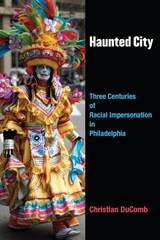
Haunted City
Three Centuries of Racial Impersonation in PhiladelphiaChristian DuComb
University of Michigan Press, 2017
Mummers have long worn blackface makeup during winter holiday celebrations in Europe and North America; in Philadelphia, mummers’ blackface persisted from the colonial period well into the twentieth century. The first annual Mummers Parade, a publicly sanctioned procession from the working-class neighborhoods of South Philadelphia to the city center, occurred in 1901. Despite a ban on blackface in the Mummers Parade after civil rights protests in 1963–64, other forms of racial and ethnic impersonation in the parade have continued to flourish unchecked. Haunted City combines detailed historical research with the author’s own experiences performing in the Mummers Parade to create a lively and richly illustrated narrative. Through its interdisciplinary approach, Haunted City addresses not only theater history and performance studies but also folklore, American studies, critical race theory, and art history. It also offers a fresh take on the historiography of the antebellum minstrel show.
Haunting Realities
Naturalist Gothic and American RealismEdited by Monika Elbert and Wendy Ryden
University of Alabama Press, 2017
An innovative collection of essays examining the sometimes paradoxical alignment of Realism and Naturalism with the Gothic in American literature to highlight their shared qualities
Following the golden age of British Gothic in the late eighteenth century, the American Gothic’s pinnacle is often recognized as having taken place during the decades of American Romanticism. However, Haunting Realities explores the period of American Realism—the end of the nineteenth century—to discover evidence of fertile ground for another age of Gothic proliferation.
At first glance, “Naturalist Gothic” seems to be a contradiction in terms. While the Gothic is known for its sensational effects, with its emphasis on horror and the supernatural, the doctrines of late nineteenth-century Naturalism attempted to move away from the aesthetics of sentimentality and stressed sobering, mechanistic views of reality steeped in scientific thought and the determinism of market values and biology. Nonetheless, what binds Gothicism and Naturalism together is a vision of shared pessimism and the perception of a fearful, lingering presence that ominously haunts an impending modernity. Indeed, it seems that in many Naturalist works reality is so horrific that it can only be depicted through Gothic tropes that prefigure the alienation and despair of modernism.
In recent years, research on the Gothic has flourished, yet there has been no extensive study of the links between the Gothic and Naturalism, particularly those which stem from the early American Realist tradition. Haunting Realities is a timely volume that addresses this gap and is an important addition to scholarly work on both the Gothic and Naturalism in the American literary tradition.
Hawthorne and Women
Engendering and Expanding the Hawthorne TraditionJohn L. Idol
University of Massachusetts Press, 1999
This collection of original essays presents a more complex and positive view of Hawthorne's attitudes toward women, demonstrating his recognition of the crucial role that women played--as critics, reviewers, readers, and authors--in building a national readership that made his writing career so successful.
The book begins with an examination of the influence exerted by the women in Hawthorne's immediate family. It goes on to explore his links to a broad range of women writers, as well as his attitudes toward the female characters he created. Among the authors discussed are Margaret Fuller, Harriet Beecher Stowe, Louisa May Alcott, Emily Dickinson, Sarah Orne Jewett, Willa Cather, Charlotte Perkins Gilman, George Eliot, Virginia Woolf, Flannery O'Connor, and Toni Morrison.
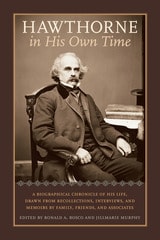
Hawthorne in His Own Time
A Biographical Chronicle of His Life,Drawn from Recollections,Interviews, and Memoirs by Family,FrieRonald A Bosco
University of Iowa Press, 2007
At his death, Nathaniel Hawthorne (1804–1864) was universally acknowledged in America and England as "the Great Romancer." Novels such as The Scarlet Letter and The House of the Seven Gables and stories published in such collections as Twice-Told Tales continue to capture the minds and imaginations of readers and critics to this day. Harder to capture, however, were the character and personality of the man himself. So few of the essays that appeared in the two years after his death offered new insights into his life, art, and reputation that Hawthorne seemed fated to premature obscurity or, at least, permanent misrepresentation. This first collection of personal reminiscences by those who knew Hawthorne intimately or knew about him through reliable secondary sources rescues him from these confusions and provides the real human history behind the successful writer.
Remembrances from Elizabeth Peabody, Sophia Hawthorne, Oliver Wendell Holmes, Ralph Waldo Emerson, Bronson Alcott, Rebecca Harding Davis, and twenty others printed in Hawthorne in His Own Time follow him from his childhood in Salem, through his years of initial literary obscurity, his days in the Boston and Salem Custom Houses, his service as U.S. Consul to Liverpool and Manchester and his life in the Anglo-American communities at Rome and Florence, to his late years as the "Great Romancer."
In their enlightening introduction, editors Ronald Bosco and Jillmarie Murphy assess the postmortem building of Hawthorne's reputation as well as his relationship to the prominent Transcendentalists, spiritualists, Swedenborgians, and other personalities of his time. By clarifying the sentimental associations between Hawthorne's writings and his actual personality and moving away from the critical review to the personal narrative, these artful and perceptive reminiscences tell the private and public story of a remarkable life.
Haydn’s Sunrise, Beethoven’s Shadow
Audiovisual Culture and the Emergence of Musical RomanticismDeirdre Loughridge
University of Chicago Press, 2016
Deirdre Loughridge reveals that allusions in musical writings to optical technologies reflect their spread from fairgrounds and laboratories into public consciousness and a range of discourses, including that of music. She demonstrates how concrete points of intersection—composers’ treatments of telescopes and peepshows in opera, for instance, or a shadow-play performance of a ballad—could then fuel new modes of listening that aimed to extend the senses. An illuminating look at romantic musical practices and aesthetics, this book yields surprising relations between the past and present and offers insight into our own contemporary audiovisual culture.
He Rode with Butch and Sundance
The Story of Harvey "Kid Curry" LoganMark T. Smokov
University of North Texas Press, 2012
Head Masters
Phrenology, Secular Education, and Nineteenth-Century Social ThoughtStephen Tomlinson
University of Alabama Press, 2005
Head Masters challenges the assumption that phrenology—the study of the conformation of the skull as it relates to mental faculties and character—played only a minor and somewhat anecdotal role in the development of education. Stephen Tomlinson asserts instead that phrenology was a scientifically respectable theory of human nature, perhaps the first solid physiological psychology. He shows that the first phrenologists were among the most prominent scientists and intellectuals of their day, and that the concept was eagerly embraced by leading members of the New England medical community.
Following its progression from European theorists Franz-Joseph Gall, Johan Gasper Spurzheim, and George Combe to Americans Horace Mann and Samuel Gridley Howe, Tomlinson traces the origins of phrenological theory and examines how its basic principles of human classification, inheritance, and development provided a foundation for the progressive practices advocated by middle-class reformers such as Combe and Mann. He also elucidates the ways in which class, race, and gender stereotypes permeated 19th century thought and how popular views of nature, mind, and society supported a secular curriculum favoring the use of disciplinary practices based on physiology.
This study ultimately offers a reconsideration of the ideas and theories that motivated education reformers such as Mann and Howe, and a reassessment of Combe, who, though hardly known by contemporary scholars, emerges as one of the most important and influential educators of the 19th century.
Healing the African Body
British Medicine in West Africa, 1800-1860John Rankin
University of Missouri Press, 2015
This timely book explores the troubled intertwining of religion, medicine, empire, and race relations in the early nineteenth century. John Rankin analyzes the British use of medicine in West Africa as a tool to usher in a “softer” form of imperialism, considers how British colonial officials, missionaries, and doctors regarded Africans, and explores the impact of race classification on colonial constructs.
Rankin goes beyond contemporary medical theory, examining the practice of medicine in colonial Africa as Britons dealt with the challenges of providing health care to their civilian employees, African soldiers, and the increasing numbers of freed slaves in the general population, even while the imperialists themselves were threatened by a lack of British doctors and western medicines. As Rankin writes, “The medical system sought to not only heal Africans but to ‘uplift’ them and make them more amenable to colonial control . . . Colonialism starts in the mind and can be pushed on the other solely through ideological pressure.”

Hearing Happiness
Deafness Cures in HistoryJaipreet Virdi
University of Chicago Press, 2020
At the age of four, Jaipreet Virdi’s world went silent. A severe case of meningitis left her alive but deaf, suddenly treated differently by everyone. Her deafness downplayed by society and doctors, she struggled to “pass” as hearing for most of her life. Countless cures, treatments, and technologies led to dead ends. Never quite deaf enough for the Deaf community or quite hearing enough for the “normal” majority, Virdi was stuck in aural limbo for years. It wasn’t until her thirties, exasperated by problems with new digital hearing aids, that she began to actively assert her deafness and reexamine society’s—and her own—perception of life as a deaf person in America.
Through lyrical history and personal memoir, Hearing Happiness raises pivotal questions about deafness in American society and the endless quest for a cure. Taking us from the 1860s up to the present, Virdi combs archives and museums in order to understand the long history of curious cures: ear trumpets, violet ray apparatuses, vibrating massagers, electrotherapy machines, airplane diving, bloodletting, skull hammering, and many more. Hundreds of procedures and products have promised grand miracles but always failed to deliver a universal cure—a harmful legacy that is still present in contemporary biomedicine.
Weaving Virdi’s own experiences together with her exploration into the fascinating history of deafness cures, Hearing Happiness is a powerful story that America needs to hear.
Heartless Immensity
Literature, Culture, and Geography in Antebellum AmericaAnne Baker
University of Michigan Press, 2010
Building on extensive archival research as well as insights from cultural geographers and theorists of nationhood, Heartless Immensity demonstrates that national expansion had a far more complicated, multifaceted impact on antebellum American culture than has previously been recognized. Baker shows that Americans developed a variety of linguistic strategies for imagining the form of the United States and its position in relation to other geopolitical entities. Comparisons
to European empires, biblical allusions, body politic metaphors, and metaphors derived from science all reflected—and often attempted to assuage—fears that the nation was becoming either monstrously large or else misshapen in ways that threatened cherished beliefs and national self-images.
Heartless Immensity argues that, in order to understand the nation’s shift from republic to empire and to understand American culture in a global context, it is first necessary to pay close attention to the processes by which the physical entity known as the United States came into being. This impressively thorough study will make a valuable contribution to the fields of American studies and literary studies.
Anne Baker is Assistant Professor of English at North Carolina State University.
Hearts of Gold
John Ernest
University of Delaware Press, 0
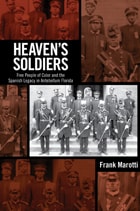
Heaven's Soldiers
Free People of Color and the Spanish Legacy in Antebellum FloridaFrank Marotti
University of Alabama Press, 2013
Heaven’s Soldiers chronicles the history of a community of free people of African descent who lived and thrived, while resisting the constraints of legal bondage, in East Florida in the four decades leading up to the Civil War.
Hegel and the Arts
Stephen Houlgate
Northwestern University Press, 2007
Addressing a range of important topics, the essays examine the conceptual bases of Hegel's organization of his aesthetics, his treatment of various specific arts (architecture, sculpture, painting, music, and tragedy), and several of the most famous issues in the literature--including the "end of art" thesis, the relation between art and religion, and the vexed relationship between Hegel and the romantics. Together they shed light on the profound reflections on art contained in Hegel's philosophy and also suggest ways in which his aesthetics might resonate well beyond the field of philosophical aesthetics, perhaps beyond philosophy itself.
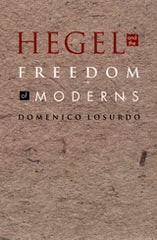
Hegel and the Freedom of Moderns
Domenico Losurdo
Duke University Press, 2004
Hegel and the Freedom of Moderns persuasively argues that the tug of war between “conservative” and “liberal” interpretations of Hegel has obscured and distorted the most important aspects of his political thought. Losurdo unravels this misleading dualism and provides an illuminating discussion of the relation between Hegel’s political philosophy and the thinking of Karl Marx and Friedrich Engels. He also discusses Hegel’s ideas in relation to the pertinent writings of other major figures of modern political philosophy such as Jean-Jacques Rousseau, John Locke, Edmund Burke, John Stuart Mill, Jeremy Bentham, Karl Popper, Norberto Bobbio, and Friedrich Hayek.

Hegel and the Problem of Multiplicity
Andrew Haas
Northwestern University Press, 2000
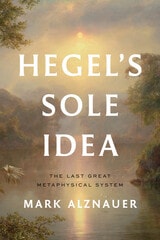
Hegel's Sole Idea
The Last Great Metaphysical SystemMark Alznauer
University of Chicago Press, 2026
An accessible reconstruction of Hegel’s attempt to derive all reality from a single concept.
In the early decades of the nineteenth century, G. W. F. Hegel came to believe that philosophy was finally in a position to achieve something it had striven for since ancient Greece: becoming an objective, demonstrative science. But to achieve this aim, he thought philosophical knowledge needed to be reconceived in a radically new way—as content contained in a single concept just as the oak tree is hidden in the acorn. In Hegel’s Sole Idea, Mark Alznauer reads Hegel’s mature philosophical system as the unprecedented attempt to comprehend the entire world as the full unfolding of that single concept, which he mysteriously calls “the absolute idea.”
Ever since Hegel set out this program in his Encyclopedia of the Philosophical Sciences in Outline, Hegel’s system has been regarded as the last best hope of philosophy as an autonomous, fully rational science. But while Hegel’s followers regarded the Encyclopedia as the successful realization of the traditional aims of philosophy, his most influential successors thought it instead showed the exhaustion and collapse of that project. Hegel’s Sole Idea offers a comprehensive interpretation of Hegelian philosophy that allows a fair confrontation with its most provocative and ambitious claims.

Hegel's Theory of Intelligibility
Rocío Zambrana
University of Chicago Press, 2015
Zambrana clarifies crucial features of Hegel’s theory of normativity previously thought to be absent from the argument of the Science of Logic—what she calls normative precariousness and normative ambivalence. She shows that Hegel’s theory of determinacy views intelligibility as both precarious, the result of practices and institutions that gain and lose authority throughout history, and ambivalent, accommodating opposite meanings and valences even when enjoying normative authority. In this way, Zambrana shows that the Science of Logic provides the philosophical justification for the necessary historicity of intelligibility. Intervening in several recent developments in the study of Kant, Hegel, and German Idealism more broadly, this book provides a productive new understanding of the value of Hegel’s systematic ambitions.
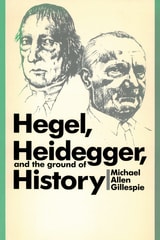
Hegel, Heidegger, and the Ground of History
Michael Allen Gillespie
University of Chicago Press, 1984
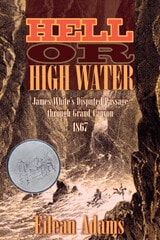
Hell Or High Water
James White's Disputed Passage through Grand Canyon, 1867Eilean Adams
Utah State University Press, 2001
Although John Wesley Powell and party are usually given credit for the first river descent through the Grand Canyon, the ghost of James White has haunted those claims. White was a Colorado prospector, who, almost two years before Powell's journey, washed up on a makeshift raft at Callville, Nevada. His claim to have entered the Colorado above the San Juan River with another man (soon drowned) as they fled from Indians was widely disseminated and believed for a time, but Powell and his successors on the river publically discounted it. Colorado River runners and historians have since debated whether White's passage through Grand Canyon even could have happened.
Hell or High Water is the first full account of White's story and how it became distorted and he disparaged over time. It is also a fascinating detective story, recounting how White's granddaughter, Eilean Adams, over decades and with the assistance of a couple of notable Colorado River historians who believed he could have done what he claimed, gradually uncovered the record of James White's adventure and put together a plausible narrative of how and why he ended up floating helplessly down a turbulent river, entrenched in massive cliffs, with nothing but a driftwood raft to carry him through.
Hellé
A NovelMarcelle Tinayre
Swan Isle Press, 2026
The first major English translation of Marcelle Tinayre’s Belle Époque novel that interrogates the struggle of coming of age as a young woman in a changing modern world.
Raised in the countryside by her reclusive classicist uncle, Hellé’s ideals are put to the test when she encounters the decadence and frivolity of Parisian society. Yet there she also meets the young political theorist and resolute socialist Antoine Genesvrier, who urges Hellé and her uncle to join him in supporting the city’s poor and advocating for social justice. Meanwhile, Hellé’s head is turned by the poet Maurice Clairmont, hailed by Parisian society as “the new Byron” and eager to win over Hellé with his beauty and charm. Caught between her love of beauty and her burgeoning social concern, Hellé must choose between two men, two ideals, and two worlds, while also staying true to herself. Tinayre infuses Hellé’s voice with the classical allusions of her uncle’s education and her love for the natural world, creating a fresh, engaging narrative that awakens both the mind and heart.
In this first major English translation, Grace Ashton brings exquisite resonance of tone, register, and spirit to Marcelle Tinayre’s perennially relevant novel.
Hemispheric Imaginings
The Monroe Doctrine and Narratives of U.S. EmpireGretchen Murphy
Duke University Press, 2005
Murphy juxtaposes close readings of novels with analyses of nonfiction texts. From uncovering the literary inspirations for the Monroe Doctrine itself to tracing visions of hemispheric unity and transatlantic separation in novels by Lydia Maria Child, Nathaniel Hawthorne, María Amparo Ruiz de Burton, Lew Wallace, and Richard Harding Davis, she reveals the Doctrine’s forgotten cultural history. In making a vital contribution to the effort to move American Studies beyond its limited focus on the United States, Murphy questions recent proposals to reframe the discipline in hemispheric terms. She warns that to do so risks replicating the Monroe Doctrine’s proprietary claim to isolate the Americas from the rest of the world.
Henry Bradley Plant
Gilded Age Dreams for Florida and a New SouthCanter Brown Jr.
University of Alabama Press, 2020
In this landmark biography, Canter Brown Jr. makes evident the extent of Henry Bradley Plant’s influences throughout North, Central, and South America as well as his role in the emergence of integrated transportation and a national tourism system. One of the preeminent historians of Florida, Brown brings this important but understudied figure in American history to the foreground.
Henry Bradley Plant: Gilded Age Dreams for Florida and a New South carefully examines the complicated years of adventure and activity that marked Plant’s existence, from his birth in Connecticut in 1819 to his somewhat mysterious death in New York City in 1899. Brown illuminates Plant’s vision and perspectives for the state of Florida and the country as a whole and traces many of his influences back to events from his childhood and early adulthood. The book also elaborates on Plant’s controversial Civil War relationships and his utilization of wartime earnings in the postwar era to invest in the bankrupt Southern rail lines. With the success of his businesses such as the Southern Express Company and the Tampa Bay Hotel, Plant transformed Florida into a hub for trade and tourism—traits we still recognize in the Florida of today.
This thoroughly researched biography fills important gaps in Florida’s social and economic history and sheds light on a historical figure to an extent never previously undertaken or sufficiently appreciated. Both informative and innovative, Brown’s volume will be a valuable resource for scholars and general readers interested in Southern history, business history, Civil War–era history, and transportation history.
Henry David Thoreau
A LifeLaura Dassow Walls
University of Chicago Press, 2017
But there was much more to Thoreau than his brief experiment in living at Walden Pond. A member of the vibrant intellectual circle centered on his neighbor Ralph Waldo Emerson, he was also an ardent naturalist, a manual laborer and inventor, a radical political activist, and more. Many books have taken up various aspects of Thoreau’s character and achievements, but, as Laura Dassow Walls writes, “Thoreau has never been captured between covers; he was too quixotic, mischievous, many-sided.” Two hundred years after his birth, and two generations after the last full-scale biography, Walls restores Henry David Thoreau to us in all his profound, inspiring complexity.
Walls traces the full arc of Thoreau’s life, from his early days in the intellectual hothouse of Concord, when the American experiment still felt fresh and precarious, and “America was a family affair, earned by one generation and about to pass to the next.” By the time he died in 1862, at only forty-four years of age, Thoreau had witnessed the transformation of his world from a community of farmers and artisans into a bustling, interconnected commercial nation. What did that portend for the contemplative individual and abundant, wild nature that Thoreau celebrated?
Drawing on Thoreau’s copious writings, published and unpublished, Walls presents a Thoreau vigorously alive in all his quirks and contradictions: the young man shattered by the sudden death of his brother; the ambitious Harvard College student; the ecstatic visionary who closed Walden with an account of the regenerative power of the Cosmos. We meet the man whose belief in human freedom and the value of labor made him an uncompromising abolitionist; the solitary walker who found society in nature, but also found his own nature in the society of which he was a deeply interwoven part. And, running through it all, Thoreau the passionate naturalist, who, long before the age of environmentalism, saw tragedy for future generations in the human heedlessness around him.
“The Thoreau I sought was not in any book, so I wrote this one,” says Walls. The result is a Thoreau unlike any seen since he walked the streets of Concord, a Thoreau for our time and all time.
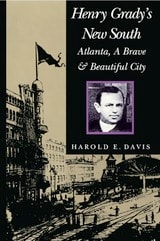
Henry Grady's New South
Atlanta, a Brave and Beautiful CityHarold E. Davis
University of Alabama Press, 1990
Reassessing the man, the movement, and the making of modern Atlanta.
The popular image of Henry W. Grady is that of a champion of the postbellum South, a region that would forgive the North for defeating it and would mobilize its own many resources for hones business and agricultural competition. Biographies and collections of Grady’s essays and speeches that appeared shortly after his death enhanced this image, and for a half-century, Grady was considered the personification of the New South Movement, a movement which promised industrialization for the South, an improved Southern agriculture, and justice and opportunity for black Southerners. As managing editor of the Atlanta Constitution, he espoused the New South throughout the nation and was in demand as a speaker for audiences in New York and Boston.
Through extensive research, focusing on the decade of the 1880s in Georgia, Davis demonstrates that although Grady said all the right things to show that he wished to industrialize the South and that he was committed to the improvement of agriculture and fairness in racial matters, in fact he spent most of his efforts on behalf of Atlanta. His major interest was in making a difference for that city, leaving the rest of the South to enjoy whatever Atlanta could not garner for itself.
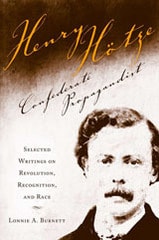
Henry Hotze, Confederate Propagandist
Selected Writings on Revolution, Recognition, and RaceLonnie A. Burnett
University of Alabama Press, 2008
Among the arguments Hotze employed were adaptations of the scientific racism of the period, which attempted to establish a rational basis for assumptions of racial difference. After the collapse of the Confederacy in 1865, Hötze remained in Europe, where he became an active partisan and promoter of the ideas of Arthur de Gobineau (1816–1882) whose work Essai sur L’inégalité des Races Humaines was a founding document in racism’s struggle for intellectual respectability.
This work consists of a biographical essay on Hotze; his contributions to Mobile newspapers during his military service in 1861; his correspondence with Confederate officials during his service in London; articles he published in London to influence British and European opinion; and his correspondence with, and published work in support of, Gobineau.
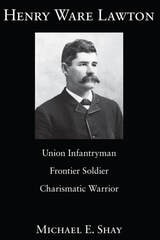
Henry Ware Lawton
Union Infantryman, Frontier Soldier, Charismatic WarriorMichael E. Shay
University of Missouri Press, 2016
Henry Ware Lawton’s nearly four decades as a professional soldier in the U.S. Army tie his story closely to that of America in the nineteenth century, from the Civil War to the settlement of the West, to the experiment with empire. Lawton served the country nearly uninterrupted from the day he enlisted at age 18—soon after Lincoln’s first call for volunteers to fight in the Civil War, where he earned a Medal of Honor—to his death at age 56, a major general in the Philippine War. In between, he fought in the Spanish-American War and the Indian Wars; during that time he rose to national prominence as the man who captured Geronimo.

Henry William Ravenel, 1814-1887
South Carolina Scientist in the Civil War EraTamara Miner Haygood
University of Alabama Press, 1987
The life of a pioneering Southern scientist in an era of war, change, and discovery.
Henry William Ravenel, 1814–1887: South Carolina Scientist in the Civil War Era is a compelling biography of one of nineteenth-century America's most accomplished yet largely overlooked natural scientists. Through meticulous archival research, Tamara Miner Haygood brings to life the story of Henry William Ravenel, a South Carolina planter, botanist, and pioneering mycologist whose work earned international recognition while he lived far from the major scientific centers of the United States.
Born into the Lowcountry planter class, Ravenel developed a lifelong fascination with the natural world and became a leading authority on the study of fungi and plants. Despite limited formal scientific training, he built an extensive network of correspondents that included some of the most prominent botanists in America and Europe. His collections, publications, and exchanges of specimens contributed significantly to the advancement of botanical science and established his reputation as one of the foremost naturalists of his generation.
Haygood places Ravenel's scientific achievements within the broader context of Southern society, demonstrating how intellectual pursuits flourished in unexpected ways within a region often overlooked in histories of American science. At the same time, the biography confronts the realities of slavery, plantation life, religion, and regional identity that shaped Ravenel's world. His experience challenges long-held assumptions about the relationship between Southern culture and scientific inquiry.
The Civil War and its aftermath transformed Ravenel's life, disrupting his finances, professional networks, and daily routines. Yet he remained committed to scientific work, continuing to collect, study, and publish despite enormous challenges. More than a biography, this volume offers a fascinating exploration of science, society, and survival during one of the most turbulent periods in American history. Essential reading for historians of science, Civil War scholars, environmental historians, botanists, and students of Southern culture.
Henry van de Velde
Selected Essays, 1889–1914Henry van de Velde
J. Paul Getty Trust, The, 2022
Belgian artist, architect, designer, and theorist Henry van de Velde (1863–1957) was a highly original and influential figure in Europe beginning in the 1890s. A founding member of the Art Nouveau and Jugendstil movements, he also directed the Grand-Ducal Saxon School of Arts and Crafts in Weimar, Germany, which eventually became the Bauhaus under Walter Gropius.
This selection of twenty-six essays, translated from French and German, includes van de Velde’s writings on William Morris and the English Arts and Crafts movement, Neo-Impressionist painting, and relationships between ornament, line, and abstraction in German aesthetics. The texts trace the evolution of van de Velde’s thoughts during his most productive period as a theorist in the artistic debates in France, Germany, Belgium, and the Netherlands. Katherine M. Kuenzli expertly guides readers to see how van de Velde’s writings reconcile themes of aesthetics and function, and expression and reason, throughout the artistic periods and regions represented by these texts. With introductory discussions of each essay and full annotations, this is an essential volume for a broad range of scholars and students of the history of fine and applied arts and ideas.
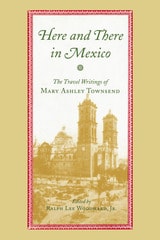
Here and There in Mexico
The Travel Writings of Mary Ashley TownsendMary Ashley Townsend, edited by Ralph Lee Woodward Jr.
University of Alabama Press, 2001
Mary Ashley Townsend was a novelist, newspaper columnist, and poet laureate of New Orleans who made several trips to Mexico with her daughter Cora during the last two decades of the 19th century. She collected her impressions of many aspects of life in that country—flora, fauna, architecture, people at work and play, fashion, society, food—and wrote about them during a time when few women engaged in solo travel, much less the pursuit of travel writing. Her collected work was still in progress when she died in a train accident in 1901, and was never published.

Here to Stay
Uncovering South Asian American HistoryGeetika Rudra
Rutgers University Press, 2022
In Here to Stay, Geetika Rudra, a second-generation Indian immigrant and American history buff, takes readers on a journey across the country to unearth the little-known histories of earlier generations of South Asian Americans. She visits storied sites such as Oregon’s “Hindoo Alley,” home to many lumber workers at the turn of the century, and Angel Island, California’s immigration hub. She also introduces readers to such inspiring figures as Bhagat Singh Thind, an immigrant who had enlisted in the U.S. Army to serve his adopted country in World War I, but who was later denied citizenship and took his case all the way to the U.S. Supreme Court. In turns both serious and joyful, this book vividly reveals how South Asians have always been a vital part of the American tapestry.
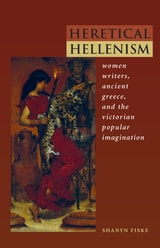
Heretical Hellenism
Women Writers, Ancient Greece, and the Victorian Popular ImaginationShanyn Fiske
Ohio University Press, 2008
The prevailing assumption regarding the Victorians’ relationship to ancient Greece is that Greek knowledge constituted an exclusive discourse within elite male domains. Heretical Hellenism: Women Writers, Ancient Greece, and the Victorian Popular Imagination challenges that theory and argues that while the information women received from popular sources was fragmentary and often fostered intellectual insecurities, it was precisely the ineffability of the Greek world refracted through popular sources and reconceived through new fields of study that appealed to women writers’ imaginations.
Examining underconsidered sources such as theater history and popular journals, Shanyn Fiske uncovers the many ways that women acquired knowledge of Greek literature, history, and philosophy without formal classical training. Through discussions of women writers such as Charlotte Brontë, George Eliot, and Jane Harrison, Heretical Hellenism demonstrates that women established the foundations of a heretical challenge to traditional humanist assumptions about the uniformity of classical knowledge and about women’s place in literary history.
Heretical Hellenism provides a historical rationale for a more expansive definition of classical knowledge and offers an interdisciplinary method for understanding the place of classics both in the nineteenth century and in our own time.
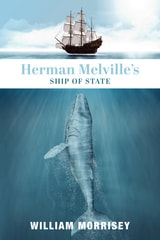
Herman Melville's Ship of State
will morrisey
St. Augustine's Press, 2020
“Does Melville also intend to be a founder in the ‘New World’?” Morrisey’s study is a compelling look at the early political moments of a new nation, but one that at the time perceived itself as already aging and maturing in the process of political voyage and adventure. Dangers lie ahead, Melville seems to warn, and in his disenchantment of the vigor of the Young America he once endorsed he tells the story of what really happens when democracy is idealized and the surrounding waters of chaos are thereby veiled; and yet also of what happens when one would seek to command the chaos only to transform into the unpredictably destructive prey he pursues, especially under the guise of moral outrage.
Melville, like Ishmael, urges a new vision of both God and nature, and challenges the notion of rule in all its expressions. Americans, the people of the New World, are invited to be unafraid, but also careful. In wandering as on the open waters one wonders, beyond civic boundaries and conventions, and in that wonder one may finally come face to face with what is good and grand––but in beholding the great white whale, can one resist the urge to conquest, now that he is likewise by the leviathan beholden? Is the rule of man and the coronation of a specific dialectic of power an untenable victory, given that “‘Nature is nobody’s ally’: it wounds or kills any person or nation that violates it, impartially”?
Morrisey writes with lucidity and weaves together elements of history, literature, politics and perhaps his own affinity for Ishmael’s passenger spirit to reveal just how broad and boundless of a narrative Melville’s Moby Dick truly is.