1563 books match the query 'African American & Black Studies' and 42 start with h

cover of Habeas Viscus: Racializing Assemblages, Biopolitics, and Black Feminist Theories of the Human

Habeas Viscus

Racializing Assemblages, Biopolitics, and Black Feminist Theories of the Human

Alexander G. Weheliye

Duke University Press, 2014
Habeas Viscus focuses attention on the centrality of race to notions of the human. Alexander G. Weheliye develops a theory of "racializing assemblages," taking race as a set of sociopolitical processes that discipline humanity into full humans, not-quite-humans, and nonhumans. This disciplining, while not biological per se, frequently depends on anchoring political hierarchies in human flesh. The work of the black feminist scholars Hortense Spillers and Sylvia Wynter is vital to Weheliye's argument. Particularly significant are their contributions to the intellectual project of black studies vis-à-vis racialization and the category of the human in western modernity. Wynter and Spillers configure black studies as an endeavor to disrupt the governing conception of humanity as synonymous with white, western man. Weheliye posits black feminist theories of modern humanity as useful correctives to the "bare life and biopolitics discourse" exemplified by the works of Giorgio Agamben and Michel Foucault, which, Weheliye contends, vastly underestimate the conceptual and political significance of race in constructions of the human. Habeas Viscus reveals the pressing need to make the insights of black studies and black feminism foundational to the study of modern humanity.
[more]
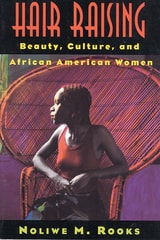
cover of Hair Raising: Beauty, Culture, and African American Women

Hair Raising

Beauty, Culture, and African American Women

Rooks, Noliwe M

Rutgers University Press, 1996
We all know there is a politics of skin color, but is there a politics of hair?In this book, Noliwe Rooks explores the history and politics of hair and beauty culture in African American communities from the nineteenth century to the 1990s. She discusses the ways in which African American women have located themselves in their own families, communities, and national culture through beauty advertisements, treatments, and styles. Bringing the story into today's beauty shop, listening to other women talk about braids, Afros, straighteners, and what they mean today to grandmothers, mothers, sisters, friends, and boyfriends, she also talks about her own family and has fun along the way. Hair Raising is that rare sort of book that manages both to entertain and to illuminate its subject.
[more]
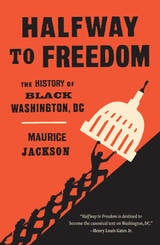
cover of Halfway to Freedom: The History of Black Washington, DC

Halfway to Freedom

The History of Black Washington, DC

Maurice Jackson. Foreword by Lonnie G. Bunch III.

Duke University Press, 2026

Halfway to Freedom is a social, political, intellectual, and cultural history of African Americans in Washington, DC, looking at the role that race, gender, color, culture, class, and power have played in the city and its relationship with the federal government, the nation, and the world.

For more than two hundred years, the history and culture of the District of Columbia have been in great part shaped by its Black residents. Several Black men were elected to political positions citywide only a handful of years after the end of the Civil War, and while the years after Reconstruction saw the region plagued with segregation and racial violence, the capital’s Black population continued to grow at all economic levels. Washington became the first major US city with a majority Black population in 1957, a status it held for almost seventy years as gentrification has led to the decline of Black political and economic power in DC in the twenty-first century. 
 
Halfway to Freedom is a social, political, intellectual, and cultural history of African Americans in Washington, DC; it explores the role that race, gender, color, class, and power have played in the city and its relationship with the federal government. Maurice Jackson explores the material conditions that shaped life for African Americans, free and enslaved, from the earliest moments of the District’s history to more contemporary times of organization and activism. Through an array of archival materials, especially firsthand accounts of Black residents in the area, Jackson critiques how and why DC exists as a haven within the Black American imaginary given the realities of conflict its Black residents have faced and continue to face today. In doing so, he highlights and honors the gains they have earned through the concerted struggles of labor organizations, women’s movements, sports, music, art, legal activism, and more.
[more]
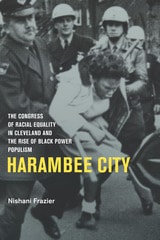
cover of Harambee City: The Congress of Racial Equality in Cleveland and the Rise of Black Power Populism

Harambee City

The Congress of Racial Equality in Cleveland and the Rise of Black Power Populism

Nishani Frazier

University of Arkansas Press, 2017

BLACK POWER!

It was a phrase that consumed the American imagination in the 1960s and 70s and inspired a new agenda for black freedom. Dynamic and transformational, the black power movement embodied more than media stereotypes of gun-toting, dashiki-wearing black radicals; the movement opened new paths to equality through political and economic empowerment.

In Harambee City, Nishani Frazier chronicles the rise and fall of black power within the Congress of Racial Equality (CORE) by exploring the powerful influence of the Cleveland CORE chapter. Frazier explores the ways that black Clevelanders began to espouse black power ideals including black institution building, self-help, and self-defense. These ideals challenged CORE’s philosophy of interracial brotherhood and nonviolent direct action, spawning ideological ambiguities in the Cleveland chapter. Later, as Cleveland CORE members rose to national prominence in the organization, they advocated an open embrace of black power and encouraged national CORE to develop a notion of black community uplift that emphasized economic populism over political engagement. Not surprisingly, these new empowerment strategies found acceptance in Cleveland.

By providing an understanding of the tensions between black power and the mainstream civil rights movement as they manifested themselves as  both local and national forces, Harambee City sheds new light on how CORE became one of the most dynamic civil rights organizations in the black power era.
[more]
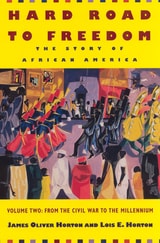
cover of Hard Road to Freedom: The Story of African America, The Civil War to the Millennium

Hard Road to Freedom

The Story of African America, The Civil War to the Millennium

Horton, Lois E

Rutgers University Press, 2002
Hard Road to Freedom tells the story of African America from its African roots to the political and social upheavals at the end of the twentieth century. It interweaves the experiences of individual black Americans with an analysis of the nation's pursuit of its fundamental principles, of freedom, and civil rights. The book begins with African cultures and the African people who withstood the horrors of the slave trade and slavery to help shape a new multiracial society in North America. The American Revolution brought freedom to some, but most remained in the grip of slavery. African Americans and their allies continually raised the cry for freedom, building determined black communities and dedicated antislavery organizations that contributed to the abolition of slavery. The precarious freedom after the Civil War brought new opportunities, but also new dangers and the limitations of Jim Crow. The wars and the depression in the early twentieth century found black Americans forging new alliances, creating a cultural renaissance, and fighting for democracy and freedom abroad. At home, they struggled against the denials of freedom and citizenship that still barred their full participation and that tarnished America's standing in the eyes of the international community. Throughout the social and political turmoil of the 1960s and 1970s and the political and cultural backlash that followed, African Americans continued to raise their voices in often eloquent and always insistent appeals that the nation live up to the promise of its principles. This book tells of America's unsteady advance along the road to freedom, the triumphs and hope, as well as the failures and despair, from the vantage point of the African Americans who resolutely played a critical role in that story.
[more]
cover of Harlem vs. Columbia University: Black Student Power in the Late 1960s

Harlem vs. Columbia University

Black Student Power in the Late 1960s

Stefan M. Bradley

University of Illinois Press, 2012
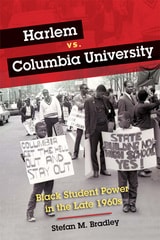
In 1968–69, Columbia University became the site for a collision of American social movements. Black Power, student power, antiwar, New Left, and Civil Rights movements all clashed with local and state politics when an alliance of black students and residents of Harlem and Morningside Heights openly protested the school's ill-conceived plan to build a large, private gymnasium in the small green park that separates the elite university from Harlem. Railing against the university's expansion policy, protesters occupied administration buildings and met violent opposition from both fellow students and the police. In this dynamic book, Stefan M. Bradley describes the impact of Black Power ideology on the Students' Afro-American Society (SAS) at Columbia. While white students--led by Mark Rudd and Students for a Democratic Society (SDS)--sought to radicalize the student body and restructure the university, black students focused on stopping the construction of the gym in Morningside Park. Through separate, militant action, black students and the black community stood up to the power of an Ivy League institution and stopped it from trampling over its relatively poor and powerless neighbors. Comparing the events at Columbia with similar events at Harvard, Cornell, Yale, and the University of Pennsylvania, Bradley locates this dramatic story within the context of the Black Power movement and the heightened youth activism of the 1960s. Harnessing the Civil Rights movement's spirit of civil disobedience and the Black Power movement's rhetoric and methodology, African American students were able to establish an identity for themselves on campus while representing the surrounding black community of Harlem. In doing so, Columbia's black students influenced their white peers on campus, re-energized the community's protest efforts, and eventually forced the university to share its power.
[more]
cover of Harlem's Theaters: A Staging Ground for Community, Class, and Contradiction, 1923-1939

Harlem's Theaters

A Staging Ground for Community, Class, and Contradiction, 1923-1939

Adrienne Macki Braconi

Northwestern University Press, 2015

Honorable Mention, 2016 Errol Hill Book Award for Outstanding Scholarship in African American Theater, Drama and/or Performance

Based on a vast amount of archival research, Adrienne Macki Braconi’s illuminating study of three important community-based theaters in Harlem shows how their work was essential to the formation of a public identity for African Americans and the articulation of their goals, laying the groundwork for the emergence of the Civil Rights movement. Macki Braconi uses textual analysis, performance reconstruction, and audience reception to examine the complex dynamics of productions by the Krigwa Players, the Harlem Experimental Theatre, and the Negro Theatre of the Federal Theatre Project. Even as these theaters demonstrated the extraordinary power of activist art, they also revealed its limits. The stage was a site in which ideological and class differences played out, theater being both a force for change and a collision of contradictory agendas. Macki Braconi’s book alters our understanding of the Harlem Renaissance, the roots of the Civil Rights movement, and the history of community theater in America.
[more]
cover of Harlemworld: Doing Race and Class in Contemporary Black America

Harlemworld

Doing Race and Class in Contemporary Black America

John L. Jackson Jr.

University of Chicago Press, 2001
Harlem is one of the most famous neighborhoods in the world—a historic symbol of both black cultural achievement and of the rigid boundaries separating the rich from the poor. But as this book shows us, Harlem is far more culturally and economically diverse than its caricature suggests: through extensive fieldwork and interviews, John L. Jackson reveals a variety of social networks and class stratifications, and explores how African Americans interpret and perform different class identities in their everyday behavior.
[more]
cover of Harriet Tubman: The Life and the Life Stories

Harriet Tubman

The Life and the Life Stories

Jean M. Humez

University of Wisconsin Press, 2005

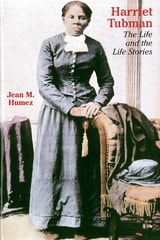
    Harriet Tubman’s name is known world-wide and her exploits as a self-liberated Underground Railroad heroine are celebrated in children’s literature, film, and history books, yet no major biography of Tubman has appeared since 1943. Jean M. Humez’s comprehensive Harriet Tubman is both an important biographical overview based on extensive new research and a complete collection of the stories Tubman told about her life—a virtual autobiography culled by Humez from rare early publications and manuscript sources. This book will become a landmark resource for scholars, historians, and general readers interested in slavery, the Underground Railroad, the Civil War, and African American women.
    Born in slavery in Maryland in or around 1820, Tubman drew upon deep spiritual resources and covert antislavery networks when she escaped to the north in 1849. Vowing to liberate her entire family, she made repeated trips south during the 1850s and successfully guided dozens of fugitives to freedom. During the Civil War she was recruited to act as spy and scout with the Union Army. After the war she settled in Auburn, New York, where she worked to support an extended family and in her later years founded a home for the indigent aged. Celebrated by her primarily white antislavery associates in a variety of private and public documents from the 1850s through the 1870s, she was rediscovered as a race heroine by woman suffragists and the African American women’s club movement in the early twentieth century. Her story was used as a key symbolic resource in education, institutional fundraising, and debates about the meaning of "race" throughout the twentieth century.
    Humez includes an extended discussion of Tubman’s work as a public performer of her own life history during the nearly sixty years she lived in the north. Drawing upon historiographical and literary discussion of the complex hybrid authorship of slave narrative literature, Humez analyzes the interactive dynamic between Tubman and her interviewers. Humez illustrates how Tubman, though unable to write, made major unrecognized contributions to the shaping of her own heroic myth by early biographers like Sarah Bradford. Selections of key documents illustrate how Tubman appeared to her contemporaries, and a comprehensive list of primary sources represents an important resource for scholars.
[more]
cover of Harry T. Burleigh: From the Spiritual to the Harlem Renaissance

Harry T. Burleigh

From the Spiritual to the Harlem Renaissance

Jean E. Snyder

University of Illinois Press, 2021
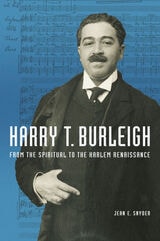
Harry T. Burleigh (1866-1949) played a leading role in American music and culture in the twentieth century. Celebrated for his arrangements of spirituals, Burleigh was also the first African American composer to create a significant body of art song. An international roster of opera and recital singers performed his works and praised them as among the best of their time. Jean E. Snyder traces Burleigh's life from his Pennsylvania childhood through his fifty-year tenure as soloist at St. George's Episcopal Church in Manhattan. As a composer, Burleigh's pioneering work preserved and transformed the African American spiritual; as a music editor, he facilitated the work of other black composers; as a role model, vocal coach, and mentor, he profoundly influenced American song; and in private life he was friends with Antonín Dvořák, Marian Anderson, Will Marion Cook, and other America luminaries. Snyder provides rich historical, social, and political contexts that explore Burleigh's professional and personal life within an era complicated by changes in race relations, class expectations, and musical tastes.
[more]
cover of Haunted City: Three Centuries of Racial Impersonation in Philadelphia

Haunted City

Three Centuries of Racial Impersonation in Philadelphia

Christian DuComb

University of Michigan Press, 2017

Haunted City explores the history of racial impersonation in Philadelphia from the late eighteenth century through the present day. The book focuses on select historical moments, such as the advent of the minstrel show and the ban on blackface makeup in the Philadelphia Mummers Parade, when local performances of racial impersonation inflected regional, national, transnational, and global formations of race.

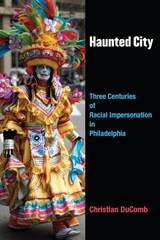
Mummers have long worn blackface makeup during winter holiday celebrations in Europe and North America; in Philadelphia, mummers’ blackface persisted from the colonial period well into the twentieth century. The first annual Mummers Parade, a publicly sanctioned procession from the working-class neighborhoods of South Philadelphia to the city center, occurred in 1901. Despite a ban on blackface in the Mummers Parade after civil rights protests in 1963–64, other forms of racial and ethnic impersonation in the parade have continued to flourish unchecked. Haunted City combines detailed historical research with the author’s own experiences performing in the Mummers Parade to create a lively and richly illustrated narrative. Through its interdisciplinary approach, Haunted City addresses not only theater history and performance studies but also folklore, American studies, critical race theory, and art history.  It also offers a fresh take on the historiography of the antebellum minstrel show.

 
[more]
cover of Haunted Life: Visual Culture and Black Modernity

Haunted Life

Visual Culture and Black Modernity

Marriott, David

Rutgers University Press, 2007

In Haunted Life, David Marriott examines the complex interplay between racial fears and anxieties and the political-visual cultures of suspicion and state terror. He compels readers to consider how media technologies are "haunted" by the phantom of racial slavery. Through examples from film and television, modernist literature, and philosophy, he shows how the ideological image of a brutal African past is endlessly recycled and how this perpetuation of historical catastrophe stokes our nation's race-conscious paranoia.

Drawing on a range of comparative readings by writers, theorists, and filmmakers, including John Edgar Wideman, Frantz Fanon, Richard Wright, Issac Julien, Alain Locke, and Sidney Poitier, Haunted Life is a bold and original exploration of the legacies of black visual culture and the political, deeply sexualized violence that lies buried beneath it.
[more]
cover of Have You Got Good Religion?: Black Women's Faith, Courage, and Moral Leadership in the Civil Rights Movement

Have You Got Good Religion?

Black Women's Faith, Courage, and Moral Leadership in the Civil Rights Movement

AnneMarie Mingo

University of Illinois Press, 2024

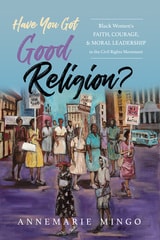
What compels a person to risk her life to change deeply rooted systems of injustice in ways that may not benefit her? The thousands of Black Churchwomen who took part in civil rights protests drew on faith, courage, and moral imagination to acquire the lived experiences at the heart of the answers to that question. AnneMarie Mingo brings these forgotten witnesses into the historical narrative to explore the moral and ethical world of a generation of Black Churchwomen and the extraordinary liberation theology they created. These women acted out of belief that what they did was bigger than themselves. Taking as their goal nothing less than the moral transformation of American society, they joined the movement because it was something they had to do. Their personal accounts of a lived religion enacted in the world provide powerful insights into how faith steels human beings to face threats, jail, violence, and seemingly implacable hatred. Throughout, Mingo draws on their experiences to construct an ethical model meant to guide contemporary activists in the ongoing pursuit of justice.

A depiction of moral imagination that resonates today, Have You Got Good Religion? reveals how Black Churchwomen’s understanding of God became action and transformed a nation.

[more]
cover of Hawai'i Is My Haven: Race and Indigeneity in the Black Pacific

Hawai'i Is My Haven

Race and Indigeneity in the Black Pacific

Nitasha Tamar Sharma

Duke University Press, 2021
Hawaiʻi Is My Haven maps the context and contours of Black life in the Hawaiian Islands. This ethnography emerges from a decade of fieldwork with both Hawaiʻi-raised Black locals and Black transplants who moved to the Islands from North America, Africa, and the Caribbean. Nitasha Tamar Sharma highlights the paradox of Hawaiʻi as a multiracial paradise and site of unacknowledged antiBlack racism. While Black culture is ubiquitous here, African-descended people seem invisible. In this formerly sovereign nation structured neither by the US Black/White binary nor the one-drop rule, nonWhite multiracials, including Black Hawaiians and Black Koreans, illustrate the coarticulation and limits of race and the native/settler divide. Despite erasure and racism, nonmilitary Black residents consider Hawaiʻi their haven, describing it as a place to “breathe” that offers the possibility of becoming local. Sharma's analysis of race, indigeneity, and Asian settler colonialism shifts North American debates in Black and Native studies to the Black Pacific. Hawaiʻi Is My Haven illustrates what the Pacific offers members of the African diaspora and how they in turn illuminate race and racism in “paradise.”
[more]
cover of Hear Our Truths: The Creative Potential of Black Girlhood

Hear Our Truths

The Creative Potential of Black Girlhood

Ruth Nicole Brown

University of Illinois Press, 2013
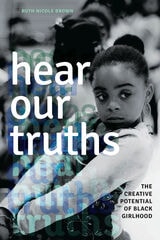
This volume examines how Saving Our Lives Hear Our Truths, or SOLHOT, a radical youth intervention, provides a space for the creative performance and expression of Black girlhood and how this creativity informs other realizations about Black girlhood and womanhood. Founded in 2006 and co-organized by the author, SOLHOT is an intergenerational collective organizing effort that celebrates and recognizes Black girls as producers of culture and knowledge. Girls discuss diverse expressions of Black girlhood, critique the issues that are important to them, and create art that keeps their lived experiences at its center.
 
Drawing directly from her experiences in SOLHOT, Ruth Nicole Brown argues that when Black girls reflect on their own lives, they articulate radically unique ideas about their lived experiences. She documents the creative potential of Black girls and women who are working together to advance original theories, practices, and performances that affirm complexity, interrogate power, and produce humanizing representation of Black girls' lives. Emotionally and intellectually powerful, this book expands on the work of Black feminists and feminists of color and breaks intriguing new ground in Black feminist thought and methodology.

[more]
cover of Hemispheric Blackface: Impersonation and Nationalist Fictions in the Americas

Hemispheric Blackface

Impersonation and Nationalist Fictions in the Americas

Danielle Roper

Duke University Press, 2025

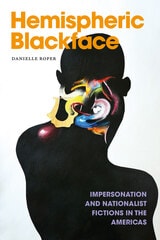
In Hemispheric Blackface, Danielle Roper examines blackface performance and its relationship to twentieth- and twenty-first-century nationalist fictions of mestizaje, creole nationalism, and other versions of postracialism in the Americas. Challenging both the dominance of the US minstrel tradition and the focus on the nation in blackface studies, Roper maps a hemispheric network of racial impersonation in Peru, Bolivia, Colombia, Jamaica, Cuba, and Miami. She analyzes blackface performance in the aftermath of the turn to multiculturalism in Latin America, the emergence of modern blackness in Jamaica, and the rise of Barack Obama in the United States, showing how blackface remains embedded in cultural entertainment. Contending that the Americas are linked by repeating nationalist fictions of postracialism, colorblindness, and myths of racial democracy, Roper assesses how acts of impersonation mediate the ongoing power of these narratives and enable people to comprehend advancements and reversals in racial equality. Rather than simply framing blackface as liberatory or oppressive, Roper traces its emergence from a shared history of slavery and the varied politics of racial enjoyment throughout the hemisphere.
[more]
cover of Heresy in the University: The Black Athena Controversy and the Responsibilities of American Intellectuals

Heresy in the University

The Black Athena Controversy and the Responsibilities of American Intellectuals

Jacques Berlinerblau

Rutgers University Press, 1999
One of the most controversial books to come out of the academy in the last fifteen years is Martin Bernal's Black Athena. It has been a true cause celebre. Afrocentrists have both praised the book and claimed that Bernal stole from the work of black scholars to create his study of the Afroasiastic roots of classical civilization. Classicists feel passionately about what they perceive as an attack from an outsider on the origins not only of ancient Greece but of their own discipline. It seems that everyone has something to say about the book; the question is how many really understand it. In Heresy in the University, Jacques Berlinerblau provides an exegesis of the contents of Black Athena, making it accessible to a wider audience. As he clarifies and restates Bernal's opus, Berlinerblau identifies Bernal's flaws in reasoning and gaps in evidence. He cuts to the heart of Bernal's prose, singling out the key points of Bernal's argument, explaining and arranging them in a cogent manner. Berlinerblau addresses the critics' really important objections, including his own, and links each of them to the appropriate substantive argument in Black Athena. He goes beyond simple summary and exposition to present the underlying --stated and unstated--agendas of Bernal and his critics. Ultimately, he exposes both sides and asks what the flawed reasoning from all concerned reveals about the stakes in this key academic dispute and what that, in turn, says about the modern academy. Jacques Berlinerblau is an assistant professor and director of Judaic studies at Hofstra University.
[more]
cover of Hidden Histories: Faith and Black Lesbian Leadership

Hidden Histories

Faith and Black Lesbian Leadership

Monique Moultrie

Duke University Press, 2023

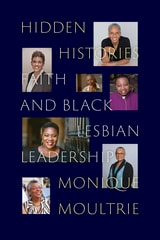
In Hidden Histories, Monique Moultrie collects oral histories of Black lesbian religious leaders in the United States to show how their authenticity, social justice awareness, spirituality, and collaborative leadership make them models of womanist ethical leadership. By examining their life histories, Moultrie frames queer storytelling as an ethical act of resistance to the racism, sexism, and heterosexism these women experience. She outlines these women’s collaborative, intergenerational, and leadership styles, and their concerns for the greater good and holistic well-being of humanity and the earth. She also demonstrates how their ethos of social justice activism extends beyond LGBTQ and racialized communities and provides other models of religious and community leadership. Addressing the invisibility of Black lesbian religious leaders in scholarship and public discourse, Moultrie revises modern understandings of how race, gender, and sexual identities interact with religious practice and organization in the twenty-first century.
[more]
cover of Hidden in the Mix: The African American Presence in Country Music

Hidden in the Mix

The African American Presence in Country Music

Diane Pecknold, ed.

Duke University Press, 2013

Country music's debt to African American music has long been recognized. Black musicians have helped to shape the styles of many of the most important performers in the country canon. The partnership between Lesley Riddle and A. P. Carter produced much of the Carter Family's repertoire; the street musician Tee Tot Payne taught a young Hank Williams Sr.; the guitar playing of Arnold Schultz influenced western Kentuckians, including Bill Monroe and Ike Everly. Yet attention to how these and other African Americans enriched the music played by whites has obscured the achievements of black country-music performers and the enjoyment of black listeners.

The contributors to Hidden in the Mix examine how country music became "white," how that fictive racialization has been maintained, and how African American artists and fans have used country music to elaborate their own identities. They investigate topics as diverse as the role of race in shaping old-time record catalogues, the transracial West of the hick-hopper Cowboy Troy, and the place of U.S. country music in postcolonial debates about race and resistance. Revealing how music mediates both the ideology and the lived experience of race, Hidden in the Mix challenges the status of country music as "the white man’s blues."

Contributors. Michael Awkward, Erika Brady, Barbara Ching, Adam Gussow, Patrick Huber, Charles Hughes, Jeffrey A. Keith, Kip Lornell, Diane Pecknold, David Sanjek, Tony Thomas, Jerry Wever

[more]
cover of History of the Mosaic Templars of America: Its Founders and Officials

History of the Mosaic Templars of America

Its Founders and Officials

A.E. Bush

University of Arkansas Press, 2008

Originally published in 1924 and long out of print, this book tells the story of the Mosaic Templars of America (MTA), a famous Black fraternal organization that was founded by John E. Bush and Chester W. Keatts (both former slaves) in Little Rock, Arkansas, in the late-nineteenth century. The organization originally provided illness, death, and burial insurance during an era of segregation when few basic services were available to Black people, and grew to include an insurance company, a building and loan association, a publishing company, a business college, a nursing school, and a hospital.

By 1905 it had a number of lodges across the state of Arkansas with thousands of members. In 1913 a handsome new headquarters building opened and Booker T. Washington delivered the dedication speech. In the 1920s they claimed chapters in twenty-six states and six foreign countries, making it one of the largest Black organizations in the world. 

However, in the 1930s the MTA began to feel the effects of the Great Depression and eventually ceased operations except for a single chapter in Barbados. Tragically, the original Little Rock headquarters building burned down in 2005.

This replica edition of History of the Mosaic Templars of America, with a new introduction by John William Graves, was published to coincide with the grand opening in 2008 of a completely rebuilt structure that houses the new Mosaic Templars Cultural Center.
[more]
cover of Hoecakes, Hambone, and All That Jazz: African American Traditions in Missouri

Hoecakes, Hambone, and All That Jazz

African American Traditions in Missouri

Rose M. Nolen

University of Missouri Press, 2003

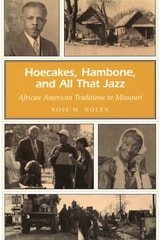
Many African Americans in Missouri are the descendants of slaves brought by the French or the Spanish to the Louisiana Territory in the 1700s or by Americans who moved from slave states after the Louisiana Purchase in the 1800s. In Hoecakes, Hambone, and All That Jazz, Rose M. Nolen explores the ways in which those Missouri “immigrants with a difference”—along with other Africans brought to America against their will—developed cultural, musical, and religious traditions that allowed them to retain customs from their past while adapting to the circumstances of the present.

Nolen writes, “Instead of the bond of common ancestors and a common language, which families had shared in Africa, the enslaved in the United States were bound together by skin color, hair texture, and condition of bondage. Out of this experience a strong sense of community was born.” Nolen traces the cultural traditions shaped by African Americans in Missouri from the early colonial period through the Civil War and Reconstruction and shows how those traditions were reshaped through the struggles of the civil rights movement and integration. Nolen demonstrates how the strong sense of community built on these traditions has sustained African Americans throughout their history.
 
Nolen focuses on some of the extraordinary Missourians produced by that community, among them William Wells Brown, “the first black man born in America to write plays, a novel, and accounts of his travels in Europe, as well as a ‘slave narrative’”; John Berry Meachum, a former slave who founded a “floating school,” anchored in the Mississippi River and thus exempt from state law, where blacks could be educated; J. W. “Blind” Boone, the celebrated composer and concert pianist; Elizabeth Keckley, who purchased her freedom, started her own business, and became dress designer and confidante to Mary Todd Lincoln; and Lucinda Lewis Haskell, daughter of a former slave, who helped establish the St. Louis Colored Orphan’s Home.
 
Hoecakes, Hambone, and All That Jazz recalls the many advances African Americans have made throughout Missouri’s history and uses the accomplishments of individuals to demonstrate the considerable contribution of African American culture to Missouri and all of the United States.
[more]
cover of Hollywood's African American Films: The Transition to Sound

Hollywood's African American Films

The Transition to Sound

Ryan Friedman

Rutgers University Press, 2011

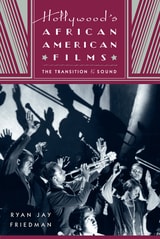
In 1929 and 1930, during the Hollywood studios' conversion to synchronized-sound film production, white-controlled trade magazines and African American newspapers celebrated a "vogue" for "Negro films." "Hollywood's African American Films" argues that the movie business turned to black musical performance to both resolve technological and aesthetic problems introduced by the medium of "talking pictures" and, at the same time, to appeal to the white "Broadway" audience that patronized their most lucrative first-run theaters. Capitalizing on highbrow associations with white "slumming" in African American cabarets and on the cultural linkage between popular black musical styles and "natural" acoustics, studios produced a series of African American-cast and white-cast films featuring African American sequences. Ryan Jay Friedman asserts that these transitional films reflect contradictions within prevailing racial ideologies--arising most clearly in the movies' treatment of African American characters' decisions to migrate. Regardless of how the films represent these choices, they all prompt elaborate visual and narrative structures of containment that tend to highlight rather than suppress historical tensions surrounding African American social mobility, Jim Crow codes, and white exploitation of black labor.
[more]
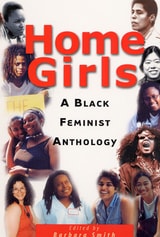
cover of Home Girls, 40th Anniversary Edition: A Black Feminist Anthology

Home Girls, 40th Anniversary Edition

A Black Feminist Anthology

Barbara Smith

Rutgers University Press, 2024

Home Girls, the pioneering anthology of Black feminist thought, features writing by Black feminist and lesbian activists on topics both provocative and profound. Since its initial publication in 1983, it has become an essential text on Black women's lives and contains work by many of feminism's foremost thinkers. This edition features an updated list of contributor biographies and an all-new preface that provides Barbara Smith the opportunity to look back on forty years of the struggle, as well as the influence the work in this book has had on generations of feminists. The preface from the previous Rutgers edition remains, as well as all of the original pieces, set in a fresh new package. 

Contributors: Tania Abdulahad, Donna Allegra, Barbara A. Banks, Becky Birtha, Cenen, Cheryl Clarke, Michelle Cliff, Michelle T. Clinton, Willi (Willie) M. Coleman, Toi Derricotte, Alexis De Veaux, Jewelle L. Gomez, Akasha (Gloria) Hull, Patricia Spears Jones, June Jordan, Audre Lorde, Raymina Y. Mays, Deidre McCalla, Chirlane McCray, Pat Parker, Linda C. Powell, Bernice Johnson Reagon, Spring Redd, Gwendolyn Rogers, Kate Rushin, Ann Allen Shockley, Barbara Smith, Beverly Smith, Shirley O. Steele, Luisah Teish, Jameelah Waheed, Alice Walker, and Renita J. Weems.
[more]
cover of Home Girls: A Black Feminist Anthology

Home Girls

A Black Feminist Anthology

Smith, Barbara

Rutgers University Press, 2000

The pioneering anthology Home Girls features writings by Black feminist and lesbian activists on topics both provocative and profound. Since its initial publication in 1983, it has become an essential text on Black women's lives and writings. This edition features an updated list of contributor biographies and an all-new preface that provides a fresh assessment of how Black women's lives have changed-or not-since the book was first published.

Contributors are Tania Abdulahad, Donna Allegra, Barbara A. Banks, Becky Birtha, Julie Carter, Cenen, Cheryl Clarke, Michelle Cliff, Michelle T. Clinton, Willie M. Coleman, Toi Derricotte, Alexis De Veaux, Jewelle L. Gomez, Akasha (Gloria) Hull, Patricia Jones, June Jordan, Audre Lorde, Raymina Y. Mays, Deidre McCalla, Chirlane McCray, Pat Parker, Linda C. Powell, Bernice Johnson Reagon, Spring Redd, Gwendolyn Rogers, Kate Rushin, Ann Allen Shockley, Barbara Smith, Beverly Smith, Shirley O. Steele, Luisah Teish, Jameelah Waheed, Alice Walker, and Renita Weems.
[more]
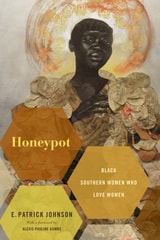
cover of Honeypot: Black Southern Women Who Love Women

Honeypot

Black Southern Women Who Love Women

E. Patrick Johnson

Duke University Press, 2019

E. Patrick Johnson's Honeypot opens with the fictional trickster character Miss B. barging into the home of Dr. EPJ, informing him that he has been chosen to collect and share the stories of her people. With little explanation, she whisks the reluctant Dr. EPJ away to the women-only world of Hymen, where she serves as his tour guide as he bears witness to the real-life stories of queer Black women throughout the American South. The women he meets come from all walks of life and recount their experiences on topics ranging from coming out and falling in love to mother/daughter relationships, religion, and political activism. As Dr. EPJ hears these stories, he must grapple with his privilege as a man and as an academic, and in the process he gains insights into patriarchy, class, sex, gender, and the challenges these women face. Combining oral history with magical realism and poetry, Honeypot is an engaging and moving book that reveals the complexity of identity while offering a creative method for scholarship to represent the lives of other people in a rich and dynamic way.
[more]
cover of Honor Bound: Race and Shame in America

Honor Bound

Race and Shame in America

Leverenz, David

Rutgers University Press, 2012

As Bill Clinton said in his second inaugural address, “The divide of race has been America’s constant curse.” In Honor Bound, David Leverenz explores the past to the present of that divide. He argues that in the United States, the rise and decline of white people’s racial shaming reflect the rise and decline of white honor. “White skin” and “black skin” are fictions of honor and shame. Americans have lived those fictions for over four hundred years.

To make his argument, Leverenz casts an unusually wide net, from ancient and modern cultures of honor to social, political, and military history to American literature and popular culture.

He highlights the convergence of whiteness and honor in the United States from the antebellum period to the present. The Civil War, the civil rights movement, and the election of Barack Obama represent racial progress; the Tea Party movement represents the latest recoil.

From exploring African American narratives to examining a 2009 episode of Hardball—in which two white commentators restore their honor by mocking U.S. Attorney General Eric Holder after he called Americans “cowards” for not talking more about race—Leverenz illustrates how white honor has prompted racial shaming and humiliation. The United States became a nation-state in which light-skinned people declared themselves white. The fear masked by white honor surfaces in such classics of American literature as The Scarlet Letter and Adventures of Huckleberry Finn and in the U.S. wars against the Barbary pirates from 1783 to 1815 and the Iraqi insurgents from 2003 to the present. John McCain’s Faith of My Fathers is used to frame the 2008 presidential campaign as white honor’s last national stand.

Honor Bound concludes by probing the endless attempts in 2009 and 2010 to preserve white honor through racial shaming, from the “birthers” and Tea Party protests to Joe Wilson’s “You lie!” in Congress and the arrest of Henry Louis Gates Jr. at the front door of his own home. Leverenz is optimistic that, in the twenty-first century, racial shaming is itself becoming shameful.
[more]
cover of Hooded Americanism: The History of the Ku Klux Klan

Hooded Americanism

The History of the Ku Klux Klan

David M. Chalmers

Duke University Press, 1987
"The only work that treats Ku Kluxism for the entire period of it's existence . . . the authoritative work on the period. Hooded Americanism is exhaustive in its rich detail and its use of primary materials to paint the picture of a century of terror. It is comprehensive, since it treats the entire period, and enjoys the perspective that the long view provides. It is timely, since it emphasizes the undeniable persistence of terrorism in American life."—John Hope Franklin
[more]
cover of Hoodlums: Black Villains and Social Bandits in American Life

Hoodlums

Black Villains and Social Bandits in American Life

William L. Van Deburg

University of Chicago Press, 2004

Martin Luther King Jr. Malcolm X. Muhammad Ali. When you think of African American history, you think of its heroes—individuals endowed with courage and strength who are celebrated for their bold exploits and nobility of purpose. But what of black villains? Villains, just as much as heroes, have helped define the black experience.

Ranging from black slaveholders and frontier outlaws to serial killers and gangsta rappers, Hoodlums examines the pivotal role of black villains in American society and popular culture. Here, William L. Van Deburg offers the most extensive treatment to date of the black badman and the challenges that this figure has posed for race relations in America. He first explores the evolution of this problematic racial stereotype in the literature of the early Republic—documents in which the enslavement of African Americans was justified through exegetical claims. Van Deburg then probes antebellum slave laws, minstrel shows, and the works of proslavery polemicists to consider how whites conceptualized blacks as members of an inferior and dangerous race. Turning to key works by blacks themselves, from the writings of Frederick Douglass and W. E. B. Du Bois to classic blaxploitation films like Black Caesar and The Mack, Van Deburg demonstrates how African Americans have combated such negative stereotypes and reconceptualized the idea of the badman through stories of social bandits—controversial individuals vilified by whites for their proclivity toward evil, but revered in the black community as necessarily insurgent and revolutionary.

Ultimately, Van Deburg brings his story up-to-date with discussions of prison and hip-hop culture, urban rioting, gang warfare, and black-on-black crime. What results is a work of remarkable virtuosity—a nuanced history that calls for both whites and blacks to rethink received wisdom on the nature and prevalence of black villainy.

[more]
cover of Hope Draped in Black: Race, Melancholy, and the Agony of Progress

Hope Draped in Black

Race, Melancholy, and the Agony of Progress

Joseph R. Winters

Duke University Press, 2016
In Hope Draped in Black Joseph R. Winters responds to the enduring belief that America follows a constant trajectory of racial progress. Such notions—like those that suggested the passage into a postracial era following Barack Obama's election—gloss over the history of racial violence and oppression to create an imaginary and self-congratulatory world where painful memories are conveniently forgotten. In place of these narratives, Winters advocates for an idea of hope that is predicated on a continuous engagement with loss and melancholy. Signaling a heightened sensitivity to the suffering of others, melancholy disconcerts us and allows us to cut against dominant narratives and identities. Winters identifies a black literary and aesthetic tradition in the work of intellectuals, writers, and artists such as W. E. B. Du Bois, Ralph Ellison, Toni Morrison, and Charles Burnett that often underscores melancholy, remembrance, loss, and tragedy in ways that gesture toward such a conception of hope. Winters also draws on Walter Benjamin and Theodor Adorno to highlight how remembering and mourning the uncomfortable dimensions of American social life can provide alternate sources for hope and imagination that might lead to building a better world.
[more]
cover of Hope and Independence: Blacks' Response to Electoral and Party Politics

Hope and Independence

Blacks' Response to Electoral and Party Politics

Patricia Gurin

Russell Sage Foundation, 1989
Over the past fifteen years, a New Black Politics has swept black candidates into office and registered black voters in numbers unimaginable since the days of Reconstruction. Based on interviews with a representative sample of nearly 1,000 voting-age black Americans, Hope and Independence explores blacks' attitudes toward electoral and party politics and toward Jesse Jackson's first presidential bid. Viewed in the light of black political history, the survey reveals enduring themes of hope (for eventual inclusion in traditional politics, despite repeated disappointments) and independence (a strategy of operating outside conventional political institutions in order to achieve incorporation). The authors describe a black electorate that is less alienated than many have suggested. Blacks are more politically engaged than whites with comparable levels of education. And despite growing economic inequality in the black community, the authors find no serious class-based political cleavage. Underlying the widespread support for Jackson among blacks, a distinction emerges between "common fate" solidarity, which is pro-black, committed to internal criticism of the Democratic party, and conscious of commonality with other disadvantaged groups, and "exclusivist" solidarity, which is pro-black but also hostile to whites and less empathetic to other minorities. This second, more divisive type of solidarity expresses itself in the desire for a separate black party or a vote black strategy—but its proponents constitute a small minority of the black electorate and show surprisingly hopeful attitudes toward the Democratic party. Hope and Independence will be welcomed by readers concerned with opinion research, the sociology of race, and the psychology of group consciousness. By probing the attitudes of individual blacks in the context of a watershed campaign, this book also makes a vital contribution to our grasp of current electoral politics.
[more]
cover of Hostile Heartland: Racism, Repression, and Resistance in the Midwest

Hostile Heartland

Racism, Repression, and Resistance in the Midwest

Brent M. S. Campney

University of Illinois Press, 2019
We forget that racist violence permeated the lower Midwest from the pre-Civil War period until the 1930s. From Kansas to Ohio, whites orchestrated extraordinary events like lynchings and riots while engaged in a spectrum of brutal acts made all the more horrific by being routine. Also forgotten is the fact African Americans forcefully responded to these assertions of white supremacy through armed resistance, the creation of press outlets and civil rights organizations, and courageous individual activism. Drawing on cutting-edge methodology and a wealth of documentary evidence, Brent M. S. Campney analyzes the institutionalized white efforts to assert and maintain dominance over African Americans. Though rooted in the past, white violence evolved into a fundamentally modern phenomenon, driven by technologies such as newspapers, photographs, automobiles, and telephones. Other surprising insights challenge our assumptions about sundown towns, who was targeted by whites, law enforcement's role in facilitating and perpetrating violence, and the details of African American resistance.
[more]
cover of Hot Feet and Social Change: African Dance and Diaspora Communities

Hot Feet and Social Change

African Dance and Diaspora Communities

Edited by Kariamu Welsh, Esailama Diouf, and Yvonne Daniel

University of Illinois Press, 2019

The popularity and profile of African dance have exploded across the African diaspora in the last fifty years. Hot Feet and Social Change presents traditionalists, neo-traditionalists, and contemporary artists, teachers, and scholars telling some of the thousands of stories lived and learned by people in the field. Concentrating on eight major cities in the United States, the essays challenges myths about African dance while demonstrating its power to awaken identity, self-worth, and community respect. These voices of experience share personal accounts of living African traditions, their first encounters with and ultimate embrace of dance, and what teaching African-based dance has meant to them and their communities. Throughout, the editors alert readers to established and ongoing research, and provide links to critical contributions by African and Caribbean dance experts.

Contributors: Ausettua Amor Amenkum, Abby Carlozzo, Steven Cornelius, Yvonne Daniel, Charles “Chuck” Davis, Esailama G. A. Diouf, Indira Etwaroo, Habib Iddrisu, Julie B. Johnson, C. Kemal Nance, Halifu Osumare, Amaniyea Payne, William Serrano-Franklin, and Kariamu Welsh

[more]
cover of Hot, Hot Chicken: A Nashville Story

Hot, Hot Chicken

A Nashville Story

Rachel Louise Martin

Vanderbilt University Press, 2021

These days, hot chicken is a “must-try” Southern food. Restaurants in New York, Detroit, Cambridge, and even Australia advertise that they fry their chicken “Nashville-style.” Thousands of people attend the Music City Hot Chicken Festival each year. The James Beard Foundation has given Prince’s Chicken Shack an American Classic Award for inventing the dish.

But for almost seventy years, hot chicken was made and sold primarily in Nashville’s Black neighborhoods—and the story of hot chicken says something powerful about race relations in Nashville, especially as the city tries to figure out what it will be in the future.

Hot, Hot Chicken recounts the history of Nashville’s Black communities through the story of its hot chicken scene from the Civil War, when Nashville became a segregated city, through the tornado that ripped through North Nashville in March 2020.
[more]
cover of Houston and the Permanence of Segregation: An Afropessimist Approach to Urban History

Houston and the Permanence of Segregation

An Afropessimist Approach to Urban History

David Ponton

University of Texas Press, 2024

2025 Most Significant Scholarly Book, Texas Institute of Letters

A history of racism and segregation in twentieth-century Houston and beyond.

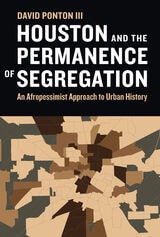
Through the 1950s and beyond, the Supreme Court issued decisions that appeared to provide immediate civil rights protections to racial minorities as it relegated Jim Crow to the past. For black Houstonians who had been hoping and actively fighting for what they called a “raceless democracy,” these postwar decades were often seen as decades of promise. In Houston and the Permanence of Segregation, David Ponton argues that these were instead “decades of capture”: times in which people were captured and constrained by gender and race, by faith in the law, by antiblack violence, and even by the narrative structures of conventional histories. Bringing the insights of Black studies and Afropessimism to the field of urban history, Ponton explores how gender roles constrained thought in black freedom movements, how the “rule of law” compelled black Houstonians to view injustice as a sign of progress, and how antiblack terror undermined Houston’s narrative of itself as a “heavenly” place.

Today, Houston is one of the most racially diverse cities in the United States, and at the same time it remains one of the most starkly segregated. Ponton’s study demonstrates how and why segregation has become a permanent feature in our cities and offers powerful tools for imagining the world otherwise.

[more]
cover of How I Got Over: Clara Ward and the World-Famous Ward Singers

How I Got Over

Clara Ward and the World-Famous Ward Singers

Willa Ward-Royster

Temple University Press, 2000
Lavishly illustrated with photographs from the author's collection, this book chronicles the world-famous Ward Singers' story from rural Anderson, South Carolina, to the streets of North Philadelphia and beyond. Told by Clara Ward's older sister, Willa, with the assistance of musician and writer Toni Rose, the Wards' story ranges over the joys and frustrations, triumphs and agonies of what it means to be simultaneously a family, an entertainment business enterprise, and a group with a mission to spread God's word.
[more]
cover of How Racism Takes Place

How Racism Takes Place

George Lipsitz

Temple University Press, 2011

White identity in the United States is place bound, asserts George Lipsitz in How Racism Takes Place. An influential scholar in American and racial studies, Lipsitz contends that racism persists because a network of practices skew opportunities and life chances along racial lines. That is, these practices assign people of different races to different spaces and therefore allow grossly unequal access to education, employment, transportation, and shelter.

Revealing how seemingly race-neutral urban sites contain hidden racial assumptions and imperatives, Lipsitz examines the ways in which urban space and social experience are racialized and emphasizes that aggrieved communities do not passively acquiesce to racism. He recognizes the people and communities that have reimagined segregated spaces in expressive culture as places for congregation.

How Racism Takes Place not only exposes the degree to which this white spatial imagining structures our society but also celebrates the black artists and activists who struggle to create a just and decent society.

 

[more]
cover of How We Write Now: Living with Black Feminist Theory

How We Write Now

Living with Black Feminist Theory

Jennifer C. Nash

Duke University Press, 2024
In How We Write Now Jennifer C. Nash examines how Black feminists use beautiful writing to allow writers and readers to stay close to the field’s central object and preoccupation: loss. She demonstrates how contemporary Black feminist writers and theorists such as Jesmyn Ward, Elizabeth Alexander, Christina Sharpe, and Natasha Trethewey mobilize their prose to ask readers to feel, undo, and reassemble themselves. These intimate invitations are more than a set of tools for decoding the social world; Black feminist prose becomes a mode of living and feeling, dreaming and being, and a distinctly affective project that treats loss as not only paradigmatic of Black life but also an aesthetic question. Through her own beautiful writing, Nash shows how Black feminism offers itself as a companion to readers to chart their own lives with and in loss, from devastating personal losses to organizing around the movement for Black lives. Charting her own losses, Nash reminds us that even as Black feminist writers get as close to loss as possible, it remains a slippery object that troubles memory and eludes capture.
[more]
cover of How to Go Mad without Losing Your Mind: Madness and Black Radical Creativity

How to Go Mad without Losing Your Mind

Madness and Black Radical Creativity

La Marr Jurelle Bruce

Duke University Press, 2020

“Hold tight. The way to go mad without losing your mind is sometimes unruly.” So begins La Marr Jurelle Bruce's urgent provocation and poignant meditation on madness in black radical art. Bruce theorizes four overlapping meanings of madness: the lived experience of an unruly mind, the psychiatric category of serious mental illness, the emotional state also known as “rage,” and any drastic deviation from psychosocial norms. With care and verve, he explores the mad in the literature of Amiri Baraka, Gayl Jones, and Ntozake Shange; in the jazz repertoires of Buddy Bolden, Sun Ra, and Charles Mingus; in the comedic performances of Richard Pryor and Dave Chappelle; in the protest music of Nina Simone, Lauryn Hill, and Kendrick Lamar, and beyond. These artists activate madness as content, form, aesthetic, strategy, philosophy, and energy in an enduring black radical tradition. Joining this tradition, Bruce mobilizes a set of interpretive practices, affective dispositions, political principles, and existential orientations that he calls “mad methodology.” Ultimately, How to Go Mad without Losing Your Mind is both a study and an act of critical, ethical, radical madness.
[more]
cover of How to Lose the Hounds: Maroon Geographies and a World beyond Policing

How to Lose the Hounds

Maroon Geographies and a World beyond Policing

Celeste Winston

Duke University Press, 2023

In How to Lose the Hounds Celeste Winston explores marronage—the practice of flight from and placemaking beyond slavery—as a guide to police abolition. She examines historically Black maroon communities in the Maryland suburbs of Washington, DC, that have been subjected to violent excesses of police power from slavery until the present day. Tracing the long and ongoing historical geography of Black freedom struggles in the face of anti-Black police violence in these communities, Winston shows how marronage provides critical lessons for reimagining public safety and community well-being. These freedom struggles take place in what Winston calls maroon geographies—sites of flight from slavery and the spaces of freedom produced in multigenerational Black communities. Maroon geographies constitute part of a Black placemaking tradition that asserts life-affirming forms of community. Winston contends that maroon geographies operate as a central method of Black flight, holding ground, and constructing places of freedom in ways that imagine and plan a world beyond policing.
[more]
cover of Humane Insight: Looking at Images of African American Suffering and Death

Humane Insight

Looking at Images of African American Suffering and Death

Courtney Baker

University of Illinois Press, 2017
In the history of black America, the image of the mortal, wounded, and dead black body has long been looked at by others from a safe distance. Courtney Baker questions the relationship between the spectator and victim and urges viewers to move beyond the safety of the "gaze" to cultivate a capacity for humane insight toward representations of human suffering. Utilizing the visual studies concept termed the "look," Baker interrogates how the notion of humanity was articulated and recognized in oft-referenced moments within the African American experience: the graphic brutality of the 1834 Lalaurie affair; the photographic exhibition of lynching, Without Sanctuary ; Emmett Till's murder and funeral; and the devastation caused by Hurricane Katrina. Contemplating these and other episodes, Baker traces how proponents of black freedom and dignity used the visual display of violence against the black body to galvanize action against racial injustice. An innovative cultural study that connects visual theory to African American history, Humane Insight asserts the importance of ethics in our analysis of race and visual culture, and reveals how representations of pain can become the currency of black liberation from injustice.
[more]
cover of Hurrah for Hampton!: Black Red Shirts in South Carolina during Reconstruction

Hurrah for Hampton!

Black Red Shirts in South Carolina during Reconstruction

Edmund L. Drago

University of Arkansas Press, 1999

This post-revisionist study examines the motives and the concerns of the ex-slaves in South Carolina who supported a movement that eventually led to white supremacy.

Although most freedmen throughout the states of the former Confederacy were Republicans loyal to the party of the Federal government that had emancipated them, they were factions of African-American voters who aligned themselves with local white Democratic leaders. one such group of black conservatives joined the “Red Shirts,” white paramilitary clubs that attempted to restore antebellum values in electing former Confederate general Wade Hampton governor of South Carolina in 1876.

Drago’s fine analysis recovers and explains this lost aspect of Southern black history. Drawing on primary sources that include testimonies of several black Red Shirts before a Congressional investigation of the election and eleven slave narratives, he de-romanticizes the black experience by examining the relationship between black initiative and southern paternalism.

[more]