Results by title
977 books match the query 'American literature' and 26 start with h
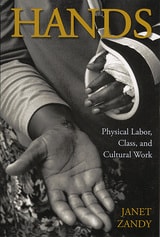
Hands
Physical Labor, Class, and Cultural WorkZandy, Janet
Rutgers University Press, 2004
In linking forms of cultural expression to labor, occupational injuries, and deaths, Hands: Physical Labor, Class, and Cultural Work centers what is usually decentered--the complex culture of working-class people. Janet Zandy begins by examining the literal loss of lives to unsafe jobs and occupational hazards. She asks critical and timely questions about worker representation--who speaks for employees when the mills, mines, factories, and even white-collar cubicles shut down? She presents the voices of working-class writers and artists, and discusses their contribution to knowledge and culture.
This innovative study reveals the flesh and bone beneath the abstractions of labor, class, and culture. It is an essential contribution to the emerging field of working-class studies, offering a hybrid model for bridging communities and non-academic workers to scholars and institutions of knowledge.

Hard Choices
An "Iowa Review" ReaderDAVID HAMILTON
University of Iowa Press, 1996
For twenty-five years, the Iowa Review has published many of America's finest writers, often helping them become established in their careers. From Tillie Olsen and William Stafford in the first volume to James Galvin and Pattiann Rogers in the twenty-fourth, the names and voices are recognizable and respected or soon will be. As editor David Hamilton notes in his introduction to this eclectic anniversary volume of nearly eighty poems and stories, "To a considerable extent we have defined ourselves by them; thus Hard Choices, a generous sampling of the best and most interesting writing from the Iowa Review's first years, defines the past and the future of American literature."
The Iowa Review is one of a small group of dedicated literary magazines that have defined American literary culture in the past quarter century. The adventurous, stimulating pieces in Hard Choices will encourage readers to look forward to the next quarter century.
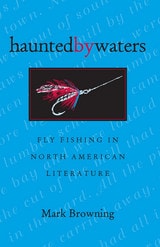
Haunted By Waters
Fly Fishing In North American LiteratureMark Browning
Ohio University Press, 1998
As his own story unfolds, Mark Browning analyzes angling literature from the Bible to Norman Maclean, always bringing his inquiry back to the same source: the enigma of this sport.
Haunted by Waters is an exploration of the apparent compulsion of those who fish not only to read about the sport, but to write about it as well. Mark Browning's personal account as a fly fisherman and his perspective as a critic make him uniquely qualified to navigate these waters.
Haunted Man's Report
Reading Charles PortisRobert Cochran
University of Arkansas Press, 2024
Haunted Man’s Report, a deeply insightful literary exploration of Portis’s singular and underexamined oeuvre, celebrates this novelist’s great achievement and is certain to prove a valuable guide for readers new to Portis as well as aficionados.
Hawthorne and Women
Engendering and Expanding the Hawthorne TraditionJohn L. Idol
University of Massachusetts Press, 1999
This collection of original essays presents a more complex and positive view of Hawthorne's attitudes toward women, demonstrating his recognition of the crucial role that women played--as critics, reviewers, readers, and authors--in building a national readership that made his writing career so successful.
The book begins with an examination of the influence exerted by the women in Hawthorne's immediate family. It goes on to explore his links to a broad range of women writers, as well as his attitudes toward the female characters he created. Among the authors discussed are Margaret Fuller, Harriet Beecher Stowe, Louisa May Alcott, Emily Dickinson, Sarah Orne Jewett, Willa Cather, Charlotte Perkins Gilman, George Eliot, Virginia Woolf, Flannery O'Connor, and Toni Morrison.
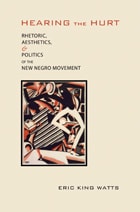
Hearing the Hurt
Rhetoric, Aesthetics, and Politics of the New Negro MovementEric King Watts
University of Alabama Press, 2012
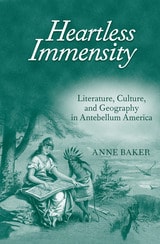
Heartless Immensity
Literature, Culture, and Geography in Antebellum AmericaAnne Baker
University of Michigan Press, 2010
Building on extensive archival research as well as insights from cultural geographers and theorists of nationhood, Heartless Immensity demonstrates that national expansion had a far more complicated, multifaceted impact on antebellum American culture than has previously been recognized. Baker shows that Americans developed a variety of linguistic strategies for imagining the form of the United States and its position in relation to other geopolitical entities. Comparisons
to European empires, biblical allusions, body politic metaphors, and metaphors derived from science all reflected—and often attempted to assuage—fears that the nation was becoming either monstrously large or else misshapen in ways that threatened cherished beliefs and national self-images.
Heartless Immensity argues that, in order to understand the nation’s shift from republic to empire and to understand American culture in a global context, it is first necessary to pay close attention to the processes by which the physical entity known as the United States came into being. This impressively thorough study will make a valuable contribution to the fields of American studies and literary studies.
Anne Baker is Assistant Professor of English at North Carolina State University.
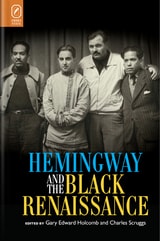
Hemingway and the Black Renaissance
Edited by Gary Edward Holcomb and Charles Scruggs
The Ohio State University Press, 2012
Hemingway and the Black Renaissance, edited by Gary Edward Holcomb and Charles Scruggs, explores a conspicuously overlooked topic: Hemingway’s wide-ranging influence on writers from the Harlem Renaissance to the present day. An observable who’s who of black writers—Ralph Ellison, James Baldwin, Langston Hughes, Claude McKay, Wallace Thurman, Chester Himes, Alex la Guma, Derek Walcott, Gayl Jones, and more—cite Hemingway as a vital influence. This inspiration extends from style, Hemingway’s minimalist art, to themes of isolation and loneliness, the dilemma of the expatriate, and the terrifying experience of living in a time of war. The relationship, nevertheless, was not unilateral, as in the case of Jean Toomer’s 1923 hybrid, short-story cycle Cane, which influenced Hemingway’s collage-like 1925 In Our Time.
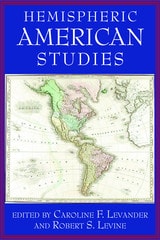
Hemispheric American Studies
Levander, Caroline F
Rutgers University Press, 2007
With essays that examine stamps, cartoons, novels, film, art, music, travel documents, and governmental publications, Hemispheric American Studies seeks to excavate the complex cultural history of texts and discourses across the ever-changing and stratified geopolitical and cultural fields that collectively comprise the American hemisphere. This collection promises to chart new directions in American literary and cultural studies.
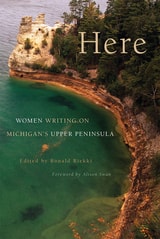
Here
Women Writing on Michigan's Upper PeninsulaRonald Riekki
Michigan State University Press, 2015
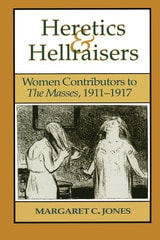
Heretics and Hellraisers
Women Contributors to The Masses, 1911-1917By Margaret C. Jones
University of Texas Press, 1993
The Masses was the most dynamic and influential left-wing magazine of the early twentieth century, a touchstone for understanding radical thought and social movements in the United States during that era. As a magazine that supported feminist issues, it played a crucial role in shaping public discourse about women's concerns. Women editors, fiction writers, poets, and activists like Mary Heaton Vorse, Louise Bryant, Adriana Spadoni, Elsie Clews Parsons, Inez Haynes Gillmore, and Helen Hull contributed as significantly to the magazine as better-known male figures.
In this major revisionist work, Margaret C. Jones calls for reexamination of the relevance of Masses feminism to that of the 1990s. She explores women contributors' perspectives on crucial issues: patriarchy, birth control, the labor movement, woman suffrage, pacifism, and ethnicity. The book includes numerous examples of the writings and visual art of Masses women and a series of biographical/bibliographical sketches designed to aid other researchers.
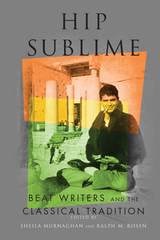
Hip Sublime
Beat Writers and the Classical TraditionEdited by Sheila Murnaghan and Ralph M. Rosen
The Ohio State University Press, 2018
In this volume, a diverse group of contributors explore for the first time the fascinating tensions and paradoxes that arose from interactions between these avant-garde writers and a literary tradition often seen as conservative and culturally hegemonic. With essays that cover the canonical Beat authors—such as Allen Ginsberg, Jack Kerouac, and William Burroughs—along with less well-known figures—including Kenneth Rexroth, Ed Sanders, and Diane di Prima—Hip Sublime: Beat Writers and the Classical Tradition brings long overdue attention to the Beat movement’s formative appropriation of the Greek and Latin classics.

Hired Pens
Professional Writers in America’s Golden Age of PrintRonald Weber
Ohio University Press, 1997
Just as mass-market magazines and cheap books have played important roles in the creation of an American identity, those skilled craftsmen (and women) whose careers are the subjects of Ronald Weber’s narrative profoundly influenced the outlook and strategies of the high-culture writers who are generally the focus of literary studies.
Hired Pens, a history of the writing profession in the United States, recognizes the place of independent writers who wrote for their livelihood from the 1830s and 1840s, with the first appearance of a broad-based print culture, to the 1960s.
Many realist authors began on this American Grub Street. Jack London turned out hackwork for any paying market he could find, while Scott Fitzgerald’s stories in slick magazines in the 1920s and early ’30s established his name as a writer.
From Edgar Allen Poe’s earliest forays into writing for pay to Sylvia Plath’s attempts to produce fiction for mass-circulation journals, Hired Pens documents without agenda the evolution of professional writing in all its permutations—travel accounts, sport, popular biography and history, genre and series fiction—and the culture it fed.
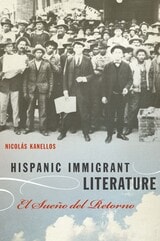
Hispanic Immigrant Literature
El Sueño del RetornoBy Nicolás Kanellos
University of Texas Press, 2011
Immigration has been one of the basic realities of life for Latino communities in the United States since the nineteenth century. It is one of the most important themes in Hispanic literature, and it has given rise to a specific type of literature while also defining what it means to be Hispanic in the United States. Immigrant literature uses predominantly the language of the homeland; it serves a population united by that language, irrespective of national origin; and it solidifies and furthers national identity. The literature of immigration reflects the reasons for emigrating, records—both orally and in writing—the trials and tribulations of immigration, and facilitates adjustment to the new society while maintaining links with the old society.
Based on an archive assembled over the past two decades by author Nicolás Kanellos's Recovering the U. S. Hispanic Literary Heritage project, this comprehensive study is one of the first to define this body of work. Written and recorded by people from Mexico, Cuba, Puerto Rico, the Caribbean, and Central and South America, the texts presented here reflect the dualities that have characterized the Hispanic immigrant experience in the United States since the mid-nineteenth century, set always against a longing for homeland.
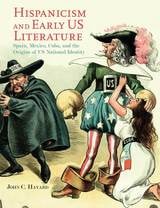
Hispanicism and Early US Literature
Spain, Mexico, Cuba, and the Origins of US National IdentityJohn C. Havard
University of Alabama Press, 2018
Revealing how Spain, Mexico, and Cuba helped shape the literary origins of American national identity.
In Hispanicism and Early US Literature, author John C. Havard posits that representations of Spain, Spanish America, Spanishness, and Spanish Americanness are integral elements in the evolution of early national and antebellum US literature. He argues that Spanish-speaking countries have long held a broad fascination for Americans and that stock narratives regarding these peoples were central to the period’s US literature.
Beginning with the work of eighteenth-century literary nationalists such as Joel Barlow, US literature has been drawn to reflect on Spain and Spanish America. Such reflection was often inspired by geopolitical conflicts such as US expansion into Spanish Louisiana and the US-Mexican War. Havard terms the discourse emerging from these reflections “Hispanicism.” This discourse was used to portray the dominant viewpoint of classical liberalism that propounded an American exceptionalism premised on the idea that Hispanophone peoples were comparatively lacking the capacity for self-determination, hence rationalizing imperialism. On the conservative side were warnings against progress through conquest.
Havard delves into selected works of early national and antebellum literature on Spain and Spanish America to illuminate US national identity. Poetry and novels by Joel Barlow, James Fenimore Cooper, and Herman Melville are mined to further his arguments regarding identity, liberalism, and conservatism. Understudied authors Mary Peabody Mann and José Antonio Saco are held up to contrast American and Cuban views on Hispanicism and Cuban annexation as well as to develop the focus on nationality and ideology via differences in views on liberalism.
More than just a work of literary criticism, there is a substantial amount of cultural and political history discussed. Havard’s use of archival sources such as political articles and personal correspondence elucidates not just literary genres and movements such as early national epic poetry, abolitionist fiction, and the American Renaissance, but also US prominent culture.
Home Girls
Chicana Literary VoicesAlvina E. Quintana
Temple University Press, 1996
Home Places
Contemporary Native American Writing from Sun TracksEdited by Larry Evers and Ofelia Zepeda
University of Arizona Press, 1995
Some are stories from oral traditions, others are autobiographical writings, and some are songs or poems. But all are contemporary, and all have as a unifying element a strong central theme in Native American writing: home places. Some of the contributors define the home place as a center of established values, while others speak of its cultural or physical geography. Healing powers are often found at home places. Home is a place to defend against those who would reduce it to insignificance, a place to reclaim, or a place reclaimed but not yet realized.
One writer recalls a home that must be pulled from deep beneath the waters of the Columbia River. By listening to these stories of home places, the reader can gain a new appreciation of the contemporary verbal expressions of Native American communities. Home Places, note the editors, "asks you to listen to Native American signers, storytellers, and writers, and in this way to celebrate the wellsprings of creativity that continue to flow from the home places in Native America."
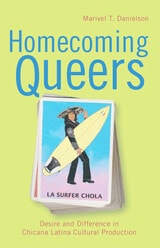
Homecoming Queers
Desire and Difference in Chicana Latina Cultural ProductionDanielson, Marivel T
Rutgers University Press, 2009
Spanning multiple genres and forms, and including scholarly theory alongside performances, films, narratives, and testimonials, Homecoming Queers leads readers along a crucial path toward understanding and overcoming the silences that previously existed across these fields.
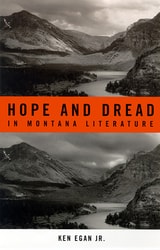
Hope And Dread In Montana Literature
Ken Egan
University of Nevada Press, 2003
This literary survey from a third-generation Montanan includes a thoughtful discussion on the now infamous events of the mid- to late-nineties. The rich literary tradition of Montana, contends author Ken Egan Jr., reflects a catastrophic vision of the West that shows the "horrors of domination" and "the foolish and destructive habits of the imperial heart." Since the 1860s, Montana’s writers have depicted struggles for survival in the state’s dramatic landscape, and for decency in a region characterized by the headlong exploitation of both natural and human resources.
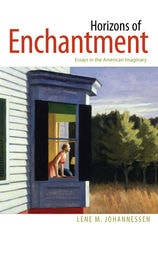
Horizons of Enchantment
Essays in the American ImaginaryLene M. Johannessen
Dartmouth College Press, 2011
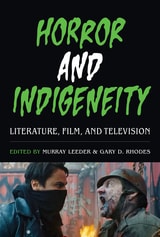
Horror and Indigeneity
Literature, Film, and TelevisionEdited by Murray Leeder and Gary D. Rhodes
University of Texas Press, 2026
A collection of essays about Indigeneity and horror in cinema, literature, and beyond.
How did Indigeneity come to be horrifying? Think of the “Indian burial ground” trope, a staple of 1970s horror cinema, not to mention decades of Western films and fictions that made “savage Indians” the face of fear in popular culture. Can horror do something else in the hands of Indigenous people? Creators such as Eden Robinson and Jeff Barnaby have self-consciously turned to horror to tell new kinds of stories, stories that question who is a monster and what constitutes the monstrous.
Horror and Indigeneity explores representations of Indigenous people in settler horror texts and in the growing corpus of horror by Indigenous writers and filmmakers. Widely spanning time periods and media, the contributors to this edited volume address themes such as cannibalism, eco-horror, historical trauma, and contemporary antiracism as they relate to classical horror cinema and recent works such as The Dead Can’t Dance, Lovecraft Country, and Stephen Graham Jones’s The Only Good Indians. Also featuring interviews with Jones and director T. J. Cuthand, Horror and Indigeneity rethinks the terror of the Other in potent and provocactive terms.
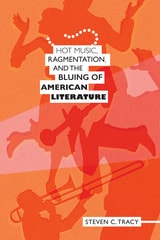
Hot Music, Ragmentation, and the Bluing of American Literature
Steven C. Tracy
University of Alabama Press, 2015
Exploring the deep and enduring relationship between music and literature, Hot Music, Ragmentation, and the Bluing of American Literature examines the diverse ways in which African American “hot” music influenced American culture—particularly literature—in early twentieth century America. Steven C. Tracy provides a history of the fusion of African and European elements that formed African American “hot” music, and considers how terms like ragtime, jazz, and blues developed their own particular meanings for American music and society. He draws from the fields of literature, literary criticism, cultural anthropology, American studies, and folklore to demonstrate how blues as a musical and poetic form has been a critical influence on American literature.
Hot Music, Ragmentation, and the Bluing of American Literature begins by highlighting instances in which American writers, including Herman Melville, Stephen Crane, and Gertrude Stein, use African American culture and music in their work, and then characterizes the social context of the Jazz Age, discussing how African American music reflected the wild abandon of the time. Tracy focuses on how a variety of schools of early twentieth century writers, from modernists to members of the Harlem Renaissance to dramatists and more, used their connections with “hot” music to give their own work meaning.
Tracy’s extensive and detailed understanding of how African American “hot” music operates has produced a fresh and original perspective on its influence on mainstream American literature and culture. An experienced blues musician himself, Tracy draws on his performance background to offer an added dimension to his analysis. Where another blues scholar might only analyze blues language, Tracy shows how the language is actually performed.
Hot Music, Ragmentation, and the Bluing of American Literature is the first book to offer such a refreshingly broad interdisciplinary vision of the influence of African American “hot” music on American literature. It is an essential addition to the library of serious scholars of American and African American literature and culture and blues aficionados alike.
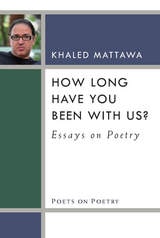
How Long Have You Been With Us?
Essays on PoetryKhaled Mattawa
University of Michigan Press, 2016
A volume in the Poets on Poetry series, which collects critical works by contemporary poets, gathering together the articles, interviews, and book reviews by which they have articulated the poetics of a new generation.
“Like the myriad companions and comrades that he summons from their exile, Khaled Mattawa is himself a ‘poet-stranger.’ In the essays, ‘written in a poet’s prose,’ collected in How Long Have You Been With Us, Mattawa evokes a powerful amalgam of the personal intimacy of the solitary and the political challenge of solidarity.”
—Barbara Harlow, University of Texas at Austin
“If you’ve read about exile, you’ve read about Brodsky and Milosz—just as, if you’ve read about translation, you’ve read about Walter Benjamin and George Steiner. While Khaled Mattawa has mastered these masters, his essays about world literature serve as a tour of the rest of the world. He introduces you to the writers you haven’t heard of but should from contemporary Libya and colonial South Asia to Latin America and China. When Mattawa invokes Saadi Youssef or Rabinidrath Tagore, Mohja Kahf or Toru Dutt, the effect is to deprovincialize American literature.”
—Ken Chen, The Asian American Writers’ Workshop
Khaled Mattawa, an American poet of Libyan origin, explores various dynamic developments shaping American poetry as it is being practiced today. Arising from an incredibly diverse range personal backgrounds, lyric traditions, and even languages, American poetry is transforming into a truly international form. Mattawa, who also translates Arabic poetry into American English and American poetry into Arabic, explores the poetics and politics of cross-cultural exchange and literary translation that fostered such transformation. The essays in this collection also shed light on Mattawa’s development as a poet and provide numerous portraits of the poets who helped shaped his poetry.
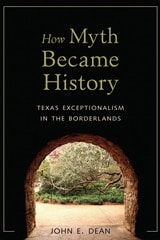
How Myth Became History
Texas Exceptionalism in the BorderlandsJohn E. Dean
University of Arizona Press, 2016
How Myth Became History explores the formation of national, ethnic, racial, and class identities in the Texas borderlands. Examining Mexican, Mexican American, and Anglo Texan narratives as competing representations of the period spanning the Texas Declaration of Independence to the Mexican Revolution, John E. Dean traces the creation and development of border subjects and histories. Dean uses history, historical fiction, postcolonial theory, and U.S.-Mexico border theory to disrupt “official” Euro-American histories.
Dean argues that the Texas-Mexico borderlands complicate national, ethnic, and racial differences. He makes this clear in his discussion of the Mexican Revolution, when many Mexican Americans who saw themselves as Mexicans fought for competing revolutionary factions in Mexico, while others who saw themselves as U.S. Americans tried to distance themselves from Mexico altogether.
Analyzing literary representations of the border, How Myth Became History emphasizes the heterogeneity of border communities and foregrounds narratives that have often been occluded, such as Mexican-Indio histories. The border, according to Dean, still represents a contested geographical entity that destabilizes ethnic and racial groups. Border dynamics provide critical insight into the vexed status of the contemporary Texas-Mexico divide and point to broader implications for national and transnational identity.
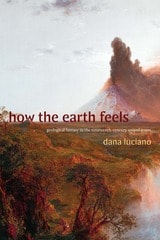
How the Earth Feels
Geological Fantasy in the Nineteenth-Century United StatesDana Luciano
Duke University Press, 2024
Humor Me
An Anthology of Humor by Writers of ColorJohn McNally
University of Iowa Press, 2002