Results by title
299 books match the query 'Arizona' and 11 start with h
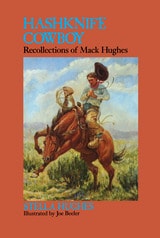
Hashknife Cowboy
Recollections of Mack HughesStella Hughes; Illustrated by Joe Beeler
University of Arizona Press, 1984
Stella Hughes, author of the best-selling Chuck Wagon Cookin' and a cowhand in her own right, has compiled from her husband's reminiscences an authentic look both at Arizona history and at cowboying as it really was. Illustrated by Joe Beeler, founding member of the Cowboy Artists of America.
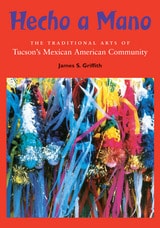
Hecho a Mano
The Traditional Arts of Tucson's Mexican American CommunityJames S. Griffith; Foreword by Patricia Preciado Martin
University of Arizona Press, 2000
Arts as intimate as a piece of needlework or a home altar. Arts as visible as decorative iron, murals, and low riders. Through such arts, members of Tucson's Mexican American community contribute much of the cultural flavor that defines the city to its residents and to the outside world. Now Tucson folklorist Jim Griffith celebrates these public and private artistic expressions and invites us to meet the people who create them.
- Josefina Lizárraga learned to make paper flowers as a girl in her native state of Nayarit, Mexico, and ensures that this delicate art is not lost.
- Ornamental blacksmith William Flores runs the oldest blacksmithing business in town, a living link with an earlier Tucson.
- Ramona Franco's family has maintained an elaborate altar to Our Lady of Guadalupe for three generations.
- Signmaker Paul Lira, responsible for many of Tucson's most interesting signs, brings to his work a thoroughly mexicano sense of aesthetics and humor.
- Muralists David Tineo and Luis Mena proclaim Mexican cultural identity in their work and carry on a tradition that has blossomed in the last twenty years.
Featuring a foreword by Tucson author Patricia Preciado Martin and a spectacular gallery of photographs, many by Pulitzer prize-winning photographer José Galvez, this remarkable book offers a close-up view of a community rich with tradition and diverse artistic expression. Hecho a Mano is a piñata bursting with unexpected treasures that will inspire and inform anyone with an interest in folk art or Mexican American culture.

Hell Or High Water
James White's Disputed Passage through Grand Canyon, 1867Eilean Adams
Utah State University Press, 2001
Although John Wesley Powell and party are usually given credit for the first river descent through the Grand Canyon, the ghost of James White has haunted those claims. White was a Colorado prospector, who, almost two years before Powell's journey, washed up on a makeshift raft at Callville, Nevada. His claim to have entered the Colorado above the San Juan River with another man (soon drowned) as they fled from Indians was widely disseminated and believed for a time, but Powell and his successors on the river publically discounted it. Colorado River runners and historians have since debated whether White's passage through Grand Canyon even could have happened.
Hell or High Water is the first full account of White's story and how it became distorted and he disparaged over time. It is also a fascinating detective story, recounting how White's granddaughter, Eilean Adams, over decades and with the assistance of a couple of notable Colorado River historians who believed he could have done what he claimed, gradually uncovered the record of James White's adventure and put together a plausible narrative of how and why he ended up floating helplessly down a turbulent river, entrenched in massive cliffs, with nothing but a driftwood raft to carry him through.
Hispanic Arizona, 1536–1856
James E. Officer
University of Arizona Press, 1987
The heart of the work centers on the early nineteenth century. It explores subjects such as the constant threat posed by hostile Apaches, government intrigue and revolution in Sonora and the provincias internas, and patterns of land ownership in villages such as Tucson and Tubac. Also covered are the origins of land grants in present-day southern Arizona and the invasion of southern Arizona by American “49ers” as seen from the Mexican point of view. Officer traces kinship ties of several elite families who ruled the frontier province over many generations—men and women whose descendants remain influential in Sonora and Arizona today.
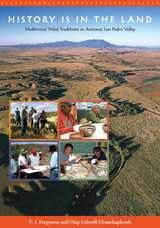
History Is in the Land
Multivocal Tribal Traditions in Arizona's San Pedro ValleyT. J. Ferguson and Chip Colwell-Chanthaphonh
University of Arizona Press, 2006
Previous research in the San Pedro Valley has focused on scientific archaeology and documentary history, with a conspicuous absence of indigenous voices, yet Native Americans maintain oral traditions that provide an anthropological context for interpreting the history and archaeology of the valley. The San Pedro Ethnohistory Project was designed to redress this situation by visiting archaeological sites, studying museum collections, and interviewing tribal members to collect traditional histories. The information it gathered is arrayed in this book along with archaeological and documentary data to interpret the histories of Native American occupation of the San Pedro Valley.
This work provides an example of the kind of interdisciplinary and politically conscious work made possible when Native Americans and archaeologists collaborate to study the past. As a methodological case study, it clearly articulates how scholars can work with Native American stakeholders to move beyond confrontations over who “owns” the past, yielding a more nuanced, multilayered, and relevant archaeology.
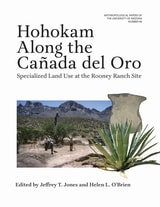
Hohokam Along the Cañada del Oro
Specialized Land Use at the Rooney Ranch SiteEdited by Jeffrey T. Jones and Helen L. O’Brien
University of Arizona Press, 2026
This work presents the results of more than a decade of archaeological fieldwork at the Rooney Ranch site in Oro Valley, Arizona—an upland Hohokam village that played a key role in regional agave production. Edited by Jeffrey T. Jones and Helen L. O’Brien, this volume synthesizes extensive data collected by the Pima Community College Centre for Archaeological Field Training, offering a rare and richly detailed look at how small peripheral settlements contributed to the sustainability of larger Hohokam communities in the Sonoran Desert. Through GIS-based mapping and the analysis of ceramics, lithics, and faunal and botanical remains, the book reveals how specialized land use shaped the economic and social fabric of the region for centuries.
This legacy project stands out not only for its depth but also for its educational significance. As one of the few long-term, community-college-led excavations in the Southwest, the Rooney Ranch project highlights the vital role of student training and local collaboration in archaeological research. With more than seventy data-rich tables and contributions from leading specialists, this volume is an essential resource for archaeologists, historians, and anyone interested in Indigenous land use, desert adaptation, and the enduring legacy of the Hohokam in southern Arizona.
Contributors
Jon Boyd
Chance Copperstone
Michael W. Diehl
Linda M. Gregonis
Lea Mason-Kohlmeyer
Christine H. Virden-Lange
Homol'ovi II
Archaeology of an Ancestral Hopi Village, ArizonaEdited by E. Charles Adams and Kelley Ann Hays
University of Arizona Press, 1991
Homol'ovi
An Ancient Hopi Settlement ClusterE. Charles Adams
University of Arizona Press, 2002
Charles Adams has directed fifteen years of research at these sites for the Arizona State Museum, including excavations in five of the seven primary Homol'ovi villages and in other villages predating them. Through this research he concludes that the founders of these settlements were Hopis who sought to protect their territory from migrating groups elsewhere in the Pueblo world. This book summarizes that research and broadens our understanding of the relationship of Homol'ovi to ancient and modern Hopi people.
Each Homol'ovi village had a unique history of establishment, growth, sociopolitical organization, length of occupation, and abandonment; and although the villages shared much in the way of material culture, their size and configuration were tremendously varied. By comparing Homol'ovi research to information from projects on other settlements in the area, Adams has been able to reconstruct a provocative history of the Homol'ovi cluster that includes relationships among the individual villages and their relationships to nearby clusters. He shows that social organization within villages is apparent by the number and variety of ritual structures, while political organization among villages is indicated by the need for cooperation to share water for irrigation and by the exchange of such materials as pottery, obsidian, and ground stone.
Adams advances several important theories about why Homol'ovi was founded where and when it was, who its founders were, and the importance of cotton in making Homol'ovi an important center of trade in the 1300s. He also considers why Pueblo settlements suddenly became so large, addressing theoretical issues pertaining to multiple settlements and the rise of enormous villages containing more than 1,000 rooms.
Homol'ovi is a rich work of synthesis and interpretation that will be important for anyone with an interest in Southwest archaeology, Arizona history, or Hopi culture. By considering the settlement trajectory of an entire cluster of sites, it will also prove valuable to archaeologists worldwide.
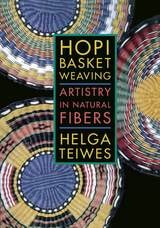
Hopi Basket Weaving
Artistry in Natural FibersHelga Teiwes
University of Arizona Press, 1996
Rising dramatically from the desert floor, Arizona's windswept mesas have been home to the Hopis for hundreds of years. A people known for protecting their privacy, these Native Americans also have a long and less known tradition of weaving baskets and plaques. Generations of Hopi weavers have passed down knowledge of techniques and materials from the plant world around them, from mother to daughter, granddaughter, or niece.
This book is filled with photographs and detailed descriptions of their beautiful baskets—the one art, above all others, that creates the strongest social bonds in Hopi life. In these pages, weavers open their lives to the outside world as a means of sharing an art form especially demanding of time and talent. The reader learns how plant materials are gathered in canyons and creek bottoms, close to home and far away. The long, painstaking process of preparation and dying is followed step by step. Then, using techniques of coiled, plaited, or wicker basketry, the weaving begins.
Underlying the stories of baskets and their weavers is a rare glimpse of what is called "the Hopi Way," a life philosophy that has strengthened and sustained the Hopi people through centuries of change. Many other glimpses of the Hopi world are also shared by author and photographer Helga Teiwes, who was warmly invited into the homes of her collaborators. Their permission and the permission of the Cultural Preservation Office of the Hopi Tribe gave her access to people and information seldom available to outsiders.
Teiwes was also granted access to some of the ceremonial observances where baskets are preeminent. Woven in brilliant reds, greens, and yellows as well as black and white, Hopi weavings, then, not only are an arresting art form but also are highly symbolic of what is most important in Hopi life. In the women's basket dance, for example, woven plaques commemorate and honor the Earth and the perpetuation of life. Other plaques play a role in the complicated web of Hopi social obligation and reciprocity.
Living in a landscape of almost surreal form and color, Hopi weavers are carrying on one of the oldest arts traditions in the world. Their stories in Hopi Basket Weaving will appeal to collectors, artists and craftspeople, and anyone with an interest in Native American studies, especially Native American arts. For the traveler or general reader, the book is an invitation to enter a little-known world and to learn more about an art form steeped in meaning and stunning in its beauty.
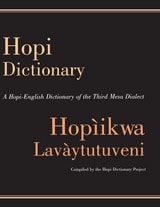
Hopi Dictionary/Hopìikwa Lavàytutuveni
A Hopi-English Dictionary of the Third Mesa DialectHopi Dictionary Project Hopi Dictionary Project
University of Arizona Press, 1998
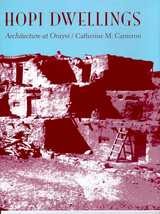
Hopi Dwellings
Architectural Change at OrayviCatherine M. Cameron
University of Arizona Press, 1999
Her study is unique in its use of historic photographs to document and understand abandonment processes and apply that knowledge to prehistoric sites. Photos taken by tourists, missionaries, and early anthropologists during the late nineteenth century portray original structures, while later photos show how Orayvi buildings changed over a period of almost eighty years. Census data relating to house size and household configuration shed additional light on social change in the pueblo.
Examining change at Orayvi afforded an opportunity to study the architectural effects of an event that must have happened many times in the past--the partial abandonment of a pueblo--by tracing the effects of sudden population decline on puebloan architecture. Cameron's work provides clues to how and why villages were abandoned and re-established repeatedly in the prehistoric Southwest as it offers a unique window on the relationship between Pueblo houses and the living people who occupied them.