Results by title
808 books match the query 'Civilization' and 29 start with h
Happy Days and Wonder Years
The Fifties and the Sixties in Contemporary Cultural PoliticsMarcus, Daniel
Rutgers University Press, 2004
From Ronald Reagan's image as a Fifties Cold Warrior to Bill Clinton's fandom for Elvis Presley and John F. Kennedy, politicians have invoked the Fifties and the Sixties to connect to their public. Marcus shows how films, television, music, and memoirs have responded to the political nostalgia of today, and why our entertainment remains immersed in reruns, revivals, and references to earlier times. This book offers a new understanding of how politics and popular culture have influenced our notions of the past, and how events from long ago continue to shape our understanding of the present day.
Happy Days
Images of the Pre-Sixties Past in Seventies AmericaBenjamin L. Alpers
Rutgers University Press, 2024
Happy Days investigates how 1970s popular culture was obsessed with America’s past but often offered radically different interpretations of the same historical events and icons. Even the figure of the greaser, once an icon of juvenile delinquency, was made family-friendly by Henry Winkler’s Fonzie at the same time that he was being appropriated in more threatening ways by punk and gay subcultures. The cultural historian Benjamin Alpers discovers similar levels of ambivalence toward the past in 1970s neo-noir films, representations of America’s founding, and neo-slave narratives by Alex Haley and Octavia Butler. By exploring how Americans used the 1970s to construct divergent representations of their shared history, he identifies it as a pivotal moment in the nation’s ideological fracturing.

Hard Luck and Heavy Rain
The Ecology of Stories in Southeast TexasJoseph C. Russo
Duke University Press, 2023
Havana beyond the Ruins
Cultural Mappings after 1989Anke Birkenmaier and Esther Whitfield, eds.
Duke University Press, 2011
Contributors
Emma Álvarez-Tabío Albo
Eric Felipe-Barkin
Anke Birkenmaier
Velia Cecilia Bobes
Mario Coyula-Cowley
Elisabeth Enenbach
Sujatha Fernandes
Jill Hamberg
Patricio del Real
Cecelia Lawless
Jacqueline Loss
Orlando Luis Pardo Lazo
Antonio José Ponte
Nicolás Quintana
Jose Quiroga
Laura Redruello
Rafael Rojas
Joseph L. Scarpaci
Esther Whitfield
Hawaii’s Past in a World of Pacific Islands
James M. Bayman
University Press of Colorado, 2013
Hell of a Vision
Regionalism and the Modern American WestRobert L. Dorman
University of Arizona Press, 2012
The American West has taken on a rich and evocative array of regional identities since the late nineteenth century. Wilderness wonderland, Hispanic borderland, homesteader’s frontier, cattle kingdom, urban dynamo, Native American homeland. Hell of a Vision explores the evolution of these diverse identities during the twentieth century, revealing how Western regionalism has been defined by generations of people seeking to understand the West’s vast landscapes and varied cultures.
Focusing on the American West from the 1890s up to the present, Dorman provides us with a wide-ranging view of the impact of regionalist ideas in pop culture and diverse fields such as geography, land-use planning, anthropology, journalism, and environmental policy-making.
Going well beyond the realm of literature, Dorman broadens the discussion by examining a unique mix of texts. He looks at major novelists such as Cather, Steinbeck, and Stegner, as well as leading Native American writers. But he also analyzes a variety of nonliterary sources in his book, such as government reports, planning documents, and environmental impact studies.
Hell of a Vision is a compelling journey through the modern history of the American West—a key region in the nation of regions known as the United States.
Hemispheric American Studies
Levander, Caroline F
Rutgers University Press, 2007
With essays that examine stamps, cartoons, novels, film, art, music, travel documents, and governmental publications, Hemispheric American Studies seeks to excavate the complex cultural history of texts and discourses across the ever-changing and stratified geopolitical and cultural fields that collectively comprise the American hemisphere. This collection promises to chart new directions in American literary and cultural studies.

Her Husband
Luigi Pirandello
Duke University Press, 2000
Evoking in vivid detail the literary world in Rome at the turn of the century, Her Husband tells the story of Silvia Roncella, a talented young female writer, and her husband Giustino Boggiolo. The novel opens with their arrival in Rome after having left their provincial southern Italian hometown following the success of Silvia’s first novel, the rather humorously titled House of Dwarves. As his wife’s self-appointed (and self-important) promoter, protector, counselor, and manager, Giustino becomes the primary target of Pirandello’s satire. But the couple’s relationship—and their dual career—is also complicated by a lively supporting cast of characters, including literary bohemians with avant-garde pretensions and would-be aristocratic esthetes who are all too aware of the newly acquired power of journalists and the publishing establishment to make or break their careers. Having based many of the characters—including Silvia and Giustino—on actual literary acquaintances of his, Pirandello reacted to the novel’s controversial reception by not allowing it to be reprinted after the first printing sold out. Not until after his death were copies again made available in Italy.
Readers will find Her Husband eerily evocative of the present in myriad ways—not the least of which is contemporary society’s ongoing transformation wrought by the changing roles of men and women, wives and husbands.
Heresy in the University
The Black Athena Controversy and the Responsibilities of American IntellectualsJacques Berlinerblau
Rutgers University Press, 1999
Heretical Hellenism
Women Writers, Ancient Greece, and the Victorian Popular ImaginationShanyn Fiske
Ohio University Press, 2008
The prevailing assumption regarding the Victorians’ relationship to ancient Greece is that Greek knowledge constituted an exclusive discourse within elite male domains. Heretical Hellenism: Women Writers, Ancient Greece, and the Victorian Popular Imagination challenges that theory and argues that while the information women received from popular sources was fragmentary and often fostered intellectual insecurities, it was precisely the ineffability of the Greek world refracted through popular sources and reconceived through new fields of study that appealed to women writers’ imaginations.
Examining underconsidered sources such as theater history and popular journals, Shanyn Fiske uncovers the many ways that women acquired knowledge of Greek literature, history, and philosophy without formal classical training. Through discussions of women writers such as Charlotte Brontë, George Eliot, and Jane Harrison, Heretical Hellenism demonstrates that women established the foundations of a heretical challenge to traditional humanist assumptions about the uniformity of classical knowledge and about women’s place in literary history.
Heretical Hellenism provides a historical rationale for a more expansive definition of classical knowledge and offers an interdisciplinary method for understanding the place of classics both in the nineteenth century and in our own time.
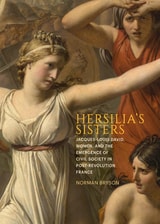
Hersilia's Sisters
Jacques-Louis David, Women, and the Emergence of Civil Society in Post-Revolution FranceNorman Bryson
J. Paul Getty Trust, The, 0
In 1799, when the French artist Jacques-Louis David (1748–1825) exhibited his Intervention of the Sabines, a history painting featuring the ancient heroine Hersilia, he added portraits of two contemporary women on either side of her—Henriette de Verninac, daughter of Charles-François Delacroix, minister of foreign affairs, and Juliette Récamier, a well-known and admired socialite. Drawing on many disciplines, Norman Bryson explains how such a combination of paintings could reveal the underlying nature of the Directoire, the period between the vicious and near-dictatorial Reign of Terror (1793–94) and the coup in 1799 that brought Napoleon to power.
Hersilia’s Sisters illuminates ways that cultural life and civil society were rebuilt during these years through an extraordinary efflorescence of women pioneers in every cultural domain—literature, the stage, opera, moral philosophy, political theory, painting, popular journalism, and fashion. Through a close examination of David’s work between The Intervention of the Sabines (begun in 1796) and Bonaparte Crossing the Alps (begun in 1800), Bryson explores how the flowering of women’s culture under the Directoire became a decisive influence on David’s art. With more than 150 illustrations, this book provides new and brilliant insight into this period that will captivate readers.

Hidden Histories
Palestine and the Eastern MediterraneanBasem L. Ra'ad
Pluto Press, 2010
For thousands of years, the region of Palestine and the East Mediterranean has been denied an indigenous voice for an inclusive history. Three religions ascribe their origins to this part of the world, appropriating and re-appropriating the "Holy Land" time and again.
Hidden Histories offers a powerful corrective to common understandings. It emphasizes Palestine's long history and dispels many old and new myths – covering issues of religious origins and sacred sites, identity and self-colonization, and the retrieval of ancient heritage.

High Mountains Rising
Appalachia in Time and PlaceEdited by Richard A. Straw and H. Tyler Blethen
University of Illinois Press, 2004
The first half of the fourteen essays deal with historical issues including Native Americans, pioneer settlement, slavery, the Civil War and Reconstruction, industrialization, the Great Depression, migration, and finally, modernization. The remaining essays take a more cultural focus, addressing stereotypes, music, folklife, language, literature, and religion.
Bringing together many of the most prestigious scholars in Appalachian studies, this volume has been designed for general and classroom use, and includes suggestions for further reading.
Hipbillies
Deep Revolution in the Arkansas OzarksJared M. Phillips
University of Arkansas Press, 2019
Historical Distance and the Holocaust
Interactions Between Historians and Middle-Class Western Europeans in Memory EducationThomas Van de Putte
Central European University Press, 2026
A detailed interactional analysis and thick ethnographic description demonstrate how the temporal, moral and emotional distancing practices reenforce the lay moralities and political subjectivities of the white middle-class. This comes with (mostly unintended) consequences. Distanced approaches to the Holocaust in non-academic environments reduce empathy for victims and survivors, normalize violence, disconnect the meaning of the Holocaust from contemporary conflict, and re-activate stereotypes about groups who employ more ‘close’ approaches to the Holocaust.
Historicizing the Enlightenment, Volume 1
Politics, Religion, Economy, and Society in BritainMichael McKeon
Bucknell University Press, 2023
Published by Bucknell University Press. Distributed worldwide by Rutgers University Press.
Historicizing the Enlightenment, Volume 2
Literature, the Arts, and the Aesthetic in BritainMichael McKeon
Bucknell University Press, 2023
Published by Bucknell University Press. Distributed worldwide by Rutgers University Press.
History of Western Civilization
A HandbookWilliam H. McNeill
University of Chicago Press, 1986
With this book, renowned historian William H. McNeil provides a brilliant narrative chronology of the development of Western civilization, representing its sociopolitical as well as cultural aspects. Sweeping in its coverage but careful in its attention to detail, and up to date with the latest scholarship History of Western Civlization is the perfect introduction to the subject for general readers and students alike.
History of the Persian Empire
A. T. Olmstead
University of Chicago Press, 1948
"The fullest and most reliable presentation of the history of the Persian Empire in existence."—M. Rostovtzeff
History's Shadow
Native Americans and Historical Consciousness in the Nineteenth CenturySteven Conn
University of Chicago Press, 2004
History's Shadow traces the struggle of Americans trying to understand the people who originally occupied the continent claimed as their own. Steven Conn considers how the question of the Indian compelled Americans to abandon older explanatory frameworks for sovereignty like the Bible and classical literature and instead develop new ones. Through their engagement with Native American language and culture, American intellectuals helped shape and define the emerging fields of archaeology, ethnology, linguistics, and art. But more important, the questions posed by the presence of the Indian in the United States forced Americans to confront the meaning of history itself, both that of Native Americans and their own: how it should be studied, what drove its processes, and where it might ultimately lead. The encounter with Native Americans, Conn argues, helped give rise to a distinctly American historical consciousness.
A work of enormous scope and intellect, History's Shadow will speak to anyone interested in Native Americans and their profound influence on our cultural imagination.
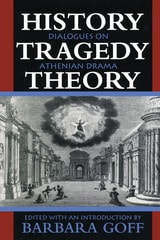
History, Tragedy, Theory
Dialogues on Athenian DramaEdited and with an introduction by Barbara Goff
University of Texas Press, 1995
Greek tragedy has held sway over the imagination of audiences for well over two millennia. This collection of essays on Athenian drama, the proceedings of a conference held at the University of Texas at Austin in 1992, demonstrates that Greek tragedy still retains its power to provoke debate and to engage the interest of specialists and non-classicists alike.
The book includes essays by seven of the foremost scholars of Greek drama—Helene Foley, Michelle Gellrich, Peter W. Rose, David Rosenbloom, Richard Seaford, Bernd Seidensticker, and Froma I. Zeitlin. These writers explore the work of all three great tragedians, Aeschylus, Sophocles, and Euripides, and approach them from a variety of perspectives on history and theory, including poststructuralism and Marxism. They investigate the possibilities for coordinating theoretically informed readings of tragedy with a renewed attention to the pressure of material history within those texts. The collection thus represents a response within classics to "New Historicism" and the debates it has generated within related literary disciplines.

Homeless and at Home in America
Evidence for the Dignity of the Human Soul in Our Time and PlacePeter Augustine Lawler
St. Augustine's Press, 2007
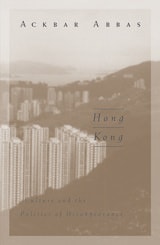
Hong Kong
Culture and the Politics of DisappearanceAckbar Abbas
University of Minnesota Press, 1997
A consideration of what the culture of Hong Kong tells us about the state of the world at the fin-de-siècle.
On June 30, 1997, Hong Kong as we know it will disappear, ceasing its singular and ambiguous existence as a colonial holdover and becoming part of the People’s Republic of China. In an intriguing and provocative exploration of its cinema, architecture, photography, and literature, Ackbar Abbas considers what Hong Kong, with its unique relations to decolonization and disappearance, can teach us about the future of both the colonial city and the global city.
The culture of Hong Kong encompasses Jackie Chan and John Woo, British colonial architecture and postmodern skyscrapers. Ironically, it was not until they were faced with the imposition of Mainland power—with the signing of the Sino-British Joint Agreement in 1984—that the denizens of the colony began the search for a Hong Kong identity. According to Abbas, Hong Kong’s peculiar lack of identity is due to its status as “not so much a place as a space of transit,” whose residents think of themselves as transients and migrants on their way from China to somewhere else. Abbas explores the way Hong Kong’s media saturation changes its people’s experience of space so that it becomes abstract, dominated by signs and images that dispel memory, history, and presence.Hong Kong disappears through simple dualities such as East/West and tradition/modernity. What is missing from a view of Hong Kong as merely a colony is the paradox that Hong Kong has benefited from and made a virtue of its dependent colonial status, turning itself into a global and financial city and outstripping its colonizer in terms of wealth.Combining sophisticated theory and a critical perspective, this rich and thought-provoking work captures the complex situation of the metropolis that is contemporary Hong Kong. Along the way, it challenges, entertains, and makes an important contribution to our thinking about the surprising processes and consequences of colonialism.Copublished with Hong Kong University Press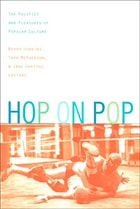
Hop on Pop
The Politics and Pleasures of Popular CultureHenry Jenkins, Tara McPherson and Jane Shattuc, eds.
Duke University Press, 2003
The essays cover a wide and colorful array of subjects including pro wrestling, the computer games Myst and Doom, soap operas, baseball card collecting, the Tour de France, karaoke, lesbian desire in the Wizard of Oz, Internet fandom for the series Babylon 5, and the stress-management industry. Broader themes examined include the origins of popular culture, the aesthetics and politics of performance, and the social and cultural processes by which objects and practices are deemed tasteful or tasteless. The commitment that binds the contributors is to an emergent perspective in cultural studies, one that engages with popular culture as the culture that "sticks to the skin," that becomes so much a part of us that it becomes increasingly difficult to examine it from a distance. By refusing to deny or rationalize their own often contradictory identifications with popular culture, the contributors ensure that the volume as a whole reflects the immediacy and vibrancy of its objects of study.
Hop on Pop will appeal to those engaged in the study of popular culture, American studies, cultural studies, cinema and visual studies, as well as to the general educated reader.
Contributors. John Bloom, Gerry Bloustein, Aniko Bodroghkozy, Diane Brooks, Peter Chvany, Elana Crane, Alexander Doty, Rob Drew, Stephen Duncombe, Nick Evans, Eric Freedman, Joy Fuqua, Tony Grajeda, Katherine Green, John Hartley, Heather Hendershot, Henry Jenkins, Eithne Johnson, Louis Kaplan, Maria Koundoura, Sharon Mazer, Anna McCarthy, Tara McPherson, Angela Ndalianis, Edward O’Neill, Catherine Palmer, Roberta Pearson, Elayne Rapping, Eric Schaefer, Jane Shattuc, Greg Smith, Ellen Strain, Matthew Tinkhom, William Uricchio, Amy Villarego, Robyn Warhol, Charles Weigl, Alan Wexelblat, Pamela Robertson Wojcik, Nabeel Zuberi
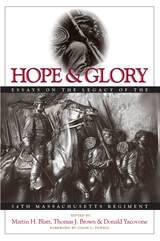
Hope and Glory
Essays on the Legacy of the 54th Massachusetts RegimentMartin H. Blatt
University of Massachusetts Press, 2009
The monument by Augustus Saint-Gaudens to Robert Gould Shaw and the 54th Massachusetts Regiment, located on Boston Common, stands at a symbolic crossroads of American history. A reminder of the nation's ongoing struggle over race, it captures the Civil War's higher purpose—the end of slavery—and memorializes those black soldiers and white officers who made common cause in the service of freedom. The monument and the saga of the 54 th Massachusetts remain powerful touchstones, inspiring enduring meditations such as Robert Lowell's poem “For the Union Dead” and the popular film Glory.
This volume brings together the best scholarship on the history of the 54th, the formation of collective memory and identity, and the ways Americans have responded to the story of the regiment and the Saint-Gaudens monument. Contributors use the historical record and popular remembrance of the 54th as a lens for examining race and community in the United States. The essays range in time from the mid-nineteenth century to the present and encompass history, literature, art, music, and popular culture.
In addition to the editors and Colin Powell, who writes about the memory and example of the 54th in his own career, contributors include Stephen Belyea, David W. Blight, Thomas Cripps, Kathryn Greenthal, James Oliver Horton, Edwin S. Redkey, Marilyn Richardson, Kirk Savage, James Smethurst, Cathy Stanton, Helen Vendler, Denise Von Glahn, and Joan Waugh.
How “Indians” Think
Colonial Indigenous Intellectuals and the Question of Critical Race TheoryGonzalo Lamana
University of Arizona Press, 2019
Hybrid Cultures
Strategies for Entering and Leaving ModernityNestor Garcia Canclini
University of Minnesota Press, 1995
Hybrid Cultures
Strategies for Entering and Leaving ModernityNestor Garcia Canclini
University of Minnesota Press, 2005
Hybrid Renaissance
Culture, Language, ArchitecturePeter Burke
Central European University Press, 2016
Hybrid Renaissance introduces the idea that the Renaissance in Italy, elsewhere in Europe, and in the world beyond Europe is an example of cultural hybridization.
The two key concepts used in this book are “hybridization” and “Renaissance”. Roughly speaking, hybridity refers to something new that emerges from the combination of diverse older elements. (The term “hybridization” is preferable to “hybridity” because it refers to a process rather than to a state, and also because it encourages the writer and the readers alike to think in terms of degree: where there is more or less, rather than presence versus absence.)
The book begins with a discussion of the concept of cultural hybridization and a cluster of other concepts related to it. Then comes a geography of cultural hybridization focusing on three locales: courts, major cities (whether ports or capitals) and frontiers. The following seven chapters describe the hybridity of the Renaissance in different fields: architecture, painting and sculpture, languages, literature, music, philosophy and law and finally religion. The essay concludes with a brief account of attempts to resist hybridization or to purify cultures or domains from what was already hybridized.