Results by title
434 books match the query 'Criticism & Theory' and 12 start with h
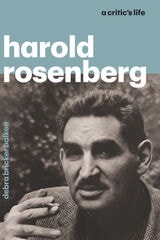
Harold Rosenberg
A Critic‘s LifeDebra Bricker Balken
University of Chicago Press, 2021
With Harold Rosenberg: A Critic’s Life, Debra Bricker Balken offers the first-ever complete biography of this great and eccentric man. Although he is now known mainly for his role as an art critic at the New Yorker from 1962 to 1978, Balken weaves together a complete tapestry of Rosenberg’s life and literary production, cast against the dynamic intellectual and social ferment of his time. She explores his role in some of the most contentious cultural debates of the Cold War period, including those over the commodification of art and the erosion of individuality in favor of celebrity, demonstrated in his famous essay “The Herd of Independent Minds.” An outspoken socialist and advocate for the political agency of art, he formed deep alliances with figures such as Hannah Arendt, Saul Bellow, Paul Goodman, Mary McCarthy, Jean-Paul Sartre, Willem de Kooning, and Jackson Pollock, all of whom Balken portrays with vivid accounts from Rosenberg’s life.
Thoroughly researched and captivatingly written, this book tells in full Rosenberg’s brilliant, fiercely independent life and the five decades in which he played a leading role in US cultural, intellectual, and political history.
Have I Reasons
Work and Writings, 1993–2007Robert Morris
Duke University Press, 2008
The writings are arranged chronologically, beginning with “Indiana Street,” a vivid autobiographical account of the artist’s early years in Kansas City, Missouri. Have I Reasons includes reflections on Morris’s own site-specific installations; transcripts of seminars he conducted in conjunction with exhibitions; and the textual element of The Birthday Boy, the two-screen video-and-sound piece he installed at the Galleria dell’Accademia in Florence, Italy, on the occasion of the five hundredth anniversary of Michelangelo’s David. Essays range from original interpretations of Cézanne’s Mont Sainte-Victoire paintings and Jasper Johns’ early work to engagements with one of Morris’s most significant interlocutors, the philosopher Donald Davidson. Have I Reasons conveys not only Morris’s enduring deep interest in philosophy and issues of resemblance and representation but also his more recent turn toward directly addressing contemporary social and political issues such as corporate excess and preemptive belligerence.
Henry van de Velde
Selected Essays, 1889–1914Henry van de Velde
J. Paul Getty Trust, The, 2022
Belgian artist, architect, designer, and theorist Henry van de Velde (1863–1957) was a highly original and influential figure in Europe beginning in the 1890s. A founding member of the Art Nouveau and Jugendstil movements, he also directed the Grand-Ducal Saxon School of Arts and Crafts in Weimar, Germany, which eventually became the Bauhaus under Walter Gropius.
This selection of twenty-six essays, translated from French and German, includes van de Velde’s writings on William Morris and the English Arts and Crafts movement, Neo-Impressionist painting, and relationships between ornament, line, and abstraction in German aesthetics. The texts trace the evolution of van de Velde’s thoughts during his most productive period as a theorist in the artistic debates in France, Germany, Belgium, and the Netherlands. Katherine M. Kuenzli expertly guides readers to see how van de Velde’s writings reconcile themes of aesthetics and function, and expression and reason, throughout the artistic periods and regions represented by these texts. With introductory discussions of each essay and full annotations, this is an essential volume for a broad range of scholars and students of the history of fine and applied arts and ideas.
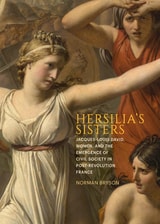
Hersilia's Sisters
Jacques-Louis David, Women, and the Emergence of Civil Society in Post-Revolution FranceNorman Bryson
J. Paul Getty Trust, The, 0
In 1799, when the French artist Jacques-Louis David (1748–1825) exhibited his Intervention of the Sabines, a history painting featuring the ancient heroine Hersilia, he added portraits of two contemporary women on either side of her—Henriette de Verninac, daughter of Charles-François Delacroix, minister of foreign affairs, and Juliette Récamier, a well-known and admired socialite. Drawing on many disciplines, Norman Bryson explains how such a combination of paintings could reveal the underlying nature of the Directoire, the period between the vicious and near-dictatorial Reign of Terror (1793–94) and the coup in 1799 that brought Napoleon to power.
Hersilia’s Sisters illuminates ways that cultural life and civil society were rebuilt during these years through an extraordinary efflorescence of women pioneers in every cultural domain—literature, the stage, opera, moral philosophy, political theory, painting, popular journalism, and fashion. Through a close examination of David’s work between The Intervention of the Sabines (begun in 1796) and Bonaparte Crossing the Alps (begun in 1800), Bryson explores how the flowering of women’s culture under the Directoire became a decisive influence on David’s art. With more than 150 illustrations, this book provides new and brilliant insight into this period that will captivate readers.
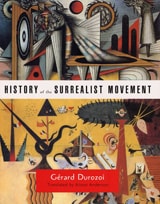
History of the Surrealist Movement
Gérard Durozoi
University of Chicago Press, 2002
From Dada to the Automatists, and from Max Ernst to André Breton, Gérard Durozoi here provides the most comprehensive history of the Surrealist movement. Tracing the movement from its origins in the 1920s to its decline in the 1950s and 1960s, Durozoi tells the history of Surrealism through its activities, publications, and reviews, demonstrating its close ties to some of the most explosive political, as well as creative, debates of the twentieth century.
Drawing on a staggering amount of documentary and visual evidence—including 1,000 photos—Durozoi illuminates all the intellectual and artistic facets of the movement, from literature and philosophy to painting, photography, and film, thus making History of the Surrealist Movement its definitive encyclopedia.
Hold It Against Me
Difficulty and Emotion in Contemporary ArtJennifer Doyle
Duke University Press, 2013
Doyle explores ideologies of emotion and how emotion circulates in and around art. Throughout, she gives readers welcoming points of entry into artworks that they may at first find off-putting or confrontational. Doyle offers new insight into how the discourse of controversy serves to shut down discussion about this side of contemporary art practice, and counters with a critical language that allows the reader to accept emotional intensity in order to learn from it.
Horn, or The Counterside of Media
Henning Schmidgen
Duke University Press, 2022
How Art Can Be Thought
A Handbook for ChangeAl-An deSouza
Duke University Press, 2018

How Color Became a Technology
The Making of Chromatic CapitalismLida Zeitlin-Wu
Duke University Press, 2027
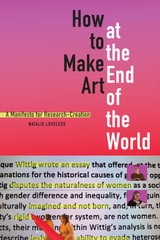
How to Make Art at the End of the World
A Manifesto for Research-CreationNatalie Loveless
Duke University Press, 2019
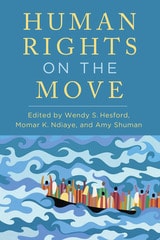
Human Rights on the Move
Edited by Wendy S. Hesford, Momar K. Ndiaye, and Amy Shuman
The Ohio State University Press, 2024
Contributing artists, activists, and scholars expose the fundamental paradox of human rights (namely that nation-states are violators and guarantors of rights) while also showing how people facing violence and persecution move with the hope of more livable and equitable futures. The assembled scholarly essays, interviews, and creative pieces demonstrate the importance of a more relational and contextual understanding of human rights—one that can destabilize current definitions and open space for new formulations.
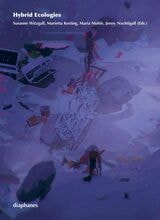
Hybrid Ecologies
Edited by Susanne Witzgall, Marietta Kesting, Maria Muhle, and Jenny Nachtigall
Diaphanes, 2021
The notion of ecology not only figures centrally in current debates around climate change, but also traverses contemporary discourses in the arts, the humanities, and the social and techno sciences. In this present form, ecology refers to the multilayered and multidimensional nexus of living processes and technological and media practices—that is, to the complex relations of human and nonhuman agents. Hybrid Ecologies understands ecology as an ambivalent notion, whose very broadness simultaneously opens up new fields of action and raises provocative questions, not least concerning its genealogy. This interdisciplinary volume explores the political and social effects of rethinking community in ecological terms, with a particular emphasis on what the contemporary notion of ecology might mean for artistic and design practices. The result of the fifth annual program of the cx centre for interdisciplinary studies, which was conceived in cooperation with the Chair of Philosophy | Aesthetic Theory at the Academy of Fine Arts in Munich, Hybrid Ecologies is a timely and thought-provoking study of one of the most important themes of our time.