425 books match the query 'Ethics' and 14 start with h

cover of Habits and Holiness: Ethics, Theology, and Biopsychology

Habits and Holiness

Ethics, Theology, and Biopsychology

Ezra, OP Sullivan

Catholic University of America Press, 2021
The topic of habitus is one of Thomas Aquinas’s greatest contributions to moral theology, but it has been generally neglected in theological scholarship until now. Habits and Holiness is the first work in English to explore Aquinas’s rich theology of habit in all of its grandeur and depth. Habits and Holiness shows that most facets of human life and behavior are greatly influenced by habits, which Thomas appraises as an analogous concept that is much broader than previous scholarship has recognized. Habits and Holiness accomplishes three tasks. First, it gives a complete and coherent account of Aquinas’s account of habitus. Most accounts of Aquinas’s view of habitus focus almost exclusively on “Treatise on Habits” in the Summa Theologiae I-II, qq. 49-54, and speak of habitus in reference to the virtues. However, Aquinas speaks of habitus in many other places, especially his commentaries on Aristotle’s works and his commentaries on Sacred Scripture. Aquinas employs the concept of habitus to explain a wide variety of human inclinations, such as instincts, personal and societal custom, acquired skills and virtues, original sin, grace, infused virtues, and Gifts of the Holy Spirit. Second, this book indicates how biological psychology illuminates and enriches Aquinas’s account of habit, and vice versa. Finally, Habits and Holiness provides readers with a framework for interpreting and utilizing the vast amount of practical habit literature that exists: it offers a practical analysis of habit development found in Aquinas’s works and those of empirical studies. The topic of habits is a golden thread that helps readers find their way through Aquinas’s extensive writings on morals. By describing the many kinds of habits we possess, and their widespread but often hidden effects in our lives, this book offers a new and unique reevaluation of many issues central to the moral life. It addresses childhood development, pagan virtue, akrasia, circumstances that limit free choice, how heroic virtue operates, and more. By seeing habits in general as a prism for understanding human action and its influences, Habits and Holiness provides a unique and appealing synthesis of Thomistic virtue theory, the contemporary science of habits, and best practices for eliminating bad habits and living good habits.
[more]
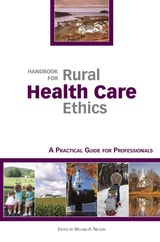
cover of Handbook for Rural Health Care Ethics: A Practical Guide for Professionals

Handbook for Rural Health Care Ethics

A Practical Guide for Professionals

Edited by William A. Nelson

Dartmouth College Press, 2010
The rural community presents not only distinct health care delivery challenges but also ethical problems for clinicians and administrators of small, rural health care facilities. Health care delivered in a rural context—in closely knit, tightly interdependent small community settings—poses unique ethical considerations for clinical practitioners. For example, a provider in a resource-poor rural setting may be faced with treating a family member, friend, business associate, or neighbor, since the role separation between clinician and patient that predominates in the urban setting is less likely to occur in a small town. Because of the unique rural context, the solutions that health care providers develop to resolve complex ethics dilemmas may differ from solutions reached in urban areas. The Handbook for Rural Health Care Ethics is designed to be a useful resource for clinicians and administrators in rural settings. It draws on the available research and real-life examples to paint a picture of challenging, yet all-too-familiar ethics conflicts while offering strategies for a proactive, preventive approach to ethical issues.
[more]
cover of Handbook of Medical Sociology, Sixth Edition

Handbook of Medical Sociology, Sixth Edition

Chloe E. Bird

Vanderbilt University Press, 2010

Composed entirely of specially commissioned chapters by many outstanding scholars in medical sociology, this edition reflects important changes in the study of health and illness. In addition to updated and reconceived chapters on the impacts of gender, race, and inequality on health, this volume has new chapters on topics that include:

• social networks, neighborhoods, and social capital
• disability
• dying and "the right to die"
• health disparities
• the growing influence of the pharmaceutical industry
• the Internet
• evidence-based medicine and quality of care
• health social movements
• genetics
• religion, spirituality, and health
[more]
cover of Healing Ableism: Stories About Disability and Religious Life

Healing Ableism

Stories About Disability and Religious Life

Darla Schumm

Rutgers University Press, 2026
Most people encounter disability at some point in their lives, either in their own bodies or through a friend or loved one. Faith leaders, sacred texts, and members of religious communities frequently offer religious teachings and metaphors as explanation for the presence of disability, but rarely do we hear the voices of people living with disabilities reflecting on their experiences of God, faith, or religious life. In Healing Ableism: Stories about Disability and Religious Life, Darla Schumm explores the extraordinary stories of people with disabilities who struggle with the ordinary human challenges of faith and doubt, exclusion and inclusion, and injustice and justice. Blending candid story-telling, cultural critique, and theory, Schumm invites readers to reflect on the experiences of people with disabilities in religious communities and organizations. Schumm argues that it’s not disability that needs healing, it’s ableism that needs healing. In the final chapter, Schumm offers accessible love as one avenue for healing ableism.
[more]
cover of Health Humanities Reader

Health Humanities Reader

Jones, Therese

Rutgers University Press, 2014

Over the past forty years, the health humanities, previously called the medical humanities, has emerged as one of the most exciting fields for interdisciplinary scholarship, advancing humanistic inquiry into bioethics, human rights, health care, and the uses of technology. It has also helped inspire medical practitioners to engage in deeper reflection about the human elements of their practice.

In Health Humanities Reader, editors Therese Jones, Delese Wear, and Lester D. Friedman have assembled fifty-four leading scholars, educators, artists, and clinicians to survey the rich body of work that has already emerged from the field—and to imagine fresh approaches to the health humanities in these original essays. The collection’s contributors reflect the extraordinary diversity of the field, including scholars from the disciplines of disability studies, history, literature, nursing, religion, narrative medicine, philosophy, bioethics, medicine, and the social sciences. 

With warmth and humor, critical acumen and ethical insight, Health Humanities Reader truly humanizes the field of medicine. Its accessible language and broad scope offers something for everyone from the experienced medical professional to a reader interested in health and illness.
[more]
cover of Healthcare and Human Dignity: Law Matters

Healthcare and Human Dignity

Law Matters

Frank M. McClellan

Rutgers University Press, 2020
The individual and structural biases that affect the American healthcare system have serious emotional and physical consequences that all too often go unseen. These biases are often rooted in power, class, racial, gender or sexual orientation prejudices, and as a result, the injured parties usually lack the resources needed to protect themselves. In Healthcare and Human Dignity, individual worth, equality, and autonomy emerge as the dominant values at stake in encounters with doctors, nurses, hospitals, and drug companies. Although the public is aware of legal battles over autonomy and dignity in the context of death, the everyday patient’s need for dignity has received scant attention.  Thus, in Healthcare, law professor Frank McClellan’s collection of cases and individual experiences bring these stories to life and establish beyond doubt that human dignity is of utmost priority in the everyday process of healthcare decision making.
[more]
cover of Higher Ground: Ethics and Leadership in the Modern University

Higher Ground

Ethics and Leadership in the Modern University

Nannerl O. Keohane

Duke University Press, 2006

Nannerl O. Keohane is one of the most widely respected leaders in higher education. A political theorist who served as President of Wellesley College and Duke University, she has firsthand knowledge of the challenges facing modern universities: rising costs, the temptations of “corporatization,” consumerist students, nomadic faculty members, and a bewildering wave of new technologies. Her views on these issues and on the role and future of higher education are captured in Higher Ground, a collection of speeches and essays that she wrote over a twenty-year period.

Keohane regards colleges and universities as intergenerational partnerships in learning and discovery, whose compelling purposes include not only teaching and research but also service to society. Their mission is to equip students with a moral education, not simply preparation for a career or professional school.

But the modern era has presented universities and their leadership with unprecedented new challenges. Keohane worries about access to education in a world of rising costs and increasing economic inequality, and about threats to academic freedom and expressions of opinion on campus. She considers diversity as a key educational tool in our increasingly pluralistic campuses, ponders the impact of information technologies on the university’s core mission, and explores the challenges facing universities as they become more “global” institutions, serving far-flung constituencies while at the same time contributing to the cities and towns that are their institutional homes.

Reflecting on the role of contemporary university leaders, Keohane asserts that while they have many problems to grapple with, they will find creative ways of dealing with them, just as their predecessors have done.
[more]
cover of Hip Hop Underground: The Integrity and Ethics of Racial Identification

Hip Hop Underground

The Integrity and Ethics of Racial Identification

Anthony Kwame Harrison

Temple University Press, 2009

Hip Hop Underground is a vivid ethnography of the author's observations and experiences in the multiracial world of the San Francisco underground hip hop scene. While Anthony Kwame Harrison interviewed area hip hop artists for this entertaining and informative book, he also performed as the emcee "Mad Squirrel." His immersion in the subculture provides him with unique insights into this dynamic and racially diverse but close-knit community.

Hip Hop Underground examines the changing nature of race among young Americans, and examines the issues of ethnic and racial identification, interaction, and understanding. Critiquing the notion that the Bay Area underground music scene is genuinely "colorblind," Harrison focuses on the issue of race to show how various ethnic groups engage hip hop in remarkably divergent ways—as a means to both claim subcultural legitimacy and establish their racial authenticity.
[more]
cover of Hope, Trust, and Forgiveness: Essays in Finitude

Hope, Trust, and Forgiveness

Essays in Finitude

John T. Lysaker

University of Chicago Press, 2023

A new ethics of human finitude developed through three experimental essays.
 
As ethical beings, we strive for lives that are meaningful and praiseworthy. But we are finite. We do not know, so we hope. We need, so we trust. We err, so we forgive. In this book, philosopher John T. Lysaker draws our attention to the ways in which these three capacities—hope, trust, and forgiveness—contend with human limits. Each experience is vital to human flourishing, yet each also poses significant personal and institutional challenges as well as opportunities for growth. Hope, Trust, and Forgiveness explores these challenges and opportunities and proposes ways to best meet them. In so doing, Lysaker experiments with the essay as a form and advances an improvisational perfectionism to deepen and expand our ethical horizons.
[more]
cover of How Is It Between Us?: Relational Ethics and Care for the World

How Is It Between Us?

Relational Ethics and Care for the World

Jarrett Zigon

HAU, 2024

A new theory of relational ethics that tackles contemporary issues.

In How Is It Between Us?, Jarrett Zigon puts anthropology and phenomenological hermeneutics in conversation to develop a new theory of relational ethics. This relational ethics takes place in the between, the interaction not just between people, but all existents. Importantly, this theory is utilized as a framework for considering some of today’s most pressing ethical concerns—for example, living in a condition of post-truth and worlds increasingly driven by algorithms and data extraction, various and competing calls for justice, and the ethical demands of the climate crisis. Written by one of the preeminent contributors to the anthropology of ethics, this is a ground-breaking book within that literature, developing a robust and systematic ethical theory to think through contemporary ethical problems.
[more]
cover of How Should We Live?: A Practical Approach to Everyday Morality

How Should We Live?

A Practical Approach to Everyday Morality

John Kekes

University of Chicago Press, 2014

What is your highest ideal? What code do you live by? We all know that these differ from person to person. Artists, scientists, social activists, farmers, executives, and athletes are guided by very different ideals. Nonetheless for hundreds of years philosophers have sought a single, overriding ideal that should guide everyone, always, everywhere, and after centuries of debate we’re no closer to an answer. In How Should We Live?, John Kekes offers a refreshing alternative, one in which we eschew absolute ideals and instead consider our lives as they really are, day by day, subject to countless vicissitudes and unforeseen obstacles.
           
Kekes argues that ideal theories are abstractions from the realities of everyday life and its problems. The well-known arenas where absolute ideals conflict—dramatic moral controversies about complex problems involved in abortion, euthanasia, plea bargaining, privacy, and other hotly debated topics—should not be the primary concerns of moral thinking. Instead, he focuses on the simpler problems of ordinary lives in ordinary circumstances. In each chapter he presents the conflicts that a real person—a schoolteacher, lawyer, father, or nurse, for example—is likely to face. He then uses their situations to shed light on the mundane issues we all must deal with in everyday life, such as how we use our limited time, energy, or money; how we balance short- and long-term satisfactions; how we deal with conflicting loyalties; how we control our emotions; how we deal with people we dislike; and so on. Along the way he engages some of our most important theorists, including Donald Davidson, Thomas Nagel, Christine Korsgaard, Harry Frankfurt, Charles Taylor, Alasdair MacIntyre, and Bernard Williams, ultimately showing that no ideal—whether autonomy, love, duty, happiness, or truthfulness—trumps any other. No single ideal can always guide how we overcome the many different problems that stand in the way of living as we should. Rather than rejecting such ideals, How Should We Live? offers a way of balancing them by a practical and pluralistic approach—rather than a theory—that helps us cope with our problems and come closer to what our lives should be. 
[more]
cover of Human Cloning: Science, Ethics, and Public Policy

Human Cloning

Science, Ethics, and Public Policy

Edited by Barbara MacKinnon

University of Illinois Press, 2000

Is human cloning a science fiction nightmare come true? Or is it a practical avenue toward beneficial new medical treatments and techniques?
 
In this concise volume, experts on all sides of the debate make arguments for why we should either pursue, regulate, or ban the cloning of human beings. From this collection, readers will gain a clearer picture of the history of cloning in agriculture and animal science, the various biological procedures that are encompassed by the term "cloning," the philosophical arguments in support of and opposed to cloning humans, and the considerations that should inform discussions about public policy matters related both the cloning research and to human cloning itself.
 
Balancing scientific detail with philosophical argument, Human Cloning succinctly outlines what cloning is and is not (e.g., cloning does not produce identical individuals), what has led to recent scientific developments, what is now possible, and what ethical dilemmas cloning presents. Opponents claim that cloning subverts human dignity, makes a mockery of spousal love, and poses serious safety hazards. Proponents cite a range of potential benefits, such as producing transplant tissue that is less likely to be rejected, extending current techniques of artificial insemination, and controlling genetic abnormalities to prevent birth defects.
 
Cloning itself is not new, but as the science of cloning continues to advance--and as human cloning thus inches closer to reality--we are compelled to consider its implications for society. Human Cloning is a lucid, substantive guide to this contentious and potentially revolutionary issue.
 
 
[more]
cover of Humanity's Ruins: Ethics, Feminism, and Genocidal Humanitarianism

Humanity's Ruins

Ethics, Feminism, and Genocidal Humanitarianism

Danielle Bouchard

Duke University Press, 2025
In Humanity’s Ruins, Danielle Bouchard examines how genocidal aspirations animate contemporary Western humanitarian projects and discourses. Drawing on anticolonial and antiracist feminist critique, Bouchard argues that humanitarianism has functioned in the Cold War and post-Cold War eras to perpetuate longer-lived, fundamentally racist conceptualizations of humanity’s defining characteristics. She examines the aesthetics of humanitarian texts, which are filled with figures of the wounded, dead, and disappeared—the atomic bomb victim whose only remainder is a shadow imprinted on concrete, the grievously injured Muslim woman, the vanished members of Amazonian “uncontacted” tribes, the dying African—to elucidate how the appearance of these figures reaffirms a genocidal view of humanity that aligns with the continuation of Western imperial warfare. Humanitarian discourses conceive of humanity as a community which, by definition, is under existential threat from some humans who are explicitly or implicitly understood as needing to be eliminated. Bouchard invokes “humanity’s ruins” to expose the genocidal fantasy of a human world in which such threat has been eliminated in the interest of supposedly ensuring humanity’s survival.
[more]
cover of Hypocrisy and Integrity: Machiavelli, Rousseau, and the Ethics of Politics

Hypocrisy and Integrity

Machiavelli, Rousseau, and the Ethics of Politics

Ruth W. Grant

University of Chicago Press, 1997

Questioning the usual judgements of political ethics, Ruth W. Grant argues that hypocrisy can actually be constructive while strictly principled behavior can be destructive. Hypocrisy and Integrity offers a new conceptual framework that clarifies the differences between idealism and fanaticism while it uncovers the moral limits of compromise.
[more]