Results by title
98 books match the query 'Existentialism' and 7 start with h
Heidegger and Plato
Toward DialogueCatalin Partenie and Tom Rockmore
Northwestern University Press, 2005
As editors Catalin Partenie and Tom Rockmore remark, a simple way to describe Heidegger's reading of Plato might be to say that what began as an attempt to appropriate Plato (and through him a large portion of Western philosophy) finally ended in an estrangement from both Plato and Western philosophy. The authors of this volume consider Heidegger's thought in relation to Plato before and after the "Kehre" or turn. In doing so, they take up various central issues in Heidegger's Being and Time (1927) and thereafter, and the questions of hermeneutics, truth, and language. The result is a subtle and multifaceted reinterpretation of Heidegger's position in the tradition of philosophy, and of Plato's role in determining that position.

Heidegger and the Myth of a Jewish World Conspiracy
Peter Trawny
University of Chicago Press, 2015
While Heidegger’s affiliation with National Socialism is well known, the anti-Semitic dimension of that engagement could not be fully told until now. Trawny traces Heidegger’s development of a grand “narrative” of the history of being, the “being-historical thinking” at the center of Heidegger’s work after Being and Time. Two of the protagonists of this narrative are well known to Heidegger’s readers: the Greeks and the Germans. The world-historical antagonist of this narrative, however, has remained hitherto undisclosed: the Jews, or, more specifically, “world Judaism.” As Trawny shows, world Judaism emerges as a racialized, destructive, and technological threat to the German homeland, indeed, to any homeland whatsoever. Trawny pinpoints recurrent, anti-Semitic themes in the Notebooks, including Heidegger’s adoption of crude cultural stereotypes, his assigning of racial reasons to philosophical decisions (even undermining his Jewish teacher, Edmund Husserl), his endorsement of a Jewish “world conspiracy,” and his first published remarks on the extermination camps and gas chambers (under the troubling aegis of a Jewish “self-annihilation”). Trawny concludes with a thoughtful meditation on how Heidegger’s achievements might still be valued despite these horrifying facets. Unflinching and systematic, this is one of the most important assessments of one of the most important philosophers in our history.
Heidegger's Confessions
The Remains of Saint Augustine in "Being and Time" and BeyondRyan Coyne
University of Chicago Press, 2015
Coyne first examines the role of Augustine in Heidegger’s early period and the development of his magnum opus, Being and Time. He then goes on to show that Heidegger owed an abiding debt to Augustine even following his own rise as a secular philosopher, tracing his early encounters with theological texts through to his late thoughts and writings. Bringing a fresh and unexpected perspective to bear on Heidegger’s profoundly influential critique of modern metaphysics, Coyne traces a larger lineage between religious and theological discourse and continental philosophy.

Heidegger's Political Thinking
James F. Ward
University of Massachusetts Press, 1995
In recent years there has been much controversy concerning Martin Heidegger’s politics, prompted by new research on the nature and extent of his engagement with National Socialism. Examining the political ideas embedded in Heidegger’s larger philosophical oeuvre, James F. Ward moves beyond the narrow preoccupation with Heidegger’s overtly pro-Nazi utterances and activities to show how the central theme of Heidegger’s philosophy—the question of Being—is itself inherently political.
Ward builds his case on close readings of texts drawn from nearly all of the writings published during Heidegger’s lifetime as well as from lectures, course transcripts, and other materials that appeared posthumously. With subtlety and insight, he uncovers the political content of Heidegger’s thinking on such topics as the temporality of Being, the role of science in the crisis of the West, and the presumed special status and destiny of the German people. In an epilogue, Ward reflects on the implications of Heidegger’s political thinking for postmodern political theory.
Heidegger, Strauss, and the Premises of Philosophy
On Original ForgettingRichard L. Velkley
University of Chicago Press, 2011
Heidegger
The Question of Being and HistoryJacques Derrida
University of Chicago Press, 2016
Derrida performs an almost surgical reading of the notoriously difficult text, marrying pedagogical clarity with patient rigor and acting as a lucid guide through the thickets of Heidegger’s prose. At this time in intellectual history, Heidegger was still somewhat unfamiliar to French readers, and Being and Time had only been partially translated into French. Here Derrida mostly uses his own translations, giving his own reading of Heidegger that directly challenges the French existential reception initiated earlier by Sartre. He focuses especially on Heidegger’s Destruktion (which Derrida would translate both into “solicitation” and “deconstruction”) of the history of ontology, and indeed of ontology as such, concentrating on passages that call for a rethinking of the place of history in the question of being, and developing a radical account of the place of metaphoricity in Heidegger’s thinking.
This is a rare window onto Derrida’s formative years, and in it we can already see the philosopher we’ve come to recognize—one characterized by a bravura of exegesis and an inventiveness of thought that are particularly and singularly his.
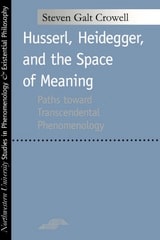
Husserl, Heidegger, and the Space of Meaning
Paths Toward Trancendental PhenomenologySteven Galt Crowell
Northwestern University Press, 2001
In a penetrating and lucid discussion of the enigmatic relationship between the work of Edmund Husserl and Martin Heidegger, Steven Galt Crowell proposes that the distinguishing feature of twentieth-century philosophy is not so much its emphasis on language as its concern with meaning. Arguing that transcendental phenomenology is indispensable to the philosophical explanation of the space of meaning, Crowell shows how a proper understanding of both Husserl and Heidegger reveals the distinctive contributions of each to that ongoing phenomenological project.