Results by title
267 books match the query 'Frontier and pioneer life' and 10 start with h

Hard Road West
History and Geology along the Gold Rush TrailKeith Heyer Meldahl
University of Chicago Press, 2007
“Alternates seamlessly between vivid accounts of the 19th-century journey and lucid explanations of the geological events that shaped the landscape traveled. . . . The reader comes away with both an appreciation for the arduous cross-continental wagon journey and an understanding of the events that created such a vast and difficult landscape.”—Library Journal
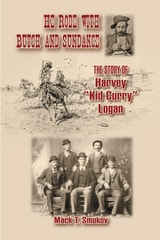
He Rode with Butch and Sundance
The Story of Harvey "Kid Curry" LoganMark T. Smokov
University of North Texas Press, 2012

Helen Halsey, or The Swamp State of Conelachita
A Tale of the BordersWilliam Gilmore Simms
University of Arkansas Press, 1998
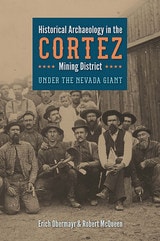
Historical Archaeology in the Cortez Mining District
Under the Nevada GiantErich Obermayr
University of Nevada Press, 2025
Readers interested in the archaeology of the West, mining history, and the history of Nevada will find this book fascinating.

History Of Louisa Barnes Pratt
The Autobiography of a Mormon Missionary Widow and PioneerGeorge S Ellsworth
Utah State University Press, 1998
Volume 3, Life Writings of Frontier Women series, ed. Maureen Ursenbach Beecher
In her memoir, and 1870s revision of her journal and diary, Louisa Barnes Pratt tells of childhood in Massachusetts and Canada during the War of 1812, and independent career as a teacher and seamstress in New England, and her marriage to the Boston seaman Addison Pratt.
Converting to the LDS Church, the Pratts moved to Nauvoo, Illinois, from where Brigham Young sent Addison on the first of the long missions to the Society Islands that would leave Louisa on her own. As a sole available parent, she hauled her children west to Winter Quarters, to Utah in 1848, to California, and, in Addison's wake, to Tahiti in 1850.
The Pratts joined the Mormon colony at San Bernardino, California. When in 1858 a federal army's march on Utah led to the colonists' recall, Addision—alienated from the Mormon Church after long absences—chose not to go. Mostly separated thereafter (Addison died in 1872), Louisa settled in Beaver, Utah, where she campaigned for women's rights, contributed to the Woman's Exponent, and depended on her own means, as she had much of her life, until her death in 1880.

Home Material
Ohio's Nineteenth-Century Regional Women's FictionSandra Parker
University of Wisconsin Press, 1998
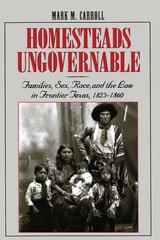
Homesteads Ungovernable
Families, Sex, Race, and the Law in Frontier Texas, 1823-1860By Mark M. Carroll
University of Texas Press, 2001
When he settled in Mexican Texas in 1832 and began courting Anna Raguet, Sam Houston had been separated from his Tennessee wife Eliza Allen for three years, while having already married and divorced his Cherokee wife Tiana and at least two other Indian "wives" during the interval. Houston's political enemies derided these marital irregularities, but in fact Houston's legal and extralegal marriages hardly set him apart from many other Texas men at a time when illicit and unstable unions were common in the yet-to-be-formed Lone Star State.
In this book, Mark Carroll draws on legal and social history to trace the evolution of sexual, family, and racial-caste relations in the most turbulent polity on the southern frontier during the antebellum period (1823-1860). He finds that the marriages of settlers in Texas were typically born of economic necessity and that, with few white women available, Anglo men frequently partnered with Native American, Tejano, and black women. While identifying a multicultural array of gender roles that combined with law and frontier disorder to destabilize the marriages of homesteaders, he also reveals how harsh living conditions, land policies, and property rules prompted settling spouses to cooperate for survival and mutual economic gain. Of equal importance, he reveals how evolving Texas law reinforced the substantial autonomy of Anglo women and provided them material rewards, even as it ensured that cross-racial sexual relationships and their reproductive consequences comported with slavery and a regime that dispossessed and subordinated free blacks, Native Americans, and Tejanos.

Honey in the Horn
H.L. Davis
Oregon State University Press, 2015
Clay Calvert, an orphan, works as a hand on a sheep ranch until he stumbles into trouble and is forced to flee. Journeying throughout the state, from the lush coastal forests, to the Columbia Gorge, to the golden wheat fields east of the Cascades, he encounters a cast of characters as rich and diverse as the land, including a native Tunne boy and a beautiful girl named Luce.
Originally published in 1935, Honey in the Horn reveals as much about the prevailing attitudes and beliefs of H. L. Davis’ lifetime as it does about the earlier era in which it is set. It transcends the limitations of its time through the sheer power and beauty of Davis’ prose. Full of humor and humanity, Davis’s first novel displays a vast knowledge of Pacific Northwest history, lore, and landscape.
An essential book for all serious readers of Northwest literature, this classic coming-of-age novel has been called the “Huckleberry Finn of the West.” It is the only Oregon book that has ever won a Pulitzer Prize for fiction. With a new introduction by Richard W. Etulain, this important work from one of Oregon’s premier authors is once again available for a new generation to enjoy.
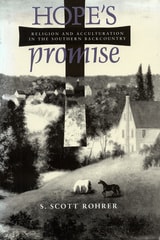
Hope's Promise
Religion and Acculturation in the Southern BackcountryS. Scott Rohrer
University of Alabama Press, 2013
In Hope's Promise, Scott Rohrer dissects the internal workings of the ecumenical Moravian movement at Wachovia—how this disparate group of pilgrims hailing from many countries (Germany, Ireland, Scandinavia, England) and different denominations (Lutheran, Reformed, Methodist, Anglican) yielded their ethnicities as they became, above all, a people of faith. By examining the "open" farm congregations of Hope, Friedberg, and Friedland, Rohrer offers a sensitive portrayal of their evangelical life and the momentous cultural changes it wrought: the organization of tight-knit congregations bound by "heart religion;" the theology of the new birth; the shape of religious discipline; the sacrament of communion; and the role of music. Drawing on courthouse documents and church records, Rohrer carefully demonstrates how various groups began to take on traits of the others. He also illustrates how evangelical values propelled interaction with the outside world—at the meetinghouse and the frontier store, for example—and fostered even more collective and accelerated change.
As the Moravians became ever more "American" and "southern," the polyglot of ethnicities that was Wachovia would, under the unifying banner of evangelicalism, meld into one of the most sophisticated religious communities in early America.
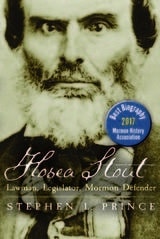
Hosea Stout
Lawman, Legislator, Mormon DefenderStephen L. Prince
Utah State University Press, 2016
Stout joined the Mormons in Missouri in 1838 and followed them to Nauvoo, where he rose quickly to become a top leader in the Nauvoo Legion and chief of police, a position he also held at Winter Quarters. He became the first attorney general for the Territory of Utah, was elected to the Utah Territorial Legislature, and served as regent for the University of Deseret (which later became the University of Utah) and as judge advocate of the Nauvoo Legion in Utah. In 1862, Stout was appointed US attorney for the Territory of Utah by President Abraham Lincoln. In 1867, he became city attorney of Salt Lake City and he was elected to the Utah House of Representatives in 1881.
But Stout’s history also had its troubled moments. Known as a violent man and aggressive enforcer, he was often at the center of controversy during his days on the police force and was accused of having a connection with deaths in Nauvoo and Utah. Ultimately, however, none of these allegations ever found traction, and the leaders of the LDS community, especially Brigham Young, saw to it that Stout was promoted to roles of increasing responsibility throughout his life. When he died in 1889, Hosea Stout left a complicated legacy of service to his state, his church, and the members of his faith community.