Results by title
66 books match the query 'Genealogy' and 3 start with h
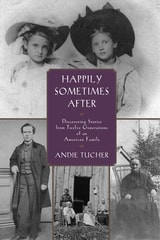
Happily Sometimes After
Discovering Stories from Twelve Generations of an American FamilyAndie Tucher
University of Massachusetts Press, 2014
A 2015 CHOICE Outstanding Academic Title
For more than four hundred years, members of the author's family have been telling stories about their American lives. They have told of impassioned elopements and heart-breaking kidnaps, of hairbreadth escapes and shocking murders, of bigamists, changelings, patriots, Indians, fires, floods, and how the great-grandmother of Chief Justice John Marshall married the pirate Blackbeard by mistake.
In this beautifully written work, Andie Tucher considers family stories as another way to look at history, neither from the top down nor the bottom up but from the inside out. She explores not just what happened—everywhere from Jamestown to Boonesborough, from the bloody field at Chickamauga to the metropolis of the Gilded Age—but also what the storytellers thought or wished or hoped or feared happened. She offers insights into what they valued, what they lost, how they judged their own lives and found meaning in them. The narrative touches on sorrow, recompense, love, pain, and the persistent tension between hope and disappointment in a nation that by making the pursuit of happiness thinkable also made unhappiness regrettable.
Based on extensive research in archives, local history societies, and family-history sources as well as conversations and correspondence, Happily Sometimes After offers an intimate and unusual perspective on how ordinary people used stories to imagine the world they wished for, and what those stories reveal about their relationships with the world they actually had.
Hispanic Arizona, 1536–1856
James E. Officer
University of Arizona Press, 1987
The heart of the work centers on the early nineteenth century. It explores subjects such as the constant threat posed by hostile Apaches, government intrigue and revolution in Sonora and the provincias internas, and patterns of land ownership in villages such as Tucson and Tubac. Also covered are the origins of land grants in present-day southern Arizona and the invasion of southern Arizona by American “49ers” as seen from the Mexican point of view. Officer traces kinship ties of several elite families who ruled the frontier province over many generations—men and women whose descendants remain influential in Sonora and Arizona today.
How We Became Our Data
A Genealogy of the Informational PersonColin Koopman
University of Chicago Press, 2019
In How We Became Our Data, Colin Koopman excavates early moments of our rapidly accelerating data-tracking technologies and their consequences for how we think of and express our selfhood today. Koopman explores the emergence of mass-scale record keeping systems like birth certificates and social security numbers, as well as new data techniques for categorizing personality traits, measuring intelligence, and even racializing subjects. This all culminates in what Koopman calls the “informational person” and the “informational power” we are now subject to. The recent explosion of digital technologies that are turning us into a series of algorithmic data points is shown to have a deeper and more turbulent past than we commonly think. Blending philosophy, history, political theory, and media theory in conversation with thinkers like Michel Foucault, Jürgen Habermas, and Friedrich Kittler, Koopman presents an illuminating perspective on how we have come to think of our personhood—and how we can resist its erosion.