Results by title
184 books match the query 'Hispanic Americans' and 8 start with h
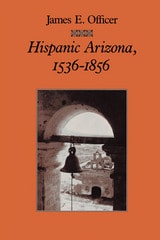
Hispanic Arizona, 1536–1856
James E. Officer
University of Arizona Press, 1987
The heart of the work centers on the early nineteenth century. It explores subjects such as the constant threat posed by hostile Apaches, government intrigue and revolution in Sonora and the provincias internas, and patterns of land ownership in villages such as Tucson and Tubac. Also covered are the origins of land grants in present-day southern Arizona and the invasion of southern Arizona by American “49ers” as seen from the Mexican point of view. Officer traces kinship ties of several elite families who ruled the frontier province over many generations—men and women whose descendants remain influential in Sonora and Arizona today.
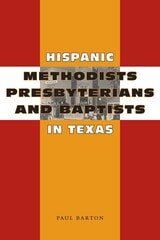
Hispanic Methodists, Presbyterians, and Baptists in Texas
By Paul Barton
University of Texas Press, 2006
The question of how one can be both Hispanic and Protestant has perplexed Mexican Americans in Texas ever since Anglo-American Protestants began converting their Mexican Catholic neighbors early in the nineteenth century. Mexican-American Protestants have faced the double challenge of being a religious minority within the larger Mexican-American community and a cultural minority within their Protestant denominations. As they have negotiated and sought to reconcile these two worlds over nearly two centuries, los Protestantes have melded Anglo-American Protestantism with Mexican-American culture to create a truly indigenous, authentic, and empowering faith tradition in the Mexican-American community.
This book presents the first comparative history of Hispanic Methodists, Presbyterians, and Baptists in Texas. Covering a broad sweep from the 1830s to the 1990s, Paul Barton examines how Mexican-American Protestant identities have formed and evolved as los Protestantes interacted with their two very different communities in the barrio and in the Protestant church. He looks at historical trends and events that affected Mexican-American Protestant identity at different periods and discusses why and how shifts in los Protestantes' sense of identity occurred. His research highlights the fact that while Protestantism has traditionally served to assimilate Mexican Americans into the dominant U.S. society, it has also been transformed into a vehicle for expressing and transmitting Hispanic culture and heritage by its Mexican-American adherents.
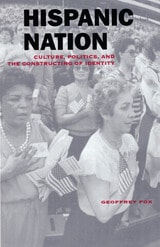
Hispanic Nation
Culture, Politics, and the Constructing of IdentityGeoffrey Fox
University of Arizona Press, 1997
Hispanic Population of the United States
Frank D. Bean
Russell Sage Foundation, 1987
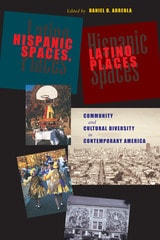
Hispanic Spaces, Latino Places
Community and Cultural Diversity in Contemporary AmericaEdited by Daniel D. Arreola
University of Texas Press, 2004
Hispanics/Latinos are the largest ethnic minority in the United States—but they are far from being a homogenous group. Mexican Americans in the Southwest have roots that extend back four centuries, while Dominicans and Salvadorans are very recent immigrants. Cuban Americans in South Florida have very different occupational achievements, employment levels, and income from immigrant Guatemalans who work in the poultry industry in Virginia. In fact, the only characteristic shared by all Hispanics/Latinos in the United States is birth or ancestry in a Spanish-speaking country.
In this book, sixteen geographers and two sociologists map the regional and cultural diversity of the Hispanic/Latino population of the United States. They report on Hispanic communities in all sections of the country, showing how factors such as people's country/culture of origin, length of time in the United States, and relations with non-Hispanic society have interacted to create a wide variety of Hispanic communities. Identifying larger trends, they also discuss the common characteristics of three types of Hispanic communities—those that have always been predominantly Hispanic, those that have become Anglo-dominated, and those in which Hispanics are just becoming a significant portion of the population.
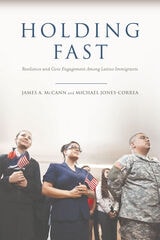
Holding Fast
Resilience and Civic Engagement Among Latino ImmigrantsJames A. McCann
Russell Sage Foundation, 2020
Holding Fast draws largely from a yearlong survey of Latino immigrants, including both citizens and noncitizens, conducted before and after the 2016 election. The survey gauges immigrants’ attitudes about the direction of the country and the emotional underpinnings of their political involvement. While survey respondents expressed pessimism about the direction of the United States following the 2016 election, there was no evidence of their withdrawal from civic life. Instead, immigrants demonstrated remarkable resilience in their political engagement, and their ties to America remained robust.
McCann and Jones-Correa examine Latino immigrants’ trust in government as well as their economic concerns and fears surrounding possible deportations of family members and friends. They find that Latino immigrants who were concerned about the likelihood of deportation were more likely to express a lack of trust in government. Concerns about personal finances were less salient. Disenchantment with the U.S. government did not differ based on citizenship status, length of stay in America, or residence in immigrant-friendly states. Foreign-born Latinos who are naturalized citizens shared similar sentiments to those with fewer political rights, and immigrants in California, for example, express views similar to those in Texas.
Addressing the potential influence immigrant voters may wield in in the coming election, the authors point to signs that the turnout rate for naturalized Latino immigrant may be higher than that for Latinos born in the United States. The authors further underscore the importance of the parties' platforms and policies, noting the still-tenuous nature of Latino immigrants’ affiliations with the Democratic Party.
Holding Fast outlines the complex political situation in which Latino immigrants find themselves today. Despite well-founded feelings of anger, fear, and skepticism, in general they maintain an abiding faith in the promise of American democracy. This book provides a comprehensive account of Latino immigrants’ political opinions and a nuanced, thoughtful outlook on the future of Latino civic participation. It will be an important contribution to scholarly work on civic engagement and immigrant integration.

Home Movies of Narcissus
Rane Arroyo
University of Arizona Press, 2002
Using sophisticated language to inspect life from barrio childhood to cosmopolitan manhood, Arroyo explores themes of gay strength and alienation, linked to his experiences as both a Puerto Rican and an intellectual. Through a variety of approaches, he examines a major recurrent Latino paradox: the need to write about Latino issues while being criticized for being too self-centered.
Sometimes reserved, sometimes passionate, Arroyo writes with humor and a remarkable quickness of association, moving with a grace that makes seamless use of speech ranging from the formal to the vernacular. Taking in love and sexuality, world literature and history, and the exile's heritage of a shifting geography of identity, he invokes remarkable imagery with language that is economical, fresh, and mischievous. Some of Arroyo's poems take an autobiographical approach and show how poets have both the luxury and necessity of speaking for those in their lives.
Others create personas that take in the American experience from a variety of viewpoints—including gays, who are often marginalized by the larger Latino community. "The Ponce de León Poems" pit the poet against a ghost who seeks to direct his writing, while a final section, "The Black Moon Poems," deals with the many sleepless nights that Arroyo has spent struggling with questions over the worth of his art and whether he has betrayed those he loves by writing-or not writing-about them. "In his home movies," he writes, "Narcissus is both the seen and the seer." As Arroyo's insightful words demonstrate, the writer must come to value his own image but not fall in love with it, for it will change, age, and, if he is fortunate, finally grow wise. As readers will discover in Home Movies of Narcissus, Rane Arroyo has seen past the mirror and charted a new territory of self-discovery.
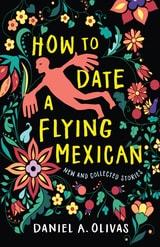
How to Date a Flying Mexican
New and Collected StoriesDaniel A. Olivas
University of Nevada Press, 2022
The collection is made up of Olivas’s favorite previously published stories, along with two new stories—one dystopian and the other magical— that challenge the Trump administration’s anti-immigration rhetoric and policies. How to Date a Flying Mexican draws together some of Olivas’s most unforgettable and strange tales, allowing readers to experience his very distinct, and very Chicano, fiction.