Results by title
72 books match the query 'Honor' and 10 start with h
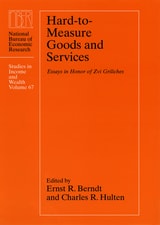
Hard-to-Measure Goods and Services
Essays in Honor of Zvi GrilichesEdited by Ernst E. Berndt and Charles R. Hulten
University of Chicago Press, 2007
The celebrated economist Zvi Griliches’s entire career can be viewed as an attempt to advance the cause of accuracy in economic measurement. His interest in the causes and consequences of technical progress led to his pathbreaking work on price hedonics, now the principal analytical technique available to account for changes in product quality.
Hard-to-Measure Goods and Services, a collection of papers from an NBER conference held in Griliches’s honor, is a tribute to his many contributions to current economic thought. Here, leading scholars of economic measurement address issues in the areas of productivity, price hedonics, capital measurement, diffusion of new technologies, and output and price measurement in “hard-to-measure” sectors of the economy. Furthering Griliches’s vital work that changed the way economists think about the U.S. National Income and Product Accounts, this volume is essential for all those interested in the labor market, economic growth, production, and real output.

Harmonic Analysis and Partial Differential Equations
Essays in Honor of Alberto P. CalderonEdited by Michael Christ, Carlos E. Kenig, and Cora Sadosky
University of Chicago Press, 1999
In 1996, more than 300 mathematicians from around the world gathered in Chicago for a conference on harmonic analysis and partial differential equations held in Calderón's honor. This volume originated in papers given there and presents timely syntheses of several major fields of mathematics as well as original research articles contributed by some of the finest scholars working in these areas. An important addition to the literature, this book is essential reading for researchers in these and other related fields.

Honor
Frank Henderson Stewart
University of Chicago Press, 1994
In the first sustained comparative analysis of this elusive notion, Frank Stewart writes that none of these ideas is correct. Drawing on information about Western ideas of honor from sources as diverse as medieval Arthurian romances, Spanish dramas of the sixteenth and seventeenth centuries, and the writings of German jurists of the nineteenth and twentieth centuries, and comparing the European ideas with the ideas of a non-Western society—the Bedouin—Stewart argues that honor must be understood as a right, basically a right to respect. He shows that by understanding honor this way, we can resolve some of the paradoxes that have long troubled scholars, and can make sense of certain institutions (for instance the medieval European pledge of honor) that have not hitherto been properly understood.
Offering a powerful new way to understand this complex notion, Honor has important implications not only for the social sciences but also for the whole history of European sensibility.

Honor Bound
Race and Shame in AmericaLeverenz, David
Rutgers University Press, 2012
To make his argument, Leverenz casts an unusually wide net, from ancient and modern cultures of honor to social, political, and military history to American literature and popular culture.
He highlights the convergence of whiteness and honor in the United States from the antebellum period to the present. The Civil War, the civil rights movement, and the election of Barack Obama represent racial progress; the Tea Party movement represents the latest recoil.
From exploring African American narratives to examining a 2009 episode of Hardball—in which two white commentators restore their honor by mocking U.S. Attorney General Eric Holder after he called Americans “cowards” for not talking more about race—Leverenz illustrates how white honor has prompted racial shaming and humiliation. The United States became a nation-state in which light-skinned people declared themselves white. The fear masked by white honor surfaces in such classics of American literature as The Scarlet Letter and Adventures of Huckleberry Finn and in the U.S. wars against the Barbary pirates from 1783 to 1815 and the Iraqi insurgents from 2003 to the present. John McCain’s Faith of My Fathers is used to frame the 2008 presidential campaign as white honor’s last national stand.
Honor Bound concludes by probing the endless attempts in 2009 and 2010 to preserve white honor through racial shaming, from the “birthers” and Tea Party protests to Joe Wilson’s “You lie!” in Congress and the arrest of Henry Louis Gates Jr. at the front door of his own home. Leverenz is optimistic that, in the twenty-first century, racial shaming is itself becoming shameful.

Honor and Personhood in Early Modern Mexico
Osvaldo F. Pardo
University of Michigan Press, 2015
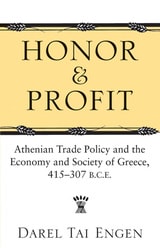
Honor and Profit
Athenian Trade Policy and the Economy and Society of Greece, 415-307 B.C.E.Darel Tai Engen
University of Michigan Press, 2010
Honor and Profit offers a welcome corrective to the outmoded Finleyite view of the ancient economy. This important volume collects and analyzes economic evidence including government decrees for all known occasions on which Athens granted honors and privileges for services relating to trade.
The analysis proceeds within the intellectual framework of substantive economic theory, in which formal market behavior and institutions are considered to be but a subset of a larger group of economic behaviors and institutions devoted to the production, distribution, and exchange of goods.
Honor and Profit merges theory with empirical historical evidence to illustrate the complexity and dynamism of the ancient Greek economy. The author's conclusions have broad implications for our understanding not only of Athens and environs but also of the social and political history of Greece and the ancient Mediterranean world.
Darel Tai Engen is Associate Professor of History at California State University, San Marcos.
Also of interest
An Introduction to Greek Epigraphy of the Hellenistic and Roman Periods from Alexander the Great down to the Reign of Constantine (323 B.C.---A.D. 337)
By B. H. McLean
The Athenian Empire Restored: Epigraphic and Historical Studies
By Harold B. Mattingly
The Athenian Experiment: Building an Imagined Political Community in Ancient Attica, 508---490 B.C.
By Greg Anderson
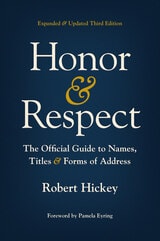
Honor and Respect
The Official Guide to Names, Titles, and Forms of AddressRobert Hickey
University of Chicago Press, 2023
For any personal or professional situation where formality is of the essence and proper decorum is the expectation, this book offers critical information on how to address, introduce, and communicate with officials, functionaries, and dignitaries from all walks of life. From presidents to pastors, ambassadors to attorneys general to your local alderperson, Honor and Respect offers clear explanations and examples of the official honorifics of thousands of federal, state, and municipal officials; corporate executives; clergy; tribal officials; and members of the armed services in the United States, Australia, Canada, and the United Kingdom. It also includes titles and guidance on addressing high officials from more than 180 countries.
This updated third edition reflects the nuanced changes in language, protocol, and conventions that have been implemented by the State Department, Armed Forces, and myriad other government offices in the United States and beyond. With its all-encompassing scope and quick-reference format, Honor and Respect provides easy access for all who seek the proper protocols of forms of address. This book is an indispensable reference for individuals and offices working in government, foreign affairs, diplomacy, law, the military, training and consulting, and public relations, among others.
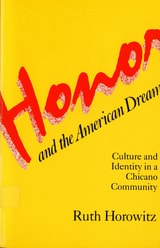
Honor and the American Dream
Culture and Identity in a Chicano CommunityHorowitz, Ruth
Rutgers University Press, 1983
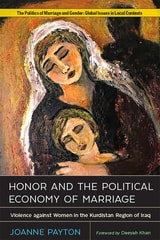
Honor and the Political Economy of Marriage
Violence against Women in the Kurdistan Region of IraqJoanne Payton
Rutgers University Press, 2020
Honor and the Political Economy of Marriage provides a description of ‘honor’-based violence that focuses upon the structure of the family rather than the perpetrator’s culture. The author, Joanne Payton, argues that within societies primarily organized by familial and marital connections, women’s ‘honor’ is a form of symbolic capital within a ‘political economy’ in which marriage organizes intergroup connections.
Drawing on statistical analysis of original data contextualized with historical and anthropological readings, Payton explores forms of marriage and their relationship to ‘honor’, sketching changing norms around the familial control of women from agrarian/pastoral roots to the contemporary era.

Honor, Status, and Law in Modern Latin America
Sueann Caulfield, Sarah C. Chambers, and Lara Putnam, eds.
Duke University Press, 2005
Each essay examines honor in the context of specific historical processes, including early republican nation-building in Peru; the transformation in Mexican villages of the cargo system, by which men rose in rank through service to the community; the abolition of slavery in Rio de Janeiro; the growth of local commerce and shifts in women’s status in highland Bolivia; the formation of a multiethnic society on Costa Rica’s Caribbean coast; and the development of nationalist cultural responses to U.S. colonialism in Puerto Rico. By connecting liberal projects that aimed to modernize law and society with popular understandings of honor and status, this volume sheds new light on broad changes and continuities in Latin America over the course of the long nineteenth century.
Contributors. José Amador de Jesus, Rossana Barragán, Sueann Caulfield, Sidney Chalhoub, Sarah C. Chambers, Eileen J. Findley, Brodwyn Fischer, Olívia Maria Gomes da Cunha, Laura Gotkowitz, Keila Grinberg, Peter Guardino, Cristiana Schettini Pereira, Lara Elizabeth Putnam