Results by title
752 books match the query 'Illinois' and 15 start with h

HISTORY OF ILLINOIS
FROM ITS COMMENCEMENT AS A STATE IN 1818Thomas Ford
University of Illinois Press, 1995
studies of Illinois during the Jackson period. His account is balanced
and critical while at the same time recognizing the value of Ford's book."
-- Robert W. Johannsen, J. G. Randall Distinguished Professor of History,
University of Illinois at Urbana-Champaign
Both cynical and self-serving, Illinois's seventh governor Thomas Ford
also possessed an unrivaled sensitivity to the dynamics of frontier life.
He reveals these and other qualities in his classic A History of Illinois,
which covers the state's first thirty years.
Ford writes with candor of the lengthy "Hancock County difficulties"
and the ouster of Mormons from the state. His treatment of the Black Hawk
War and his writings on the slavery controversy in the state, the murder
of Elijah Lovejoy, and the larger issues of violence and vigilantism help
show why this volume has been called the outstanding early survey of Illinois
history. This reissue of Ford's book includes an introduction by Rodney
O. Davis and a publication history by Terence Tanner.
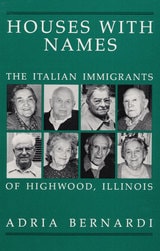
HOUSES WITH NAMES
"THE ITALIAN IMMIGRANTS OF HIGHWOOD, ILLAdria Bernardi
University of Illinois Press, 1990

Hack
Stories from a Chicago CabDmitry Samarov
University of Chicago Press, 2011
An artist and painter trained at the School of the Art Institute of Chicago, Samarov began driving a cab in 1993 to make ends meet, and he’s been working as a taxi driver ever since. In Hack: Stories from a Chicago Cab, he recounts tales that will delight, surprise, and sometimes shock the most seasoned urbanite. We follow Samarov through the rhythms of a typical week, as he waits hours at the garage to pick up a shift, ferries comically drunken passengers between bars, delivers prostitutes to their johns, and inadvertently observes drug deals. There are long waits with other cabbies at O’Hare, vivid portraits of street corners and their regular denizens, amorous Cubs fans celebrating after a game at Wrigley Field, and customers who are pleasantly surprised that Samarov is white—and tell him so. Throughout, Samarov’s own drawings—of his fares, of the taxi garage, and of a variety of Chicago street scenes—accompany his stories. In the grand tradition of Nelson Algren, Saul Bellow, Mike Royko, and Studs Terkel, Dmitry Samarov has rendered an entertaining, poignant, and unforgettable vision of Chicago and its people.
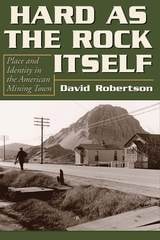
Hard as the Rock Itself
Place and Identity in the American Mining TownDavid Robertson
University Press of Colorado, 2006
Robertson documents the history of Toluca, Illinois; Cokedale, Colorado; and Picher, Oklahoma, from the mineral discovery phase through mine closure, telling for the first time how these century-old mining towns have survived and how sense of place has played a vital role.
Acknowledging the hardships that mining's social, environmental, and economic legacies have created for current residents, Robertson argues that the industry's influences also have contributed to the creation of strong, cohesive communities in which residents have always identified with the severe landscape and challenging, but rewarding way of life.
Robertson contends that the tough, unpretentious appearance of mining landscapes mirrors qualities that residents value in themselves, confirming that a strong sense of place in mining regions, as elsewhere, is not necessarily wedded to an attractive aesthetic or even to a thriving economy.
Mining historians, geographers, and other students of place in the American landscape will find fascinating material in Hard As the Rock Itself.
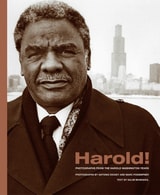
Harold!
Photographs from the Harold Washington YearsPhotographs by Antonio Dickey and Marc PoKempner, text by Salim Muwakkil
Northwestern University Press, 2007
Antonio Dickey and Marc PoKempner were there with Washington throughout 1982-87, Dickey as his campaign and personal photographer and PoKempner on assignment for the New York Times, People, and Time, capturing the force of his personality and the inspiration he brought to Chicago. Their photographs have become the definitive documentation of the Harold years and were featured in the Chicago Historical Society’s 2003–2004 exhibit “Harold Washington: The Man and the Movement.” They were there for his underdog rise, his win, his first term, and his untimely death just seven months into his second term. The year 2007 marks the twentieth anniversary of Washington’s death, and this loving tribute in words and pictures will keep his message alive for future generations.
Heat Wave
A Social Autopsy of Disaster in ChicagoEric Klinenberg
University of Chicago Press, 2002
Heat waves in the United States kill more people during a typical year than all other natural disasters combined. Until now, no one could explain either the overwhelming number or the heartbreaking manner of the deaths resulting from the 1995 Chicago heat wave. Meteorologists and medical scientists have been unable to account for the scale of the trauma, and political officials have puzzled over the sources of the city's vulnerability. In Heat Wave, Eric Klinenberg takes us inside the anatomy of the metropolis to conduct what he calls a "social autopsy," examining the social, political, and institutional organs of the city that made this urban disaster so much worse than it ought to have been.
Starting with the question of why so many people died at home alone, Klinenberg investigates why some neighborhoods experienced greater mortality than others, how the city government responded to the crisis, and how journalists, scientists, and public officials reported on and explained these events. Through a combination of years of fieldwork, extensive interviews, and archival research, Klinenberg uncovers how a number of surprising and unsettling forms of social breakdown—including the literal and social isolation of seniors, the institutional abandonment of poor neighborhoods, and the retrenchment of public assistance programs—contributed to the high fatality rates. The human catastrophe, he argues, cannot simply be blamed on the failures of any particular individuals or organizations. For when hundreds of people die behind locked doors and sealed windows, out of contact with friends, family, community groups, and public agencies, everyone is implicated in their demise.
As Klinenberg demonstrates in this incisive and gripping account of the contemporary urban condition, the widening cracks in the social foundations of American cities that the 1995 Chicago heat wave made visible have by no means subsided as the temperatures returned to normal. The forces that affected Chicago so disastrously remain in play in America's cities, and we ignore them at our peril.
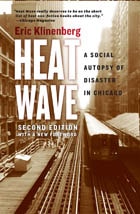
Heat Wave
A Social Autopsy of Disaster in ChicagoEric Klinenberg
University of Chicago Press, 2015
On Thursday, July 13, 1995, Chicagoans awoke to a blistering day in which the temperature would reach 106 degrees. The heat index, which measures how the temperature actually feels on the body, would hit 126 degrees by the time the day was over. Meteorologists had been warning residents about a two-day heat wave, but these temperatures did not end that soon. When the heat wave broke a week later, city streets had buckled; the records for electrical use were shattered; and power grids had failed, leaving residents without electricity for up to two days. And by July 20, over seven hundred people had perished-more than twice the number that died in the Chicago Fire of 1871, twenty times the number of those struck by Hurricane Andrew in 1992—in the great Chicago heat wave, one of the deadliest in American history.
Heat waves in the United States kill more people during a typical year than all other natural disasters combined. Until now, no one could explain either the overwhelming number or the heartbreaking manner of the deaths resulting from the 1995 Chicago heat wave. Meteorologists and medical scientists have been unable to account for the scale of the trauma, and political officials have puzzled over the sources of the city's vulnerability. In Heat Wave, Eric Klinenberg takes us inside the anatomy of the metropolis to conduct what he calls a "social autopsy," examining the social, political, and institutional organs of the city that made this urban disaster so much worse than it ought to have been.
Starting with the question of why so many people died at home alone, Klinenberg investigates why some neighborhoods experienced greater mortality than others, how the city government responded to the crisis, and how journalists, scientists, and public officials reported on and explained these events. Through a combination of years of fieldwork, extensive interviews, and archival research, Klinenberg uncovers how a number of surprising and unsettling forms of social breakdown—including the literal and social isolation of seniors, the institutional abandonment of poor neighborhoods, and the retrenchment of public assistance programs—contributed to the high fatality rates. The human catastrophe, he argues, cannot simply be blamed on the failures of any particular individuals or organizations. For when hundreds of people die behind locked doors and sealed windows, out of contact with friends, family, community groups, and public agencies, everyone is implicated in their demise.
As Klinenberg demonstrates in this incisive and gripping account of the contemporary urban condition, the widening cracks in the social foundations of American cities that the 1995 Chicago heat wave made visible have by no means subsided as the temperatures returned to normal. The forces that affected Chicago so disastrously remain in play in America's cities, and we ignore them at our peril.
For the Second Edition Klinenberg has added a new Preface showing how climate change has made extreme weather events in urban centers a major challenge for cities and nations across our planet, one that will require commitment to climate-proofing changes to infrastructure rather than just relief responses.
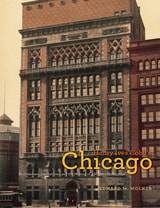
Henry Ives Cobb's Chicago
Architecture, Institutions, and the Making of a Modern MetropolisEdward W. Wolner
University of Chicago Press, 2011
When championing the commercial buildings and homes that made the Windy City famous, one can’t help but mention the brilliant names of their architects—Daniel Burnham, Louis Sullivan, and Frank Lloyd Wright, among others. But few people are aware of Henry Ives Cobb (1859–1931), the man responsible for an extraordinarily rich chapter in the city’s turn-of-the-century building boom, and fewer still realize Cobb’s lasting importance as a designer of the private and public institutions that continue to enrich Chicago’s exceptional architectural heritage.
Henry Ives Cobb’s Chicago is the first book about this distinguished architect and the magnificent buildings he created, including the Newberry Library, the Chicago Historical Society, the Chicago Athletic Association, the Fisheries Building for the 1893 World’s Fair, and the Chicago Federal Building. Cobb filled a huge institutional void with his inventive Romanesque and Gothic buildings—something that the other architect-giants, occupied largely with residential and commercial work, did not do. Edward W. Wolner argues that these constructions and the enterprises they housed—including the first buildings and master plan for the University of Chicago—signaled that the city had come of age, that its leaders were finally pursuing the highest ambitions in the realms of culture and intellect.
Assembling a cast of colorful characters from a free-wheeling age gone by, and including over 140 images of Cobb’s most creative buildings, Henry Ives Cobb’s Chicago is a rare achievement: a dynamic portrait of an architect whose institutional designs decisively changed the city’s identity during its most critical phase of development.
Historic Illinois from the Air
David Buisseret
University of Chicago Press, 1990
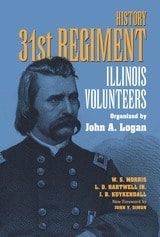
History 31st Regiment
Illinois Volunteers Organized by John A. LoganW. S. Morris, J. B. Kuykendall, and L. D. Hartwell. Foreword by John Y. Simon
Southern Illinois University Press, 1998
The story of John A. Logan’s famed 31st Regiment Illinois Volunteers, told by three veterans, follows the regiment from the battles of Belmont, Fort Donelson, Vicksburg, Kenesaw Mountain, and Atlanta through the March to the Sea and into North Carolina. "Few regiments," notes historian John Y. Simon in the foreword, "fought longer or more fiercely, suffered more casualties, or won more victories."
Logan proved a valiant and valuable Union commander, yet when the Civil War first began, it was far from clear whether he would lead Union or Confederate troops. In dramatic fashion, however, he broke what Simon calls an "ominous silence ... interpreted by many as sympathy for the South." Speaking from a wagon platform in Marion, Illinois, Logan proclaimed: "[The] time has come when a man must be for or against his country." Logan accepted a commission from Illinois governor Richard Yates, recruited heavily in southern Illinois, and formed the 31st Regiment Illinois Volunteers.
The 31st became a prime component in Grant’s western campaigns, fighting for the first time at Belmont, Missouri. In February of 1862, the 31st foiled Confederate general Gideon J. Pillow’s dramatic escape from the Union siege at Fort Donelson. Although this is often listed as one of the proudest moments for the 31st, casualties ran high (fifty-eight killed), with Logan so severely wounded that at first he was reported dead. Logan’s valor at Fort Donelson won him promotion to brigadier general.
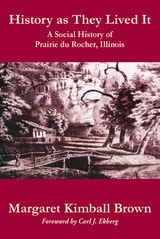
History as They Lived It
A Social History of Prairie du Rocher, IllinoisMargaret Kimball Brown, Foreword by Carl J. Ekberg
Southern Illinois University Press, 2005
“History as They Lived It deserves to be placed within the rich context of Illinois Country historiography going back more than a century. . . . It brings together the fully ripened thoughts of a mature scholar at the very moment that students of the Illinois Country need such a book.”—from the foreword by Carl J. Ekberg
Settled in 1722, Prairie du Rocher was at the geographic center of a French colony in the Mississippi Valley, which also included other villages in what is now Illinois and Missouri: Cahokia, Kaskaskia, Fort de Chartres, St. Philippe, Ste. Genevieve, and St. Louis. Located in an alluvial valley near towering limestone bluffs, which inspired the village’s name—French for “prairie of the rock”— Prairie du Rocher is the only one of the seven French colonial villages that still exists today as a small compact community.
The village of Prairie du Rocher endured governance by France, Great Britain, Virginia, and the Illinois territory before Illinois became a state in 1818. Despite these changes, the villagers persisted in maintaining the community and its values. Margaret Kimball Brown looks at one of the oldest towns in the region through the lenses of history and anthropology, utilizing extensive research in archives and public records to give historians, anthropologists, and general readers a lively depiction of this small community and its people.
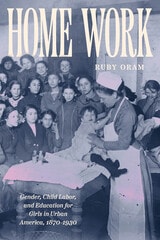
Home Work
Gender, Child Labor, and Education for Girls in Urban America, 1870–1930Ruby Oram
University of Chicago Press, 2025
In Home Work, historian Ruby Oram tells the story of how middle-class, white women reformers lobbied the state to implement various public education reforms to shape the lives of girls and women in industrial cities between 1870 and 1930. Women such as Jane Addams and Florence Kelley used education reform to target working-class communities and advocate for their middle-class ideals of girlhood and femininity, which could vary depending on the racial or socio-economic backgrounds of the girls. For example, reformers generally encouraged white girls to care for their future families, while pushing Black girls toward becoming domestic workers in others’ homes. Using Chicago as a case study, Oram also explores how many of the reforms sought by white women were in response to evolving anxieties about immigration, health, and sexual delinquency.
An illuminating addition to the history of urban education in America, Home Work enriches our understanding of educational inequality in twentieth-century schools.
Honor and the American Dream
Culture and Identity in a Chicano CommunityHorowitz, Ruth
Rutgers University Press, 1983
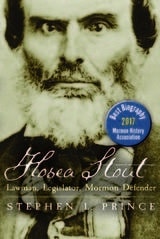
Hosea Stout
Lawman, Legislator, Mormon DefenderStephen L. Prince
Utah State University Press, 2016
Stout joined the Mormons in Missouri in 1838 and followed them to Nauvoo, where he rose quickly to become a top leader in the Nauvoo Legion and chief of police, a position he also held at Winter Quarters. He became the first attorney general for the Territory of Utah, was elected to the Utah Territorial Legislature, and served as regent for the University of Deseret (which later became the University of Utah) and as judge advocate of the Nauvoo Legion in Utah. In 1862, Stout was appointed US attorney for the Territory of Utah by President Abraham Lincoln. In 1867, he became city attorney of Salt Lake City and he was elected to the Utah House of Representatives in 1881.
But Stout’s history also had its troubled moments. Known as a violent man and aggressive enforcer, he was often at the center of controversy during his days on the police force and was accused of having a connection with deaths in Nauvoo and Utah. Ultimately, however, none of these allegations ever found traction, and the leaders of the LDS community, especially Brigham Young, saw to it that Stout was promoted to roles of increasing responsibility throughout his life. When he died in 1889, Hosea Stout left a complicated legacy of service to his state, his church, and the members of his faith community.
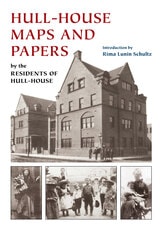
Hull-House Maps and Papers
A Presentation of Nationalities and Wages in a Congested District of Chicago, Together with Comments and Essays on Problems Growing Out of the Social ConditionsBy the Residents of Hull-House
University of Illinois Press, 2007
Inspired by their Progressive Era faith in social science solutions to society’s problems, the residents of Hull-House collaborated on this work of sociology based on their experiences as residents of Chicago’s Near West Side. The contributors to this book believed that an enlightened citizenry could be mobilized for reform, and that by publishing maps with explicit information about the wages and conditions of the working poor in Chicago’s Nineteenth Ward they would educate the public and inspire reforms.
In addition to Jane Addams’s own prefatory note and paper on the role of social settlements in the labor movement, contributors provided detailed, real-world analyses of the Chicago Jewish ghetto, garment workers and the sweatshops, child labor, immigrant neighborhoods in the vicinity of Hull-House, and local charities. This edition also contains eight color reproductions of the original Hull-House neighborhood maps. The year 2006 marks the one hundred and eleventh anniversary of the publication of Hull-House Maps and Papers, and the volume remains a dramatic statement about the residents’ shared values as well as a major influence on subsequent social surveys.