Results by title
129 books match the query 'Individual Philosophers' and 13 start with h
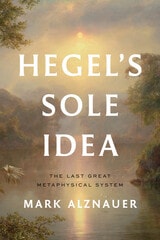
Hegel's Sole Idea
The Last Great Metaphysical SystemMark Alznauer
University of Chicago Press, 2026
An accessible reconstruction of Hegel’s attempt to derive all reality from a single concept.
In the early decades of the nineteenth century, G. W. F. Hegel came to believe that philosophy was finally in a position to achieve something it had striven for since ancient Greece: becoming an objective, demonstrative science. But to achieve this aim, he thought philosophical knowledge needed to be reconceived in a radically new way—as content contained in a single concept just as the oak tree is hidden in the acorn. In Hegel’s Sole Idea, Mark Alznauer reads Hegel’s mature philosophical system as the unprecedented attempt to comprehend the entire world as the full unfolding of that single concept, which he mysteriously calls “the absolute idea.”
Ever since Hegel set out this program in his Encyclopedia of the Philosophical Sciences in Outline, Hegel’s system has been regarded as the last best hope of philosophy as an autonomous, fully rational science. But while Hegel’s followers regarded the Encyclopedia as the successful realization of the traditional aims of philosophy, his most influential successors thought it instead showed the exhaustion and collapse of that project. Hegel’s Sole Idea offers a comprehensive interpretation of Hegelian philosophy that allows a fair confrontation with its most provocative and ambitious claims.
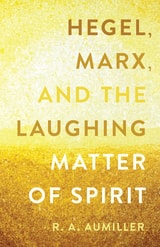
Hegel, Marx, and the Laughing Matter of Spirit
R. A. Aumiller
Northwestern University Press, 2026
What happens when those who have been denied political subjectivity fully play out their negative role in a historical drama that damned them from the beginning? Hegel, Marx, and the Laughing Matter of Spirit locates the eruption of revolutionary laughter in historical cracks across nineteenth- and twentieth-century Europe, where exiled philosophers, partisan fighters, and artists framed their political resistance as a historical comedy. Hegelian comedy fuels the Young Hegelian critique of Prussian censorship, Walter Benjamin’s staging of the anti-fascist resistance, and the Yugoslavian partisan attempt to begin again in fascism’s aftermath. Revolution erupts from a historical stage that can no longer look on its own contradictions with a straight face. Drawing on the defiant spirit of comedy, this Hegelian feminist manifesto defies political despair, overturning the perception that history tragically repeats itself. Invoking the phrase “Nothing changes” as a mantra, R. A. Aumiller turns a concession of defeat into a battle cry for political resistance.
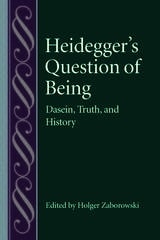
Heidegger's Question of Being
Holger Zaborowski
Catholic University of America Press, 2017
The contributions to this volume, written by leading scholars in the field of Heidegger research, address many of these questions in close readings of Heidegger’s texts and thus provide sound orientation in the field of contemporary Heidegger research. They show how the different trajectories of Heidegger’s thought—his early interest in the meaning of Being and in Dasein, his discussion of, and involvement with, politics, his understanding of art, poetry, and technology, his concept of truth and the idea of a history of Being—all converge at one point: the question of Being. It thus becomes clear that, all differences notwithstanding, Heidegger followed one very consistent path of thinking.
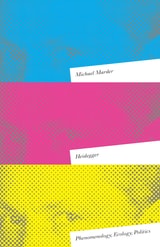
Heidegger
Phenomenology, Ecology, PoliticsMichael Marder
University of Minnesota Press, 2018
Understanding the political and ecological implications of Heidegger’s work without ignoring his noxious public engagements
The most controversial philosopher of the twentieth century, Martin Heidegger has influenced generations of intellectuals even as his involvement with Nazism and blatant anti-Semitism, made even clearer after the publication of his Black Notebooks, have recently prompted some to discard his contributions entirely. For Michael Marder, Heidegger’s thought remains critical for interpretations of contemporary politics and our relation to the natural environment.
Bringing together and reframing more than a decade of Marder’s work on Heidegger, this volume questions the wholesale rejection of Heidegger, arguing that dismissive readings of his project overlook the fact that it is impossible to grasp without appreciating his lifelong commitment to phenomenology and that Heidegger’s anti-Semitism is an aberration in his still-relevant ecological and political thought, rather than a defining characteristic. Through close readings of Heidegger’s books and seminars, along with writings by other key phenomenologists and political philosophers, Marder contends that neither Heidegger’s politics nor his reflections on ecology should be considered in isolation from his phenomenology. By demonstrating the codetermination of his phenomenological, ecological, and political thinking, Marder accounts for Heidegger’s failures without either justifying them or suggesting that they invalidate his philosophical endeavor as a whole.
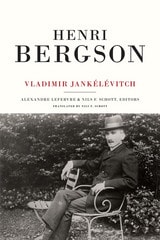
Henri Bergson
Vladimir Jankélévitch
Duke University Press, 2015
Hermes I
CommunicationMichel Serres
University of Minnesota Press, 2023
For the first time in English, the introductory volume in a major French philosopher’s groundbreaking series of poetic transdisciplinary works
Michel Serres is recognized as one of the giants of postwar French philosophy of knowledge, along with Gilles Deleuze, Jacques Derrida, Michel Foucault, and Gilbert Simondon. His early five-volume series Hermes, which appeared in the 1960s and 1970s, was an intellectual supernova in its proposition that culture and science shared the same mythic and narrative structures. Hermes I: Communication marks the start of a major publishing endeavor to introduce this foundational series into English.
Building on the figure of the Greek god Hermes, who presides over the realms of communication and interpretation, Hermes I embarks on a reflection concerning the history of mathematics via Descartes and Leibniz and culminates by way of a Bachelardian logoanalytic reading of Homer, Dumas, Molière, Verne, and the story of Cinderella. We observe a singular poetic philosopher seeking to bridge the gap between the liberal arts and the sciences through a profound mathematical and poetic fable regarding information theory, history, and art, establishing a new way to think about the production of knowledge during the late twentieth century. In these pages, students and scholars of philosophy will discover an extraordinary project of thought as vital to critical reflection today as it was fifty years ago.
Hermes II
InterferenceMichel Serres
University of Minnesota Press, 2025
Unveiling the hidden connections in the network of knowledge
Hermes II: Interference is the second in a series of works by philosopher Michel Serres using Hermes, god of communication, as an archetypal symbolic figure for reflecting on philosophy and the arts and sciences. Serres delves into the concept of interreferentiality, proposing that every node—whether it be knowledge, objects, or people—exists within a network where it both receives and transmits information. He argues against the existence of a dominant center or pole within these networks, emphasizing that each node can temporarily serve as a focal point depending on context.
Serres presents unique insights into topics such as the nature of knowledge, the world of objects, intersubjectivity, the origins of geometry, the interplay of music and background noise, and empiricism. By identifying parallel structures across these areas, Serres unifies them into a comprehensive theoretical framework, revealing hidden connections and potential future influences. Additionally, this work includes a critique of Gaston Bachelard’s The Formation of the Scientific Mind and concludes with an analysis of communication in Hergé’s The Castafiore Emerald.
Hermes II is a unique blend of ancient and modern perspectives, combining rigorous analysis with an optimistic outlook and highlighting the interconnectedness of knowledge and its implications for fostering peaceful relations within the network of life.
Hermes III
TranslationMichel Serres
University of Minnesota Press, 2026
Unlocking the hidden patterns of knowledge—where science, art, and philosophy speak a common language
Hermes III: Translation is the third volume in Michel Serres’s renowned Hermes series, an ambitious exploration of the deep interconnections among disparate fields of knowledge. While Hermes II: Interference traced the overlapping echoes of ideas across realms, Hermes III moves to translate the structural logics of one field—be it genetics, painting, or philosophy—into the language of another. Revealing how the humanities, science, and art share hidden combinatory architectures, Serres exposes the underlying unity of knowledge systems typically thought distinct.
Through an array of examples—from Monod’s Chance and Necessity to works by Descartes, Leibniz, Comte, Turner, and Roumain—Serres shows how translation uncovers informational and mathematical patterns that shape both ancient and modern thought. This illuminating methodology leads Serres to issue a stark warning: when knowledge is detached from its guiding purpose, it becomes vulnerable to appropriation by destructive political forces.
Yet Serres’s vision remains ultimately hopeful. By tracing knowledge systems back to their mythic and structural roots, Hermes III: Translation gestures toward more harmonious relationships between fields. A rare synthesis of philosophy, science, art, and literature, this work will engage readers interested in the interdependence of disciplines and the possibilities for a more unified, humane understanding of knowledge.
Hermes IV
DistributionMichel Serres
University of Minnesota Press, 2026
How order, meaning, and knowledge emerge from noise across science, literature, and philosophy
Hermes IV: Distribution is the fourth and penultimate volume in Michel Serres’s landmark series on knowledge and communication across disciplines. This collection of essays investigates how order emerges from noise, using thermodynamics and information theory as structural models applicable to science, literature, and culture alike. Moving beyond the themes of interference and translation developed in earlier volumes, Serres focuses on distribution: the processes by which systems take shape, endure, and eventually disperse.
At the core of the book is a dynamic vision of knowledge as an unstable formation. Systems arise from chance encounters or deviations that, through repetition, harden into law. They resist entropy by remaining open to external inputs, forming temporary pockets of negentropy within a wider field of chaos. Space, time, energy, language, and meaning are all shown to emerge from such conditions of mixture and imbalance.
Serres develops his argument through a striking range of materials, including fables, myths, literary texts, philosophy, and the history of science. The result is an uncommon synthesis of hard science and the humanities that reveals shared structures across domains while affirming the irreducible plurality of their laws and methods.
Retail e-book files for this title are screen-reader friendly with images accompanied by short alt text and/or extended descriptions.
Hospitality, Volume II
Jacques Derrida
University of Chicago Press, 2024
Hospitality reproduces a two-year seminar series delivered by Jacques Derrida at the École des hautes études en sciences sociales in Paris between 1995 and 1997. In these lectures, Derrida asks a series of related questions about responsibility and “the foreigner”: How do we welcome or turn away the foreigner? What does the idea of the foreigner reveal about kinship and the state, particularly in relation to friendship, citizenship, migration, asylum, assimilation, and xenophobia? Central to his project is a rigorous distinction between conventional, finite hospitality, with its many conditions, and the aspirational idea of hospitality as something offered unconditionally to the stranger. This volume collects the second year of the seminar, which considers an Islamic problematic of hospitality, the relevance of forgiveness, and the work of Emmanuel Levinas.

How Slavoj Became Zizek
The Digital Making of a Public IntellectualEliran Bar-El
University of Chicago Press, 2025
This revised edition corrects several erroneous and insufficient references in the first edition of this book.
Slovenian philosopher bad boy Slavoj Žižek is one of the most famous intellectuals of our time, publishing at a breakneck speed and lecturing around the world. With his unmistakable speaking style and set of mannerisms that have made him ripe material for internet humor and meme culture, he is recognizable to a wide spectrum of fans and detractors. But how did an intellectual from a small Eastern European country come to such popular notoriety? In How Slavoj Became Žižek, sociologist Eliran Bar-El plumbs the emergence, popularization, and development of the phenomenon called “Žižek.”
Beginning with Žižek’s early years as a thinker and political figure in Slovenian civil society, Bar-El traces Žižek’s rise from Marxist philosopher to political candidate to eventual intellectual celebrity, as Žižek perfected his unique performative style and a rhetorical arsenal of “Hegelacanese.” Following 9/11, Žižek’s career as a global op-ed writer and TV commentator married his rhetoric with global events such as the war on terror, the financial crisis of 2008, and the Arab Spring of 2011. Yet, at the same time, this mainstream popularity, as well as a series of politically incorrect views, almost entirely estranged the Slovenian from the normal workings of academia. Ultimately, this account shows how Žižek has harnessed the power of the digital era in his own self-fashioning as a public intellectual.

How Slavoj Became Žižek
The Digital Making of a Public IntellectualEliran Bar-El
University of Chicago Press, 2023
Slovenian philosopher bad boy Slavoj Žižek is one of the most famous intellectuals of our time, publishing at a breakneck speed and lecturing around the world. With his unmistakable speaking style and set of mannerisms that have made him ripe material for internet humor and meme culture, he is recognizable to a wide spectrum of fans and detractors. But how did an intellectual from a remote Eastern European country come to such popular notoriety? In How Slavoj Became Žižek, sociologist Eliran Bar-El plumbs the emergence, popularization, and development of this phenomenon called “Žižek.”
Beginning with Žižek’s early years as a thinker and political figure in Slovenian civil society, Bar-El traces Žižek’s rise from Marxist philosopher to a political candidate to eventual intellectual celebrity as Žižek perfects his unique performative style and a rhetorical arsenal of “Hegelacanese.” Following 9/11, Žižek’s career as a global op-ed writer and TV commentator married his rhetoric with global events such as the War on Terror, the financial crisis of 2008, and the Arab Spring of 2011. Yet, at the same time, this mainstream popularity, as well as a series of politically incorrect views, almost entirely estranged the Slovenian from the normal workings of academia. Ultimately, this account shows how Žižek harnessed the power of the digital era in his own self-fashioning as a public intellectual.
How to Read Hegel Now
Shannon Hoff
University of Chicago Press, 2026
One might be forgiven for feeling that the philosophical tradition, notoriously replete with seemingly aloof and problematic men like Hegel, has little to offer contemporary conversations about justice. Yet for Shannon Hoff, Hegel’s ideas about freedom in particular contain vital resources for efforts to redress racism, sexism, colonialism, ableism, and capitalism today.
In How to Read Hegel Now, Hoff rereads the German philosopher alongside our most compelling thinkers about how oppression disavows our common humanity, including Frantz Fanon, Jessica Benjamin, Saba Mahmood, la paperson, Jean-Paul Sartre, Georges Canguilhem, and Rosemarie Garland-Thomson. Along the way, Hoff recovers in Hegel a new vision for human freedom that challenges the heritage of modern liberalism he helped to construct.