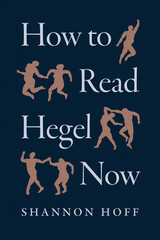
How to Read Hegel Now
University of Chicago Press, 2026
Cloth: 978-0-226-84707-8 | Paper: 978-0-226-84708-5 | eISBN: 978-0-226-84709-2 (all)
Library of Congress Classification B2948.H544 2026
See other books on: 1770-1831 | Hegel, Georg Wilhelm Friedrich | How | Individual Philosophers | Liberty
See other titles from University of Chicago Press
Cloth: 978-0-226-84707-8 | Paper: 978-0-226-84708-5 | eISBN: 978-0-226-84709-2 (all)
Library of Congress Classification B2948.H544 2026
ABOUT THIS BOOK | AUTHOR BIOGRAPHY | REVIEWS | TOC | REQUEST ACCESSIBLE FILE
ABOUT THIS BOOK
A powerful exploration of how Hegel’s ideas about freedom can speak to social injustice today.
One might be forgiven for feeling that the philosophical tradition, notoriously replete with seemingly aloof and problematic men like Hegel, has little to offer contemporary conversations about justice. Yet for Shannon Hoff, Hegel’s ideas about freedom in particular contain vital resources for efforts to redress racism, sexism, colonialism, ableism, and capitalism today.
In How to Read Hegel Now, Hoff rereads the German philosopher alongside our most compelling thinkers about how oppression disavows our common humanity, including Frantz Fanon, Jessica Benjamin, Saba Mahmood, la paperson, Jean-Paul Sartre, Georges Canguilhem, and Rosemarie Garland-Thomson. Along the way, Hoff recovers in Hegel a new vision for human freedom that challenges the heritage of modern liberalism he helped to construct.
See other books on: 1770-1831 | Hegel, Georg Wilhelm Friedrich | How | Individual Philosophers | Liberty
See other titles from University of Chicago Press