Results by title
100 books match the query 'Kings and rulers' and 4 start with h
Hamlet
William Shakespeare
Arizona Center for Medieval and Renaissance Studies, 2021
Lovers of Shakespeare’s language take heart: Lisa Peterson’s translation of Hamlet into contemporary American English was guided by the principle of “First, do no harm.” Leaving the most famous parts of Hamlet untouched, Peterson untied the language knots that can make the rest of the play difficult to understand in a single theatrical viewing. Peterson’s translation makes Hamlet accessible to new audiences, drawing out its timeless themes while helping to contextualize "To be, or not to be: that is the question," and “Something is rotten in the state of Denmark,” so that contemporary audiences can feel their full weight.
This translation of Hamlet was written as part of the Oregon Shakespeare Festival’s Play On! project, which commissioned new translations of thirty-nine Shakespeare plays. These translations present work from "The Bard" in language accessible to modern audiences while never losing the beauty of Shakespeare’s verse. Enlisting the talents of a diverse group of contemporary playwrights, screenwriters, and dramaturges from diverse backgrounds, this project reenvisions Shakespeare for the twenty-first century. These volumes make these works available for the first time in print—a new First Folio for a new era.
Henry IV Part 1
William Shakespeare
Arizona Center for Medieval and Renaissance Studies, 2021
Shakespeare’s two Henry IV plays follow the exploits of King Henry IV after usurping the crown from his cousin Richard II. Featuring some of Shakespeare’s most recognizable characters such as Prince Hal and the roguish Sir John Falstaff, Henry IV, Part 1 delves into complicated questions of loyalty and kingship on and off the battlefield. Henry IV, Part 2 follows Prince Hal as he grapples with his eventual ascent to the throne and his increasingly strained relationship with Falstaff. As the king falls sick and Hal’s ascent appears imminent, Hal’s decisions hold significant implications for all those around him. Modernizing the language of the two plays, Yvette Nolan’s translation carefully works at the seeds sown by Shakespeare—bringing to new life the characters and dramatic arcs of the original.
These translations of Henry IV were written as part of the Oregon Shakespeare Festival’s Play On! project, which commissioned new translations of thirty-nine Shakespeare plays. These translations present work from “The Bard” in language accessible to modern audiences while never losing the beauty of Shakespeare’s verse. Enlisting the talents of a diverse group of contemporary playwrights, screenwriters, and dramaturges from diverse backgrounds, this project reenvisions Shakespeare for the twenty-first century. These volumes make these works available for the first time in print—a new First Folio for a new era.
Hispaniola
Caribbean Chiefdoms in the Age of ColumbusSamuel M. Wilson
University of Alabama Press, 1990
In 1492 the island of Hispaniola was inhabited by the Taino, an Indian group whose ancestors had moved into the Caribbean archipelago from lowland South America more than 1,500 years before. They were organized politically into large cacicazgos, or chiefdoms, comprising 70 or more villages under the authority of a paramount cacique, or chief. From the first voyage on, Columbus made Hispaniola his primary base for operations in the New World. Over the subsequent decades, disease, warfare, famine, and enslavement brought about the destruction of the Taino chiefdoms and almost completely annihilated the aboriginal population of the island.
This book examines the early years of the contact period in the Caribbean and in narrative form reconstructs the social and political organization of the Taino. Wilson describes in detail the interactions between the Taino and the Spaniards, with special attention paid to the structure and functioning of the Taino chiefdoms. By providing additional information from archaeology and recent ethnography, he builds a rich context within which to understand the Taino and their responses to the Europeans.
The Taino are especially important in a New World context because they represent a society undergoing rapid sociopolitical change and becoming more complex through time. The early contact period on Hispaniola gives us a rich ethnohistorical glimpse of the political processes of a complex New World society before and during its destruction brought about by the arrival of the Europeans.
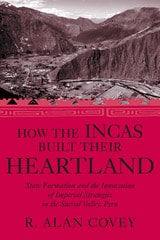
How the Incas Built Their Heartland
State Formation and the Innovation of Imperial Strategies in the Sacred Valley, PeruR. Alan Covey
University of Michigan Press, 2006
In How the Incas Built Their Heartland R. Alan Covey supplements an archaeological approach with the tools of a historian, forming an interdisciplinary study of how the Incas became sufficiently powerful to embark on an unprecedented campaign of territorial expansion and how such developments related to earlier patterns of Andean statecraft. In roughly a hundred years of military campaigns, Inca dominion spread like wildfire across the Andes, a process traditionally thought to have been set in motion by a single charismatic ruler, Pachacuti Inca Yupanqui. Taking nearly a century of archaeological research in the region around the Inca capital as his point of departure, Covey offers an alternative description of Inca society in the centuries leading up to imperial expansion. To do so, Covey proposes a new reading of the Spanish chronicles, one that focuses on processes, rather than singular events, occurring throughout the region surrounding Cusco, the Inca capital. His focus on long-term regional changes, rather than heroic actions of Inca kings, allows the historical and archaeological evidence to be placed on equal interpretive footing. The result is a narrative of Inca political origins linking Inca statecraft to traditions of Andean power structures, long-term ecological changes, and internal social transformations. By reading the Inca histories in a compatible way, Covey shows that it is possible to construct a unified theory of how the Inca heartland was transformed after AD 1000.
R. Alan Covey is Assistant Professor of Anthropology at Southern Methodist University.