Results by title
8113 books match the query 'Literary Criticism' and 211 start with h
H. G. Adler
Life, Literature, LegacyEdited by Julia Creet, Sara R. Horowitz, and Amira Bojadzija-Dan
Northwestern University Press, 2016
H. G. Adler: Life, Literature, Legacy is the first collection of essays in English dedicated to the life and work of German-language author H. G. Adler. Among the international scholars of German, Jewish, and Holocaust literature and history who reveal the range of Adler’s legacy across genres are Adler’s son, Jeremy Adler, and Peter Filkins, translator of Adler’s trilogy, Panorama, (The Journey). Together, the essays examine Adler’s writing in relation to his life, especially his memory as a survivor of the Nazi death camps and his posthumous recognition for having produced a Gesamtkunstwerk, an aesthetic synthesis of the Shoah. The book carries the moral charge of Adler’s work, moving beyond testimony to a complex dialectic between fact and fiction, exploring Adler’s experiments with voice and the ethical work of literary engagement with the Shoah.

H.D. and Poets After
Donna Krolik Hollenberg
University of Iowa Press, 2000
Twenty essays—half by eminent American poets writing about their literary engagement with H.D. and half by critics writing about H.D. in relation to these same poets—provide a fruitful exchange of perceptions and interpretations. The dialogue between these two perspectives—the first autobiographical testimony and the second critical analysis by scholars attuned to both modern and contemporary poetries and poetics—calls into question both traditional notions of literary criticism and earlier theories of literary influence.
The volume includes a range of contemporary responses to H.D.'s work—from Alicia Ostriker's radical eroticism to Brenda Hillman's epistemological restlessness to Carolyn Forché's response to moral disasters of the century. H.D. and Poets After demonstrates key aspects of the poet's continuing importance as a "poet's poet" in the best sense.
HAVING A GOOD CRY
Effeminate Feelings and Pop-Culture FormsRobyn R. Warhol
The Ohio State University Press, 2003
Robyn R. Warhol’s goal is to investigate the effects of readers’ emotional responses to formulaic fiction of the nineteenth and twentieth centuries on gendered subjectivity. She argues that modern literary and cultural studies have ignored nonsexual affectivity in their inquiries. The book elaborates on Warhol’s theory of affect and then focuses on sentimental stories, marriage plots, serialized novels, and soap operas as distinct genres producing specific feelings among fans.
Popular narrative forms use formulas to bring up familiar patterns of feelings in the audiences who love them. This book looks at the patterns of feelings that some nineteenth- and twentieth-century popular genres evoke, and asks how those patterns are related to gender. Soap operas and sentimentalism are generally derided as “effeminate” forms because their emotional range is seen as hyperfeminine. Having a Good Cry presents a celebration of effeminate feelings and works toward promoting more flexible, less pejorative concepts of gender. Using a psychophysiological rather than a psychoanalytic approach to reading and emotion, Warhol seeks to make readers more conscious of what is happening to the gendered body when we read.
HAWTHORNE AND THE REAL
BICENTENNIAL ESSAYSMILLICENT BELL
The Ohio State University Press, 2005
Contributors:
- Millicent Bell
- Nina Baym
- Michael T. Gilmore
- Leland S. Person
- David Leverenz
- Larry J. Reynolds
- Lawrence Buell
- Rita K. Gollin
- John Carlos Row
- Brenda Wineapple
HEARTS OF GOLD
a novel by J. McHenry Jones, edited by John Ernest and Eric Gardner
West Virginia University Press, 2010
J. McHenry Jones’s Hearts of Gold is a gripping tale of post-Civil War battles against racism and systemic injustice. Originally published in 1896, this novel reveals an African American community of individuals dedicated to education, journalism, fraternal organizations, and tireless work serving the needs of those abandoned by the political process of the white world. Jones challenges conventional wisdom by addressing a range of subjects—from interracial relationships to forced labor in coal mines—that virtually no other novelist of the time was willing to approach. With the addition of an introduction and appendix, this new edition reveals the difficult foundations upon which African Americans built a platform to address injustice; generate opportunities; and play a prominent role in American social, economic, and political life.

Habib Tanvir and His Legacy in Theatre
A Centennial ReappraisalEdited by Anjum Katyal and Javed Malick
Seagull Books, 2024
This collection of essays delves into the profound legacy of Habib Tanvir (1923–2009), a luminary in the post-Independence Indian theater scene. Tanvir's decades-long contributions as a director, poet, playwright, and actor are explored by a diverse group of scholars, practitioners, and peers. The book examines his pivotal role in founding the Naya Theatre in 1959, a pioneering group blending rural traditions with contemporary theatre, challenging conventional norms.
Against the backdrop of contemporary societal and political shifts, the essays reflect on Tanvir's fearless resistance against the right wing in his later years, particularly his challenges to religious dogma and caste discrimination in works like Ponga Pandit. The collection also emphasizes the enduring impact of Tanvir's seminal work, Charandas Chor, highlighting its adaptability across varied cultural landscapes.
With international contributors, the book expands beyond national borders, showcasing Tanvir's impact on global theatre and cross-cultural collaborations. The essays in this volume assert Tanvir's continued relevance, positioning his ideals as a guiding force for India amid evolving cultural and political landscapes.
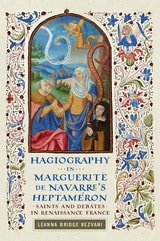
Hagiography in Marguerite de Navarre’s Heptaméron
Saints and Debates in Renaissance FranceLeanna Bridge Rezvani
University of Delaware Press, 2026
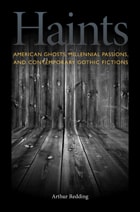
Haints
American Ghosts, Millennial Passions, and Contemporary Gothic FictionsArthur Redding
University of Alabama Press, 2011
In Haints: American Ghosts, Millennial Passions, and Contemporary Gothic Fictions, Arthur Redding argues that ghosts serve as lasting witnesses to the legacies of slaves and indigenous peoples whose stories were lost in the remembrance or mistranslation of history.
Authors such as Toni Morrison and Leslie Marmon Silko deploy the ghost as a means of reconciling their own violently repressed heritage with their identity as modern Americans. And just as our ancestors were haunted by ghosts of the past, today their descendants are haunted by ghosts of contemporary crises: urban violence, racial hatred, and even terrorism. In other cases that Redding studies—such as James Baldwin’s The Evidence of Things Not Seen and Toni Cade Bambara’s Those Bones Are Not My Child—gothic writers address similar crises to challenge traditional American claims of innocence and justice.
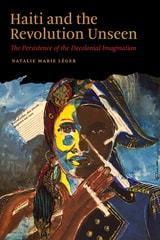
Haiti and the Revolution Unseen
The Persistence of the Decolonial ImaginationNatalie Marie Léger
Vanderbilt University Press, 2025
Léger writes against a Haiti- and Haitians-less idea of the Revolution. She asks scholars and artists of the Revolution to know Haitians as Ginens (African Haitians) and Haiti as Ayiti Ginen (Africa Haiti). This form of knowing demands a decolonial understanding of the Haitian Revolution and a reevaluation of its stories as told by influential twentieth-century Caribbean writers. The story she tells showcases the immense political impact of the African Haitian revolutionist’s philosophies of freedom in Saint Domingue and Haiti thereafter; and she argues that the absence of these philosophies in Caribbean classics of the Revolution demands consideration of why these classics continue to shape how the Revolution and Haiti are discussed in Caribbean Studies, Black Studies, Postcolonial Studies and Haitian Studies. More pressingly, Léger calls on artists and scholars of the Revolution to be mindful of how Haiti and Haitians are figured in narratives of the Revolution. The immense space Haiti holds in Caribbean imaginings of freedom and revolution makes mediating it, its Revolution, and peoples through a prejudiced gaze that serves the West hugely problematic, since a denigrated Haiti yields stunted visions of the Caribbean’s future. These conditions require attention to the pervasive presence of colonial paradigms for being in classic literatures of the Revolution and the way they undermine the generative manner Caribbean writers have used Haiti to think through their past, present, and future.
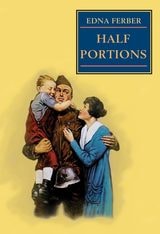
Half Portions
Edna Ferber
University of Illinois Press, 2002
A collection of short stories from Pultizer Prize winner, Edna Ferber
The short stories in this collection take the reader from small-town Wisconsin to the bustling streets of New York and Chicago and back again. While they range greatly in length and tone, they all share the trademark wit and affectionate insight of Edna Ferber.
Showcasing the facility with words that made her a mainstay at the Algonquin round table, Ferber explores some of her favorite themes: the role of women (especially strong or unconventional women) in modern society, the mores of the midwestern small town, and the changes over time in relationships between parents and children.
In “The Maternal Feminine,” a plain, overlooked child grows into a strong, resourceful businesswoman and forms a strong motherly bond with the children of her more attractive sister. In “April 25th, As Usual,” an aging Wisconsin couple reluctantly join their successful daughter in New York, where they try to adjust to a very different lifestyle. “Old Lady Mandle” is a bittersweet tale about an elderly Chicago mother coming to terms with the fact that she is no longer the most important woman in the life of her grown son. “One Hundred Per Cent” features Ferber’s celebrated heroine Emma McChesney, now re-married, seeing her husband off to war.
The stories gathered here are beautifully observed chronicles of early twentieth-century life and are filled with characters who, despite their very human foibles, are all bestowed by Ferber with warmth and dignity.
Half-Truths and One-and-a-Half Truths
Selected AphorismsKarl Kraus
University of Chicago Press, 1990
"Kraus is a superb aphorist."—D. J. Enright, New York Review of Books
Hamlet
shakespeare
St. Augustine's Press, 2024
This edition is the first that treats Hamlet as the work of a philosophical poet concerned with knowing the nature of the world, particularly the human world. Where conventional editions lift the play out of its specific setting and analyze it in the light of the social, cultural, and political circumstances of Elizabethan England, Jan Blits takes the play’s dramatic setting of early Renaissance Denmark as indispensable to understanding its rich meaning. In providing notations and commentary on Hamlet, Blits sets aside the historicist principle or prejudice, pervasive throughout literary studies today. Blits, by contrast, strives to understand the play entirely on its own terms. He inflicts no literary or philosophic theory—no parochial professional preconceptions—upon the play. Instead, he aims to be fully receptive to what Shakespeare wrote and try to draw out of the play the substance that he deliberately put into it. His treatment of Horatio is particularly stunning in this regard.
Though they differ from each other, there are two generally trustworthy texts of Hamlet—namely, the Second Quarto (1604–5) and the Folio (1623). Blits does not consult the First Quarto (1603), which contains a much different dialogue, some different character names, and omits some famous passages. Blits points out important variations and refrains from pronouncing which are clearly right or wrong. He omits references to secondary works (including his own) as distractions from the play itself. The Bibliography lists many primary and secondary readings that readers will find helpful. He follows the line-numbering of the New Cambridge Shakespeare Edition, edited by Philips Edwards.
Teachers and students of Shakespeare will find a valuable resource in Blits' new edition of Hamlet, which brings readers as close to the mind and heart of the real Shakespeare as possible and remains untouched by the fingerprints of literary theory and other mechanisms unknown and inconsequential to Shakespeare. This is also an indispensable tool in helping teachers in one of the greatest challenges of the classical classroom––namely, how to teach Shakespeare?
Hamlet's Castle
The Study of Literature as a Social ExperienceBy Gordon Mills
University of Texas Press, 1976
Hamlet's Castle is both a theoretical and a practical examination of the interactions that take place in a literary classroom. The book traces the source of literature's power to the relationship between its illusional quality and its abstract meaning and relates these elements to the process by which a group, typically an academic class, forms a judgment about a literary work. In focusing on the importance of the exchange of ideas by readers, Gordon Mills reveals a new way of looking at literature as well as a different concept of the social function of the literary classroom and the possible application of this model to other human activities.
The three fundamental elements that constitute Mills's schema are the relationship between a reader and the illusional quality of literature, the relationship between a reader and the meaning of a text, and the concept of social experience within the environment of a text. The roles of illusion and meaning in a text are explored in detail and are associated with areas outside literature, including science and jurisprudence. There is an examination of the way in which decisions are forced by peers upon one another during discussion of a literary work-an exchange of opinion which is commonly a source of pleasure and insight, sought for its own sake. In the course of his study, Mills shows that the act of apprehending a literary structure resembles that of apprehending a social structure. From this relationship, he derives the social function of the literary classroom.
In combining a theoretical analysis with the practical objective of determining what value can be found in the study of literature by groups of people, Mills has produced a critical study of great significance. Hamlet's Castle will change concepts about the purpose of teaching literature, affect the way in which literature is taught, and become involved in the continuing discussion of the relationship of literary studies to other disciplines.
Hamletics
Shakespeare, Kafka, BeckettMassimo Cacciari
Seagull Books, 2023
During the dramatic course of the twentieth century, amid the clash of the titans which marked that era, humanity could still think in terms of partisan struggles in which large masses took sides against one another. The new millennium, by contrast, appears to have opened under the guise of generalized insecurity, which pertains not only to the historical and social situation, or to one’s personal psychological predicament, but to our very being. The Earth’s current faltering and the twilight of every convention that might govern it—where roles, images, and languages become confused by a lack of direction and distance—were already powerfully prophesied in Shakespeare’s Hamlet, and later in the works of Kafka and Beckett. In Hamletics, Massimo Cacciari, one of Italy’s foremost philosophers and leftist political figures, establishes a dialogue between these fateful authors, exploring the relationship between European nihilism and the aporias of action in the present.
HandiLand
The Crippest Place on EarthElizabeth A. Wheeler
University of Michigan Press, 2019
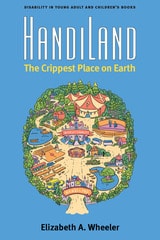
HandiLand looks at young adult novels, fantasy series, graphic memoirs, and picture books of the last 25 years in which characters with disabilities take center stage for the first time. These books take what others regard as weaknesses—for instance, Harry Potter’s headaches or Hazel Lancaster’s oxygen tank—and redefine them as part of the hero’s journey. HandiLand places this movement from sidekick to hero in the political contexts of disability rights movements in the United States, the United Kingdom, and Ghana.
Elizabeth A. Wheeler invokes the fantasy of HandiLand, an ideal society ready for young people with disabilities before they get there, as a yardstick to measure how far we’ve come and how far we still need to go toward the goal of total inclusion. The book moves through the public spaces young people with disabilities have entered, including schools, nature, and online communities. As a disabled person and parent of children with disabilities, Wheeler offers an inside look into families who collude with their kids in shaping a better world. Moving, funny, and beautifully written, HandiLand: The Crippest Place on Earth is the definitive study of disability in contemporary literature for young readers.
Handsomely Done
Aesthetics, Politics, and Media after MelvilleEdited by Daniel Hoffman-Schwartz
Northwestern University Press, 2019
The volume thus engages not only Melville reception across media (Jorge Luis Borges, John Huston, Jean-Luc Godard, Led Zeppelin, Claire Denis) but also the Melvillean resonances and echoes of various political events and movements, such as the Attica uprising, the Red Army Faction, Occupy Wall Street, and Black Lives Matter. This consideration of Melville’s afterlife opens onto theorizations of intermediality, un/translatability, and material intensity even as it also continually faces the most concrete and pressing questions of history and politics.
Handwriting in Early America
A Media HistoryEdited by Mark Alan Mattes, Foreword by Karen Sánchez-Eppler, Afterword by Christopher Hager
University of Massachusetts Press, 2023
As digital communication has become dominant, commentators have declared that handwriting is a thing of the past, a relic of an earlier age. This volume of original essays makes it clear that anxiety around handwriting has existed for centuries and explores writing practices from a variety of interdisciplinary fields, including manuscript studies, Native American studies, media history, African American studies, book history, bibliography, textual studies, and archive theory.
By examining how a culturally diverse set of people grappled with handwriting in their own time and weathered shifting relationships to it, Handwriting in Early America uncovers perspectives that are multiethnic and multiracial, transatlantic and hemispheric, colonial and Indigenous, multilingual and illiterate. Essays describe a future of handwriting as envisioned by practitioners, teachers, and even government officials of this time, revealing the tension between the anxiety of loss and the need to allow for variations going forward.
Contributors include James Berkey, Blake Bronson-Bartlett, John J. Garcia, Christopher Hager, Desirée Henderson, Frank Kelderman, Michelle Levy, Lisa Maruca, Christen Mucher, Alan Niles, Seth Perlow, Carla L. Peterson, Sarah Robbins, Patricia Jane Roylance, Karen Sánchez-Eppler, and Danielle Skeehan.
Hannah Whitman Heyde
The Complete CorrespondenceMaire Mullins
Bucknell University Press, 2022
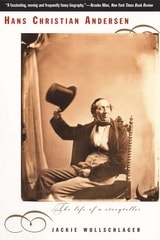
Hans Christian Andersen
The Life of a StorytellerJackie Wullschlager
University of Chicago Press, 2002
Drawing on letters, diaries, and other original sources (many never before translated from the Danish), Wullschlager shows in this compelling, extensively researched biography how Andersen's writings—darker and more diverse than previously recognized—reflected the complexities of his life, a far cry from the "happily ever after" of a fairy tale. As we follow in his footsteps from Golden Age Copenhagen to the princely courts of Germany and the villas of southern Italy, Andersen becomes a figure every bit as fascinating as a character from one of his stories—a gawky, self-pitying, and desperate man, but also one of the most gifted storytellers the world has ever known.
Hansberry's Drama
COMMITMENT AMID COMPLEXITYSteven R. Carter
University of Illinois Press, 1991
Haphazard Families
Romanticism, Nation, and the Prehistory of Modern AdoptionEric C. Walker
The Ohio State University Press, 2024
There are no provisions for adoption in English common law, and adoption wasn't legally formalized in England and Wales until 1926. But a century earlier, untimely adoptions navigated the new exceptionalism of childhood in Romanticism. In Haphazard Families, Eric C. Walker explores the history of the adopted child in Romantic-era England. Taking up the stories of both fictional and historical adoptees, he demonstrates how these children, diminished to nonpersons, shouldered the burden of social constructs of nation, family, gender, and class. Walker further demonstrates how Rousseau’s infamous failure to follow his own ideals of parenthood shaped British reactions in famous texts such as Frankenstein and Emma. Incorporating perspectives from Romantic scholarship and critical adoption studies and examining the stories of adopted children associated with Queen Caroline, Anna Letitia Barbauld, Jane Austen, the Wordsworth siblings, Mary Shelley, Charles and Mary Lamb, Letitia Landon, and others, Haphazard Families considers how Romantic constructions of childhood supply foundational structures of modern adoptee subjectivity.

Hard Choices
An "Iowa Review" ReaderDAVID HAMILTON
University of Iowa Press, 1996
For twenty-five years, the Iowa Review has published many of America's finest writers, often helping them become established in their careers. From Tillie Olsen and William Stafford in the first volume to James Galvin and Pattiann Rogers in the twenty-fourth, the names and voices are recognizable and respected or soon will be. As editor David Hamilton notes in his introduction to this eclectic anniversary volume of nearly eighty poems and stories, "To a considerable extent we have defined ourselves by them; thus Hard Choices, a generous sampling of the best and most interesting writing from the Iowa Review's first years, defines the past and the future of American literature."
The Iowa Review is one of a small group of dedicated literary magazines that have defined American literary culture in the past quarter century. The adventurous, stimulating pieces in Hard Choices will encourage readers to look forward to the next quarter century.

Hard Science Fiction
George E Slusser
Southern Illinois University Press, 1986
These 16 essays from the fifth annual J.Lloyd Eaton Conference at the University of California, Riverside, seek to come to grips with science fiction’s core, the core at which “science must ultimately seem to outweigh the fiction.”
Never before has hard SF been the topic of such extended discussion by such qualified people. The dialogue constitutes new (and potentially shocking to a traditional literary critic) modes of literary criticism, modes that take into account the impact of scientific speculation and method on our culture and on the ways our culture invents stories and myths.
Essayists include writer/scientist professors Robert L. Forward, David Brin, and Gregory Benford. Noted critics and writers with scientific backgrounds or interests include: James Gunn, Frank McConnell, George Guffey, John Huntington, Paul Carter, Patricia Warrick, Paul Alkon, Robert M. Philmus, David Clayton, Eric S. Rabkin, Herbert Sussman, Michael Collings, and George E. Slusser.
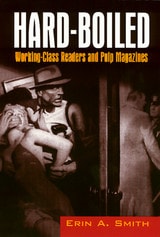
Hard-Boiled
Erin A. Smith
Temple University Press, 2000
Relying on pulp magazine advertising, the memoirs of writers and publishers, Depression-era studies of adult reading habits, social and labor history, Smith offers an innovative account of how these popular stories were generated and read. She shows that although the work of pulp fiction authors like Dashiell Hammett, Raymond Chandler, and Erle Stanley Gardner have become “classics” of popular culture, the hard-boiled genre was dominated by hack writers paid by the word, not self-styled artists. Pulp magazine editors and writers emphasized a gritty realism in the new genre. Unlike the highly rational and respectable British protagonists (Miss Marple and Hercule Poirot, for instance), tough-talking American private eyes relied as much on their fists as their brains as they made their way through tangled plotlines.
Casting working-class readers of pulp fiction as “poachers,” Smith argues that they understood these stories as parables about Taylorism, work, and manhood; as guides to navigating consumer culture; as sites for managing anxieties about working women. Engaged in re-creating white, male privilege for the modern, heterosocial world, pulp detective fiction shaped readers into consumers by selling them what they wanted to hear – stories about manly artisan-heroes who resisted encroaching commodity culture and the female consumers who came with it. Commenting on the genre’s staying power, Smith considers contemporary detective fiction by women, minority, and gay and lesbian writers.
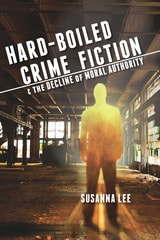
Hard-Boiled Crime Fiction and the Decline of Moral Authority
Susanna Lee
The Ohio State University Press, 2016
Lee traces the history of the hard-boiled detective through the twentieth century and on both sides of the Atlantic (France and the United States), tying the idea of morality to the character model in nuanced, multifaceted ways. When the heroic model devolves, the very conceptual validity of individual moral authority can seem to devolve as well. Hard-Boiled Crime Fiction and the Decline of Moral Authority charts the evolution of that character model of the hard-boiled hero, the mid-century deterioration of his exemplarity, and twenty-first-century endeavors to resuscitate the accountable hero. The history of hard-boiled crime fiction tells nothing less than the story of individual autonomy and accountability in modern Western culture.
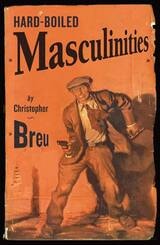
Hard-Boiled Masculinities
Christopher Breu
University of Minnesota Press, 2005
Looking closely at this transformation, Christopher Breu offers a complex account of how and why hard-boiled masculinity emerged during an unsettled time of increased urbanization and tenuous peace and traces the changes in its cultural conception as it moved back and forth across the divide between high and low culture as well as the color line that bifurcated American society.
Examining the work of Ernest Hemingway, Dashiell Hammett, Chester Himes, and William Faulkner, as well as many lesser-known writers for the hypermasculine pulp magazines of the 1920s and 1930s, Breu illustrates how the tough male was a product of cultural fantasy, one that shored up gender and racial stereotypes as a way of lashing out at the destabilizing effects of capitalism and social transformation.
Christopher Breu is assistant professor of English at Illinois State University.

Hard-Core Romance
"Fifty Shades of Grey," Best-Sellers, and SocietyEva Illouz
University of Chicago Press, 2014
Harmful Eloquence
Ovid's Amores from Antiquity to ShakespeareM. L. Stapleton
University of Michigan Press, 1996
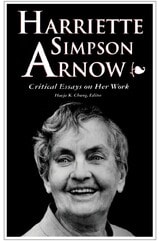
Harriette Simpson Arnow
Critical Essays on Her WorkHaeja K. Chung
Michigan State University Press, 1995
At her death in 1986, Harriette Simpson Arnow left a modest collection of published work: ten short stories, five novels, two non-fiction books, a short autobiography, and nineteen essays and book reviews. Although the sum is small, her writing has been examined from regionalist, Marxist, feminist, and other critical perspectives.
The 1970s saw the first serious attempts to revive interest in Arnow. In 1971, Tillie Olsen identified her as a writer whose "books of great worth suffer the death of being unknown, or at best, a peculiar eclipsing." Joyse Carol Oates wrote in The New York Times Book Review that Arnow's The Dollmaker is "our most unpretentious American masterpiece."
In the 1990s, it is appropriate to take stock of her earlier work and to prompt reexamination of this powerful yet poorly understood writer. This collection of critical essays examines traditional as well as new interpretations of Arnow and her work. It also suggests future directions for Arnow scholarship and includes studies of all of Arnow's writing, fiction and non-fiction, published and unpublished.
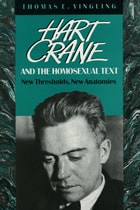
Hart Crane and the Homosexual Text
New Thresholds, New AnatomiesThomas E. Yingling
University of Chicago Press, 1990
"A brilliant critical model for understanding how textuality and sexuality can produce pervasive effects on each other in the writing of a figure like Crane."—Michael Moon, Duke University
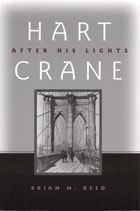
Hart Crane
After His LightsBrian M. Reed
University of Alabama Press, 2006
In Hart Crane: After His Lights, Brian Reed undertakes a study of Crane’s poetic output that takes into account, but also questions, the post-structural and theoretical developments in humanities scholarship of the last decade that have largely approached Crane in a piecemeal way, or pigeonholed him as represen-tative of his class, gender, or sexual orientation. Reed examines Crane’s career from his juvenilia to his posthumous critical reception and his impact on practicing poets following World War II. The first part of the study tests common rubrics of literary theory—nationality, sexuality, period—against Crane’s poetry, and finds that these labels, while enlightening, also obfuscate the origin and character of the poet’s work. The second part examines Crane’s poetry through the process of its composition, sources, and models, taking up questions of style, genealogy, and genre. The final section examines Crane’s influence on subsequent generations of American poets, especially by avant-garde literary circles like the New American poets, the Black Mountain School, the New York School, and the Beats.
The result is a study that complicates and enriches our understandings of Crane’s poetry and contributes to the ongoing reassessment of literary modernism’s origins, course, and legacy.

Harvester of Hearts
Motherhood under the Sign of FrankensteinRachel Feder
Northwestern University Press, 2018
In the period between 1815 and 1820, Mary Shelley wrote her most famous novel, Frankenstein; or, The Modern Prometheus, as well as its companion piece, Mathilda, a tragic incest narrative that was confiscated by her father, William Godwin, and left unpublished until 1959. She also gave birth to four—and lost three—children.
In this hybrid text, Rachel Feder interprets Frankenstein and Mathilda within a series of provocative frameworks including Shelley’s experiences of motherhood and maternal loss, twentieth-century feminists’ interests in and attachments to Mary Shelley, and the critic’s own experiences of pregnancy, childbirth, and motherhood. Harvester of Hearts explores how Mary Shelley’s exchanges with her children—in utero, in birth, in life, and in death—infuse her literary creations. Drawing on the archives of feminist scholarship, Feder theorizes “elective affinities,” a term she borrows from Goethe to interrogate how the personal attachments of literary critics shape our sense of literary history. Feder blurs the distinctions between intellectual, bodily, literary, and personal history, reanimating the classical feminist discourse on Frankenstein by stepping into the frame.
The result—at once an experimental book of literary criticism, a performative foray into feminist praxis, and a deeply personal lyric essay—not only locates Mary Shelley’s monsters within the folds of maternal identity but also illuminates the connections between the literary and the quotidian.
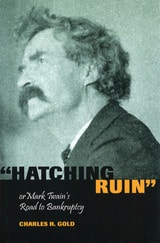
Hatching Ruin
Or Mark Twain's Road to BankruptcyCharles H. Gold
University of Missouri Press, 2003
In “Hatching Ruin,” Charles H. Gold provides a complete description of Samuel L. Clemens’s business relationships with Charles L. Webster and James W. Paige during the 1880s. Gold analyzes how these relationships affected Clemens as a person and an artist, most notably in A Connecticut Yankee in King Arthur’s Court.
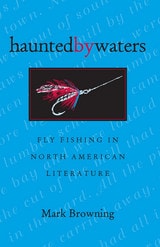
Haunted By Waters
Fly Fishing In North American LiteratureMark Browning
Ohio University Press, 1998
As his own story unfolds, Mark Browning analyzes angling literature from the Bible to Norman Maclean, always bringing his inquiry back to the same source: the enigma of this sport.
Haunted by Waters is an exploration of the apparent compulsion of those who fish not only to read about the sport, but to write about it as well. Mark Browning's personal account as a fly fisherman and his perspective as a critic make him uniquely qualified to navigate these waters.
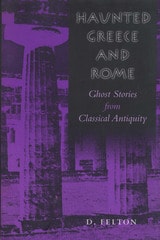
Haunted Greece and Rome
Ghost Stories from Classical AntiquityBy D. Felton
University of Texas Press, 1998
Stories of ghostly spirits who return to this world to warn of danger, to prophesy, to take revenge, to request proper burial, or to comfort the living fascinated people in ancient times just as they do today. In this innovative, interdisciplinary study, the author combines a modern folkloric perspective with literary analysis of ghost stories from classical antiquity to shed new light on the stories' folk roots.
The author begins by examining ancient Greek and Roman beliefs about death and the departed and the various kinds of ghost stories which arose from these beliefs. She then focuses on the longer stories of Plautus, Pliny, and Lucian, which concern haunted houses. Her analysis illuminates the oral and literary transmission and adaptation of folkloric motifs and the development of the ghost story as a literary form. In her concluding chapter, the author also traces the influence of ancient ghost stories on modern ghost story writers, a topic that will interest all readers and scholars of tales of hauntings.

Haunted Man's Report
Reading Charles PortisRobert Cochran
University of Arkansas Press, 2024
Haunted Man’s Report, a deeply insightful literary exploration of Portis’s singular and underexamined oeuvre, celebrates this novelist’s great achievement and is certain to prove a valuable guide for readers new to Portis as well as aficionados.
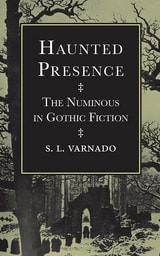
Haunted Presence
The Numinous in Gothic FictionS. L. Varnado
University of Alabama Press, 1987
Varnado offers a fresh and audacious analysis of the literature of the supernatural by employing insights derived from the philosophy of religious experience. Ranging from the Gothic novel of the eighteenth century to ghostly tales from the nineteenth and twentieth centuries, Varnado frames ghost stories as ontological challenge to the reader. The challenge is not in the form of philosophical proposition, however. Rather it is in the form of feelings and emotions that maintain a connection with the sense of reality. It is this area of reality that Rudolph Otto called the numinous—the feeling of the supernatural—that stands at the center of Gothic literature.
An understanding of this unique category of experience, aligned with its associated concept of “the sacred and the profane,” exposes the purpose of ghostly literature and demonstrates the enduring relevance of this mesmerizing genre.
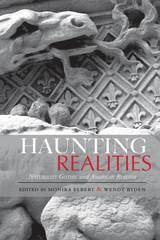
Haunting Realities
Naturalist Gothic and American RealismEdited by Monika Elbert and Wendy Ryden
University of Alabama Press, 2017
An innovative collection of essays examining the sometimes paradoxical alignment of Realism and Naturalism with the Gothic in American literature to highlight their shared qualities
Following the golden age of British Gothic in the late eighteenth century, the American Gothic’s pinnacle is often recognized as having taken place during the decades of American Romanticism. However, Haunting Realities explores the period of American Realism—the end of the nineteenth century—to discover evidence of fertile ground for another age of Gothic proliferation.
At first glance, “Naturalist Gothic” seems to be a contradiction in terms. While the Gothic is known for its sensational effects, with its emphasis on horror and the supernatural, the doctrines of late nineteenth-century Naturalism attempted to move away from the aesthetics of sentimentality and stressed sobering, mechanistic views of reality steeped in scientific thought and the determinism of market values and biology. Nonetheless, what binds Gothicism and Naturalism together is a vision of shared pessimism and the perception of a fearful, lingering presence that ominously haunts an impending modernity. Indeed, it seems that in many Naturalist works reality is so horrific that it can only be depicted through Gothic tropes that prefigure the alienation and despair of modernism.
In recent years, research on the Gothic has flourished, yet there has been no extensive study of the links between the Gothic and Naturalism, particularly those which stem from the early American Realist tradition. Haunting Realities is a timely volume that addresses this gap and is an important addition to scholarly work on both the Gothic and Naturalism in the American literary tradition.

Haunting Violations
Feminist Criticism and the Crisis of the "Real"Edited by Wendy S. Hesford and Wendy Kozol
University of Illinois Press, 2000
Feminist critics place a premium on the "real" stories told by the victimized and the oppressed. Haunting Violations offers a corrective to such uncritical acceptance of the "real" in confessional, testimonial, and ethnographic narratives. Through close readings of a wide variety of texts, contributors argue that depictions of the "real" are inherently performative, crafted within the limits and in the interests of specific personal, political, or social projects.
Haunting Violations explores the inseparability of discourse and politics in quasi-autobiographical works such as I, Rigoberta Menchú and When Heaven and Earth Changed Places. Contributors consider how the Sri Lankan Mother's Front movement exploits the sanctity of the maternal and how multiple political purposes on both sides bleed through government "documentary" photographs of Japanese-American concentration camp internees. This volume also investigates how South Asian feminists use the authority of their personal experience to critique the film Mississippi Masala and how realist narratives, such as Janet Campbell Hale's autobiographical Bloodlines, Margie Strosser's documentary film Rape Stories, and Shekur Kapur's film Bandit Queen, reexamine how assumptions about power and trauma are embedded in the promise of the real.
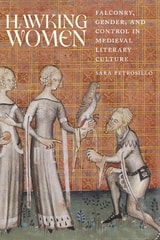
Hawking Women
Falconry, Gender, and Control in Medieval Literary CultureSara Petrosillo
The Ohio State University Press, 2023
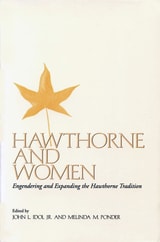
Hawthorne and Women
Engendering and Expanding the Hawthorne TraditionJohn L. Idol
University of Massachusetts Press, 1999
This collection of original essays presents a more complex and positive view of Hawthorne's attitudes toward women, demonstrating his recognition of the crucial role that women played--as critics, reviewers, readers, and authors--in building a national readership that made his writing career so successful.
The book begins with an examination of the influence exerted by the women in Hawthorne's immediate family. It goes on to explore his links to a broad range of women writers, as well as his attitudes toward the female characters he created. Among the authors discussed are Margaret Fuller, Harriet Beecher Stowe, Louisa May Alcott, Emily Dickinson, Sarah Orne Jewett, Willa Cather, Charlotte Perkins Gilman, George Eliot, Virginia Woolf, Flannery O'Connor, and Toni Morrison.
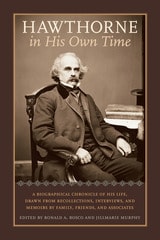
Hawthorne in His Own Time
A Biographical Chronicle of His Life,Drawn from Recollections,Interviews, and Memoirs by Family,FrieRonald A Bosco
University of Iowa Press, 2007
At his death, Nathaniel Hawthorne (1804–1864) was universally acknowledged in America and England as "the Great Romancer." Novels such as The Scarlet Letter and The House of the Seven Gables and stories published in such collections as Twice-Told Tales continue to capture the minds and imaginations of readers and critics to this day. Harder to capture, however, were the character and personality of the man himself. So few of the essays that appeared in the two years after his death offered new insights into his life, art, and reputation that Hawthorne seemed fated to premature obscurity or, at least, permanent misrepresentation. This first collection of personal reminiscences by those who knew Hawthorne intimately or knew about him through reliable secondary sources rescues him from these confusions and provides the real human history behind the successful writer.
Remembrances from Elizabeth Peabody, Sophia Hawthorne, Oliver Wendell Holmes, Ralph Waldo Emerson, Bronson Alcott, Rebecca Harding Davis, and twenty others printed in Hawthorne in His Own Time follow him from his childhood in Salem, through his years of initial literary obscurity, his days in the Boston and Salem Custom Houses, his service as U.S. Consul to Liverpool and Manchester and his life in the Anglo-American communities at Rome and Florence, to his late years as the "Great Romancer."
In their enlightening introduction, editors Ronald Bosco and Jillmarie Murphy assess the postmortem building of Hawthorne's reputation as well as his relationship to the prominent Transcendentalists, spiritualists, Swedenborgians, and other personalities of his time. By clarifying the sentimental associations between Hawthorne's writings and his actual personality and moving away from the critical review to the personal narrative, these artful and perceptive reminiscences tell the private and public story of a remarkable life.
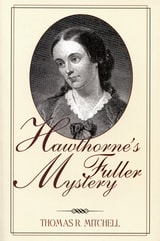
Hawthorne's Fuller Mystery
Thomas R. Mitchell
University of Massachusetts Press, 2009
Drawing on recently published letters and journals, Thomas R. Mitchell describes how Julian Hawthorne's misrepresentation of his father's relationship with Fuller destroyed her literary reputation, promoted Hawthorne as a defender of conservative values, and continues to obscure the depth of Hawthorne's personal and intellectual involvement with her. Mitchell concludes that far from being repulsed by Fuller and her assertiveness--as many scholars have claimed--Hawthorne experienced with her perhaps the most intimate relationship that he ever had with a woman, his wife alone excepted.
Blending biography, cultural history, and literary and psychological analysis, Hawthorne's Fuller Mystery raises provocative questions about the origins and intent of Hawthorne's greatest works and offers compelling new readings of "Rapaccini's Daughter," The Scarlet Letter, The Blithedale Romance, and The Marble Faun.
He Knew She Was Right
The Independent Woman in the Novels of Anthony TrollopeJane Nardin
Southern Illinois University Press, 1989
Trollope’s mother, wife, and a friend he loved platonically most of his life provided him three very different views of the Victorian woman. And, according to Jane Nardin, they were responsible for the dramatic shift in his treatment of women in his novels.
This is the first book in Sandra Gilbert’s Ad Feminam series to examine a male author. Nardin initially analyzes the novels Trollope wrote from 1855 to 1861, in which male concerns are central to the plot and women are angelic heroines, submissive and self-sacrificing. Even the titles of his novels written during this period are totally male oriented. The Three Clerks, Doctor Thorne, and The Bertrams all refer to men. Shortly after meeting Kate Field, Trollope wrote Orley Farm, which refers to the estate an angry woman steals from her husband and which marks a change in the attitudes toward women evident in his novels.
His next four books, The Small House at Allington, Rachel Ray, Can You Forgive Her?, and Miss Mackenzie, prove that women’s concerns had become central in his writing. Nardin examines specific novels written from 1861 to 1865 in which Trollope, with increasing vigor, subverts the conventional notions of gender that his earlier novels had endorsed.
Nardin argues that his novels written after 1865 and often recognized as feminist are not really departures but merely refinements of attitudes Trollope exhibited in earlier works.
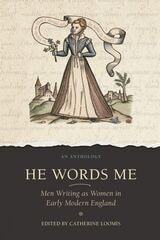
He Words Me
Men Writing as Women in Early Modern EnglandCatherine Loomis
Arizona Center for Medieval and Renaissance Studies, 2026
This anthology gives students and scholars access to a body of texts that provide a clearer understanding of what life was like for early modern women by presenting hundreds of little-known primary texts that contain details about early modern women’s work, relationships, emotional and intellectual development, friendships, and daily struggles. He Words Me brings together work from a variety of genres in which male authors adopt the voice of a female narrator and use that voice to provide intimate details about the lives of women.
These works introduce modern readers to less familiar genres, complement or contradict portrayals of women in canonical texts, and raise compelling questions about who speaks for women and when women can speak for themselves. Through these women’s voices, readers can encounter characters and experiences that will broaden their understanding of early modern English literature and culture, and of the history of women in the late sixteenth and early seventeenth centuries.
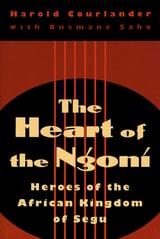
Heart of the Ngoni
Heroes of the African Kingdom of SeguHarold Courlander
University of Massachusetts Press, 1994
The heroic legends described here recreate the events and annals of the kingdom of Segu and of the Bambara tribe that formed a series of important city-states along the Niger River during the 17th century.
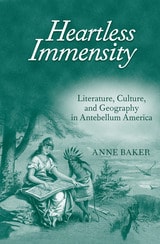
Heartless Immensity
Literature, Culture, and Geography in Antebellum AmericaAnne Baker
University of Michigan Press, 2010
Building on extensive archival research as well as insights from cultural geographers and theorists of nationhood, Heartless Immensity demonstrates that national expansion had a far more complicated, multifaceted impact on antebellum American culture than has previously been recognized. Baker shows that Americans developed a variety of linguistic strategies for imagining the form of the United States and its position in relation to other geopolitical entities. Comparisons
to European empires, biblical allusions, body politic metaphors, and metaphors derived from science all reflected—and often attempted to assuage—fears that the nation was becoming either monstrously large or else misshapen in ways that threatened cherished beliefs and national self-images.
Heartless Immensity argues that, in order to understand the nation’s shift from republic to empire and to understand American culture in a global context, it is first necessary to pay close attention to the processes by which the physical entity known as the United States came into being. This impressively thorough study will make a valuable contribution to the fields of American studies and literary studies.
Anne Baker is Assistant Professor of English at North Carolina State University.
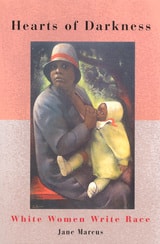
Hearts of Darkness
White Women Write RaceMarcus, Jane
Rutgers University Press, 2004
The centerpiece of the book is Marcus's dialogue with one of her best-known essays, "Britannia Rules The Waves." In that piece, she argues that The Waves makes a strong anti-imperialist statement. Although many already support that argument, she now goes further in order to question the moral value of such a buried critique on Woolf's part. In "A Very Fine Negress" she analyzes the painful subject of Virginia Woolf's racism in A Room of One's Own. Other chapters traverse the connected issues of modernism, race, and imperialism. In two of them, we follow Nancy Cunard through the making of the Negro anthology and her appearance in a popular novel of the freewheeling Jazz Age. Elsewhere, Marcus delivers a complex analysis of A Passage to India, in a reading that interrogates E. M. Forster's displacement of his fear of white Englishwomen struggling for the vote.
Marcus, as always, brings considerable gifts as both researcher and writer to this collection of new and reprinted essays, a combination resulting in a powerful interpretation of many of modernism's most cherished figures.
Hearts of Gold
John Ernest
University of Delaware Press, 0
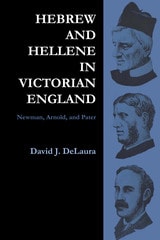
Hebrew and Hellene in Victorian England
Newman, Arnold, and PaterBy David DeLaura
University of Texas Press, 1969
Hebrew and Hellene explores the intellectual and personal relations among John Henry Newman, Matthew Arnold, and Walter Pater, three figures important in the development of nineteenth-century English thought and culture. Fundamentally concerned with the humanistic vision of Arnold and Pater, especially as they adapted the traditional religious culture to the needs of their generation, David DeLaura also recognizes Newman's central role. To a far greater degree than has been realized, Newman assumed a commanding position in the thought of the two younger men.
DeLaura seeks to define the mechanics of the process by which the conservative religious humanism of Newman could be exploited in the fluid, relativistic, and "aesthetic" humanism of Pater. The careers of Arnold and Pater are viewed as a continuing effort to reconcile the opposing forces of one of the central modern myths, the great cultural struggle between religious and secular values—Arnold's Hebraism and Hellenism.
DeLaura traces this important movement in nineteenth-century culture by studying the development of key phrases and ideas in the writings of the three men: the secularization of Newman's ideal of "inwardness" in Arnold's "criticism" and "culture" and in Pater's "impassioned contemplation"; the shared emphasis on an elite culture; the growing tendency to identify culture with the functions of traditional religion.
Newman, as the supreme apologist of both religious orthodoxy and the older Oxonian tradition, offered a rich arsenal to the defenders of a literary culture increasingly threatened by the utilitarian spirit (!nd by a rising scientific naturalism. Moreover, with the appearance of his Apologia in 1864, the "mystery" and the "miracle" of Newman's personality intrigued a new literary generation.
In Hebrew and Hellene DeLaura looks beyond the debates of the Late Victorians, the immediate inheritors of this legacy, to the continuing twentieth-century discussion of the nature of literature, its place in the humanizing process, and its role in a science-dominated civilization. He finds the problems faced by Pater, Arnold, and Newman—and some of their solutions—surprisingly relevant to unfinished contemporary debate.