Results by title
458 books match the query 'Literature' and 14 start with h
Hamlet's Castle
The Study of Literature as a Social ExperienceBy Gordon Mills
University of Texas Press, 1976
Hamlet's Castle is both a theoretical and a practical examination of the interactions that take place in a literary classroom. The book traces the source of literature's power to the relationship between its illusional quality and its abstract meaning and relates these elements to the process by which a group, typically an academic class, forms a judgment about a literary work. In focusing on the importance of the exchange of ideas by readers, Gordon Mills reveals a new way of looking at literature as well as a different concept of the social function of the literary classroom and the possible application of this model to other human activities.
The three fundamental elements that constitute Mills's schema are the relationship between a reader and the illusional quality of literature, the relationship between a reader and the meaning of a text, and the concept of social experience within the environment of a text. The roles of illusion and meaning in a text are explored in detail and are associated with areas outside literature, including science and jurisprudence. There is an examination of the way in which decisions are forced by peers upon one another during discussion of a literary work-an exchange of opinion which is commonly a source of pleasure and insight, sought for its own sake. In the course of his study, Mills shows that the act of apprehending a literary structure resembles that of apprehending a social structure. From this relationship, he derives the social function of the literary classroom.
In combining a theoretical analysis with the practical objective of determining what value can be found in the study of literature by groups of people, Mills has produced a critical study of great significance. Hamlet's Castle will change concepts about the purpose of teaching literature, affect the way in which literature is taught, and become involved in the continuing discussion of the relationship of literary studies to other disciplines.
Hawthorne and Women
Engendering and Expanding the Hawthorne TraditionJohn L. Idol
University of Massachusetts Press, 1999
This collection of original essays presents a more complex and positive view of Hawthorne's attitudes toward women, demonstrating his recognition of the crucial role that women played--as critics, reviewers, readers, and authors--in building a national readership that made his writing career so successful.
The book begins with an examination of the influence exerted by the women in Hawthorne's immediate family. It goes on to explore his links to a broad range of women writers, as well as his attitudes toward the female characters he created. Among the authors discussed are Margaret Fuller, Harriet Beecher Stowe, Louisa May Alcott, Emily Dickinson, Sarah Orne Jewett, Willa Cather, Charlotte Perkins Gilman, George Eliot, Virginia Woolf, Flannery O'Connor, and Toni Morrison.
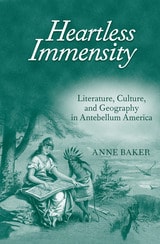
Heartless Immensity
Literature, Culture, and Geography in Antebellum AmericaAnne Baker
University of Michigan Press, 2010
Building on extensive archival research as well as insights from cultural geographers and theorists of nationhood, Heartless Immensity demonstrates that national expansion had a far more complicated, multifaceted impact on antebellum American culture than has previously been recognized. Baker shows that Americans developed a variety of linguistic strategies for imagining the form of the United States and its position in relation to other geopolitical entities. Comparisons
to European empires, biblical allusions, body politic metaphors, and metaphors derived from science all reflected—and often attempted to assuage—fears that the nation was becoming either monstrously large or else misshapen in ways that threatened cherished beliefs and national self-images.
Heartless Immensity argues that, in order to understand the nation’s shift from republic to empire and to understand American culture in a global context, it is first necessary to pay close attention to the processes by which the physical entity known as the United States came into being. This impressively thorough study will make a valuable contribution to the fields of American studies and literary studies.
Anne Baker is Assistant Professor of English at North Carolina State University.
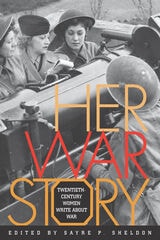
Her War Story
Twentieth-Century Women Write About WarEdited by Sayre P. Sheldon
Southern Illinois University Press, 1999
Sayre P. Sheldon chose the twentieth century for this collection of women's war writing because women's roles in war have changed dramatically in this century. The twentieth century has redefined the meaning of combat and expanded the territory of war to include women in larger numbers than ever before. When the technological advances of modern war began to target civilians, the home front became the front line. Women took an active part in war whether or not by choice, often by moving into occupations previously closed to them. Women covered wars for their newspapers, wrote war propaganda for their governments, published their wartime diaries, described fighting alongside men, and used wartime experience for their fiction and poetry.
Women writers also chose the right to imagine war, just as men for centuries had written about war without actually experiencing it. Women writers anthologized here include Anna Akhmatova, Vera Brittain, Gwendolyn Brooks, Willa Cather, Colette, Martha Gellhorn, H.D., Etty Hillesum, Käthe Kollwitz, Doris Lessing, Amy Lowell, Katherine Mansfield, Mary McCarthy, Toni Morrison, Dorothy Parker, Mary Lee Settle, Gertrude Stein, Huong Tram, Edith Wharton, Virginia Woolf, and Mitsuye Yamada.
Here Is a Figure
Grounding Literary FormSarah Dowling
Northwestern University Press, 2025
A study of supine, prone, and recumbent figures in contemporary literature
The prostitute, the protester, the murder victim, the invalid, the layabout, the depressive: all are associated with lying down. Skewing and flattening the perpendicular axis that defines the human in Western philosophy, art, and humanist inquiry, these downward-directed figures’ refusals or failures to hew to the moral and postural logics of uprightness enable a reassessment of subjectivity, ecological relation, and representation—that last of which is, after all, a process of standing-in-for. Here Is a Figure: Grounding Literary Form works across an array of well-known and counter-canonical texts, showing that recumbent figures saturate the literary arts of the present and respond to the proliferation of contemporary forms of grounding, in all its meanings. Reading these figures in dialogue with critical Indigenous studies, disability studies, and horizontalist feminisms, Sarah Dowling reveals the potential in thinking with and through a position stretched out across, dependent on, and undetachable from the earth.
Heretical Fictions
Religion in the Literature of Mark TwainLAWRENCE I. BERKOVE
University of Iowa Press, 2010
Challenging the prevailing belief that Mark Twain’s position on religion hovered somewhere between skepticism and outright heresy, Lawrence Berkove and Joseph Csicsila marshal biographical details of Twain’s life alongside close readings of his work to explore the religious faith of America’s most beloved writer and humorist. They conclude not only that religion was an important factor in Twain’s life but also that the popular conception of Twain as agnostic, atheist, or apostate is simply wrong.
Heretical Fictions is the first full-length study to assess the importance of Twain’s heretical Calvinism as the foundation of his major works, bringing to light important thematic ties that connect the author’s early work to his high period and from there to his late work. Berkove and Csicsila set forth the main elements of Twain’s “countertheological” interpretation of Calvinism and analyze in detail the way it shapes five of his major books—Roughing It, The Adventures of Tom Sawyer, Adventures of Huckleberry Finn, A Connecticut Yankee in King Arthur's Court, and No. 44, The Mysterious Stranger—as well as some of his major short stories. The result is a ground-breaking and unconventional portrait of a seminal figure in American letters.
Heterologies
Discourse on the OtherMichel De Certeau
University of Minnesota Press, 1986

Hints And Disguises
Marianne Moore ContemporariesCeleste Goodridge
University of Iowa Press, 1989
The first book-length exploration of Marianne Moore's prose focuses on her private and public critical exchanges with Wallace Stevens, Ezra Pound, William Carlos Williams, and T.S. Eliot. Drawing on previously unpublished material from the Moore Archive—correspondence, notebooks, manuscript notes, and books—Celeste Goodridge establishes Moore's central role as both poet-critic and prose stylist, providing a new perspective for considering Moore in relation to her contemporaries.
With clarity and elegance, Goodridge shows that Moore's most compelling critical judgments can best be recovered by examining the relationship between her private disclosures and her public pronouncements; her aesthetic of "hints and disguises" reveals a tension between what she felt free to voice and what she chose to veil.
In writing about these four poets, Moore made her greatest contribution to modernist criticism. With unusual perspicacity, she anticipated and defined many of the critical debates which still surround these writers' projects. Furthermore, Moore's critical exchanges indicated that her deepest alliances were with Stevens and Pound and not, as most have argued, with Williams and Eliot.
History, Literature and the Writing of the Canadian Prairies
Alison Calder
University of Manitoba Press, 2005
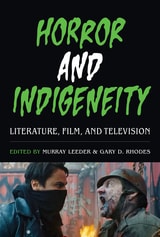
Horror and Indigeneity
Literature, Film, and TelevisionEdited by Murray Leeder and Gary D. Rhodes
University of Texas Press, 2026
A collection of essays about Indigeneity and horror in cinema, literature, and beyond.
How did Indigeneity come to be horrifying? Think of the “Indian burial ground” trope, a staple of 1970s horror cinema, not to mention decades of Western films and fictions that made “savage Indians” the face of fear in popular culture. Can horror do something else in the hands of Indigenous people? Creators such as Eden Robinson and Jeff Barnaby have self-consciously turned to horror to tell new kinds of stories, stories that question who is a monster and what constitutes the monstrous.
Horror and Indigeneity explores representations of Indigenous people in settler horror texts and in the growing corpus of horror by Indigenous writers and filmmakers. Widely spanning time periods and media, the contributors to this edited volume address themes such as cannibalism, eco-horror, historical trauma, and contemporary antiracism as they relate to classical horror cinema and recent works such as The Dead Can’t Dance, Lovecraft Country, and Stephen Graham Jones’s The Only Good Indians. Also featuring interviews with Jones and director T. J. Cuthand, Horror and Indigeneity rethinks the terror of the Other in potent and provocactive terms.

Hot Property
The Stakes and Claims of Literary OriginalityFrançoise Meltzer
University of Chicago Press, 1994
Freud, inventor of "dream work," turns a blind eye upon the dreams that were the starting point of his predecessor Descartes's famous methode, the one man's obsession with originality mirroring the other's fear of plagiarism. The Holocaust poet Paul Celan, whose sense of identity and place resided in his work, is devastated by a charge of plagiarism. Colette's husband Willy outdoes himself, and his "lazy" wife as well, with his enactment of literary seriousness. Walter Benjamin's early interpreters, notably Hannah Arendt and Theodor Adorno, insidiously undermine the originality of his project . In each of these cases, Meltzer shows how a threat to a writer's status as creator betrays the larger fraud of the originality myth itself.
Fascinating for its insights into the ways originality is both at risk and at work in Western literary culture, Hot Property will engage all those who have an interest in questions of authorship, textual soveriegnty, and the legitimacy of the critical establishment.
How Russia Learned to Write
Literature and the Imperial Table of RanksIrina Reyfman
University of Wisconsin Press, 2021
Irina Reyfman illuminates the surprisingly diverse effects of the Table of Ranks on writers, their work, and literary culture in Russia. From Sumarokov and Derzhavin in the eighteenth century through Pushkin, Gogol, Dostoevsky, and poets serving in the military in the nineteenth, state service affected the self-images of writers and the themes of their creative output. Reyfman also notes its effects on Russia’s atypical course in the professionalization and social status of literary work.
How We Became Posthuman
Virtual Bodies in Cybernetics, Literature, and InformaticsN. Katherine Hayles
University of Chicago Press, 1999
Hayles relates three interwoven stories: how information lost its body, that is, how it came to be conceptualized as an entity separate from the material forms that carry it; the cultural and technological construction of the cyborg; and the dismantling of the liberal humanist "subject" in cybernetic discourse, along with the emergence of the "posthuman."
Ranging widely across the history of technology, cultural studies, and literary criticism, Hayles shows what had to be erased, forgotten, and elided to conceive of information as a disembodied entity. Thus she moves from the post-World War II Macy Conferences on cybernetics to the 1952 novel Limbo by cybernetics aficionado Bernard Wolfe; from the concept of self-making to Philip K. Dick's literary explorations of hallucination and reality; and from artificial life to postmodern novels exploring the implications of seeing humans as cybernetic systems.
Although becoming posthuman can be nightmarish, Hayles shows how it can also be liberating. From the birth of cybernetics to artificial life, How We Became Posthuman provides an indispensable account of how we arrived in our virtual age, and of where we might go from here.
Hugo von Hofmannsthal and His Time
The European Imagination, 1860-1920Hermann Broch
University of Chicago Press, 1984
Through an analysis of the changing thought and career of the Austrian poet, librettist, and essaist Hugo von Hofmannsthal (1874-1929), Broch attempts to define and analyze the major intellectual issues of the European fin de siècle, a period that he characterizes according to the Nietzschean concepts of the breakdown of rationality and the loss of a central value system. The result is a major examination of European thought as well as a comparative study of political systems and artistic styles.