Results by title
63 books match the query 'Medical policy' and 5 start with h
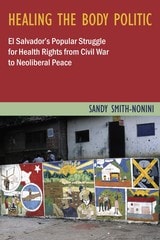
Healing the Body Politic
El Salvador's Popular Struggle for Health Rights from Civil War to Neoliberal PeaceSmith-Nonini, Sandy
Rutgers University Press, 2010
Incorporating investigative journalism and drawing on interviews with participants and leaders, Sandy Smith-Nonini examines the contested place of health and development in El Salvador over the last two decades. Healing the Body Politic recounts the dramatic story of radical health activism from its origins in liberation theology and guerrilla medicine during the third-world country's twelve-year civil war, through development of a remarkable "popular health system," administered by lay providers in a former war zone controlled by leftist rebels. This ethnography casts light on the conflicts between the conservative Ministry of Health and primary health advocates during the 1990s peace process--a time when the government sought to dismantle the effective peasant-run rural system. It offers a rare analysis of the White Marches of 2002û2003, when radicalized physicians rose to national leadership in a successful campaign against privatization of the social security health system. Healing the Body Politic contributes to the productive integration of medical and political anthropology by bringing the semiotics of health and the body to bear on cultural understandings of warfare, the state, and globalization.
[more]

Health Policy and the Disadvantaged
Lawrence D. Brown, ed.
Duke University Press, 1991
This important collection of essays, originating in a 1989 conference on the disadvantaged in American health care, provides incisive commentary on U.S. health care policy and politics. Examining public responses to health crises and analyzing the political logic of the American community, this volume charts the immobility of U.S. health policy in recent years and points to its disastrous consequences for the 1990s.
Focusing on the particular needs of disadvantaged groups—the elderly, children, people with AIDS, the mentally ill, the chemically dependent, the homeless, the hungry, the medically uninsured—these essays develop strong policy statements. The authors describe the growth in U.S. health care programs, from Kerr-Mills to Medicare, Medicaid, and subsequent revisions, and stress the serious omissions resulting from incremental policy expansion, both in identifying disadvantaged groups and in implementing programs. They report the weakness of the U.S. health care system compared to systems of other technologically developed countries.
Focusing on the particular needs of disadvantaged groups—the elderly, children, people with AIDS, the mentally ill, the chemically dependent, the homeless, the hungry, the medically uninsured—these essays develop strong policy statements. The authors describe the growth in U.S. health care programs, from Kerr-Mills to Medicare, Medicaid, and subsequent revisions, and stress the serious omissions resulting from incremental policy expansion, both in identifying disadvantaged groups and in implementing programs. They report the weakness of the U.S. health care system compared to systems of other technologically developed countries.
Contributors. Deborah A. Stone and Theodore R. Marmor, Judith Feder, Alice Sardell, Bruce C. Vladeck, Michael Lipsky and Marc A. Thibodeau, Daniel M. Fox, William E. McAuliffe, M. Gregg Bloche and Francine Cournos, Lawrence D. Brown, James A. Morrone
[more]
Health Services Privatization in Industrial Societies
Scarpaci, Joseph L
Rutgers University Press, 1989
As governments in industrialized nations around the world face fiscal crises, they are increasingly turning over the functions of the welfare state to the private sector. Health care systems are particularly tempting targets for privatization. The costs of health care have risen faster than many other services. Health care systems fail to reward efficiency, and liberal welfare policies have enlarged the number of people who benefit from public health care services, and have done so in ways that often seem inequitable. The particular forms that privatized health care take are closely intertwined with local and political and economic circumstances, but the popularity of the idea in all kinds of governments, in all parts of the world, is very striking. This book looks at the theory and practice of privatization of health services internationally. The contributors argue that the restructuring of health care systems affects local communities in markedly uneven ways. Ultimately, they conclude, conflicts arising from economic and geographic inequities implicit in privatization will limit the degree to which any government can dismantle its health care services.
[more]
History and Health Policy in the United States
Putting the Past Back InStevens, Rosemary A
Rutgers University Press, 2006
In our rapidly advancing scientific and technological world, many take great pride and comfort in believing that we are on the threshold of new ways of thinking, living, and understanding ourselves. But despite dramatic discoveries that appear in every way to herald the future, legacies still carry great weight. Even in swiftly developing fields such as health and medicine, most systems and policies embody a sequence of earlier ideas and preexisting patterns.
In History and Health Policy in the United States, seventeen leading scholars of history, the history of medicine, bioethics, law, health policy, sociology, and organizational theory make the case for the usefulness of history in evaluating and formulating health policy today. In looking at issues as varied as the consumer economy, risk, and the plight of the uninsured, the contributors uncover the often unstated assumptions that shape the way we think about technology, the role of government, and contemporary medicine. They show how historical perspectives can help policymakers avoid the pitfalls of partisan, outdated, or merely fashionable approaches, as well as how knowledge of previous systems can offer alternatives when policy directions seem unclear.
Together, the essays argue that it is only by knowing where we have been that we can begin to understand health services today or speculate on policies for tomorrow.
[more]

How Many Doctors Do We Need?
Duncan Yaggy and Patricia Hodgson, eds.
Duke University Press, 1986
This volume addresses the public and private policies affecting physician supply in the United States, focusing on the physician surplus, market forces, and geographic distribution of physicians, life-style choices and evolving practice patterns, market influences of foreign medical graduates, the university's role in establishing priorities for medical education, and other pertinent topics.
[more]