Results by title
65 books match the query 'Melville, Herman' and 6 start with h
Handsomely Done
Aesthetics, Politics, and Media after MelvilleEdited by Daniel Hoffman-Schwartz
Northwestern University Press, 2019
The volume thus engages not only Melville reception across media (Jorge Luis Borges, John Huston, Jean-Luc Godard, Led Zeppelin, Claire Denis) but also the Melvillean resonances and echoes of various political events and movements, such as the Attica uprising, the Red Army Faction, Occupy Wall Street, and Black Lives Matter. This consideration of Melville’s afterlife opens onto theorizations of intermediality, un/translatability, and material intensity even as it also continually faces the most concrete and pressing questions of history and politics.
Heggie and Scheer's Moby-Dick
A Grand Opera for the Twenty-first CenturyRobert K. Wallace
University of North Texas Press, 2013
Herman Melville's Ship of State
will morrisey
St. Augustine's Press, 2020
“Does Melville also intend to be a founder in the ‘New World’?” Morrisey’s study is a compelling look at the early political moments of a new nation, but one that at the time perceived itself as already aging and maturing in the process of political voyage and adventure. Dangers lie ahead, Melville seems to warn, and in his disenchantment of the vigor of the Young America he once endorsed he tells the story of what really happens when democracy is idealized and the surrounding waters of chaos are thereby veiled; and yet also of what happens when one would seek to command the chaos only to transform into the unpredictably destructive prey he pursues, especially under the guise of moral outrage.
Melville, like Ishmael, urges a new vision of both God and nature, and challenges the notion of rule in all its expressions. Americans, the people of the New World, are invited to be unafraid, but also careful. In wandering as on the open waters one wonders, beyond civic boundaries and conventions, and in that wonder one may finally come face to face with what is good and grand––but in beholding the great white whale, can one resist the urge to conquest, now that he is likewise by the leviathan beholden? Is the rule of man and the coronation of a specific dialectic of power an untenable victory, given that “‘Nature is nobody’s ally’: it wounds or kills any person or nation that violates it, impartially”?
Morrisey writes with lucidity and weaves together elements of history, literature, politics and perhaps his own affinity for Ishmael’s passenger spirit to reveal just how broad and boundless of a narrative Melville’s Moby Dick truly is.
Herman Melville's Whaling Years
Wilson Heflin
Vanderbilt University Press, 2004
During his time in the Pacific, Melville served on three whaling ships, as well as on a U.S. Navy man-of-war. As a deserter from one whaleship, he spent four weeks among the cannibals of Nukahiva in the Marquesas, seeing those islands in a relatively untouched state before they were irrevocably changed by French annexation in 1842. Rebelling against duty on another ship, he was held as a prisoner in a native calaboose in Tahiti. He prowled South American ports while on liberty, hunted giant tortoises in the Galapagos Islands, and explored the islands of Eimeo (Moorea) and Maui. He also saw the Society and Sandwich (Hawaiian) Islands when the Western missionary presence was at its height.
Heflin combed the logbooks of any ship at sea at the time of Melville's voyages and examined nineteenth-century newspaper items, especially the marine intelligence columns, for mention of Melville's vessels. He also studied British consular records pertaining to the mutiny aboard the Australian whaler Lucy Ann, an insurrection in which Melville participated and which inspired his second novel, Omoo.
Distilling the life's work of a leading Melville expert into book form for the first time, this scrupulously edited volume is the most in-depth account ever published of Melville's years on whaleships and how those singular experiences influenced his writing.
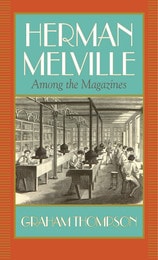
Herman Melville
Among the MagazinesGraham Thompson
University of Massachusetts Press, 2018
What I feel most moved to write, that is banned,—it will not pay. Yet, altogether, write the other way I cannot. Herman Melville wrote these words as he struggled to survive as a failing novelist. Between 1853 and 1856, he did write “the other way,” working exclusively for magazines. He earned more money from his stories than from the combined sales of his most well known novels, Moby-Dick, Pierre, and The Confidence-Man.
In Herman Melville Graham Thompson examines the author's magazine work in its original publication context, including stories that became classics, such as “Bartelby, the Scrivener” and “Benito Cereno,” alongside lesser-known work. Using a concept he calls “embedded authorship,” Thompson explores what it meant to be a magazine writer in the 1850s and discovers a new Melville enmeshed with forgotten materials, editors, writers, and literary traditions. He reveals how Melville responded to the practical demands of magazine writing with dazzling displays of innovation that reinvented magazine traditions and helped create the modern short story.

Herman Melville
Modernity and the Material TextKatie McGettigan
University of New Hampshire Press, 2018
Combining archival research in print and publishing history with close reading, McGettigan situates Melville's works alongside advertising materials, magazine articles, trade manuals, and British and American commentary on the literary industry to demonstrate how Melville's literary practice relies on and aestheticizes the specific conditions of literary production in which he worked. For Melville, the book is a physical object produced by particular technological processes, as well as an entity that manifests social and economic values. His characters carry books, write on them, and even sleep on them; they also imagine, observe, and participate in the buying and selling of books. Melville employs the book's print, paper, and binding—and its market circulations—to construct literary figures, to shape textual form, and to create irony and ambiguity.
Exploring the printed book in Melville's writings brings neglected sections of his poetry and prose to the fore and invites new readings of familiar passages and images. These readings encourage a reassessment of Melville's career as shaped by his creative engagements with print, rather than his failures in the literary marketplace. McGettigan demonstrates that a sustained and deliberate imaginative dialogue with the material text is at the core of Melville's expressive practice and that, for Melville, the printed book served as a site for imagining the problems and possibilities of modernity.
Hardcover is un-jacketed.