Results by title
13 books match the query 'Village'

A Village with My Name
A Family History of China's Opening to the WorldScott Tong
University of Chicago Press, 2017
A Village with My Name offers a unique perspective on the transitions in China through the eyes of regular people who have witnessed such epochal events as the toppling of the Qing monarchy, Japan’s occupation during World War II, exile of political prisoners to forced labor camps, mass death and famine during the Great Leap Forward, market reforms under Deng Xiaoping, and the dawn of the One Child Policy. Tong’s story focuses on five members of his family, who each offer a specific window on a changing country: a rare American-educated girl born in the closing days of the Qing Dynasty, a pioneer exchange student, an abandoned toddler from World War II who later rides the wave of China’s global export boom, a young professional climbing the ladder at a multinational company, and an orphan (the author’s daughter) adopted in the middle of a baby-selling scandal fueled by foreign money. Through their stories, Tong shows us China anew, visiting former prison labor camps on the Tibetan plateau and rural outposts along the Yangtze, exploring the Shanghai of the 1930s, and touring factories across the mainland.
With curiosity and sensitivity, Tong explores the moments that have shaped China and its people, offering a compelling and deeply personal take on how China became what it is today.

A return to the village
community ethnographies and the study of Andean culture in retrospectiveEdited by Francisco Ferreira and Billie Jean Isbell
University of London Press, 2016
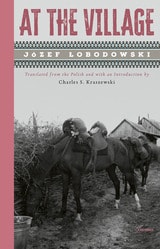
At the Village
Józef Lobodowski
Central European University Press, 2026
The book’s protagonist, Stas, finds himself the guest of the Cossack Jakov Antonovich, a scholar as well as a military leader and an agricultural potentate. His time at Antonovich’s stanitsa provides him with an incomparable education in the history of the old Polish Commonwealth of nations, which at its height encompassed Poland, Ukraine, Belarus, Lithuania, Latvia and Estonia. It is a lesson all the more engaging to the reader in that it is presented from a perspective that is neither Polish nor Russian, but Cossack. Through Lobodowski’s interweaving of historical reflection with sumptuous descriptions of agricultural life on the well-ordered stanitsa, At the Village is sometimes compared to the Polish national epic, Adam Mickiewicz’s Pan Tadeusz (1834), upon which Lobodowski is said to have consciously modelled the novel.
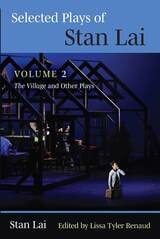
Selected Plays of Stan Lai
Volume 2: The Village and Other PlaysStan Lai, edited by Lissa Tyler Renaud
University of Michigan Press, 2021
Volume Two contains:
Millennium Teahouse
Sand on a Distant Star
Like Shadows
The Village
Writing in Water
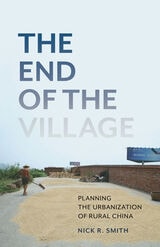
The End of the Village
Planning the Urbanization of Rural ChinaNick R. Smith
University of Minnesota Press, 2021
How China’s expansive new era of urbanization threatens to undermine the foundations of rural life
Since the beginning of the twenty-first century, China has vastly expanded its urbanization processes in an effort to reduce the inequalities between urban and rural areas. Centered on the mountainous region of Chongqing, which serves as an experimental site for the country’s new urban development policies, The End of the Village analyzes the radical expansion of urbanization and its consequences for China’s villagers. It reveals a fundamental rewriting of the nation’s social contract, as villages that once organized rural life and guaranteed rural livelihoods are replaced by an increasingly urbanized landscape dominated by state institutions.
Throughout this comprehensive study of China’s “urban–rural coordination” policy, Nick R. Smith traces the diminishing autonomy of the country’s rural populations and their subordination to larger urban networks and shared administrative structures. Outside Chongqing’s urban centers, competing forces are at work in reshaping the social, political, and spatial organization of its villages. While municipal planners and policy makers seek to extend state power structures beyond the boundaries of the city, village leaders and inhabitants try to maintain control over their communities’ uncertain futures through strategies such as collectivization, shareholding, real estate development, and migration.
As China seeks to rectify the development crises of previous decades through rapid urban growth, such drastic transformations threaten to displace existing ways of life for more than 600 million residents. Offering an unprecedented look at the country’s contentious shift in urban planning and policy, The End of the Village exposes the precarious future of rural life in China and suggests a critical reappraisal of how we think about urbanization.

The Village and the Class War
Anti-Kulak Campaign in Estonia 1944-49Anu Mai Kõll
Central European University Press, 2013

The Village of Vanished Souls
The Vanished Souls Duology, Book 1Richard Zimler
Tagus Press, 2027
Winner of Book of the Year in Portugal, The Village of Vanished Souls is a sweeping historical tale inspired by authentic records of the Portuguese Inquisition and the real lives of villagers whose stories have long been forgotten.
Portugal, 1671—Nine-year-old Isaaque Zarco lives a peaceful life in the remote mountain village of Castelo Rodrigo, where he helps his mother prepare meals, roams the surrounding forests with his spirited best friend Lena, and learns about nature from the village apothecary, Samuel. But his idyllic childhood is shattered when Lena and her family suddenly vanish, followed by a series of brutal murders that plunge the isolated community into fear.
When Isaaque’s formidable Castilian grandmother visits, she says what no one else dares: the Inquisition is hunting descendants of Jews who continue to secretly practice. Then she entrusts Isaaque with an even more dangerous secret—that he, too, belongs to a secret Jewish family. As she introduces him to the forbidden traditions and sacred writings of their ancestors, Isaaque’s understanding of his parents, his village, and himself is transformed forever.
As Isaaque comes of age, he is drawn into a clandestine network that helps persecuted Jews escape Portugal. Every mission carries the risk of imprisonment, torture, and death, yet this dangerous work gives Isaaque a profound sense of purpose while deepening his commitment to his heritage. When he learns that his beloved grandmother is ill, he embarks on a journey that will expose long-buried family secrets and reveal that learning to embrace his heritage is only the beginning of what will soon be asked of him.
Inspired by the names, arrest records, and testimonies preserved in Inquisitional archives, The Village of Vanished Souls recreates a little-known chapter of history with vivid historical detail and emotional depth. At once an unforgettable coming-of-age story and a moving portrait of resilience, identity, faith, and love, it gives voice to people whose courage endured despite centuries of persecution and forced silence.

The Village on the Plain
Auburn University, 1856–2006Dwayne Cox
University of Alabama Press, 2016
The Village on the Plain tells the story of the founding of Auburn University as a small private college and the tumultuous history of its growth and transformation into the complex institution it is today.
Auburn University possesses a rich and storied past as well as an esprit de corps that is the envy of its rivals. Dwayne Cox’s The Village on the Plain traces the school’s history in fascinating detail from its origins as a private college through its emergence as a nationally recognized land-grant university.
Founded before the Civil War to provide a classical education, Auburn became the state’s land-grant college after the cessation of hostilities. This infused the school with a vision of the reborn South as a commercial and industrial power. By the 1880s, the applied sciences were at the core of Auburn’s growth and strength. Like most southern universities, Auburn never enjoyed financial abundance, and scarcity intensified internal debates over investments in liberal arts or science. Modest state funding for higher education also complicated Auburn’s rise. It became a source of competition with the University of Alabama. This rivalry was most intense between 1908 and 1948. The two schools did not meet on the gridiron but blocked and tackled one another in the legislature over the division of state funds.
On the idyllic plains of Lee County, Alabama, Auburn developed a unique, sometimes introspective culture, which is true of many universities founded far from urban centers. Long Auburn’s head archivist, Cox describes this culture with an insider’s insights and shows how it shaped the school's history and community.
Auburn University’s history is that of a small private college that rose to the challenges of convulsive state and national events, not only to survive but to emerge more vibrant and thriving. Offering much to students of higher education and Alabama history, as well as readers affiliated with Auburn University, The Village on the Plain tells the story of this complex and fascinating institution.
Village and Bureaucracy in Southern Sung China
Brian E. McKnight
University of Chicago Press, 1983

Village and Family in Contemporary China
William L. Parish and Martin King Whyte
University of Chicago Press, 1978
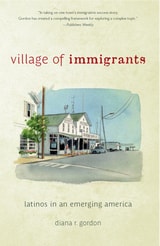
Village of Immigrants
Latinos in an Emerging AmericaGordon, Diana R
Rutgers University Press, 2015
Greenport today boasts a population that is one-third Hispanic. Gordon contends that these immigrants have effectively saved the town’s economy by taking low-skill jobs, increasing the tax base, filling local schools, and patronizing local businesses. Greenport’s seaside beauty still attracts summer tourists, but it is only with the support of the local Latino workforce that elegant restaurants and bed-and-breakfasts are able to serve these visitors. For Gordon the picture is complex, because the wave of immigrants also presents the town with challenges to its services and institutions. Gordon’s portraits of local immigrants capture the positive and the negative, with a cast of characters ranging from a Guatemalan mother of three, including one child who is profoundly disabled, to a Colombian house painter with a successful business who cannot become licensed because he remains undocumented. Village of Immigrants weaves together these people’s stories, fears, and dreams to reveal an environment plagued by threats of deportation, debts owed to coyotes, low wages, and the other bleak realities that shape the immigrant experience—even in the charming seaport town of Greenport.
A timely contribution to the national dialogue on immigration, Gordon’s book shows the pivotal role the American small town plays in the ongoing American immigrant story—as well as how this booming population is shaping and reviving rural communities.
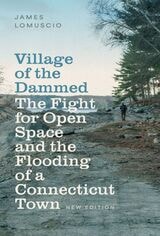
Village of the Dammed
The Fight for Open Space and the Flooding of a Connecticut TownJames Lomuscio
Brandeis University Press, 2025
In the early 1940s, the Bridgeport Hydraulic Company flooded Connecticut’s Saugatuck River Valley to create a reservoir that would meet the region’s growing population. Under twelve billion gallons of water lay Valley Forge, once a thriving iron and steel manufacturing town, which was seized by eminent domain to create the reservoir and dam. In Village of the Dammed, journalist James Lomuscio tells the story of the rise and fall of Valley Forge, drawing on Civil War-era photographs of the town and other sources to show what the town was like, document the futile battle to save it, and reveal the flooding’s life-altering repercussions. He also recounts a grassroots movement to prevent the development of nearby Trout Brook Valley in the 1990s, a heated fight with a different outcome. As the population of the American northeast continues to swell and spread, placing new demands on existing resources, communities are frequently confronted with forces and choices not unlike those faced by Valley Forge and Trout Brook Valley. Village of the Dammed reminds us to be ever vigilant in the protection of our irreplaceable environmental heritage.

Village of the Ghost Bells
A NovelBy Edla Van Steen
University of Texas Press, 1991
In the village of the ghost bells, the church chimes ring—even though the church has no bells. One of the neighbors wants to buy dreams—or is she a dream that someone else is dreaming? Where and why do dreams become nightmares?
These are only some of the fascinating questions raised in Village of the Ghost Bells, Edla Van Steen’s second novel. First published in 1983 as Coraçôes mordidos, the novel tells the story of the would-be utopian community built on an old plantation of the outskirts of São Paulo, Brazil. Its atmosphere is dreamlike, often verging on the supernatural, and strange events signal the transformation of the utopian dream into a nightmare. Ultimately destroyed by greed, corruption, and exploitation, the community becomes a microcosm of the Brazilian socioeconomic system, in which it takes all of a person’s warmth, idealism, passion, and humor to survive the bleak environment.