Results by title
1107 books match the query 'Memoirs' and 44 start with h
Habibi Means Beloved
A Queer Memoir on War, Stuttering, and BelongingMoudi Sbeity
University of Utah Press, 2026
A memoir of exile, love, and the search for home
Born into a Muslim family from a small Lebanese village, Moudi Sbeity came of age at the intersection of war, displacement, and difference. Queer, with a stutter, and often on the margins of belonging, Sbeity survived the conflicts that fractured their homeland and family before arriving in Utah as an eighteen-year-old evacuee.
From there, Sbeity transformed anonymity into advocacy as plaintiff in Kitchen v. Herbert, the landmark case that secured marriage equality across the 10th Circuit, and as founder of the celebrated Salt Lake City queer-friendly restaurant Laziz Kitchen. Yet behind these outward triumphs, Sbeity felt an inner call to return to their roots through writing and poetry. Habibi Means Beloved interweaves personal narrative, Sufi mysticism, and Lebanese heritage in a memoir of resilience, disconnection, and reconciliation. Both intimate and universal, it invites readers to reimagine belonging and recognize ourselves—and one another—as already beloved.
Hadassah
An American StoryHadassah Lieberman
Brandeis University Press, 2021
Born in Prague to Holocaust survivors, Hadassah Lieberman and her family immigrated in 1949 to the United States. She went on to earn a BA from Boston University in government and dramatics and an MA in international relations and American government from Northeastern University. She built a career devoted largely to public health that has included positions at Lehman Brothers, Pfizer, and the National Research Council. After her first marriage ended in divorce, she married Joe Lieberman, a US senator from Connecticut who was the Democratic nominee for vice president with Al Gore and would go on to run for president.
In Hadassah, Lieberman pens the compelling story of her extraordinary life: from her family's experience in Eastern Europe to their move to Gardner, Massachusetts; forging her career; experiencing divorce; and, following her remarriage, her life on the national political stage. By offering insight into her identity as an immigrant, an American Jew, a working woman, and a wife, mother, and grandmother, Lieberman’s moving memoir speaks to many of the major issues of our time, from immigration to gender politics. Featuring an introduction by Joe Lieberman and an afterword by Megan McCain, it is a true American story.
Halcyon Journey
In Search of the Belted KingfisherMarina Richie
Oregon State University Press, 2022
Winner of a 2022 National Outdoor Award
Winner of a Foreword INDIES Award
More than one hundred species of kingfishers brighten every continent but Antarctica. Not all are fishing birds. They range in size from the African dwarf kingfisher to the laughing kookaburra of Australia. This first book to feature North America’s belted kingfisher is a lyrical story of observation, revelation, and curiosity in the presence of flowing waters.
The kingfisher—also known as the halcyon bird—is linked to the mythic origin of halcyon days, a state of happiness that Marina Richie hopes to find outside her back door in Missoula, Montana. Epiphanies and a citizen science discovery punctuate days tracking a bird that outwits at every turn. The female is more colorful than the male (unusual and puzzling) and the birds’ earthen nest holes are difficult to locate.
While the heart of the drama takes place on Rattlesnake Creek in Missoula, the author’s adventures in search of kingfisher kin on the lower Rio Grande, in South Africa, and in London illuminate her relationships with the birds of Montana. In the quiet of winter, she explores tribal stories of the kingfisher as messenger and helper, pivotal qualities for her quest. For all who love birds or simply seek solace in nature, Halcyon Journey is an inviting introduction to the mythic and mysterious belted kingfisher.
Half-Life of a Zealot
Swanee Hunt
Duke University Press, 2006
Half-Life of a Zealot tells how the girl who spoke against “Reds” alongside her father became a fierce advocate for progressive change in America and abroad, an innovative philanthropist, and Bill Clinton’s Ambassador to Austria. In captivating prose, Hunt describes the warmth and wear of Southern Baptist culture, which instilled in her a calling to help those who are vulnerable. The reader is drawn into her full-throttle professional life as it competes with critical family needs.
Hunt gives a remarkably frank account of her triumphs and shortcomings; her sorrows, including a miscarriage and the failure of a marriage; the joys and struggles of her second marriage; and her angst over the life-threatening illness of one of her three children. She is candid about the opportunities her fortune has created, as well as the challenge of life as an heiress.
Much of Swanee Hunt’s professional life is devoted to expanding women’s roles in making and shaping public policy. She is the founding director of Harvard’s Women and Public Policy Program at the Kennedy School of Government, chair of the Initiative for Inclusive Security, and president of the Hunt Alternatives Fund.
Swanee Hunt’s autobiography brims over with strong women: her mother, whose religious faith and optimism were an inspiration; her daughter, who fights the social stigma of mental disorders; the women of war-torn Bosnia, who transformed their grief into action; and friends like Hillary Clinton, who used her position as First Lady to strengthen the voices of others.
Hunt is one more strong woman. Half-Life of a Zealot is her story—so far.
Hannah Whitman Heyde
The Complete CorrespondenceMaire Mullins
Bucknell University Press, 2022
Happenstance
Robert Root
University of Iowa Press, 2013
Hard Scrabble
Observations on a Patch of LandBy John Graves<br>Introduction by Rick Bass
University of Texas Press, 2016
“A kind of homemade book—imperfect like a handmade thing, a prize. It’s a galloping, spontaneous book, on occasion within whooping distance of that greatest and sweetest of country books, Ivan Turgenev’s A Sportsman’s Notebook.” —Edward Hoagland, New York Times Book Review
“His subjects are trees and brush, hired help, fences, soil, armadillos and other wildlife, flood and drought, local history, sheep and goats . . . and they come to us reshaped and reenlivened by his agreeably individual (and sometimes cranky) notions.” —New Yorker
“If Goodbye to a River was in some sense Graves’s Odyssey, this book is his [version of Hesiod’s] Works and Days. It is partly a book about work, partly a book about nature, but mostly a book about belonging. In the end John Graves has learned to belong to his patch of land so thoroughly that at moments he can sense in himself a unity with medieval peasants and Sumerian farmers, working with their fields by the Tigris.” —Larry McMurtry, Washington Post Book World
“Hard Scrabble is hard pastoral of the kind we have learned to recognize in Wordsworth, Frost, Hemingway, and Faulkner. It celebrates life in accommodation with a piece of the ‘given’ creation, a recalcitrant four hundred or so acres of Texas cedar brake, old field, and creek bottom, which will require of any genuine resident all the character he can muster.” —Southwest Review
Havana and Other Missing Fathers
Mia Leonin
University of Arizona Press, 2009
Shortly after her sixteenth birthday, Leonin learned from her mother that her father, a Cuban exile, was very much alive and living in Florida. Her attempts to contact him, however, were thwarted until four years later, when she left home in search of her roots.
She meets her father, but trying to discover the truth behind him proves to be a more daunting task. Her journey takes her to Miami, Colombia, and Cuba, and her search for cultural identity leads her to create memories, friendships, and romances. She finds moments of connection and redemption, ending up in Havana not as a cultural tourist but as an illegitimate daughter of Cuba looking for validation. What she discovers is an island bereft of fathers and brimming with paternalism. As she becomes entangled with two different men, she descends further into the Havana of poverty, humiliation, and despair, as well as the ever-inventive city that is as passionate as it is contradictory.
Insightful, imaginative, and often poetic, Havana and Other Missing Fathers is Mia Leonin’s recollection of this journey and her longing to learn more about her origins. In the end, she must learn to accept the answers she discovers as well as the questions that remain.

Heart of Palms
My Peace Corps Years in TranquillaMeredith W. Cornett
University of Alabama Press, 2014
A memoir of service, culture and transformation in a rural Panamanian village by a young American woman trained as a community forester for the Peace Corp.
In the storied fifty-year history of the US Peace Corps, Heart of Palms is the first Peace Corps memoir set in Panama, the slender isthmus that connects two continents and two oceans. In her memoir, Meredith Cornett transports readers to the remote village of Tranquilla, where dugout canoes are the mainstay of daily transportation, life and nature are permeated by witchcraft, and a restful night’s sleep may be disturbed by a raiding phalanx of army ants.
Cornett is sent to help counter the rapid deforestation that is destroying the ecosystem and livelihoods of the Panama Canal watershed region. Her first chapters chronicle her arrival and struggles not only with the social issues of language, loneliness, and insecurity, but also with the tragicomic basics of mastering open-fire cookery and intrusions by insects and poisonous snakes. As she grows to understand the region and its people, her keen eye discerns the overwhelming scope of her task. Unable to plant trees faster than they are lost, she writes with moving clarity about her sense of powerlessness.
Combating deforestation leads Cornett into an equally fierce battle against her own feelings of fear and isolation. Her journey to Panama becomes a parallel journey into herself. In this way, Heart of Palms is much more than a record of her Peace Corps service; it is also a moving environmental coming-of-age story and nuanced meditation on one village’s relationship to nature. When she returns home two years later, Cornett brings with her both skills and experience and a remarkable, newfound sense of confidence and mission.
Writing with rueful, self-deprecating humor, Cornett lets us ride along with her on a wave of naïve optimism, a wave that breaks not only on fear and intimidation, but also on tedium and isolation. Heart of Palms offers a bracing alternative to the romantic idealism common to Peace Corps memoirs and will be valued as a welcome addition to writing about the Peace Corps and environmental service.
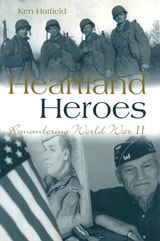
Heartland Heroes
Remembering World War IIKen Hatfield
University of Missouri Press, 2003
"War is about patriotism, about sacrifice, about conquering fear. And perhaps most of all, it's about the guy in the foxhole next to you, taking care of each other, protecting each other, loving each other; a camaraderie so intense only men who have been in combat can ever know what it's like. Yes, most of all, war is about love."
Heartland Heroes is a collection of remarkable stories from ordinary men and women who lived through extraordinary times. They resided in places like Lee’s Summit, Independence, and Kansas City, yet their experiences were very much like those of World War II veterans everywhere. Some were marines, nurses, or fighter pilots, others were simply civilians who lived through the war under the martial law imposed on the Hawaiian Islands after the attack on Pearl Harbor.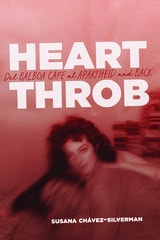
Heartthrob
Del Balboa Cafe al Apartheid and BackSusana Chávez-Silverman
University of Wisconsin Press, 2019
Their attraction was intense, but the social and political climate of South Africa, still in the grip of apartheid, threatened to tear them apart. Describing the vicissitudes of the Latina migratory experience, Chávez-Silverman struggles to overcome the hostility of a place that is so unwelcoming to nonwhite persons and outsiders.
Heartthrob, a love story for the ages, implores us to consider how things could have been. In these romantic crónicas based on detailed diary entries and confessional letters to family and friends, Chávez-Silverman weaves together English and Spanish to lay bare the raw intensity and true fragility of love. Anyone who has wondered about the-one-that-got-away or sought out the true meaning of happily-ever-after will be enraptured by this intimate exploration of love, loss, and regret.

Heaven Is Near
The Lives of Two Artists and Their Daughter’s Quest to UnderstandLo Dagerman
University of Minnesota Press, 2027
Lo Dagerman reconstructs the love, trauma, and creative journeys of her parents—Swedish writer Stig Dagerman and actress Anita Björk
In 1953, Swedish writer Stig Dagerman, one of Europe’s greatest postwar writers, married Anita Björk, an acclaimed actress famous for the Cannes Grand Prix award-winning film Miss Julie. Inscribed into her wedding ring were his words “Heaven Is Near.” A year later, Stig was found dead by suicide. His death shocked Sweden and left a devastated Anita to raise their small daughter, Lo.
Heaven Is Near is Lo Dagerman’s endeavor to understand what happened. In an unconventional hybrid of biography and memoir, Lo dives deep into diaries, notebooks, letters, and other source material to bring her parents’ stories to life. Her account offers an unsparing look at her father’s creative crisis, depression, and suicide, as well as her mother’s life-long striving and sustained success in reaching the height of artistic excellence while navigating motherhood and family. Moving between Stockholm, Paris, Berlin, and Hollywood, Lo lays bare her parents’ legacy not as a tragic abstraction but as their lived experience, inserting her own memories and reflections along the way.
Through Lo’s unsentimental, psychologically rich narration, Heaven Is Near offers a quietly luminous, multigenerational account of genius, trauma, and creative regeneration.
Retail e-book files for this title are screen-reader friendly with images accompanied by short alt text and/or extended descriptions.
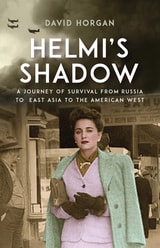
Helmi's Shadow
A Journey of Survival From Russia to East Asia to the American WestDavid Horgan
University of Nevada Press, 2021
Rachel Koskin was a middle-class Russian Jew born in Odessa, Ukraine, in 1896. Ten years later, her family fled from the murderous pogroms against Jews in the Russian Empire eastward to Harbin, a Russian-controlled city within China’s borders on the harsh plain of Manchuria. Full of lively detail and the struggles of being stateless in a time of war, the narrative follows Rachel through her life in Harbin, which became a center of Russian culture in the Far East; the birth of her daughter, Helmi, in Kobe, Japan; their life together in the slums of Shanghai and back in Japan during World War II, where they endured many more hardships; and their subsequent immigration to the United States.
This remarkable account uncovers a history of refugees living in war-torn China and Japan, a history that to this day remains largely unknown. It is also a story of survival during a long period of upheaval and war—from the Russian Revolution to the Holocaust—and an intimate portrait of an American immigrant family. David reveals both the joys and tragedies he experienced growing up in a multicultural household in post\-Second World War America with a Jewish mother, a live-in Russian grandmother, and a devout Irish Catholic American father.
As David develops a clearer awareness of the mysterious past lives of his mother and grandmother—and the impact of these events on his own understanding of the long-term effects of fear, trauma, and loss—he shows us that, even in times of peace and security, we are all shadows of our past, marked by our experiences, whether we choose to reveal them to others or not.
Helmi's Shadow
A Journey of Survival From Russia to East Asia to the American WestDavid Horgan
University of Nevada Press, 2021
Rachel Koskin was a middle-class Russian Jew born in Odessa, Ukraine, in 1896. Ten years later, her family fled from the murderous pogroms against Jews in the Russian Empire eastward to Harbin, a Russian-controlled city within China’s borders on the harsh plain of Manchuria. Full of lively detail and the struggles of being stateless in a time of war, the narrative follows Rachel through her life in Harbin, which became a center of Russian culture in the Far East; the birth of her daughter, Helmi, in Kobe, Japan; their life together in the slums of Shanghai and back in Japan during World War II, where they endured many more hardships; and their subsequent immigration to the United States.
This remarkable account uncovers a history of refugees living in war-torn China and Japan, a history that to this day remains largely unknown. It is also a story of survival during a long period of upheaval and war—from the Russian Revolution to the Holocaust—and an intimate portrait of an American immigrant family. David reveals both the joys and tragedies he experienced growing up in a multicultural household in post\-Second World War America with a Jewish mother, a live-in Russian grandmother, and a devout Irish Catholic American father.
As David develops a clearer awareness of the mysterious past lives of his mother and grandmother—and the impact of these events on his own understanding of the long-term effects of fear, trauma, and loss—he shows us that, even in times of peace and security, we are all shadows of our past, marked by our experiences, whether we choose to reveal them to others or not.
Here on Lake Hallie
In Praise of Barflies, Fix-It Guys, and Other Folks in Our HometownPatti See
Wisconsin Historical Society Press, 2022
Growing up in the 1970s and 1980s as the youngest of eight children, Patti never imagined she’d stay in Chippewa Falls as an adult. Now, living on rural Lake Hallie just five miles from her childhood home, she has a new appreciation for all that comes with country living, from ice fishing and eagle sightings to pontoon rides and tavern dice. These brief essays—many of which were originally published in the Sawdust Stories column of the Eau Claire Leader-Telegram—establish that, above all else, it’s friends, family, and other folks in our hometown who provide us with a sense of belonging.
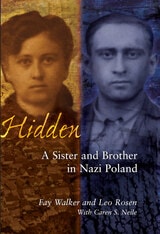
Hidden
A Sister and Brother in Nazi PolandFay Walker
University of Wisconsin Press, 2002
Of the Rosenbluth family, only the older children, Faiga and Luzer, had gone into hiding before the SS rounded up the Jews of Kanczuga, Poland. Hidden is Faiga and Luzer’s story, a memoir whose intimate and quiet particularity makes the incomprehensible enormity of the Holocaust immediate, human, and devastatingly real.
In alternating first-person narratives, Faiga (Fay) and Luzer (Leo) take readers into their very different but inextricably linked experiences in Nazi-occupied Poland. Faiga, the once-dignified young lady from a good home with servants and a seat by the eastern wall of the synagogue, spends two years wandering the perilous countryside, hoping to be taken for a peasant. Mere miles away, knowing nothing of his sister’s fate, Luzer, the leather wholesaler’s only son, lies silent all day in the stifling dark corner of a barn, where the smell of the cows’ warm hides are a piquant reminder of his lost world. Hidden deftly summons that world, as the familiar comforts and squabbles of life in a well-to-do, religious Jewish family are slowly overwhelmed by the grim news coming out of Germany. We follow Faiga and Luzer through the early forebodings and deprivations of the war, into hiding among righteous Poles and erstwhile neighbors-turned-betrayers, and finally, at war’s end, back once more into the world—but not necessarily into safety. Told in a confident, clear, and unsentimental prose, this is a story of heroism and tragedy writ large and small, of two young people coming of age in a world in chaos and then trying to return to "normal" after experiences as unimaginable as they are unforgettable.
His Humble Servant
Sister M. Pascalina Lehnert's Memoirs of Her Years of Service to Eugenio Pacelli, Pope Pius XIIM. Pascalina Lehnert
St. Augustine's Press, 2012
This is a personal and insightful portrait of Pope Pius XII, the memories of Sister M. Pascalina Lehnert, who served as his housekeeper for forty years. Her book, most of it written just a few months after the Pope’s death, shares insights into the person, the life, and the thinking of Pius XII, from his time as Nuncio in Munich until his death. Much of Sister’s motivation in writing this work was to correct the many distortions of fact and interpretation regarding this great pope.
This book was a best seller in the original German, as well as in the Italian and French translations. This is the first edition in English.
These reminiscences were written down at the instructions of Sister’s Superior General, but were not made known to the public until 1982, when it was published in German at the express wishes of Pope John Paul II to publish the work without any changes. So the work remained a lively, flowing account of memories and anecdotes in a simple, spontaneous style. It is a powerful and insightful account of Pius’s daily life, his treatment of those around him, and his concern for the upholding of the traditional teaching of the Church in the face of his awesome burden to lead the Church during World War II.
History Is Embarrassing
Karen Chase
CavanKerry Press, 2024
Filled with profound reflections and snapshots from the past, Karen Chase’s History is Embarrassing weaves together threads from one single life—a girl suffering from polio, a poet, a Jewish woman, a writer, and a painter. Like Chase, the characters who populate these essays are outsiders—undercover cops, a gay couple in 1500s India, bear poachers, psychiatric patients, and even a president—each a meaningful part of history. Divided into three parts—histories, pleasures, and horrors—History is Embarrassing is an assortment of thought-provoking essays that are sure to resonate with many readers.
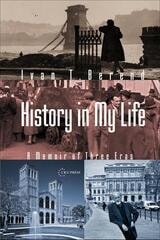
History in My Life
A Memoir of Three ErasIvan T. Berend is Distinguished Research Professor at the History Department of the University of California Los Angeles.
Central European University Press, 2009
Ivan T. Berend is Distinguished Professor at the University of California Los Angeles, Director of the European Studies Program. He was one of the masterminds of regime change in Hungary. He made a career in Hungary as a university professor, Rector of the University of Economics (1973–79), and President of the Hungarian Academy of Sciences (1985–90). He was President of the International Committee of Historical Sciences (1995–2000), and Vice-President of the International Economic History Association (1986–1994). His research interests are the complex economic, social, ideological, and cultural history of Central and Eastern Europe in the 19th–20th century; economic modernization; problems of European backwardness; transition from state socialism to capitalism. He published and 26 books and more than 120 studies.
Before he became a professor at UCLA, Ivan Berend had survived five regime changes and two revolutions in Hungary, had been in prison and German concentration camp in 1944–45.
His memoir offers an interesting case study, a subjective addition to the “objective” historical works on Central and Eastern European state socialism. It describes the hard choices of intellectuals in a dictatorial state: 1. remain in isolation, concentrate on scholarly works, and exclude politics in your personal life; 2. be in opposition, criticize and unveil the regime, accept discrimination and exclusion; 3. remain within the establishment and work for reforming the country using legal possibilities to criticize the regime and to achieve changes from within.
Berend’s book raises basic historical questions and debates, compares East European and American higher education systems, and presents an eyewitness’ insights on life in the United States.
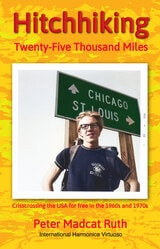
Hitchhiking Hitchhiking Twenty-Five Thousand Miles
Crisscrossing the USA for free in the 1960s and 1970sPeter Madcat Ruth
Parkhurst Brothers, Inc., 2026
Personal Travelogue with dates, ride lists, and commentary about the hitchhiking culture of the era.
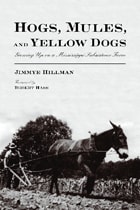
Hogs, Mules, and Yellow Dogs
Growing Up on a Mississippi Subsistence FarmJimmye Hillman; Foreword by Robert Hass
University of Arizona Press, 2012
"It's in the nature of things that whole worlds disappear," writes the poet Robert Hass in the foreword to Jimmye Hillman's insightful memoir. "Their vanishings, more often than not, go unrecorded or pass into myth, just as they slip from the memory of the living."
To ensure that the world of Jimmye Hillman's childhood in Greene County, Mississippi during the Great Depression doesn't slip away, he has gathered together accounts of his family and the other people of Old Washington village. There are humorous stories of hog hunting and heart-wrenching tales of poverty set against a rural backdrop shaded by the local social, religious, and political climate of the time. Jimmye and his family were subsistence farmers out of bare-bones necessity, decades before discussions about sustainability made such practices laudable.
More than just childhood memories and a family saga, though, this book serves as a snapshot of the natural, historical, and linguistic details of the time and place. It is a remarkable record of Southern life. Observations loaded with detail uncover broader themes of work, family loyalty, and the politics of changing times.
Hillman, now eighty-eight, went on to a distinguished career as an economist specializing in agriculture. He realizes the importance of his story as an example of the cultural history of the Deep South but allows readers to discover the significance on their own by witnessing the lives of a colorful cast of characters. Hogs, Mules, and Yellow Dogs is unique, a blend of humor and reflection, wisdom and sympathy—but it's also a hard-nosed look at the realities of living on a dirt farm in a vanished world.
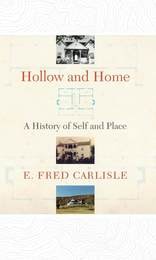
Hollow and Home
A History of Self and PlaceE. Fred Carlisle
West Virginia University Press, 2017
Carlisle incorporates perspectives from writers like Edward S. Casey, Christian Norberg-Schulz, Yi-Fu Tuan, and Witold Rybczynski, but he applies theory with a light touch. Placing this literature in dialog with personal experience, he concentrates on two places that profoundly influenced him and enabled him to overcome a lifelong sense of always leaving his pasts behind. The first is Clover Hollow in Appalachian Virginia, where the author lived for ten years among fifth-, sixth-, and seventh-generation residents. The people and places there enabled him to value his own past and primary places in a new way. The story then turns to Carlisle’s life growing up in Delaware, Ohio. He describes in rich detail the ways the town shaped him in both enabling and disabling ways. In the end, after years of moving from place to place, Carlisle’s experience in Appalachia helped him rediscover his hometown—both the Old Delaware, where he grew up, and the New Delaware, a larger, thriving small city—as his true home.
The themes of the book transcend specific localities and speak to the relationship of self and place everywhere.

Hollywood Notebook
EssaysWendy C. Ortiz
Northwestern University Press, 2025
A daylight traipse through early-aughts Los Angeles, Hollywood Notebook encapsulates the powerful feelings and hopeful futures of twentysomething Wendy C. Ortiz. In this boundary-defying sister memoir to Bruja, Ortiz navigates internal maps as she traverses external palm-treed streets, moving through her youthful twenties and into the pensiveness of her thirties. Peering at what lies ahead while dipping her toes into the past, Ortiz shows us that there is no place like Hollywood to unearth the joys of success and the blows of mistakes—both realized and denied. An innovative and bold examination of the daytime roaming mind, Hollywood Notebook is a cartography of love, loss, and transformation in the face of a brilliant psyche in a vibrant city.
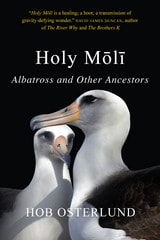
Holy Moli
Albatross and Other AncestorsHob Osterlund
Oregon State University Press, 2016
In Hawaiian mythology, ancestors may occupy the physical forms of animals known as 'aumakua. Laysan albatross—known as moli—are among them. Smitten with these charismatic creatures, Osterlund set out to learn everything she could about moli. She eventually came to embrace them as her 'aumakua—not as dusty old myths on a museum bookshelf, but as breathing, breeding, boisterous realities.
Albatross sport many superlative qualities. They live long—sometimes longer than sixty years—and spend the majority of their time airborne, gliding across vast oceanic expanses. They are model mates and devoted parents, and are among the only animals known to take long-term same-sex partners. In nesting season, they rack up inconceivable mileage just to find supper for chicks waiting on the islands of the Hawaiian archipelago.
It is from the island of Kaua'i that Holy Moli takes flight. Osterlund relates a true tale of courage, celebration and grief—of patience, affection and resilience. This is the story of how albatross guided the author on her own long journey, retracing distances and decades, back to the origin of a binding bargain she struck when she was ten years old, shortly after her mother’s death.
Holy Moli is a natural history of the albatross, a moving memoir of grief, and a soaring tribute to ancestors. Within its pages are lyrics of wonder—for freedom, for beauty, and for the far-flung feathered creatures known to us as albatross.
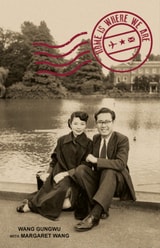
Home Is Where We Are
Wang Gungwu and Margaret Wang
National University of Singapore Press, 2020
Wang Gungwu’s account of his university education in Singapore and the UK, and the early years of his career as an academic in Malaysia captures the excitement, the ambition, and the choices of a generation that saw it their responsibility to build the new nations of Southeast Asia.
The exploration of the emotional and intellectual journey towards the formation of an identity, treasured by readers of Wang's Home Is Not Here, extends in this volume into an appreciation of love, family life, and the life of the mind. We also see these years from Margaret’s perspective, her own fascinating family story, and her early impressions of this young bearded poet. Wise and moving, this is a fascinating reflection on identity and belonging, and on the ability of the individual to find a place amidst the historical currents that have shaped Asia.
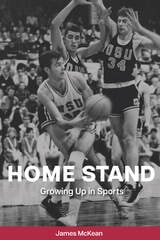
Home Stand
Growing Up in SportsJames McKean
Michigan State University Press, 2005
If he had not fouled out, maybe Washington State University’s center, James McKean, might have held Lew Alcindor (now Kareem Abdul-Jabbar) to only forty points. It was 1967, a transition year for college athletics in a dramatic time for those coming ofage. In this memoir set in the 1950s and 1960s, McKean revisits his years growing up in a family dedicated to sports and the outdoors, his playing basketball at Washington State University (for coaches Marv Harshman and Jud Heathcote), and his fashioning a life during and after basketball.
Driven by the energy and spirit of athletics, the language in Home Stand lights up McKean’s wonderfully eclectic work—the aunt who won a bronze medal in the 1936 Olympics in Berlin, his last run as a misguided drag racer, his playing basketball for a washing machine factory in Bologna, Italy, or against the prisoners in Walla Walla State Penitentiary—all seen in the context of turbulent times. Needless to say, Lew Alcindor scored his points and UCLA won, which they did every game that season. What James McKean took home was five fouls and a good story.
Home Stand delivers a lyrical, thoughtful reflection of what it is to be an athlete—inside as well as outside the game—and how one man’s love of basketball evolved into a love of poetry, "good turns of speech," writing, and teaching.
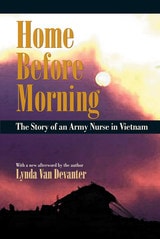
Home before Morning
The Story of an Army Nurse in VietnamLynda Van Devanter
University of Massachusetts Press, 2001
Lynda Van Devanter was the girl next door, the cheerleader who went to Catholic schools, enjoyed sports, and got along well with her four sisters and parents. After high school she attended nursing school and then did something that would shatter her secure world for the rest of her life: in 1969, she joined the army and was shipped to Vietnam. When she arrived in Vietnam her idealistic view of the war vanished quickly. She worked long and arduous hours in cramped, ill-equipped, understaffed operating rooms. She saw friends die. Witnessing a war close-up, operating on soldiers and civilians whose injuries were catastrophic, she found the very foundations of her thinking changing daily.
After one traumatic year, she came home, a Vietnam veteran. Coming home was nearly as devastating as the time she spent in Asia. Nothing was the same -- including Lynda herself. Viewed by many as a murderer instead of a healer, she felt isolated and angry. The anger turned to depression; like many other Vietnam veterans she suffered from delayed stress syndrome. Working in hospitals brought back chilling scenes of hopelessly wounded soldiers. A marriage ended in divorce. The war that was fought physically halfway around the world had become a personal, internal battle.
Home before Morning is the story of a woman whose courage, stamina, and personal history make this a compelling autobiography. It is also the saga of others who went to war to aid the wounded and came back wounded -- physically and emotionally -- themselves. And, it is the true story of one person's triumphs: her understanding of, and coming to terms with, her destiny.

Home on the Double Bayou
Memories of an East Texas RanchBy Ralph Semmes Jackson
University of Texas Press, 1961
Once again, through a boy’s eyes, Ralph Jackson sees a winter sky darkened with geese and ducks, a kitchen stove glowing with cheerful warmth, Aunt May strolling in her flower garden, moonlight filtering through treetops to cast patches of white light on a sandy woodland road.
Again he catches odors once so familiar: of a mysterious attic, of burning salt grass in late summer, of mountain streams with their fresh green smell, of dark-roast coffee and of slab bacon sizzling in the pan.
He hears again a panther’s scream from the darkness surrounding a campfire, the scampering of mice across the barnloft floor, the sigh of a felled pine tree changing to a crashing roar as it meets the ground, the sounds of a meal in preparation, the hum of a mosquito swarm rising from the marshes.
He remembers the taste of barbecued goat, the sweet sharpness of peppermint candy, the flavor of gumdrops from the country store—where, as showcase neighbors of cigars and chewing tobacco, they acquired a faint tobacco taste.
And he feels again the welcome shock of frigid spring water on a hot perspiring body, the pleasant sensation of sand between his toes, the breathtaking exhilaration of swinging on a sapling top.
The joy of childhood on an East Texas ranch is the subject of this book: exciting events like the arrival of the first norther of the season, swimming with alligators, hogkilling, building tree houses, roundup, hunting and fishing, calf-riding, fording strange streams. Interspersed among these episodes are others of darker mood: a smallpox epidemic, the burning of the ranch house, wolves attacking the cattle.
Jackson’s characters come alive. Scenes are vivid; moods are various and enveloping. The author has told the delightful story of his boyhood from a highly personal yet universal perspective, and in doing so he has presented a picture of a region of the state previously largely neglected in Texas literature.
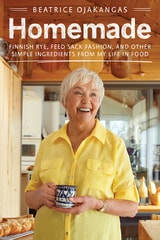
Homemade
Finnish Rye, Feed Sack Fashion, and Other Simple Ingredients from My Life in FoodBeatrice Ojakangas
University of Minnesota Press, 2018
Beatrice Ojakangas, the oldest of ten children, came by it naturally—the cooking but also the pluck and perseverance that she's served up with her renowned Scandinavian dishes over the years. In the wake of the Moose Lake fires and famine of 1918, Ojakangas tells us in this delightful memoir-cum-cookbook, her grandfather sent for a Finnish mail-order bride—and got one who’d trained as a chef.
Ojakangas’s stories, are, unsurprisingly, steeped in food lore: tales of cardamom and rye, baking salt cake at the age of five on a wood-burning stove, growing up on venison, making egg rolls for Chun King, and sending off a Pillsbury Bake Off–winning recipe without ever making it. And from here, how those early roots flourished through hard work and dedication to a successful (but never easy) career in food writing and a much wider world, from working for pizza roll king Jeno Paulucci to researching food traditions in Finland and appearing with Julia Child and Martha Stewart—all without ever leaving behind the lessons learned on the farm. As she says, “first you have to start with good ingredients and a good idea.”
Chock-full of recipes, anecdotes, and a kind humor that bring to vivid life the Finnish culture of northern Minnesota as well as the wider culinary world, Homemade delivers the savory and the sweet in equal measures and casts a warm light on a rich slice of the country’s cooking heritage.
Homing Instincts
Dionisia Morales
Oregon State University Press, 2018
Although Morales migrated from one North American coast to another, the questions she raises are relevant to migrations of any scale and place, whether across town or around the world. What does it mean to be a newcomer? Who has the right to claim a sense of place? What is gained or lost when we try to fit in? In a world where people are migrating more than ever for social, economic, personal, and political reasons, these questions take on a new urgency.
A wife and mother as well as a professional writer and editor, Morales writes with grace and resolve about a broad range of topics, including pregnancy, people watching, rock climbing, and bee colony collapse. She channels a spirit of adventure and adaptability while acknowledging how certain habits and mindsets are indelibly ingrained and are—like it or not—forever part of where, what, and who we call home.
As issues of migration and social integration play out in national and international politics, Morales provides a personal lens through which readers can appreciate that at one time or another we have all been in the process of arriving. Homing Instincts is a remarkable debut from a gifted prose stylist. It will be warmly received by lovers of the essay form and anyone who has sought, or still seeks, a place to call home.
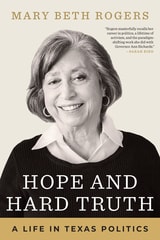
Hope and Hard Truth
A Life in Texas PoliticsMary Beth Rogers
University of Texas Press, 2022
Mary Beth Rogers has led an eventful life rooted in the weeds of Texas politics, occasionally savoring a few victories—particularly the 1990 governor’s race when, as campaign manager for Ann Richards, she did the impossible and put a Democratic woman in office. She also learned to absorb her losses—after all, she was a liberal feminist in America’s most aggressively conservative state.
Rogers’s road to a political life was complex. Candidly and vulnerably, she shares both public and private memories of how she tried to maintain a rich family life with growing children and a husband with a debilitating illness. She goes on to provide an insider’s account of her experiences as Richards’s first chief of staff while weaving her way through the highs and lows of political intrigue and legislative maneuvering.
Reflecting on her family heritage and nascent spiritual quest, Rogers discovers a reality at once sobering and invigorating: nothing is ever completely lost or completely won. It is a constant struggle to create humane public policies built on a foundation of fairness and justice—particularly in her beloved Texas.

House Hold
A Memoir of PlaceAnn Peters
University of Wisconsin Press, 2013
More than a memoir of remembered landscapes, House Hold is also an expansive contemplation of America, a meditation on place and property, and an exploration of how literature shapes our thinking about the places we live. A gifted prose stylist, Peters seamlessly combines her love of buildings with her love of books. She wanders through the rooms of her past but also through what Henry James called “the house of fiction,” interweaving personal narrative with musings on James, Willa Cather, William Dean Howells, Paule Marshall, William Maxwell, and others. Peters reflects on the romance of pastoral retreat, the hazards of nostalgia, America’s history of expansion and land ownership, and the conflicted desires to put down roots and to hit the road. Throughout House Hold, she asks how places make us who we are.
House of Houses
Pat Mora
University of Arizona Press, 1997
How I Married Michele
and Other Journeys, EssaysGary Gildner
BkMk Press, 2021
Essays from this collection have appeared in such venues as the New York Times Magazine, The Southern Review, and New Letters.
How to Be an Indian in the 21st Century
Louis V. Clark (Two Shoes)
Wisconsin Historical Society Press, 2017
How to Make a Life
A Tibetan Refugee Family and the Midwestern Woman They AdoptedMadeline Uraneck
Wisconsin Historical Society Press, 2018
When Madeline Uraneck said hello to the Tibetan woman cleaning her office cubicle, she never imagined the moment would change her life. After learning that Tenzin Kalsang had left her husband and four children behind in a Tibetan refugee settlement in India to try to forge a better life for them, Madeline took on the task of helping her apply for US visas. When the family reunited in their new Midwestern home, Madeline became swept up in their lives, from homework and soccer games to family dinners and shared holiday traditions. By reaching out, she found more than she bargained for—a family who welcomed her as their own and taught her more than she offered them.
An evocative blend of immersion journalism and memoir, How to Make a Life shares the immigration story of a Tibetan refugee family who crossed real and cultural bridges to make a life in Madison, Wisconsin, with the assistance of the Midwestern woman they befriended. From tales of escaping Tibet over the Himalayas, to striking a balance between old traditions with new, to bridging divides one friendly gesture at a time, readers will expand their understanding of family, culture, and belonging.
How to Make a Slave and Other Essays
Jerald Walker
The Ohio State University Press, 2020
Winner, 2021 Massachusetts Book Award, Nonfiction Category
A Book of the Year pick from Kirkus, BuzzFeed, and Literary Hub
“The essays in this collection are restless, brilliant and short. . . . The brevity suits not just Walker’s style but his worldview, too.…Keeping things quick gives him the freedom to move; he can alight on a truth without pinning it into place.” —Jennifer Szalai, the New York Times
For the black community, Jerald Walker asserts in How to Make a Slave, “anger is often a prelude to a joke, as there is broad understanding that the triumph over this destructive emotion lay in finding its punchline.” It is on the knife’s edge between fury and farce that the essays in this exquisite collection balance. Whether confronting the medical profession’s racial biases, considering the complicated legacy of Michael Jackson, paying homage to his writing mentor James Alan McPherson, or attempting to break free of personal and societal stereotypes, Walker elegantly blends personal revelation and cultural critique. The result is a bracing and often humorous examination by one of America’s most acclaimed essayists of what it is to grow, parent, write, and exist as a black American male. Walker refuses to lull his readers; instead his missives urge them to do better as they consider, through his eyes, how to be a good citizen, how to be a good father, how to live, and how to love.
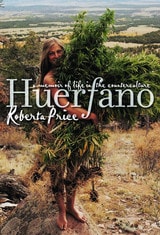
Huerfano
A Memoir of Life in the CountercultureRoberta M. Price
University of Massachusetts Press, 2004
In the late 1960s, new age communes began springing up in the American Southwest with names like Drop City, New Buffalo, Lama Foundation, Morning Star, Reality Construction Company, and the Hog Farm. In the summer of 1969, Roberta Price, a recent college graduate, secured a grant to visit these communities and photograph them. When she and her lover David arrived at Libre in the Huerfano Valley of southern Colorado, they were so taken with what they found that they wanted to participate instead of observe. The following spring they married, dropped out of graduate school in upstate New York, packed their belongings into a 1947 Chrysler Windsor Coupe, and moved to Libre, leaving family and academia behind.
Huerfano is Price's captivating memoir of the seven years she spent in the Huerfano ("Orphan") Valley when it was a petri dish of countercultural experiments. She and David joined with fellow baby boomers in learning to mix cement, strip logs, weave rugs, tan leather, grow marijuana, build houses, fix cars, give birth, and make cheese, beer, and furniture as well as poetry, art, music, and love. They built a house around a boulder high on a ridge overlooking the valley and made ends meet by growing their own food, selling homemade goods, and hiring themselves out as day laborers. Over time their collective ranks swelled to more than three hundred, only to diminish again as, for many participants, the dream of a life of unbridled possibility gradually yielded to the hard realities of a life of voluntary poverty.
Price tells her story with a clear, distinctive voice, documenting her experiences with photos as well as words. Placing her story in the larger context of the times, she describes her participation in the antiwar movement, the advent of the women's movement, and her encounters with such icons as Ken Kesey, Gary Snyder, Abbie Hoffman, Stewart Brand, Allen Ginsberg, and Baba Ram Dass.
At once comic, poignant, and above all honest, Huerfano recaptures the sense of affirmation and experimentation that fueled the counterculture without lapsing into nostalgic sentimentality on the one hand or cynicism on the other.
Hummingbirds Between the Pages
Chris Arthur
The Ohio State University Press, 2018
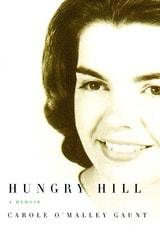
Hungry Hill
A MemoirCarole O'Malley Gaunt
University of Massachusetts Press, 2007
On a sweltering June night in 1959, Betty O'Malley died from lymphatic cancer, leaving behind an alcoholic husband and eight shell-shocked children—seven sons and one daughter, ranging in age from two to fifteen years. The daughter, Carole, was thirteen at the time. In this poignant memoir, she recalls in vivid detail the chaotic course of her family life over the next four years.
The setting for the story is Hungry Hill, an Irish-Catholic working-class neighborhood in Springfield, Massachusetts. The author recounts her sad and turbulent story with remarkable clarity, humor, and insight, punctuating the narrative with occasional fictional scenes that allow the adult Carole to comment on her teenage experiences and to probe the impact of her mother's death and her father's alcoholism.
Hungry Hill
A MemoirCarole O'Malley Gaunt
University of Massachusetts Press, 2007
On a sweltering June night in 1959, Betty O'Malley died from lymphatic cancer, leaving behind an alcoholic husband and eight shell-shocked children—seven sons and one daughter, ranging in age from two to fifteen years. The daughter, Carole, was thirteen at the time. In this poignant memoir, she recalls in vivid detail the chaotic course of her family life over the next four years.
The setting for the story is Hungry Hill, an Irish-Catholic working-class neighborhood in Springfield, Massachusetts. The author recounts her sad and turbulent story with remarkable clarity, humor, and insight, punctuating the narrative with occasional fictional scenes that allow the adult Carole to comment on her teenage experiences and to probe the impact of her mother's death and her father's alcoholism.
Hunting Camp 52
Tales from a North Woods Deer CampJohn Marvin Hanson
Wisconsin Historical Society Press, 2016
Meet the Jolly Boys—five men from northern Wisconsin who built a deer hunting shack in 1955 and established a tradition that has now lasted over six decades. Hunting Camp 52, affectionately known as Blue Heaven, is a place where every trail, rock, and ravine has its own nickname; every kill is recorded by hand on a window shade; every hunter happily croons along during evening songfests; and every rowdy poker game lasts late into the night. The outhouse is always cold, the porcupines are always a problem, and the vehicles are always getting stuck in the mud, but there’s nowhere else these men would rather be.
In Hunting Camp 52: Tales from a North Woods Deer Camp, John Marvin Hanson—the son of one of the original Jolly Boys—recounts the sidesplitting antics, the memorable hunts, and the profound camaraderie that has developed over almost sixty seasons at Blue Heaven. Hanson also includes more than twenty recipes for gourmet comfort foods prepared each year at camp, from pickled venison hearts to Norwegian meatballs to the treasured recipe for Reali Spaghetti. As the Jolly Boys age and younger generations take up the mantle of Blue Heaven, Hanson comes to appreciate that hunting camp is not about bagging a trophy buck as much as it is about spending time with the friends and family members who matter most.
Hurricane Pioneer
Memoirs of Bob SimpsonRobert H. Simpson with Neal M. Dorst
American Meteorological Society, 2014
For Simpson this was just one of his many pioneering explorations of hurricanes and extreme storms. Over his decades-long career his research led to great leaps in our understanding of tropical meteorology and our approach to hurricane safety. He was the first director of the National Hurricane Research Project and the second director of the National Hurricane Center, though he may be best known as co-creator of the widely used Saffir-Simpson Hurricane Scale, familiar to anyone who has heard a reporter use the words “category five.”
Simpson’s memoirs take readers from his experience with the Corpus Christi hurricane of 1919 to his travels to study weather across the globe. Along the way he crosses paths with other weather greats, including his trailblazing wife, meteorologist Joanne Simpson. Hurricane Pioneer is a riveting first-hand account at a revolutionary time in meteorology.
Hurt, Baby, Hurt
William Walter Scott, III
University of Michigan Press, 2025
This memoir recounts Scott’s life from his birth up through the Rebellion. It tells the story of how the Rebellion started and provides an on-the-ground account of the Rebellion and its immediate aftermath, including the police detainment of the people involved. Now with a new foreword by Austin McCoy that considers the lasting impact of the rebellion, Hurt, Baby, Hurt offers valuable insight into an important part of Detroit history.