Results by title
2817 books match the query 'Nature' and 81 start with h
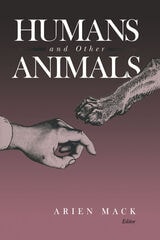
HUMANS AND OTHER ANIMALS
Edited by Arien Mack with a foreword by Marc Bekoff
The Ohio State University Press, 1999
In 1995 the New School for Social Research sponsored a landmark conference to explore human/animal interactions. Published as a special issue of the journal Social Research (under the title In the Company of Animals), this collection is now available for the first time in a book edition.
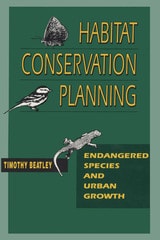
Habitat Conservation Planning
Endangered Species and Urban GrowthBy Timothy Beatley
University of Texas Press, 1994
As environmental awareness grows around the world, people are learning that a diversity of species and the habitat to support them is necessary to maintain the ecological health of the earth. At the same time, however, the pressure to develop wildlife habitat for human settlement and economic gain also grows, causing frequent clashes between the forces of development and of conservation.
This pioneering study focuses on a new tool for resolving the land-use conflict—the creation of habitat conservation plans (HCPs). Timothy Beatley explores the development and early results of this provision of the United States' federal Endangered Species Act, which allows development of some habitat and a certain "take" of a protected species in return for the conservation of sufficient habitat to ensure its survival and long-term recovery.
Beatley looks specifically at nine HCPs in California, Nevada, Texas, and Florida, states where biological diversity and increasing populations have triggered many conflicts. Some of the HCPs include the San Bruno Mountain HCP near San Francisco, the North Key Largo HCP in the Florida Keys, the Clark County HCP near Las Vegas, Nevada, and the Balcones Canyonlands HCP near Austin, Texas. This first comprehensive overview of habitat conservation planning in the United States will be important reading for everyone involved in land-use debates.

Hagfish Slime and Lobster Rolls
Ellen Prager
University of Chicago Press, 2011
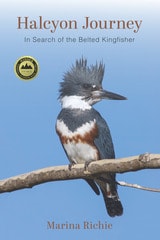
Halcyon Journey
In Search of the Belted KingfisherMarina Richie
Oregon State University Press, 2022
Winner of a 2022 National Outdoor Award
Winner of a Foreword INDIES Award
More than one hundred species of kingfishers brighten every continent but Antarctica. Not all are fishing birds. They range in size from the African dwarf kingfisher to the laughing kookaburra of Australia. This first book to feature North America’s belted kingfisher is a lyrical story of observation, revelation, and curiosity in the presence of flowing waters.
The kingfisher—also known as the halcyon bird—is linked to the mythic origin of halcyon days, a state of happiness that Marina Richie hopes to find outside her back door in Missoula, Montana. Epiphanies and a citizen science discovery punctuate days tracking a bird that outwits at every turn. The female is more colorful than the male (unusual and puzzling) and the birds’ earthen nest holes are difficult to locate.
While the heart of the drama takes place on Rattlesnake Creek in Missoula, the author’s adventures in search of kingfisher kin on the lower Rio Grande, in South Africa, and in London illuminate her relationships with the birds of Montana. In the quiet of winter, she explores tribal stories of the kingfisher as messenger and helper, pivotal qualities for her quest. For all who love birds or simply seek solace in nature, Halcyon Journey is an inviting introduction to the mythic and mysterious belted kingfisher.
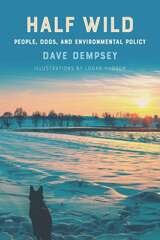
Half Wild
People, Dogs, and Environmental PolicyDave Dempsey
Michigan State University Press, 2023
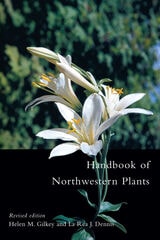
Handbook of Northwestern Plants Revised Edition
Helen Gilkey
Oregon State University Press, 2001
Handbook of Quantitative Ecology
Justin Kitzes
University of Chicago Press, 2022
Quantitative research techniques have become increasingly important in ecology and conservation biology, but the sheer breadth of methods that must be understood—from population modeling and probabilistic thinking to modern statistics, simulation, and data science—and a lack of computational or mathematics training have hindered quantitative literacy in these fields. In this book, ecologist Justin Kitzes addresses those challenges for students and practicing scientists alike.
Requiring only basic algebra and the ability to use a spreadsheet, Handbook of Quantitative Ecology is designed to provide a practical, intuitive, and integrated introduction to widely used quantitative methods. Kitzes builds each chapter around a specific ecological problem and arrives, step by step, at a general principle through the process of solving that problem. Grouped into five broad categories—difference equations, probability, matrix models, likelihood statistics, and other numerical methods—the book introduces basic concepts, starting with exponential and logistic growth, and helps readers to understand the field’s more advanced subjects, such as bootstrapping, stochastic optimization, and cellular automata. Complete with online solutions to all numerical problems, Kitzes’s Handbook of Quantitative Ecology is an ideal coursebook for both undergraduate and graduate students of ecology, as well as a useful and necessary resource for mathematically out-of-practice scientists.
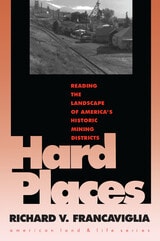
Hard Places
Reading the Landscape of America's Historic Mining DistrictsRichard V. Francaviglia
University of Iowa Press, 1997
Working with the premise that there are much meaning and value in the "repelling beauty" of mining landscapes, Richard Francaviglia identifies the visual clues that indicate an area has been mined and tells us how to read them, showing the interconnections among all of America's major mining districts. With a style as bold as the landscape he reads and with photographs to match, he interprets the major forces that have shaped the architecture, design, and topography of mining areas. Covering many different types of mining and mining locations, he concludes that mining landscapes have come to symbolize the turmoil between what our society elects to view as two opposing forces: culture and nature.
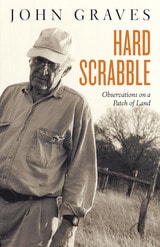
Hard Scrabble
Observations on a Patch of LandBy John Graves<br>Introduction by Rick Bass
University of Texas Press, 2016
“A kind of homemade book—imperfect like a handmade thing, a prize. It’s a galloping, spontaneous book, on occasion within whooping distance of that greatest and sweetest of country books, Ivan Turgenev’s A Sportsman’s Notebook.” —Edward Hoagland, New York Times Book Review
“His subjects are trees and brush, hired help, fences, soil, armadillos and other wildlife, flood and drought, local history, sheep and goats . . . and they come to us reshaped and reenlivened by his agreeably individual (and sometimes cranky) notions.” —New Yorker
“If Goodbye to a River was in some sense Graves’s Odyssey, this book is his [version of Hesiod’s] Works and Days. It is partly a book about work, partly a book about nature, but mostly a book about belonging. In the end John Graves has learned to belong to his patch of land so thoroughly that at moments he can sense in himself a unity with medieval peasants and Sumerian farmers, working with their fields by the Tigris.” —Larry McMurtry, Washington Post Book World
“Hard Scrabble is hard pastoral of the kind we have learned to recognize in Wordsworth, Frost, Hemingway, and Faulkner. It celebrates life in accommodation with a piece of the ‘given’ creation, a recalcitrant four hundred or so acres of Texas cedar brake, old field, and creek bottom, which will require of any genuine resident all the character he can muster.” —Southwest Review
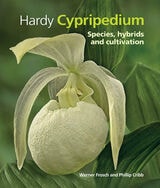
Hardy Cypripedium
Species, Hybrids and CultivationWerner Frosch, Phillip Cribb
Royal Botanic Gardens, Kew, 2012
Hardy Cypripedium presents the fifty species and one hundred hybrids of the slipper orchid through more than three hundred photos. It also provides plant descriptions, ecology, distribution, and cultivation methods. Sections on history, morphology, and conservation round out the guide. Professional and amateur growers, as well as fans of orchids of all types, will find a wealth of useful information in this beautiful book.
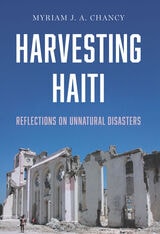
Harvesting Haiti
Reflections on Unnatural DisastersMyriam J.A. Chancy
University of Texas Press, 2023
2024 Isis Duarte Book Prize, Haiti/ Dominican Republic Section, Latin American Studies Association
2024 Longlist, OCM Bocas Prize for Caribbean Literature, Bocas Lit Fest
This collection ponders the personal and political implications for Haitians at home and abroad resulting from the devastating 2010 earthquake.
The 7.0 magnitude earthquake that struck Haiti in January 2010 was a debilitating event that followed decades of political, social, and financial issues. Leaving over 250,000 people dead, 300,000 injured, and 1.5 million people homeless, the earthquake has had lasting repercussions on a struggling nation. As the post-earthquake political situation unfolded, Myriam Chancy worked to illuminate on-the-ground concerns, from the vulnerable position of Haitian women to the failures of international aid. Originally presented at invited campus talks, published as columns for a newspaper in Trinidad and Tobago, and circulated in other ways, her essays and creative responses preserve the reactions and urgencies of the years following the disaster.
In Harvesting Haiti, Chancy examines the structures that have resulted in Haiti's post-earthquake conditions and reflects at key points after the earthquake on its effects on vulnerable communities. Her essays make clear the importance of sustaining and supporting the dignity of Haitian lives and of creating a better, contextualized understanding of the issues that mark Haitians’ historical and present realities, from gender parity to the vexed relationship between Haiti and the Dominican Republic.
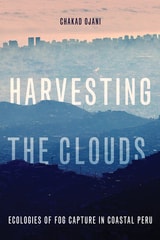
Harvesting the Clouds
Ecologies of Fog Capture in Coastal PeruChakad Ojani
University of Arizona Press, 2027
Vision limited, sounds muffled. Tiny water droplets reflect light back to its source and make it difficult to locate the origin of sounds: this is fog. In Chakad Ojani’s ethnography, this atmospheric phenomenon plays a pivotal role.
Drawing on long-term ethnographic research on engagements with fog in Lima and coastal Peru, Harvesting the Clouds examines how local NGO workers and fog oasis conservationists sought to utilize coastal fog as a water source. NGO workers installed fog catchers in informal or recently formalized neighborhoods where state infrastructure was absent, while conservationists harnessed ground-touching clouds in order to prevent informal urbanization. As they set out to capture ground-touching clouds to pursue their distinct goals, these collectives became entrapped by activities, demands, and expectations that they had not foreseen. The book frames these relationships as ecologies of capture: emergent webs of relationships held together by conflicting aims and expectations, the possibilities and limitations of fog capture, and the material qualities of fog itself.
Harvesting the Clouds argues that capture is always only partially successful, but by virtue of this partiality, it becomes productive of social relations—an understanding that the author extends to anthropological inquiry itself as an exercise in the productive impossibility of ethnographic entrapment.
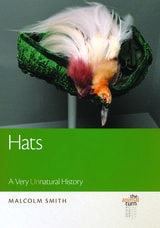
Hats
A Very UNnatural HistoryMalcolm Smith
Michigan State University Press, 2020
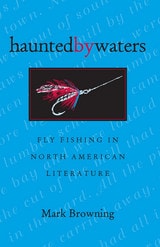
Haunted By Waters
Fly Fishing In North American LiteratureMark Browning
Ohio University Press, 1998
As his own story unfolds, Mark Browning analyzes angling literature from the Bible to Norman Maclean, always bringing his inquiry back to the same source: the enigma of this sport.
Haunted by Waters is an exploration of the apparent compulsion of those who fish not only to read about the sport, but to write about it as well. Mark Browning's personal account as a fly fisherman and his perspective as a critic make him uniquely qualified to navigate these waters.
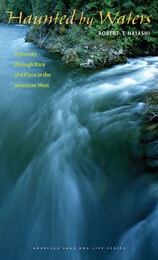
Haunted by Waters
A Journey through Race and Place in the American WestRobert T. Hayashi
University of Iowa Press, 2007
Even though race influenced how Americans envisioned, represented, and shaped the American West, discussions of its history devalue the experiences of racial and ethnic minorities. In this lyrical history of marginalized peoples in Idaho, Robert T. Hayashi views the West from a different perspective by detailing the ways in which they shaped the western landscape and its meaning.
As an easterner, researcher, angler, and third-generation Japanese American traveling across the contemporary Idaho landscape—where his grandfather died during internment during World War II—Hayashi reconstructs a landscape that lured emigrants of all races at the same time its ruling forces were developing cultured processes that excluded nonwhites. Throughout each convincing and compelling chapter, he searches for the stories of dispossessed minorities as patiently as he searches for trout.
Using a wide range of materials that include memoirs, oral interviews, poetry, legal cases, letters, government documents, and even road signs, Hayashi illustrates how Thomas Jefferson’s vision of an agrarian, all-white, and democratic West affected the Gem State’s Nez Perce, Chinese, Shoshone, Mormon, and particularly Japanese residents. Starting at the site of the Corps of Discovery’s journey into Idaho, he details the ideological, aesthetic, and material manifestations of these intertwined notions of race and place. As he ?y-?shes Idaho’s fabled rivers and visits its historical sites and museums, Hayashi reads the contemporary landscape in light of this evolution.
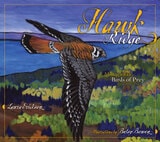
Hawk Ridge
Minnesota's Birds of PreyLaura Erickson
University of Minnesota Press, 2012
Was Caesar like the eagle because of his aquiline (from aquila, for “eagle” in Latin) nose, or does the eagle seem imperial because of his Caesar-like beak? Does the sharp vision of a “hawk-eyed” observer have any basis in nature? And what the heck is “kettling” to a bird-watcher, or, for that matter, a bird? Raptors have captured the imagination from time immemorial and have an especially rich history in Minnesota. The ancient peoples whose pictographs adorn the rock faces of Lake Superior’s North Shore may well have witnessed the first hawk movements along Lake Superior—the same annual migration that today draws as many as twenty thousand people to Duluth’s Hawk Ridge. These birds, passing through in astounding numbers, are among the hawks and accipiters, buteos and harriers, eagles and ospreys pictured and profiled in detail in this book.
Written by one of Minnesota’s best-known bird authorities, with images by one of the state’s favorite illustrators, Hawk Ridge is as fun as it is informative. It introduces the state’s raptors, from the rare visitor to the most familiar hawk, noting each species’ signature traits—osprey wings, for instance, are crooked to help them catch fish; vultures urinate on their legs to cool themselves—and their nesting, breeding, and migrating habits. Did you know that Sharp-shinned Hawks banded at Hawk Ridge have been found throughout Central America and even into South America, and also, in midwinter, in Wisconsin? Laura Erickson offers a broad perspective (a bird’s-eye view!), making sense of the raptor’s role in the larger ornithological scheme.
With descriptions of various species—and helpful distinctions between species, families, and orders—the book gives readers a clear idea of which raptors might be seen in Minnesota, when, where, and how often. It also includes a hawk migration primer that explains the movements that bring these birds in such awe-inspiring numbers to places like Hawk Ridge. Filled with curious facts and practical information for expert and amateur bird-watcher alike, the book is at once a guide to the hawks of Minnesota and a beautifully illustrated album of the most regal members of the avian kingdom.
Hawks and Owls of Eastern North America
Heintzelman, Donald S.
Rutgers University Press, 2004
Headless Males Make Great Lovers
And Other Unusual Natural HistoriesMarty Crump
University of Chicago Press, 2005
Headless Males Make Great Lovers and Other Unusual Natural Histories celebrates the extraordinary world of animals with essays on curious creatures and their amazing behaviors. In five thematic chapters, Marty Crump—a tropical field biologist well known for her work with the reproductive behavior of amphibians—examines the bizarre conduct of animals as they mate, parent, feed, defend themselves, and communicate. Crump's enthusiasm for the unusual behaviors she describes-from sex change and free love in sponges to aphrodisiac concoctions in bats-is visible on every page, thanks to her skilled storytelling, which makes even sea slugs, dung beetles, ticks, and tapeworms fascinating and appealing. Steeped in biology, Headless Males Make Great Lovers points out that diverse and unrelated animals often share seemingly bizarre behaviors—evidence, Crump argues, that these natural histories, though outwardly weird, are successful ways of living.
Illustrated throughout, and filled with vignettes of personal and scientific interest, Headless Males Make Great Lovers will enchant the general reader with its tales of blood-squirting horned lizards and intestine-ejecting sea cucumbers—all in the service of a greater appreciation of the diversity of the natural histories of animals.
Headwaters
A Journey on Alabama RiversJohn C. Hall and Beth Maynor Young
University of Alabama Press, 2009
A breathtaking portrait of Alabama rivers.
From their primal seepages in the Appalachian highlands or along the broad Chunnenuggee Hills, Alabama’s rivers carve through the rocky uplands and down the Fall Line rapids, then ease across the coastal plain to their eventual confluence with the Gulf of Mexico.
Beth Maynor Young’s 155 full-color photographs constitute art through a lens; the colors, the light, and the angles all converge for a tender praise of her subject. Her stunning visuals are supported by tantalizing captions and introductory text from John C. Hall, a master field trip leader. Together, they tell a proud story of the native beauty and complexity of these Alabama watercourses that shepherd fully 20% of the nation’s fresh water to sea.
The intimate close-up of verdant mosses or pebbled beaches pulls one into their space just as surely as does a sweeping scene of a watershed valley or a sparkling sunset over water. We all become eager listeners and observers on this guided “paddle to the Gulf,” drinking in the peace, delight, and beauty offered by the experience. At the end, we know we won’t be the same as before beginning the journey.
In addition to being a celebration of their richness, Headwaters serves as a call to greater stewardship of these riverine resources. Conservation sidebars describe the current efforts in this direction and encourage further study and protection. This book tells us, in glorious color and instructive word, why we’ll always treasure these wonderful rivers.
Healing the Herds
Disease, Livestock Economies, and the Globalization of Veterinary MedicineKaren Brown
Ohio University Press, 2010
During the early 1990s, the ability of dangerous diseases to pass between animals and humans was brought once more to the public consciousness. These concerns continue to raise questions about how livestock diseases have been managed over time and in different social, economic, and political circumstances. Healing the Herds: Disease, Livestock Economies, and the Globalization of Veterinary Medicine brings together case studies from the Americas, western Europe, and the European and Japanese colonies to illustrate how the rapid growth of the international trade in animals through the nineteenth century engendered the spread of infectious diseases, sometimes with devastating consequences for indigenous pastoral societies. At different times and across much of the globe, livestock epidemics have challenged social order and provoked state interventions, often opposed by farmers and herders. The intensification of agriculture has transformed environments, with consequences for animal and human health.
But the last two centuries have also witnessed major changes in the way societies have conceptualized diseases and sought to control them. From the late nineteenth century, advances in veterinary technologies afforded veterinary scientists a new professional status and allowed them to wield greater political influence. While older methods have remained important to strategies of control and prevention, as demonstrated during the outbreak of foot-and-mouth disease in Britain in 2001, the rise of germ theories and the discovery of vaccines against some infections made it possible to move beyond the blunt tools of animal culls and restrictive quarantines of the past. Healing the Herds: Disease, Livestock Economies, and the Globalization of Veterinary Medicine offers a new and exciting comparative approach to the complex interrelationships of microbes, markets, and medicine in the global economy.
Heart Of The Sound
Marybeth Holleman
University of Utah Press, 2004
"You can’t step in the same river twice—although I once believed I could. I believed that the pieces of my life I had chosen, those I held close to my heart, would, once chosen and held, remain the same."—from the book
How does one recover from disaster? That question is at the heart of Marybeth Holleman’s lyrical, elegiac response to the repercussions of the Exxon Valdez oil spill that devastated Alaska’s Prince William Sound in 1989. Twining together the destruction of an ecosystem and the disintegration of her marriage, Holleman explores the resiliency of nature—both wild and human—and the ways in which that resiliency is tested. Like the oil that remains pooled beneath rocks years after the tanker spill, the emotional wounds of the past lie just below the surface. Recovery and restoration from the pain wrought by human hands does not come easily.
If much of nature writing is about the heart’s search for an unspoiled, perfect landscape, The Heart of the Sound is about what happens when the return-to-paradise fantasy is over and paradise is lost. In language rich with passion and hard-won insight, Holleman creates a captivating picture of a woman who found her Eden in the sweeping fjords of Alaska only to lose it to ecological tragedy. But somewhere within that loss, she finds herself.
Heart Stays Country
Meditations from the Southern Flint HillsGary Lantz
University of Iowa Press, 2017
As proud grasslanders know, the prairie is biologically fulfilling, unique, and increasingly rare: biologists from the National Park Service and the Nature Conservancy agree that a healthy prairie remains one of the most ecologically diverse and dynamic ecosystems on this planet—as well as one of the rarest left on earth. This landscape that once inspired rapturous exclamations from travelers headed west on horseback now mostly exists in fragments exiled from each other by cropland, cities, and interstate highways.
Historically, tallgrass prairie stretched from Canada to Texas, from central Kansas to Indiana. Now the last major expanse of tallgrass occurs in the Flint Hills, a verdant landscape extending in a north-south strip across eastern Kansas and into northern Oklahoma’s Osage County. In these essays, Gary Lantz brings the beautiful diversity of the prairie home to all of us.

Hearts And Minds
The Controversy Over Laboratory AnimalsJulian Groves
Temple University Press, 1996
Heavy Ground
William Mulholland and the St. Francis Dam DisasterNorris Hundley
University of Nevada Press, 2020
Hell Or High Water
James White's Disputed Passage through Grand Canyon, 1867Eilean Adams
Utah State University Press, 2001
Although John Wesley Powell and party are usually given credit for the first river descent through the Grand Canyon, the ghost of James White has haunted those claims. White was a Colorado prospector, who, almost two years before Powell's journey, washed up on a makeshift raft at Callville, Nevada. His claim to have entered the Colorado above the San Juan River with another man (soon drowned) as they fled from Indians was widely disseminated and believed for a time, but Powell and his successors on the river publically discounted it. Colorado River runners and historians have since debated whether White's passage through Grand Canyon even could have happened.
Hell or High Water is the first full account of White's story and how it became distorted and he disparaged over time. It is also a fascinating detective story, recounting how White's granddaughter, Eilean Adams, over decades and with the assistance of a couple of notable Colorado River historians who believed he could have done what he claimed, gradually uncovered the record of James White's adventure and put together a plausible narrative of how and why he ended up floating helplessly down a turbulent river, entrenched in massive cliffs, with nothing but a driftwood raft to carry him through.
Helpers At Birds Nests
Cooperative Breeding & Related BehaviorAlexander F. Skutch
University of Iowa Press, 1999
In Helpers at Birds' Nests, renowned naturalist and ornithologist Alexander Skutch provides vivid, detailed accounts of a remarkable aspect of bird behavior—he aid that one bird gives another who is neither its mate nor its dependent young and who may even belong to a different species.
In graceful, clear prose, Skutch makes accessible to amateur bird-watchers examples of cooperation in species as far-flung as the little rifleman of New Zealand, the Laysan albatross in the mid Pacific, and the neotropical birds of Skutch's own Valley of El General in Costa Rica.
Skutch describes the cooperative behavior of more than fifty families of birds. Each family is introduced by a brief sketch of its distribution and outstanding features, followed by intimate, nontechnical accounts of the helpful behaviors that have been most carefully studied. Skutch considers the significance of helpful birds and discusses the theoretical aspects of cooperative breeding, its evolution, kin selection, altruism, and demography.
First discovered by the author more than half a century ago, cooperative breeding has become increasingly studied by professional ornithologists. In this expanded edition, noted behaviorist Stephen Emlen credits Skutch's passionate observations of birds with promoting scientific interest in avian behavior. Emlen offers readers a summary of the advances made in the field during the past ten years and places Skutch's work in the context of contemporary ornithological research.
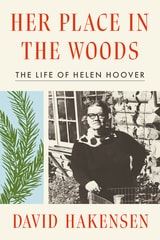
Her Place in the Woods
The Life of Helen HooverDavid Hakensen
University of Minnesota Press, 2025
The biography of one of Minnesota’s most beloved nature writers, from her career in the city to her rustic cabin on Gunflint Lake
During the late 1950s through the early 1970s, Helen Hoover’s stories and essays of life in the wilderness on northern Minnesota’s Gunflint Lake, published in popular magazines and several bestselling books (including The Gift of the Deer in 1966 and A Place in the Woods in 1969), found millions of fans and earned her accolades alongside nature writers like Sigurd Olson, Rachel Carson, Sally Carrighar, and Calvin Rutstrum. Hoover’s own unlikely history of leaving a corporate career in Chicago for a small cabin without electricity or running water—with no interest in hunting or fishing—is just one chapter of the remarkable life that David Hakensen describes in Her Place in the Woods. This first complete biography illuminates how Helen Hoover (1910–1984) made a place for herself and for countless readers in, as she put it, the world of her time.
Hoover defied convention. Self-trained and without an academic degree, she worked in the male-dominated metallurgical field as a researcher at International Harvester, where she solved a long-standing problem with the manufacture of discs for farm implements and earned a patent. She and her husband, Adrian, a commercial artist, had long dreamed of moving to a remote cabin in the woods. As they started the long return drive to Chicago after a summer spent on Gunflint Lake, they finally made the leap, quitting their jobs with a long-distance phone call from Grand Marais and figuring out the rest as they went.
The Hoovers were woefully unprepared for life off the grid and slowly learned how to convert sheds into chicken coops and fend off bears. Social encounters presented their own challenges, with Helen’s fiery personality leading to clashes with hunters and other Gunflint neighbors. Gradually, the Hoovers settled into the rhythms of their remote homestead, and Helen would craft a prolific literary livelihood from her keen observations of nature and encounters with animals in the surrounding woods.
Her Place in the Woods captures both an awakening to the power and fragility of the natural world and the efforts and talents of an extraordinary woman defining herself as a writer. Though Helen Hoover would move on from the secluded North Woods, as she wrote in her final book, The Years of the Forest, “From this time on it would be both here and with me wherever I might be, as long as I should live.”

Herbs for the Gourmet Gardener
A Practical Resource from the Garden to the TableCaroline Holmes
University of Chicago Press, 2014
A feast for the eyes and the table, this user-friendly resource traverses the realms of both the garden and the kitchen, addressing the cultivation, storage, and preparation of more than sixty herbs. Practical growing tips, fascinating histories, nutritional information, and classic recipes appear alongside botanical illustrations drawn from the Royal Horticultural Society’s cherished collection. With both familiar varieties and novel options, Herbs for the Gourmet Gardener will inspire you to create a world of new shapes, colors, and tastes.
Here and There
A Fire SurveyStephen J. Pyne
University of Arizona Press, 2018
In this collection of essays, historian and renowned fire expert Stephen J. Pyne offers his reflections on national and global wildland fire management. Pyne distills the long saga of fire on Earth and its role in underwriting an Anthropocene that might equally be called a Pyrocene.
Presented through a mixture of journalism, history, and literary imagination, Here and There moves the discussion of fire beyond the usual formations of science and policy within a national narrative to one of thoughtful interpretation, analysis, and commentary. Centered on the unique complexities of fire management in a global world, Here and There offers a punctuation point to our understanding of wildfire.
Included in this volume:
- How fire policy has changed within the United States
- How policy in the United States differs from that in other countries
- The history of one of the most famous fire paintings of all time
- Suggested next steps for the future of fire research
Here is Where I Walk
Episodes From a Life in the ForestLeslie Carol Roberts
University of Nevada Press, 2019
In layered stories of her life and travels, Leslie turns her daily walks into revelations of deeper meaning. From Maryland to Iowa to Tasmania, we follow a fierce and keenly observant walker through places of exquisite beauty and complexity. Her daily walks inspire Leslie to accept the invitation of the beckoning trees where she finds herself colliding with the urban coyote, the peculiar banana slug, and the manzanita. She also notes both ridiculous and poignant aspects of human ecosystems in pursuit of what it means to live a life of creativity and creation from scientist-activists battling to save environments to the tragic realities of ordinary life.
In this finely crafted eco-memoir, each place provides Leslie with exactly the scaffolding needed to survive, with nature serving as the tonic. Here is Where I Walk provides a vivid answer to how we can find our place, not only in nature but within ourselves and the world we walk.
Hidden Natural Histories
HerbsKim Hurst
University of Chicago Press, 2015
Hidden Natural Histories
TreesNoel Kingsbury
University of Chicago Press, 2015
Hidden Nature
Wild Southern CavesMichael Ray Taylor
Vanderbilt University Press, 2020
More than ten thousand known caves lie beneath the state of Tennessee according to the Tennessee Cave Survey, a nonprofit organization that catalogs and maps them. Thousands more riddle surrounding states. In Hidden Nature, Michael Ray Taylor tells the story of this vast underground wilderness. In addition to describing the sheer physical majesty of the region’s wild caverns and the concurrent joys and dangers of exploring them, he examines their rich natural history and scientific import, their relationship to clean water and a healthy surface environment, and their uncertain future.
As a longtime caver and the author of three popular books related to caving—Cave Passages, Dark Life, and Caves—Taylor enjoys (for a journalist) unusual access to this secretive world. He is personally acquainted with many of the region’s most accomplished cave explorers and scientists, and they in turn are familiar with his popular writing on caves in books; in magazines such as Audubon, Outside, and Sports Illustrated; and on websites such as those of the Discovery Channel and the PBS science series Nova.
Hidden Nature is structured as a comprehensive work of well-researched fact that reads like a personal narrative of the author’s long attraction to these caves and the people who dare enter their hidden chambers.
Hidden Nature
Wild Southern CavesMichael Ray Taylor
Vanderbilt University Press, 2020
More than ten thousand known caves lie beneath the state of Tennessee according to the Tennessee Cave Survey, a nonprofit organization that catalogs and maps them. Thousands more riddle surrounding states. In Hidden Nature, Michael Ray Taylor tells the story of this vast underground wilderness. In addition to describing the sheer physical majesty of the region’s wild caverns and the concurrent joys and dangers of exploring them, he examines their rich natural history and scientific import, their relationship to clean water and a healthy surface environment, and their uncertain future.
As a longtime caver and the author of three popular books related to caving—Cave Passages, Dark Life, and Caves—Taylor enjoys (for a journalist) unusual access to this secretive world. He is personally acquainted with many of the region’s most accomplished cave explorers and scientists, and they in turn are familiar with his popular writing on caves in books; in magazines such as Audubon, Outside, and Sports Illustrated; and on websites such as those of the Discovery Channel and the PBS science series Nova.
Hidden Nature is structured as a comprehensive work of well-researched fact that reads like a personal narrative of the author’s long attraction to these caves and the people who dare enter their hidden chambers.

Hidden Ocean Forests
An Undersea Journey to Uncover a Fascinating World of KelpRoss Frylinck and Faine Loubser
University of Chicago Press, 2027
Stunning underwater photography of the world’s great marine kelp forests and the wildlife they shelter.
Kelp forests, which thrive in cold, nutrient-rich waters, are found along the coasts of every continent except Antarctica. These underwater realms are stunningly beautiful and host entire ecosystems, providing food, shelter, and breeding grounds for an abundance of marine life.
With transcendent photography and compelling accounts from freedivers and storytellers Ross Frylinck and Faine Loubser, this book offers a captivating glimpse into these ocean forests. Dive beneath the midnight sun in the Arctic Circle and watch the northern lights dance over the waters of Shetland, Scotland. In Aotearoa New Zealand, swim with playful sea lions off Rakiura Stewart Island. In South Africa’s Cape Peninsula, cross paths with dusky dolphins, whales, and sharks. Meet an austral sea wolf in the icy Strait of Magellan and learn from kelp harvesters on remote islands in Japan.
Hidden Ocean Forests documents kelp forests around the world, showcasing their rich biodiversity and long-lasting impacts on human culture. These remarkable images and enchanting essays reveal the hidden beauty, significance, and fragility of these submerged wonderlands.
Hidden Prairie
Photographing Life in One Square MeterChris Helzer
University of Iowa Press, 2020
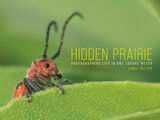
This book is packed with gorgeous full-page close-up photos of prairie plants and animals, interspersed with a dozen short essays that include both ecology and natural history tidbits and enthralling and gently humorous anecdotes about Helzer’s experience staring into a tiny bit of prairie for one year. Helzer writes eloquently about the conservation value of prairies and uses his photos and stories to reinforce a conservation ethic among his readers.
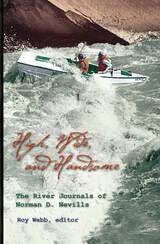
High, Wide, and Handsome
The River Journals of Norman D. Nevillsedited by Roy Webb
Utah State University Press, 2005
When he started taking paying passengers by boat through the rapids of the Colorado River's canyons, Norman Nevills invented whitewater tourism and the commercial river business. For twelve years, from 1938 until his death in a plane crash in 1949, he safely took, without a single life lost, friends, explorers, and customers down the Colorado, Green, San Juan, Salmon, and Snake Rivers in boats he designed. National media found him and his adventures irresistible and turned him into the personification of river running. Logging seven trips through the Grand Canyon when no one else had completed more than two, he was called the Fast Water Man. Boatmen he trained went on to found their own competing operations. Always controversial, Nevills had important critics and enemies as well as friends and supporters, but no one can dispute his tremendous impact on the history of western rivers and recreation.
Nevills's complete extant journals of those river expeditions are published for the first time in High, Wide, and Handsome. They contain vivid stories and images of still untamed-by-dams rivers and canyons in the Colorado River system and elsewhere, of wild rides in wooden boats, and of the few intrepid pioneers of adventure tourism who paid Nevills so they could experience it all. They have been transcribed and edited by river historian Roy Webb, author of If We Had a Boat: Green River Explorers, Adventurers, and Runners and Call of the
Colorado.
Highland Sanctuary
Environmental History in Tanzania’s Usambara MountainsChristopher A. Conte
Ohio University Press, 2004

Highpoints of the United States
A Guide to the Fifty State SummitsDon W. Holmes
University of Utah Press, 2023
The highpoints of the fifty states range from Alaska’s 20,310-foot-high Mount McKinley to 345 feet at Lakewood Park in Florida. Some highpoints, such as Mount Mitchell in North Carolina and New Hampshire’s Mount Washington, can be reached by car on a sightseeing drive. Others, including Colorado’s Mount Elbert or Mount Marcy in New York, are accessible as wilderness day hikes. Still others, such as Mount Rainier in Washington or Gannett Peak in Wyoming, are strenuous and risky mountaineering challenges that should be attempted only by experienced climbers. Whatever your level of skill and interest, these varied highpoints offer a diverse range of experiences.
The third edition of this classic guide updates route descriptions and maps, changes to private property ownership and public lands requirements, lists of guides and outfitters, and essential online resources. As with the two popular previous editions, Highpoints of the United States is arranged alphabetically by state, each site description accompanied with a map, photographs, information on trailhead, main and alternative routes, elevation gain, conditions, historical and natural history notes, and lists of potential guides or outfitters. Appendices include a list of highpoints by region and by elevation, useful resources, and a personal log for the unashamed “peak-bagger.”
Whether you’re an armchair hiker or a seasoned climber, interested only in your state’s highest point or all fifty, this book will be an invaluable companion and reference.
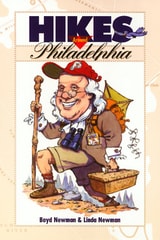
Hikes Around Philadelphia
Boyd Newman
Temple University Press, 1997
These are only five of the forty hiking trails described in Hikes Around Philadelphia. All are within an hour and a half's drive of the city. Ranging from 1.0 to 12.6 miles in length, they will take you through dense forests or wide-open meadows, past early farmsteads or a ringing boulder field from the last ice age. You can break your hike with a visit to a restored home or leave civilization behind on an isolated mountain ridge. Some of the trails are gravel or paved, or are canal towpaths, and are quite suitable for young children, older adults, or wheelchair hikers. Others are longer and more challenging, including rugged sections of the Appalachian Trail and the Horseshoe Trail.
For each hike Boyd Newman and Linda Newman provide a detailed write-up, a trail map showing the hike route on a USGS survey map, and directions to the trailhead. They also include information on distance, elevation, probable time, surface, interesting features, facililities, disability access, whether hunting is allowed in the vicinity, and availability to public transportation. This format allows you to browse through the book and easily locate the particular hike that appeals to you today.
In a concise introduction, the authors not only explain how to get the most out of the book but also give some hints on hiking safety and appropriate clothing and equipment.
This handy reference offers:
*a detailed write-up of each hike
*easy-to-read trail maps
*directions to the trail heads
*information that are accessible by public transportation
*details about handicap accessibility
*lots of other pointers that make planned or last-minute hikes fun and easy for everyone
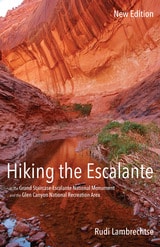
Hiking the Escalante
In the Grand Staircase-Escalante National Monument and the Glen Canyon National Recreation Area, New EditionRudi Lambrechtse
University of Utah Press, 2015
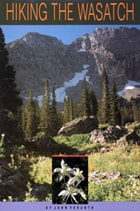
Hiking the Wasatch
A Hiking and Natural History Guide to the Central WasatchJohn Veranth
University of Utah Press, 2014
Trail descriptions range from nearly level walks requiring less than an hour to ascents that challenge experienced mountaineers. To assist in selecting an appropriate trail, hikes are listed according to best season, time required, objective, and desired level of difficulty. The easy trails have the most detailed descriptions to aid beginners, while expert trails have sparse descriptions to preserve the adventure. Maps, photos, and line drawings are included and detailed driving directions to the trailheads are consolidated to save repetition. The area’s geology, flora and fauna, and human history are also discussed to further appreciation of this mountain environment.
Since the first publication of Hiking the Wasatch, there have been numerous changes to these trails, especially along the foothill-urban interface. This revised third edition contains full updates based on the author’s field checking, comments from members of the Wasatch Mountain Club, and information from land-management agencies. Hiking the Wasatch is an essential resource for exploring these mountain trails.
Historicity of Nature
Essays on Science and TheologyWolfhart Pannenberg
Templeton Press, 2008
Known as one of the most outstanding theologians of the twentieth century, Wolfhart Pannenberg is also considered a great interdisciplinary thinker. Now, essays and articles on science and theology that are central to understanding Pannenberg's theories have been collected into one volume.
Niels Henrik Gregersen, a former student of Pannenberg and now professor of systematic theology at Copenhagen University, has compiled the writings in four sections: Methodology, Creation and Nature's Historicity, Religion and Anthropology, and Meaning and Metaphysics. Included in this volume are:
•Translations of Pannenberg's principled argument for the consonance between science and religion, including contingency and laws of nature, field theories and space-time, and divine action•Translations of Pannenberg's theory of theology as a rational hypothetical science, including his discussions with leading British and American scholars such as A. N. Whitehead, John Cobb, and Langdon Gilkey
•Previously unpublished articles on the problems between science and theology in the course of modern history, explaining why chance may be more important for theology than design
•Translations of seminal articles that articulate Pannenberg's understanding of the role of religion in human nature
•One of the few theological articles on aggression as a psychological and social phenomenon
With this collection, the essays of this important contemporary theologian and his illuminating views are presented in one convenient volume.
History of the Alps, 1500 - 1900
Environment, Development, and SocietyJon Mathieu, translated by Matthew Vester
West Virginia University Press, 2009
In the 1700s, Jean-Jacques Rousseau celebrated the Alps as the quintessence of the triumph of nature over the “horrors” of civilization. Now available in English, History of the Alps, 1500-1900: Environment, Development, and Society provides a precise history of one of the greatest mountain range systems in the world. Jon Mathieu’s work disproves a number of commonly held notions about the Alps, positioning them as neither an inversion of lowland society nor a world apart with respect to Europe. Mathieu’s broad historical portrait addresses both the economic and sociopolitical—exploring the relationship between population levels, development, and the Alpine environment, as well as the complex links between agrarian structure, society, and the development of modern civilization. More detailed analysis examines the relationship between various agrarian structures and shifting political configurations, several aspects of family history between the late Middle Ages and the turn of the twentieth century, and exploration of the Savoy, Grisons, and Carinthia regions.
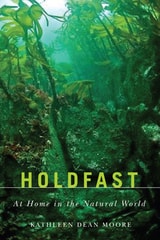
Holdfast
At Home in the Natural WorldKathleen Dean Moore
Oregon State University Press, 2013
Naturalist and philosopher Kathleen Dean Moore meditates on connection and separation in these twenty-one elegant, probing essays. Using the metaphor of holdfasts—the structures that attach seaweed to rocks with a grip strong enough to withstand winter gales—she examines our connections to our own bedrock.
“When people lock themselves in their houses at night and seal the windows shut to keep out storms, it is possible to forget, sometimes for years and years, that human beings are part of the natural world,” she writes. Holdfast passionately reclaims an awareness of the natural world, exploring the sense of belonging fostered by the communal howls of wolves; the inevitability of losing children to their own lives; the fear of bears and love of storms; the sublimity of life and longing in the creatures of the sea; her agonizing decision when facing her father’s bone-deep pain. As Moore travels philosophically and geographically—from Oregon’s shores to Alaska’s islands—she leaves no doubt of her virtuosity and range.
The new afterword is an important statement on the new responsibilities of nature writers as the world faces the consequences of climate change.

Holding On to Reality
The Nature of Information at the Turn of the MillenniumAlbert Borgmann
University of Chicago Press, 1999
"[Borgmann] has offered a stunningly clear definition of information in Holding On to Reality. . . . He leaves room for little argument, unless one wants to pose the now vogue objection: I guess it depends on what you mean by nothing."—Paul Bennett, Wired
"A superb anecdotal analysis of information for a hype-addled age."—New Scientist
"This insightful and poetic reflection on the changing nature of information is a wonderful antidote to much of the current hype about the 'information revolution.' Borgmann reminds us that whatever the reality of our time, we need 'a balance of signs and things' in our lives."—Margaret Wertheim, LA Weekly
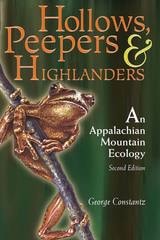
Hollows, Peepers, and Highlanders
An Appalachian Mountain EcologyGeorge Constantz
West Virginia University Press, 2004
In this revised and expanded edition of Hollows, Peepers, and Highlanders, author George Constantz, a biologist and naturalist, writes about the beauty and nature of the Appalachian landscape. While the information is scientific in nature, Constantz's accessible descriptions of the adaptation of various organisms to their environment enable the reader to enjoy learning about the Appalachian ecosystem. The book is divided into three sections: "Stage and Theater," "The Players," and "Seasonal Act." Each section sets the scene and describes the events occurring in nature. "Stage and Theatre" is comprised of chapters that describe the origins of the Appalachia region. "The Players" is an interesting and in-depth look into the ecology of animals, such as the mating rituals of different species, and the evolutionary explanation for the adaptation of Appalachian wildlife. The last section, "Seasonal Act," makes note of the changes in Appalachian weather each season and its effect on the inhabitants.
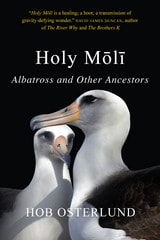
Holy Moli
Albatross and Other AncestorsHob Osterlund
Oregon State University Press, 2016
In Hawaiian mythology, ancestors may occupy the physical forms of animals known as 'aumakua. Laysan albatross—known as moli—are among them. Smitten with these charismatic creatures, Osterlund set out to learn everything she could about moli. She eventually came to embrace them as her 'aumakua—not as dusty old myths on a museum bookshelf, but as breathing, breeding, boisterous realities.
Albatross sport many superlative qualities. They live long—sometimes longer than sixty years—and spend the majority of their time airborne, gliding across vast oceanic expanses. They are model mates and devoted parents, and are among the only animals known to take long-term same-sex partners. In nesting season, they rack up inconceivable mileage just to find supper for chicks waiting on the islands of the Hawaiian archipelago.
It is from the island of Kaua'i that Holy Moli takes flight. Osterlund relates a true tale of courage, celebration and grief—of patience, affection and resilience. This is the story of how albatross guided the author on her own long journey, retracing distances and decades, back to the origin of a binding bargain she struck when she was ten years old, shortly after her mother’s death.
Holy Moli is a natural history of the albatross, a moving memoir of grief, and a soaring tribute to ancestors. Within its pages are lyrics of wonder—for freedom, for beauty, and for the far-flung feathered creatures known to us as albatross.
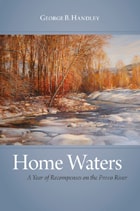
Home Waters
A Year of Recompenses on the Provo RiverGeorge B Handley
University of Utah Press, 2010
People who flyfish know that a favorite river bend, a secluded spot in moving waters, can feel like home—a place you know intimately and intuitively. In prose that reads like the flowing current of a river, scholar and essayist George Handley blends nature writing, local history, theology, environmental history, and personal memoir in his new book Home Waters: A Year of Recompenses on the Provo River.
Handley’s meditations on the local Provo River watershed present the argument that a sense of place requires more than a strong sense of history and belonging, it requires awareness and commitment. Handley traces a history of settlement along the Provo that has profoundly transformed the landscape and yet neglected its Native American and environmental legacies. As a descendent of one of the first pioneers to irrigate the area, and as a witness to the loss of orchards, open space, and an eroded environmental ethic, Handley weaves his own personal and family history into the landscape to argue for sustainable belonging. In avoiding the exclusionist and environmentally harmful attitudes that come with the territorial claims to a homeland, the flyfishing term, “home waters,” is offered as an alternative, a kind of belonging that is informed by deference to others, to the mysteries of deep time, and to a fragile dependence on water. While it has sometimes been mistakenly assumed that the Mormon faith is inimical to good environmental stewardship, Handley explores the faith’s openness to science, its recognition of the holiness of the creation, and its call for an ethical engagement with nature. A metaphysical approach to the physical world is offered as an antidote to the suicidal impulses of modern society and our persistent ambivalence about the facts of our biology and earthly condition. Home Waters contributes a perspective from within the Mormon religious experience to the tradition of such Western writers as Wallace Stegner, Terry Tempest Williams, Steven Trimble, and Amy Irvine.
Winner of the Mormon Letters Award for Memoir.
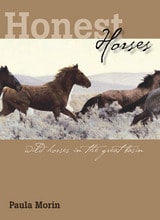
Honest Horses
Wild Horses In The Great BasinPaula Morin
University of Nevada Press, 2006
Horses have been part of the American West since the first Spanish explorers brought their European-bred steeds onto the new continent. Soon thereafter, some of these animals, lost or abandoned by their owners or captured by indigenous peoples, became the foundation of the great herds of mustangs (from the Spanish mesteño, stray) that still roam the West. These feral horses are inextricably intertwined with the culture, economy, and mythology of the West. The current situation of the mustangs as vigorous competitors for the scanty resources of the West’s drought-parched rangelands has put them at the center of passionate controversies about their purpose, place, and future on the open range. Photographer/oral historian Paula Morin has interviewed sixty-two people who know these horses best: ranchers, horse breeders and trainers, Native Americans, veterinarians, wild horse advocates, mustangers, range scientists, cowboy poets, western historians, wildlife experts, animal behaviorists, and agents of the federal Bureau of Land Management. The result is the most comprehensive, impartial examination yet of the history and impact of wild mustangs in the Great Basin. Morin elicits from her interviewees a range of expertise, insight, and candid opinion about the nature of horses, ranching, and the western environment. Honest Horses brings us the voices of authentic westerners, people who live intimately with horses and the land, who share their experiences and love of the mustangs, and who understand how precariously all life exists in Great Basin.