Results by title
1148 books match the query 'Political Ideologies' and 30 start with h

Hannah Arendt
A Critical IntroductionFinn Bowring
Pluto Press, 2011
Hannah Arendt is one of the most famous political theorists of the twentieth century, yet in the social sciences her work has rarely been given the attention it deserves. This careful and comprehensive study introduces Arendt to a wider audience.
Finn Bowring shows how Arendt's writings have engaged with and influenced prominent figures in the sociological canon, and how her ideas may shed light on some of the most pressing social and political problems of today. He explores her critique of Marx, her relationship to Weber, the influence of her work on Habermas and the parallels and discrepancies between her and Foucault. This is a clearly written and scholarly text which surveys the leading debates over Arendt’s work, including discussions of totalitarianism, the public sphere and the nature of political responsibility.
This book will bring new perspectives to students and lecturers in sociology and politics.
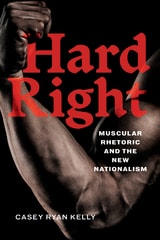
Hard Right
Muscular Rhetoric and the New NationalismCasey Ryan Kelly
The Ohio State University Press, 2026
A groundbreaking examination of far-right rhetoric around fitness and the human body and how such rhetoric serves white nationalist, masculinist aims.
In recent years, far-right, white-nationalist groups in the US have churned out streams of discourse glorifying “muscularity” as the ideal masculine form. This preoccupation with physical fitness—along with expressed fears of declining testosterone levels in men, race-mixing, and transgender women—all reveal the masculine bodily fantasies and anxieties that underwrite the political unconscious of the far right. In Hard Right, Casey Ryan Kelly examines the link between extreme fitness culture and fascist organizations, arguing that the human body operates as a privileged signifier of national belonging in the rhetoric of the far right.
Drawing from psychoanalytic theory, Kelly shows that far-right rhetoric constructs fantasies of recovering the “natural” or primal masculine body. These fantasies are frequently accompanied by anxieties about “soft,” disabled, and ambiguously gendered bodies, all of which are seen as signs of degeneracy that must be transformed, exiled, or eradicated for the sake of national and racial health. Through its examination of “Red Pill” fitness influencers, “bro science” conspiracy theories, far-right podcasts, and more, Hard Right ultimately shows how the cultural logics of men’s health and physical fitness converge with the political logics of white nationalism and late fascism.
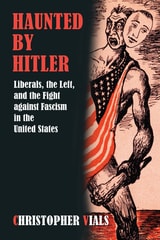
Haunted by Hitler
Liberals, the Left, and the Fight against Fascism in the United StatesChristopher Vials
University of Massachusetts Press, 2014
Although fascism is typically associated with Europe, the threat of fascism in the United States haunted the imaginations of activists, writers, and artists, spurring them to create a rich, elaborate body of cultural and political work. Traversing the Popular Front of the 1930s, the struggle against McCarthyism in the 1950s, the Black Power movement of the 1960s, and the AIDS activism of the 1980s, Haunted by Hitler highlights the value of “antifascist” cultural politics, showing how it helped to frame the national discourse.
Christopher Vials examines the ways in which anxieties about fascism in the United States have been expressed in the public sphere, through American television shows, Off-Broadway theater, party newspapers, bestselling works of history, journalism, popular sociology, political theory, and other media. He argues that twentieth-century liberals and leftists were more deeply unsettled by the problem of fascism than those at the center or the right and that they tirelessly and often successfully worked to counter America's fascist equivalents.
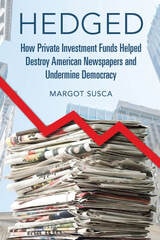
Hedged
How Private Investment Funds Helped Destroy American Newspapers and Undermine DemocracyMargot Susca
University of Illinois Press, 2024
The ultrawealthy largely own and guide the newspaper system in the United States. Through entities like hedge funds and private equity firms, this investor class continues to dismantle the one institution meant to give voice to average citizens in a democracy.
Margot Susca reveals the little-known history of how private investment took over the newspaper industry. Drawing on a political economy of media, Susca’s analysis uses in-depth interviews and documentary evidence to examine issues surrounding ownership and power. Susca also traces the scorched-earth policies of layoffs, debt, cash-outs, and wholesale newspaper closings left behind by private investors and the effects of the devastation on the future of news and information. Throughout, Susca reveals an industry rocked less by external forces like lost ad revenue and more by ownership and management obsessed with profit and beholden to private fund interests that feel no responsibility toward journalism or the public it is meant to serve.
Hell's Not Far Off
Bruce Crawford and the Appalachian LeftJosh Howard
West Virginia University Press, 2024
A biography of Bruce Crawford, a southwest Virginia journalist-writer of the radical tradition and one of the first to interpret Appalachian labor history.
Hell’s Not Far Off is a grounded, politically engaged study of the Appalachian journalist and political critic Bruce Crawford, a scourge of coal and railway interests. Crawford fought injustices wherever he saw them at major risk to his own life and became an early interpreter of Appalachian labor history.
His writings and actions from the 1920s to the 1960s helped shape southwest Virginia and West Virginia. Through Crawford’s Weekly, a newspaper active from 1920 to 1935, Crawford challenged the Ku Klux Klan, lynch mobs, and the private police forces of coal barons. The wounds received for these efforts were the closing of his paper and a bullet to his leg during a Harlan County strike in the 1930s. In his work after journalism, he led the West Virginia branch of the Federal Writers’ Project during the political standoff over the contents of the state’s official guidebook.
In Hell’s Not Far Off, Josh Howard resurrects strands of a radical tradition centered especially on matters of labor, environment, and race, drawing attention to that tradition’s ongoing salience: “Present-day Appalachia’s fights were [Crawford’s], and his fights are still ours.”

Heroes and Villains
Creating National History in Contemporary UkraineDavid R. Marples
Central European University Press, 2007

Hidden San Francisco
A Guide to Lost Landscapes, Unsung Heroes and Radical HistoriesChris Carlsson
Pluto Press, 2020
Hidden San Francisco is a guidebook like no other. It’s a radical, alternative guidebook and history of San Francisco, complete with maps detailing walking and bike routes around the city.
San Francisco is an iconic and symbolic city. But only when you look beyond the picture-postcards of the Golden Gate Bridge and the quaint cable cars do you realize that the city's most interesting stories are not the Summer of Love, the Beats or even the latest gold rush in Silicon Valley.
Carlsson delves into the Bay Area's long prehistory, examining the region's geography and the lives of its inhabitants before the 1849 Gold Rush changed everything, setting in motion the clash between capital and labor that shaped the modern city. Structured around the four major themes of ecology, labor, transit and dissent, Chris Carlsson’s book peels back the layers of San Francisco's history to reveal a storied past: behind old walls and gleaming glass facades lurk former industries, secret music and poetry venues, forgotten terrorist bombings, and much more.
From the perspective of the students and secretaries, hippies and beatniks, longshoremen and waitresses, Hidden San Francisco uncovers dozens of overlooked, forgotten and buried histories that pulse through the streets and hills even today, inviting the reader to see themselves in the middle of the ongoing, everyday process of making history together.

Hidden Transfers
How Rural Women’s Reproductive Work Paid for Industrialization in Mao’s ChinaJacob Eyferth
University of Chicago Press, 0
Provides a striking, new interpretation of the importance of rural women’s cloth production in collective-era China.
Based on extensive archival research, fieldwork across multiple villages, and hundreds of interviews, Hidden Transfers offers a material history of the working lives of rural women in communist China from 1949 to 1983.
Focusing on cotton cultivation and manual textile production in rural households, historian Jacob Eyferth examines the relationship between domestic labor and socialist development by recovering the story of the millions of women who spent countless hours spinning yarn, weaving cloth, and making clothes for their families. He shows how the “hidden transfers” from the domestic economy to fund accumulation rested, as with capitalist economies, on women’s unpaid domestic work. But state socialism went even further, celebrating the future-making work of production while disparaging work that reproduced life at home. Through careful research, Eyferth tracks how the Chinese state’s project of primitive accumulation, in turn, created the conditions for the spectacular growth experienced in the post-Mao years.

History in My Life
A Memoir of Three ErasIvan T. Berend is Distinguished Research Professor at the History Department of the University of California Los Angeles.
Central European University Press, 2009
Ivan T. Berend is Distinguished Professor at the University of California Los Angeles, Director of the European Studies Program. He was one of the masterminds of regime change in Hungary. He made a career in Hungary as a university professor, Rector of the University of Economics (1973–79), and President of the Hungarian Academy of Sciences (1985–90). He was President of the International Committee of Historical Sciences (1995–2000), and Vice-President of the International Economic History Association (1986–1994). His research interests are the complex economic, social, ideological, and cultural history of Central and Eastern Europe in the 19th–20th century; economic modernization; problems of European backwardness; transition from state socialism to capitalism. He published and 26 books and more than 120 studies.
Before he became a professor at UCLA, Ivan Berend had survived five regime changes and two revolutions in Hungary, had been in prison and German concentration camp in 1944–45.
His memoir offers an interesting case study, a subjective addition to the “objective” historical works on Central and Eastern European state socialism. It describes the hard choices of intellectuals in a dictatorial state: 1. remain in isolation, concentrate on scholarly works, and exclude politics in your personal life; 2. be in opposition, criticize and unveil the regime, accept discrimination and exclusion; 3. remain within the establishment and work for reforming the country using legal possibilities to criticize the regime and to achieve changes from within.
Berend’s book raises basic historical questions and debates, compares East European and American higher education systems, and presents an eyewitness’ insights on life in the United States.

Hitler and the Germans
Eric Voegelin, Edited, Translated, & Intro by Detlev Clemens & Brendan Purcell
University of Missouri Press, 2003
Holding Fast
Resilience and Civic Engagement Among Latino ImmigrantsJames A. McCann
Russell Sage Foundation, 2020
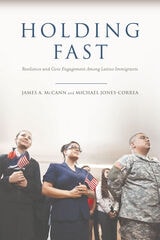
Holding Fast draws largely from a yearlong survey of Latino immigrants, including both citizens and noncitizens, conducted before and after the 2016 election. The survey gauges immigrants’ attitudes about the direction of the country and the emotional underpinnings of their political involvement. While survey respondents expressed pessimism about the direction of the United States following the 2016 election, there was no evidence of their withdrawal from civic life. Instead, immigrants demonstrated remarkable resilience in their political engagement, and their ties to America remained robust.
McCann and Jones-Correa examine Latino immigrants’ trust in government as well as their economic concerns and fears surrounding possible deportations of family members and friends. They find that Latino immigrants who were concerned about the likelihood of deportation were more likely to express a lack of trust in government. Concerns about personal finances were less salient. Disenchantment with the U.S. government did not differ based on citizenship status, length of stay in America, or residence in immigrant-friendly states. Foreign-born Latinos who are naturalized citizens shared similar sentiments to those with fewer political rights, and immigrants in California, for example, express views similar to those in Texas.
Addressing the potential influence immigrant voters may wield in in the coming election, the authors point to signs that the turnout rate for naturalized Latino immigrant may be higher than that for Latinos born in the United States. The authors further underscore the importance of the parties' platforms and policies, noting the still-tenuous nature of Latino immigrants’ affiliations with the Democratic Party.
Holding Fast outlines the complex political situation in which Latino immigrants find themselves today. Despite well-founded feelings of anger, fear, and skepticism, in general they maintain an abiding faith in the promise of American democracy. This book provides a comprehensive account of Latino immigrants’ political opinions and a nuanced, thoughtful outlook on the future of Latino civic participation. It will be an important contribution to scholarly work on civic engagement and immigrant integration.

Holocaust And Memory In The Global Age
Daniel Levy
Temple University Press, 2005
Originally published in Germany, The Holocaust and Memory in the Global Age examines the nature of collective memory in a globalized world, and how the memory of one particular event—the Holocaust—helped give rise to an emerging global consensus on human rights.
Daniel Levy and Natan Sznaider show how memories of the Holocaust have been de-contextualized from the original event and offer a framework for interpreting contemporary acts of injustice such as ethnic cleansing and genocide. Representations of mass atrocities in Bosnia and Kosovo during the 1990s resonated with iconographies of the Holocaust and played a significant role in the political and military interventions in the Balkans. Subsequently, these representations have had a crucial impact on the consolidation of international human rights and related issues of transitional justice, reparations, and restitution.
Homo Americanus
The Rise of Totalitarian Democracy in AmericaZbigniew Janowski
St. Augustine's Press, 2021
“Only someone shortsighted, or someone who values equality more than freedom, would deny that today’s citizens enjoy little or no freedom, particularly freedom of speech, and even less the ability to express openly or publicly the opinions that are not in conformity with what the majority considers acceptable at a given moment. It may sound paradoxical to contemporary ears, but a fight against totalitarianism must also mean a fight against the expansion of democracy.”
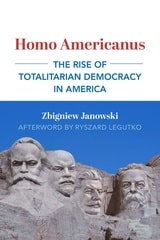
Janowski all at once brazen and out of bounds states what he calls the obvious and unthinkable truth: In the United States, we are already living in a totalitarian reality. The American citizen, the Homo Americanus, is an ideological being who is no longer good or bad, reasonable or irrational, proper or improper except when measured against the objectives of the dominating egalitarian mentality that American democracy has successfully incubated. American democracy has done what other despotic regimes have likewise achieved––namely, taken hold of the individual and forced him to renounce (or forget) his greatness, pursuit of virtue and his orientation toward history and Tradition.
Homo Americanus, Janowski argues, has no mind or soul and he cannot tolerate diversity and indeed he now censors himself. Democracy is not benign, and we should fear its principles come by and applied ad hoc. It is deeply troublesome that in the way democracy moves today it gives critics no real insight into any trajectory of reason behind its motion, which is erratic and unmappable. The Homo Americanus is an ideological entity whose thought and even morality are forbidden from universal abstraction.
Janowski mounts the offensive against what the American holds most sacred, and he does so in order to save him. After exposing the danger and the damage done, Janowski makes another startling proposal. It is a “diseased collective mind” that is the source of this ideology, the liberal anti-perspective that presses man into the image of the Homo Americanus, and its grip can only be broken through the recovery of instinct. Homo Americanus cannot be free again until he is himself again. That is, until the shadow that belongs only to him is restored, and he is thereby no longer alienated from others. Despite the condemnation Janowski seems to be levying on the citizen of the United States, he betrays a great hope and confidence that the means to shake ourselves awake from the bad dream are nevertheless in hand.
Janowski’s work is the next title in St. Augustine’s Press Dissident American Thought Today Series. It occupies a controversial overlapping terrain between the philosophical descriptions of liberalism as a tradition, psychology and the fundamentally influential critiques of democracy offered by Thucydides, Jefferson, Franklin, Tocqueville, Mill, Burke and more. More anecdotal than analytical, Janowski offers the contemporary proof that the reader is right to be scandalized by democracy and his or her own likeness of the Homo Americanus. Once upon a time it was the despicable Homo Sovieticus fruit of tyranny, but now we fear democratic society too might fall and all its citizens never be found again.
Honor, Status, and Law in Modern Latin America
Sueann Caulfield, Sarah C. Chambers, and Lara Putnam, eds.
Duke University Press, 2005
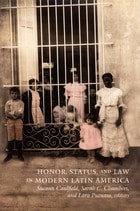
Each essay examines honor in the context of specific historical processes, including early republican nation-building in Peru; the transformation in Mexican villages of the cargo system, by which men rose in rank through service to the community; the abolition of slavery in Rio de Janeiro; the growth of local commerce and shifts in women’s status in highland Bolivia; the formation of a multiethnic society on Costa Rica’s Caribbean coast; and the development of nationalist cultural responses to U.S. colonialism in Puerto Rico. By connecting liberal projects that aimed to modernize law and society with popular understandings of honor and status, this volume sheds new light on broad changes and continuities in Latin America over the course of the long nineteenth century.
Contributors. José Amador de Jesus, Rossana Barragán, Sueann Caulfield, Sidney Chalhoub, Sarah C. Chambers, Eileen J. Findley, Brodwyn Fischer, Olívia Maria Gomes da Cunha, Laura Gotkowitz, Keila Grinberg, Peter Guardino, Cristiana Schettini Pereira, Lara Elizabeth Putnam
Hope in Hopeless Times
John Holloway
Pluto Press, 2022
Hope lies in our richness, in the joy of our collective creativity. But that richness exists in the peculiar form of money. The fact that we relate to one another through money causes tremendous social pain and destruction and is dragging us through pandemics and war towards extinction.
Richness against money: this battle will decide the future of humanity. If we cannot emancipate richness from money-capital profit, there is probably no hope. Money seems invincible but the constant expansion of debt shows that its rule is fragile. The fictitious expansion of money through debt is driven by fear, fear of us, fear of the rabble. Money contains, but richness overflows.

Hope in the Heartlands
Rebuilding Economies to Save DemocracyJohn Austin
Michigan State University Press, 2027
Why did the American heartland, once the engine of the world’s most dynamic economy, become the seedbed of its angriest politics? For more than twenty years, John Austin has pursued that question in Flint, Detroit, Milwaukee, and Pittsburgh—and now in Europe’s industrial regions, where many communities face the same reckoning. In Hope in the Heartlands he traces his journey from a minister’s son raised in West Virginia coal country to the man who made Flint and the industrial Midwest his adopted home. He shows how he came to see economic abandonment as the root of democratic decay—and what he and a network of like-minded leaders did about it. From coining the “Blue Economy” to championing “ally-shoring”—rebuilding supply chains across allied democracies—Austin offers a field-tested agenda for renewing left-behind regions. The stakes, he argues, could not be higher.
How Democracies Live
Power, Statecraft, and Freedom in Modern SocietiesStein Ringen
University of Chicago Press, 2022
In the new century, the triumph of democracy at the end of the Cold War turned to retrenchment. The core democracies, in America and Britain, succumbed to polarization and misrule. Dictatorships, such as China, made themselves assertive. New democracies in Central Europe turned to muddled ideologies of “illiberal democracy.” In this book, Stein Ringen offers a meditation on what democracy is, the challenges it faces, and how it can be defended. Ringen argues that democracy must be rooted in a culture that supports the ability of citizens to exchange views and information among themselves and with their rulers.
Drawing on the ideas of Machiavelli, Aristotle, Tocqueville, Max Weber, and others, Ringen shows how power is the fuel of government, and statecraft turns power into effective rule. Democracy should prize freedom and minimizing unfairness, especially poverty. Altogether, Ringen offers powerful insight on the meaning of democracy, including a new definition, and how countries can improve upon it and make it function more effectively. Timely and thought-provoking, How Democracies Live is a sober reminder of the majesty of the democratic enterprise.
How Political Parties Mobilize Religion
Lessons from Mexico and TurkeyLuis Felipe Mantilla
Temple University Press, 2021
Political mobilization tends to take different forms in contemporary Catholic- and Sunni-majority countries. Luis Felipe Mantilla attributes this dynamic to changes taking place in religious communities and the political institutions that govern religious political engagement.
In How Political Parties Mobilize Religion, Mantillaevenhandedly traces the emergence and success of religious parties in Mexico and Turkey, two countries shaped by assertive secular regimes. In doing so, he demonstrates that religious parties are highly responsive to political institutions, such as electoral laws, as well as to the structure of broader religious communities.
Whereas in both countries, the electoral success of religious mobilizers was initially a boon for democracy, in Mexico it was marred by political mismanagement and became entangled with persistent corruption and escalating violence. In Turkey, the democratic credentials of religious mobilizers were profoundly eroded as the government became increasingly autocratic, concentrating power in very few hands and rolling back basic liberal rights.
Mantilla investigates the role religious mobilization plays in the evolution of electoral politics and democratic institutions, and to what extent their trajectories reflect broader trends in political Catholicism and Islam.
How Politicians Polarize
Political Representation in an Age of Negative PartisanshipMia Costa
University of Chicago Press, 2025
A fresh examination of political representation in an era of negative partisanship.
What does representation look like when politicians focus on "othering" the opposing party rather than the policy interests of their constituents? How do voters react to negative partisan rhetoric? And is policy responsiveness still the cornerstone of American representative democracy?
In How Politicians Polarize, Mia Costa draws on survey experiments, analysis of congressional newsletters and tweets, and data on fundraising and media coverage to examine how and why politicians rely so often on negative partisan attacks. Costa shows that most Americans do not like negative rhetoric, and politicians know this. Nonetheless, these kinds of attacks can reap powerful rewards from national media, donors, and party elites. Costa’s findings challenge the popular notion that Americans are motivated more by their partisan identities than by policy representation. Her research illuminates how the political ecosystem rewards negative representation and how this affects the quality of American democracy.
How the Tea Party Captured the GOP
Insurgent Factions in American PoliticsRachel M. Blum
University of Chicago Press, 2020
In How the Tea Party Captured the GOP, Rachel Marie Blum approaches the Tea Party from the angle of party politics, explaining the Tea Party’s insurgent strategies as those of a party faction. Blum offers a novel theory of factions as miniature parties within parties, discussing how fringe groups can use factions to increase their political influence in the US two-party system. In this richly researched book, the author uncovers how the electoral losses of 2008 sparked disgruntled Republicans to form the Tea Party faction, and the strategies the Tea Party used to wage a systematic takeover of the Republican Party. This book not only illuminates how the Tea Party achieved its influence, but also provides a framework for identifying other factional insurgencies.
How the West Came to Rule
The Geopolitical Origins of CapitalismAlex Anievas and Kerem Nisancioglu
Pluto Press, 2015
***Winner, British International Studies Association International Political Economy Working Group Book Prize 2016***
Mainstream historical accounts of the development of capitalism describe a profess which is fundamentally European—a system that was born in the mills and factories of English and under the guillotines of the French Revolution. This groundbreaking book tells a very difference story.
How the West Came to Rule offers a unique interdisciplinary and international historical account of the origins of capitalism. It argues that, contrary to dominant wisdom, capitalism’s origins should not be understood as a development confined to the geographically and culturally sealed borders of Europe, but the outcome of a wider array of global processes in which non-European societies played a decisive role.
Here is a provocative, incisive explanation of how capitalism emerged in England and Europe through a dialectical intersocietal and geopolitical process. The authors’ aim to undermine a Eurocentric bias that has been prominent in the debate about capitalisms rise to supremacy, and their case is remarkably convincing. They provide a fundamental rethinking. Anievas and Nisancioglu contend that often cited assumptions are neither theoretically nor empirically tenable and deny the agency of non-Western societies to the emergence of capitalism. Topics covered include:
*The Problem of Eurocentrism
*The Problem of Historical Specificity
*The Brenner Thesis: Explanation and Critique
*The Geopolitical in the Making of Capitalism
*The Political Marxist Conception of Capitalism
*Rethinking the Origins of Capitalism
*And much more!
Through an outline of the uneven histories of Mongolian expansion, New World discoveries, Ottoman-Habsburg rivalry, the development of the colonies, and bourgeois revolutions, Alex Anievas and Kerem Nisancioglu offer an account of capitalism’s origins that convincingly argues against the prevailing Eurocentric narratives. It will change minds and open the eyes of historians, economists, and political thinkers.
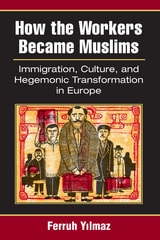
How the Workers Became Muslims
Immigration, Culture, and Hegemonic Transformation in EuropeFerruh Yilmaz
University of Michigan Press, 2016
Yilmaz’s primary case study is Danish immigration discourse, but his argument contextualizes his study in terms of questions of current concern across Europe, where right-wing groups that were long on the fringes of “legitimate” politics have managed to make significant gains with populations traditionally aligned with the Left. Specifically, Yilmaz argues that sociopolitical space has been transformed in the last three decades such that group classification has been destabilized to emphasize cultural rather than economic attributes.
According to this point-of-view, traditional European social and political splits are jettisoned for new “cultural” alliances pulling the political spectrum to the right, against the “corrosive” presence of Muslim immigrants, whose own social and political variety is flattened into an illusion of alien sameness.
How to Look Good in a War
Justifying and Challenging State ViolenceBrian Rappert
Pluto Press, 2012
How to Look Good in A War examines the methods used to depict, defend and justify the use of state violence. Many books have shown how 'truth is the first casualty of war' but this is the first to analyse exactly how pro-war narratives are constructed and normalised.
Brian Rappert details the 'upside-down' world of war in which revelation conceals, knowledge fosters uncertainty, and transparency obscures. He looks at government spin during recent wars in Iraq, Afghanistan and Libya where officials manoeuvre between circulating and withholding information.
Examining how organised violence is justified, How to Look Good in A War draws on experiences from recent controversy to consider how ignorance about the operation of war is produced and how concerned individuals and groups can intervene to make a difference.
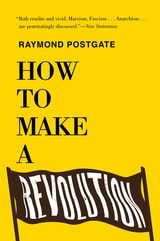
How to Make a Revolution
Raymond Postgate
Westholme Publishing, 2018
The first third of the twentieth century saw a seismic upheaval in global politics and society that still reverberates today. Communism and fascism toppled both traditional monarchies and representative democracies, while trade unions and other factions effectively challenged existing governments to adopt reforms or face crippling economic or social upheaval. Given these extraordinary events, Raymond Postgate set forth in How to Make a Revolution to objectively discuss revolutionary methods, and which tactics or strategies are the most effective. Drawing on his own idealistic experience as a young labor agitator and editor of a communist newspaper and more than fifteen years of close study of past revolutionary history and theories, the author dispassionately discusses Marxism, fascism, anarchism, and Blanquism (a doctrine within socialism), as well as syndicalism and industrial unionism. He then reviews revolutionary practice, including general strikes, financial pressure, armed revolution, and communist tactics, and ends with a prescient and frightening conclusion: without general consensus and determination, a peaceful revolution is impossible, and “if no action is taken, action of another kind will be taken for us. . . . The continuance of uncertainty will mean that the disillusioned will drift steadily across to a Fascist organization. Fascism means war; the character of a Fascist State is fairly well known. Once it is established, those who read, who write, who publish or who print, books like this are likely to be dead or in concentration camps.” Originally published in 1934, Postgate’s book was heralded for its clarity and scholarship.
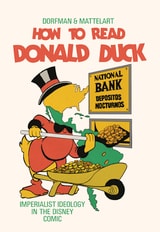
How to Read Donald Duck
Imperialist Ideology in the Disney ComicAriel Dorfman
Pluto Press, 2020
First published in 1971, How to Read Donald Duck shocked readers by revealing how capitalist ideology operates in our most beloved cartoons. Having survived bonfires, impounding and being dumped into the ocean by the Chilean army, this controversial book is once again back on our shelves.
Written and published during the blossoming of Salvador Allende's revolutionary socialism in Chile, the book examines how Disney products reflect capitalist ideology, and are active agents working in this ideology’s favor. Focusing on the hapless mice and ducks of Disney, curiously parentless, marginalized and always short of cash, Ariel Dorfman and Armand Mattelart expose how these characters established hegemonic ideas about capital, race, gender and the relationship between developed countries and the Third World.
A devastating indictment of a media giant, a document of twentieth-century political upheaval, and a reminder of the dark undercurrent of pop culture, How to Read Donald Duck is once again available, together with a new introduction by Ariel Dorfman in which he writes.
"It is that joy in liberation, that alegria, that spirit of resistance, that I wish to share with America, as the book that Pinochet’s soldiers could not liquidate or Disney’s lawyers stop from entering the United States finally finds its way to its new home, deep into the land that invented Donald Duck and Donald Trump. Is the same country that gave me such a warm welcome as a child, and perhaps may now equally greet with open arms this critique of oppression and it certainty that we don’t have to leave the world as it was when we first encountered it."
How to Save a Constitutional Democracy
Tom Ginsburg and Aziz Z. Huq
University of Chicago Press, 2018
How to Save a Constitutional Democracy mounts an urgent argument that we can no longer afford to be complacent. Drawing on a rich array of other countries’ experiences with democratic backsliding, Tom Ginsburg and Aziz Z. Huq show how constitutional rules can both hinder and hasten the decline of democratic institutions. The checks and balances of the federal government, a robust civil society and media, and individual rights—such as those enshrined in the First Amendment—often fail as bulwarks against democratic decline. The sobering reality for the United States, Ginsburg and Huq contend, is that the Constitution’s design makes democratic erosion more, not less, likely. Its structural rigidity has had unforeseen consequence—leaving the presidency weakly regulated and empowering the Supreme Court conjure up doctrines that ultimately facilitate rather than inhibit rights violations. Even the bright spots in the Constitution—the First Amendment, for example—may have perverse consequences in the hands of a deft communicator who can degrade the public sphere by wielding hateful language banned in many other democracies. We—and the rest of the world—can do better. The authors conclude by laying out practical steps for how laws and constitutional design can play a more positive role in managing the risk of democratic decline.

How to Save a Constitutional Democracy
Tom Ginsburg and Aziz Z. Huq
University of Chicago Press, 2018
Democracies are in danger. Around the world, a rising wave of populist leaders threatens to erode the core structures of democratic self-rule. In the United States, the tenure of Donald Trump has seemed decisive turning point for many. What kind of president intimidates jurors, calls the news media the “enemy of the American people,” and seeks foreign assistance investigating domestic political rivals? Whatever one thinks of President Trump, many think the Constitution will safeguard us from lasting damage. But is that assumption justified?
How to Save a Constitutional Democracy mounts an urgent argument that we can no longer afford to be complacent. Drawing on a rich array of other countries’ experiences with democratic backsliding, Tom Ginsburg and Aziz Z. Huq show how constitutional rules can both hinder and hasten the decline of democratic institutions. The checks and balances of the federal government, a robust civil society and media, and individual rights—such as those enshrined in the First Amendment—often fail as bulwarks against democratic decline. The sobering reality for the United States, Ginsburg and Huq contend, is that the Constitution’s design makes democratic erosion more, not less, likely. Its structural rigidity has had unforeseen consequence—leaving the presidency weakly regulated and empowering the Supreme Court conjure up doctrines that ultimately facilitate rather than inhibit rights violations. Even the bright spots in the Constitution—the First Amendment, for example—may have perverse consequences in the hands of a deft communicator who can degrade the public sphere by wielding hateful language banned in many other democracies. We—and the rest of the world—can do better. The authors conclude by laying out practical steps for how laws and constitutional design can play a more positive role in managing the risk of democratic decline.
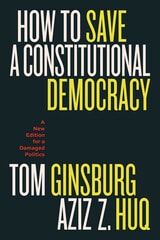
How to Save a Constitutional Democracy
A New Edition for a Damaged PoliticsTom Ginsburg and Aziz Z. Huq
University of Chicago Press, 2026
Updated to take stock of recent developments, Tom Ginsburg and Aziz Z. Huq’s prescient and insightful book shows how constitutional rules both hinder and hasten democratic decline.
Around the world, autocratic leaders threaten the core structures of democratic self-rule. But democratic constitutions are not fail-proof safeguards. By looking at how such leaders exploit legal mechanisms to advance their aims, we can see how democratic constitutions can sometimes abet—and even accelerate—democratic decline. In this new edition of How to Save a Constitutional Democracy, constitutional law experts Tom Ginsburg and Aziz Z. Huq offer a powerful analysis of today’s challenges while arguing that the time has come for meaningful, actionable change.
This new edition takes up the torch of its predecessor, canvasing developments in the United States and other countries that have transpired since 2018. Drawing lessons from countries around the world and reflecting on the prospects for American democracy, the authors show how constitutional design can, in fact, either undermine or support democratic institutions. The sobering reality for the United States is that the Constitution’s design makes democratic erosion eminently feasible. But Ginsburg and Huq do not stop there. They suggest practical ways that law and constitutional design can better manage these mounting threats, analyzing constitutional and legal questions that are consequential yet poorly understood, all while cautioning against an overreliance on technocratic fixes.
Even more urgent and salient in its new edition, How to Save a Constitutional Democracy reflects on why autocrats tend to pose even greater danger the second time they come to power and asks how we can begin to repair a democracy that has failed.

Human Capital versus Basic Income
Ideology and Models for Anti-Poverty Programs in Latin AmericaFabián A. Borges
University of Michigan Press, 2022
There were two distinct models of CCTs: a “human capital” model based on means-tested targeting and strict enforcement of program conditions, exemplified by the program launched by Mexico’s right, and a more universalistic “basic income” model with more permissive enforcement of conditionality, exemplified by Brazil’s program under Lula. These two models then spread across the region. Whereas right and center governments, with assistance from international financial institutions, enacted CCTs based on the human capital model, the left, with assistance from Brazil, enacted CCTs based on the basic income model.
The existence of two distinct types of CCTs and their relation to ideology is supported by quantitative analyses covering the entire region and in-depth case studies based on field research in three countries. Left-wing governments operate CCTs that cover more people and spend more on those programs than their center or right-wing counterparts. Beyond coverage, a subsequent analysis of the 10 national programs adopted after Lula’s embrace of CCTs confirms that program design—evaluated in terms of scope of the target population, strictness of conditionality enforcement, and stipend structure—is shaped by government ideology. This finding is then fleshed out through case studies of the political processes that culminated in the adoption of basic income CCTs by left-wing governments in Argentina and Bolivia and a human capital CCT by a centrist president in Costa Rica.
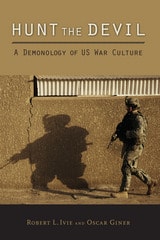
Hunt the Devil
A Demonology of US War CultureRobert L. Ivie and Oscar Giner
University of Alabama Press, 2015
Meticulously researched, documented, and argued, Hunt the Devil opens with contemporary images of the US’s global war on terror in the aftermath of 9/11. In five chapters devoted to the demonization of evildoers, witches, Indians, dictators, and Reds by American writers, in presidential rhetoric, and in popular culture, Ivie and Giner show how the use of demonization in the war on terror is only the most recent manifestation of a process that has recurred throughout American history.
In a sixth chapter, the authors introduce the archetype of the Trickster. Though not opposed to the Devil per se, the Trickster’s democratic impulses have often provided a corrective antidote to the corrosive and distorting effects of demonization. Invoking the framework of Carl Jung’s shadow aspect, Hunt the Devil offers the Trickster as a figure who can break the cycle of demonization and war.
The role of the mythic Devil in the American psyche has profound implications, not just for American diplomacy and the use of American arms in the world, but for the possibility of domestic peace within an increasingly diverse society. Hunt the Devil provides much of interest to readers and scholars in the fields of war, rhetorical studies, American Studies, US political culture, Jungian psychology, and mythography.