Results by title
637 books match the query 'Political activity' and 16 start with h

Half-Life of a Zealot
Swanee Hunt
Duke University Press, 2006
Half-Life of a Zealot tells how the girl who spoke against “Reds” alongside her father became a fierce advocate for progressive change in America and abroad, an innovative philanthropist, and Bill Clinton’s Ambassador to Austria. In captivating prose, Hunt describes the warmth and wear of Southern Baptist culture, which instilled in her a calling to help those who are vulnerable. The reader is drawn into her full-throttle professional life as it competes with critical family needs.
Hunt gives a remarkably frank account of her triumphs and shortcomings; her sorrows, including a miscarriage and the failure of a marriage; the joys and struggles of her second marriage; and her angst over the life-threatening illness of one of her three children. She is candid about the opportunities her fortune has created, as well as the challenge of life as an heiress.
Much of Swanee Hunt’s professional life is devoted to expanding women’s roles in making and shaping public policy. She is the founding director of Harvard’s Women and Public Policy Program at the Kennedy School of Government, chair of the Initiative for Inclusive Security, and president of the Hunt Alternatives Fund.
Swanee Hunt’s autobiography brims over with strong women: her mother, whose religious faith and optimism were an inspiration; her daughter, who fights the social stigma of mental disorders; the women of war-torn Bosnia, who transformed their grief into action; and friends like Hillary Clinton, who used her position as First Lady to strengthen the voices of others.
Hunt is one more strong woman. Half-Life of a Zealot is her story—so far.
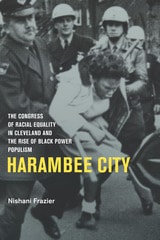
Harambee City
The Congress of Racial Equality in Cleveland and the Rise of Black Power PopulismNishani Frazier
University of Arkansas Press, 2017
BLACK POWER!
It was a phrase that consumed the American imagination in the 1960s and 70s and inspired a new agenda for black freedom. Dynamic and transformational, the black power movement embodied more than media stereotypes of gun-toting, dashiki-wearing black radicals; the movement opened new paths to equality through political and economic empowerment.
In Harambee City, Nishani Frazier chronicles the rise and fall of black power within the Congress of Racial Equality (CORE) by exploring the powerful influence of the Cleveland CORE chapter. Frazier explores the ways that black Clevelanders began to espouse black power ideals including black institution building, self-help, and self-defense. These ideals challenged CORE’s philosophy of interracial brotherhood and nonviolent direct action, spawning ideological ambiguities in the Cleveland chapter. Later, as Cleveland CORE members rose to national prominence in the organization, they advocated an open embrace of black power and encouraged national CORE to develop a notion of black community uplift that emphasized economic populism over political engagement. Not surprisingly, these new empowerment strategies found acceptance in Cleveland.
By providing an understanding of the tensions between black power and the mainstream civil rights movement as they manifested themselves as both local and national forces, Harambee City sheds new light on how CORE became one of the most dynamic civil rights organizations in the black power era.
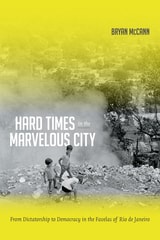
Hard Times in the Marvelous City
From Dictatorship to Democracy in the Favelas of Rio de JaneiroBryan McCann
Duke University Press, 2013

Hear #MeToo in India
News, Social Media, and Anti-Rape and Sexual Harassment ActivismPallavi Guha
Rutgers University Press, 2021

Here to Stay, Here to Fight
A Race Today AnthologyPaul Field
Pluto Press, 2019

Here to Stay, Here to Fight
A Race Today AnthologyPaul Field
Pluto Press, 2019
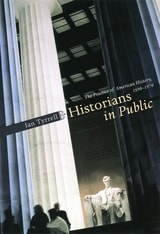
Historians in Public
The Practice of American History, 1890-1970Ian Tyrrell
University of Chicago Press, 2005
Tyrrell's elegant history of the practice of American history traces debates, beginning shortly after the profession's emergence in American academia, about history's role in school curricula. He also examines the use of historians in and by the government and whether historians should utilize mass media such as film and radio to influence the general public. As Historians in Public shows, the utility of history is a distinctive theme throughout the history of the discipline, as is the attempt to be responsive to public issues among pressure groups.
A superb examination of the practice of American history since the turn of the century, Historians in Public uncovers the often tangled ways history-makers make history-both as artisans and as actors.
Hizbu'llah
Politics and ReligionAmal Saad-Ghorayeb
Pluto Press, 2001
Hizbu’llah is the largest and most prominent political party in Lebanon, and one of the most renowned Islamist movements in the world. In this book, Amal Saad-Ghorayeb examines the organisation’s understanding of jihad and how this, together with its belief in martyrdom, brought about the withdrawal of Israeli occupation forces from Lebanon in May 2000.
Saad-Ghorayeb explores the nature of the party’s struggle against the West by studying its views on the use of violence against Westerners. Crucially, she also addresses the question of whether Hizbu’llah depicts this struggle in purely political or civilisational terms. The existential nature of the movement’s conflict with Israel is analysed and the Islamic roots of its anti-Judaism is unearthed.
The author explores the mechanics and rationale behind the party’s integration into the Lebanese political system, and sheds light on how it has reconciled its national idenitity with its solidarity with the Muslim umma.
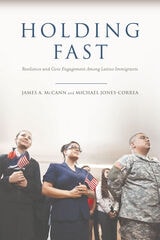
Holding Fast
Resilience and Civic Engagement Among Latino ImmigrantsJames A. McCann
Russell Sage Foundation, 2020
Holding Fast draws largely from a yearlong survey of Latino immigrants, including both citizens and noncitizens, conducted before and after the 2016 election. The survey gauges immigrants’ attitudes about the direction of the country and the emotional underpinnings of their political involvement. While survey respondents expressed pessimism about the direction of the United States following the 2016 election, there was no evidence of their withdrawal from civic life. Instead, immigrants demonstrated remarkable resilience in their political engagement, and their ties to America remained robust.
McCann and Jones-Correa examine Latino immigrants’ trust in government as well as their economic concerns and fears surrounding possible deportations of family members and friends. They find that Latino immigrants who were concerned about the likelihood of deportation were more likely to express a lack of trust in government. Concerns about personal finances were less salient. Disenchantment with the U.S. government did not differ based on citizenship status, length of stay in America, or residence in immigrant-friendly states. Foreign-born Latinos who are naturalized citizens shared similar sentiments to those with fewer political rights, and immigrants in California, for example, express views similar to those in Texas.
Addressing the potential influence immigrant voters may wield in in the coming election, the authors point to signs that the turnout rate for naturalized Latino immigrant may be higher than that for Latinos born in the United States. The authors further underscore the importance of the parties' platforms and policies, noting the still-tenuous nature of Latino immigrants’ affiliations with the Democratic Party.
Holding Fast outlines the complex political situation in which Latino immigrants find themselves today. Despite well-founded feelings of anger, fear, and skepticism, in general they maintain an abiding faith in the promise of American democracy. This book provides a comprehensive account of Latino immigrants’ political opinions and a nuanced, thoughtful outlook on the future of Latino civic participation. It will be an important contribution to scholarly work on civic engagement and immigrant integration.
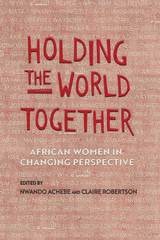
Holding the World Together
African Women in Changing PerspectiveEdited by Nwando Achebe and Claire Robertson
University of Wisconsin Press, 2021
Contributors: Nwando Achebe, Ousseina Alidou, Signe Arnfred, Andrea L. Arrington-Sirois, Henryatta Ballah, Teresa Barnes, Josephine Beoku-Betts, Emily Burril, Abena P. A. Busia, Gracia Clark, Alicia Decker, Karen Flint, December Green, Cajetan Iheka, Rachel Jean-Baptiste, Elizabeth M. Perego, Claire Robertson, Kathleen Sheldon, Aili Mari Tripp, Cassandra Veney
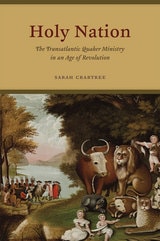
Holy Nation
The Transatlantic Quaker Ministry in an Age of RevolutionSarah Crabtree
University of Chicago Press, 2015
Holy Nation convincingly shows that ideals and actions were inseparable for the Society of Friends, yielding an account of Quakerism that is simultaneously a history of the faith and its adherents and a history of its confrontations with the wider world. Ultimately, Crabtree argues, the conflicts experienced between obligations of church and state that Quakers faced can illuminate similar contemporary struggles.
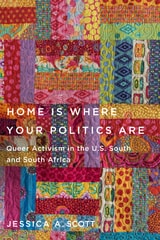
Home Is Where Your Politics Are
Queer Activism in the U.S. South and South AfricaJessica A. Scott
Rutgers University Press, 2024

Hot Coal, Cold Steel
Russian and Ukrainian Workers from the End of the Soviet Union to the Post-Communist TransformationsStephen Crowley
University of Michigan Press, 1997
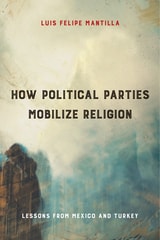
How Political Parties Mobilize Religion
Lessons from Mexico and TurkeyLuis Felipe Mantilla
Temple University Press, 2021
Political mobilization tends to take different forms in contemporary Catholic- and Sunni-majority countries. Luis Felipe Mantilla attributes this dynamic to changes taking place in religious communities and the political institutions that govern religious political engagement.
In How Political Parties Mobilize Religion, Mantillaevenhandedly traces the emergence and success of religious parties in Mexico and Turkey, two countries shaped by assertive secular regimes. In doing so, he demonstrates that religious parties are highly responsive to political institutions, such as electoral laws, as well as to the structure of broader religious communities.
Whereas in both countries, the electoral success of religious mobilizers was initially a boon for democracy, in Mexico it was marred by political mismanagement and became entangled with persistent corruption and escalating violence. In Turkey, the democratic credentials of religious mobilizers were profoundly eroded as the government became increasingly autocratic, concentrating power in very few hands and rolling back basic liberal rights.
Mantilla investigates the role religious mobilization plays in the evolution of electoral politics and democratic institutions, and to what extent their trajectories reflect broader trends in political Catholicism and Islam.
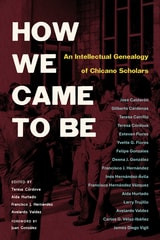
How We Came to Be
An Intellectual Genealogy of Chicano ScholarsEdited by Teresa Córdova, Aída Hurtado, Francisco J. Hernández, Avelardo Valdez; Foreword by Juan González
University of Arizona Press, 2026
This work chronicles the lives and legacies of Chicana and Chicano scholars whose formative experiences in the Chicano Movement shaped the development of Chicano studies and transformed higher education. Originating from the Reuniónes de Colegas—gatherings of veteran scholars reflecting on their shared histories—the volume features sixteen essays organized into five thematic sections that explore the intersections of activism, scholarship, and institutional change.
The contributors document how grassroots organizing evolved into academic inquiry, leading to the creation of departments, student support systems, and policy reforms that advanced equity and representation in universities. Essays address how community-engaged research influenced urban planning, health advocacy, and cultural production, while also highlighting Indigenous and transnational epistemologies that redefined theoretical frameworks in Chicano studies. The volume concludes with reflections on academic leadership and the breaking of barriers by Chicana scholars in higher education administration.
Together, these essays offer a powerful intellectual history and a testament to a generation’s enduring commitment to social justice. How We Came to Be is both a scholarly archive and a call to action, preserving the legacy of those who built Chicano studies and inspiring future generations to continue the work of transformation within and beyond the academy.
Contributors
José Calderón
Gilberto Cárdenas
Teresa Carrillo
Teresa Córdova
Estevan Flores
Yvette G. Flores
Felipe Gonzales
Deena J. González
Francisco J. Hernández
Inés Hernández-Ávila
Francisco Hernández Vázquez
Aída Hurtado
Larry Trujillo
Avelardo Valdez
Carlos G. Vélez-Ibáñez
James Diego Vigil
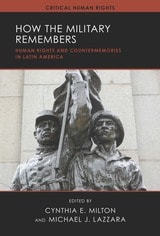
How the Military Remembers
Human Rights and Countermemories in Latin AmericaEdited by Cynthia E. Milton and Michael J. Lazzara
University of Wisconsin Press, 2025
With attention to the distinct cultural, political, and historical contexts across Latin America, the essays reveal how military figures and institutions appropriate mechanisms of truth-telling and accountability to reframe the past, blur the lines between perpetrator and victim, and weaponize memory itself.
Contributors: Mariana Achugar, Gabriela Fried Amilivia, Rebecca Atencio, Jo-Marie Burt, Rachel Hatcher, Nicolás Rodríguez Idárraga, Michael J. Lazzara, Cynthia E. Milton, Carla Granados Moya, María Emma Wills Obregón, Leith Passmore, Valentina Salvi, Gladys Vásquez Zevallos