Results by title
418 books match the query 'Southern States' and 18 start with h

HEARTS OF GOLD
a novel by J. McHenry Jones, edited by John Ernest and Eric Gardner
West Virginia University Press, 2010
J. McHenry Jones’s Hearts of Gold is a gripping tale of post-Civil War battles against racism and systemic injustice. Originally published in 1896, this novel reveals an African American community of individuals dedicated to education, journalism, fraternal organizations, and tireless work serving the needs of those abandoned by the political process of the white world. Jones challenges conventional wisdom by addressing a range of subjects—from interracial relationships to forced labor in coal mines—that virtually no other novelist of the time was willing to approach. With the addition of an introduction and appendix, this new edition reveals the difficult foundations upon which African Americans built a platform to address injustice; generate opportunities; and play a prominent role in American social, economic, and political life.
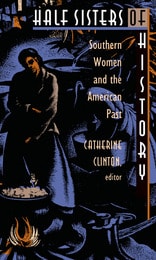
Half Sisters of History
Southern Women and the American PastCatherine Clinton
Duke University Press, 1994
This collection of essays by pioneering scholars surveys the roots and development of southern women’s history and examines the roles of white women and women of color across the boundaries of class and social status from the founding of the nation to the present. Authors including Anne Firor Scott, Elizabeth Fox-Genovese, Jacquelyn Dowd Hall, and Nell Irwin Painter, among others, analyze women’s participation in prewar slavery, their representation in popular fiction, and their involvement in social movements. In no way restricted to views of the plantation South, other essays examine the role of women during the American Revolution, the social status of Native American women, the involvement of Appalachian women in labor struggles, and the significance of women in the battle for civil rights. Because of their indelible impact on gender relations, issues of class, race, and sexuality figure centrally in these analyses.
Half Sisters of History will be important not only to women’s historians, but also to southern historians and women’s studies scholars. It will prove invaluable to anyone in search of a full understanding of the history of women, the South, or the nation itself.
Contributors. Catherine Clinton, Sara Evans, Elizabeth Fox-Genovese, Jacquelyn Dowd Hall, Jacqueline Jones, Suzanne D. Lebsock, Nell Irwin Painter, Theda Perdue, Anne Firor Scott, Deborah Gray White

Handbook of the Linguistic Atlas of the Middle and South Atlantic States
William A. Kretzschmar Jr., Virginia G. McDavid, Theodore K. Lerud, and Ellen Johnson
University of Chicago Press, 1993
This handbook is an essential guide to the LAMSAS project, laying out its history and describing its scope and methodology. In addition, the handbook reveals biographical information about the informants and social histories of the communities in which they lived, including primary settlement areas of the original colonies. Dialectologists will rely on it for understanding the LAMSAS, and historians will find it valuable for its original historical research.
Since much of the LAMSAS questionnaire concerns rural terms, the data collected from the interviews can pinpoint such language differences as those between areas of plantation and small-farm agriculture. For example, LAMSAS reveals that two waves of settlement through the Appalachians created two distinct speech types. Settlers coming into Georgia and other parts of the Upper South through the Shenandoah Valley and on to the western side of the mountain range had a Pennsylvania-influenced dialect, and were typically small farmers. Those who settled the Deep South in the rich lowlands and plateaus tended to be plantation farmers from Virginia and the Carolinas who retained the vocabulary and speech patterns of coastal areas.
With these revealing findings, the LAMSAS represents a benchmark study of the English language, and this handbook is an indispensable guide to its riches.
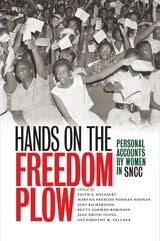
Hands on the Freedom Plow
Personal Accounts by Women in SNCCFaith S. Holsaert
University of Illinois Press, 2012
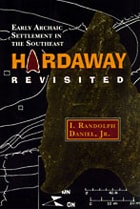
Hardaway Revisited
Early Archaic Settlement in the SoutheastI. Randolph Daniel, Jr.
University of Alabama Press, 1998
A landmark reassessment of Early Archaic settlement and adaptation in the southeastern United States.
Since the early 1970s, southeastern archaeologists have focused their attention on identifying the function of prehistoric sites and settlement practices during the Early Archaic period (ca. 9,000-10,500 B.P.). The Hardaway site in the North Carolina Piedmont, one of the most important archaeological sites in eastern North America, has not yet figured notably in this research. Daniel's reanalysis of the Hardaway artifacts provides a broad range of evidence—including stone tool morphology, intrasite distributions of artifacts, and regional distributions of stoneraw material types—that suggests that Hardaway played a unique role in Early Archaic settlement.
The Hardaway site functioned as a base camp where hunting and gathering groups lived for extended periods. From this camp they exploited nearby stone outcrops in the Uwharrie Mountains to replenish expended toolkits. Based on the results of this study, Daniel's new model proposes that settlement was conditioned less by the availability of food resources than by the limited distribution of high-quality knappable stone in the region. These results challenge the prevalent view of Early Archaic settlement that group movement was largely confined by the availability of food resources within major southeastern river valleys.

Henry Bradley Plant
Gilded Age Dreams for Florida and a New SouthCanter Brown Jr.
University of Alabama Press, 2020
In this landmark biography, Canter Brown Jr. makes evident the extent of Henry Bradley Plant’s influences throughout North, Central, and South America as well as his role in the emergence of integrated transportation and a national tourism system. One of the preeminent historians of Florida, Brown brings this important but understudied figure in American history to the foreground.
Henry Bradley Plant: Gilded Age Dreams for Florida and a New South carefully examines the complicated years of adventure and activity that marked Plant’s existence, from his birth in Connecticut in 1819 to his somewhat mysterious death in New York City in 1899. Brown illuminates Plant’s vision and perspectives for the state of Florida and the country as a whole and traces many of his influences back to events from his childhood and early adulthood. The book also elaborates on Plant’s controversial Civil War relationships and his utilization of wartime earnings in the postwar era to invest in the bankrupt Southern rail lines. With the success of his businesses such as the Southern Express Company and the Tampa Bay Hotel, Plant transformed Florida into a hub for trade and tourism—traits we still recognize in the Florida of today.
This thoroughly researched biography fills important gaps in Florida’s social and economic history and sheds light on a historical figure to an extent never previously undertaken or sufficiently appreciated. Both informative and innovative, Brown’s volume will be a valuable resource for scholars and general readers interested in Southern history, business history, Civil War–era history, and transportation history.
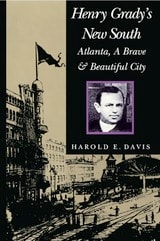
Henry Grady's New South
Atlanta, a Brave and Beautiful CityHarold E. Davis
University of Alabama Press, 1990
Reassessing the man, the movement, and the making of modern Atlanta.
The popular image of Henry W. Grady is that of a champion of the postbellum South, a region that would forgive the North for defeating it and would mobilize its own many resources for hones business and agricultural competition. Biographies and collections of Grady’s essays and speeches that appeared shortly after his death enhanced this image, and for a half-century, Grady was considered the personification of the New South Movement, a movement which promised industrialization for the South, an improved Southern agriculture, and justice and opportunity for black Southerners. As managing editor of the Atlanta Constitution, he espoused the New South throughout the nation and was in demand as a speaker for audiences in New York and Boston.
Through extensive research, focusing on the decade of the 1880s in Georgia, Davis demonstrates that although Grady said all the right things to show that he wished to industrialize the South and that he was committed to the improvement of agriculture and fairness in racial matters, in fact he spent most of his efforts on behalf of Atlanta. His major interest was in making a difference for that city, leaving the rest of the South to enjoy whatever Atlanta could not garner for itself.
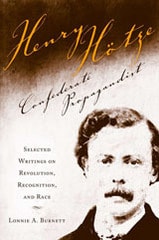
Henry Hotze, Confederate Propagandist
Selected Writings on Revolution, Recognition, and RaceLonnie A. Burnett
University of Alabama Press, 2008
Among the arguments Hotze employed were adaptations of the scientific racism of the period, which attempted to establish a rational basis for assumptions of racial difference. After the collapse of the Confederacy in 1865, Hötze remained in Europe, where he became an active partisan and promoter of the ideas of Arthur de Gobineau (1816–1882) whose work Essai sur L’inégalité des Races Humaines was a founding document in racism’s struggle for intellectual respectability.
This work consists of a biographical essay on Hotze; his contributions to Mobile newspapers during his military service in 1861; his correspondence with Confederate officials during his service in London; articles he published in London to influence British and European opinion; and his correspondence with, and published work in support of, Gobineau.
Heritage and Hate
Old South Rhetoric at Southern UniversitiesStephen M. Monroe
University of Alabama Press, 2021
How southern universities continue to wrestle with the words and symbols that embody and perpetuate Old South traditions
The US South is a rhetorical landscape that pulsates with division, a place where words and symbols rooted in a deeply problematic past litter the ground and contaminate the soil. Stephen M. Monroe’s provocative study focuses on predominantly white southern universities where Old South rhetoric still reverberates, where rebel flags cast a shadow over attempts at racial harmony, school cheers to reinforce racial barriers, and student yearbooks to create and protect an oppressive culture of exclusion. Across the region, in college towns like Oxford, Mississippi; Athens, Georgia; and Tuscaloosa, Alabama—communities remain locked in a difficult, recursive, and inherently rhetorical struggle that wrestles with this troubling legacy.
Words, images, and symbols are not merely passive artifacts of southern history, Monroe argues, but formative agents that influence human behavior and shape historical events. Drawing on research from many disciplines, including rhetoric, southern studies, history, sociology, and African American studies, Monroe develops the concept of confederate rhetoric: the collection of Old South words and symbols that have been and remain central to the identity conflicts of the South. He charts examples of such rhetoric at work in southern universities from Reconstruction to the present day.
Tracing the long life and legacy of Old South words and symbols at southern universities, this book provides close and nuanced analysis of the rhetorical conflicts that have resulted at places like the University of Mississippi and the University of Missouri. Some conflicts erupted during the civil rights movement, when the first African American students sought admission to all-white southern universities and colleges, and others are brewing now, as African Americans (and their progressive white peers) begin to cement genuine agency and voice in these communities. Tensions have been, and remain, high.
Ultimately, Monroe offers hope and optimism, contending that if words and symbols can be used to damage and divide, then words and symbols can also be used to heal and unify. Racist rhetoric can be replaced by antiracist rhetoric. The old South can become new. While resisting naïve or facile arguments, Heritage and Hate ultimately finds the promise of progress within the tremendous power of language.

Herod's Wife
A NovelMadison Jones
University of Alabama Press, 2003
A timely novel evocative of the biblical story of the beheading of John the Baptist by a major American writer
Hugh Helton, a prosperous attorney in a progressive town, has married his brother's ex-wife, Nora. As Hugh negotiates his relationships with his new spouse, her daughter, Jean, and parish priest Father John Riley, Nora’s growing hate for the church into which they were all born and from which they have all lapsed drives her to desperate acts of deceit and manipulation.
Father Riley himself wrestles with his own sense of purpose and mission. But when Nora attempts to discredit him as an authority figure in the minds of both her husband and their community, she uses her devoted daughter as the springboard for a series of accusations against the priest that has catastrophic results for all involved.
Grappling with issues of faith, trust, family loyalty, child molestation, and scandal in the Catholic Church, Herod’s Wife is a timely exploration of subjects from today's headlines. It illuminates the isolation and search for meaning of characters young and old, innocent and experienced, in a rapidly changing and bewildering southern landscape. Madison Smartt Bell, author of All Soul's Rising, writes, “The main plot revolves around a mother pressuring a child to express her will in a more concrete way than she would or could herself—so that the child ultimately commits acts which are both criminal and morally horrifying. . . . [Herod’s Wife] is a morality play set in contemporary conditions, with its eye on eternal verities.”
Madison Jones is the author of 10 previous novels, including An Exile and A Cry of Absence. He has won the T. S. Eliot Award from the Ingersoll Foundation, the Michael Shaara Award from the United States Civil War Center, and the Harper Lee Award.

Hillbilly Realist
Herman Clarence Nixon of Possum TrotSarah Newman Shouse
University of Alabama Press, 1986
Nixon’s life offers insight into one southerner’s efforts to comprehend and interpret the conflict and change of his time and illuminates for contemporary Americans a classical view of life—one lived fully, right in strength, beauty, courage, compassion, adventure, and thought.
Clarence Nixon was first and foremost a Southern intellectual, deeply involved in the region’s cultural renaissance, and his life reveals an intellectual odyssey from Victorianism to Modernism. As his personality, ideology, and social environment interacted, a new world view emerged. But he was an ambivalent modernist, like many intellectuals who were reared in the nineteenth-century South, he never abandoned certain Victorian ideals and values.
Histories of Southeastern Archaeology
Edited by Shannon Tushingham, Jane Hill, and Charles H. McNutt
University of Alabama Press, 2002
Histories of Southeastern Archaeology originated as a symposium at the 1999 Southeastern Archaeological Conference (SEAC) organized in honor of the retirement of Charles H. McNutt following 30 years of teaching anthropology. Written for the most part by members of the first post-depression generation of southeastern archaeologists, this volume offers a window not only into the archaeological past of the United States but also into the hopes and despairs of archaeologists who worked to write that unrecorded history or to test scientific theories concerning culture.
The contributors take different approaches, each guided by experience, personality, and location, as well as by the legislation that shaped the practical conduct of archaeology in their area. Despite the state-by-state approach, there are certain common themes, such as the effect (or lack thereof) of changing theory in Americanist archaeology, the explosion of contract archaeology and its relationship to academic archaeology, goals achieved or not achieved, and the common ground of SEAC.
This book tells us how we learned what we now know about the Southeast's unwritten past. Of obvious interest to professionals and students of the field, this volume will also be sought after by historians, political scientists, amateurs, and anyone interested in the South.
Additional reviews:

History and Hope in the Heart of Dixie
Scholarship, Activism, and Wayne Flynt in the Modern SouthEdited by Gordon E. Harvey, Richard D. Starnes and Glenn Feldman
University of Alabama Press, 2006
Exploring the history, challenges, and promise of a changing South through the legacy of Wayne Flynt.
This collection of essays on the social and political history of the modern South consider the region’s poor, racial mores and race relations, economic opportunity, Protestant activism, political coalitions and interest groups, social justice, and progressive reform. History and Hope in the Heart of Dixie illuminates the dual role of historian and public advocate in modern America. In a time when the nation’s eyes have been focused by Hurricanes Katrina and Rita onto the vulnerability and dire condition of poor people in the South, the applicability of research, teaching, and activism for this voiceless element seems all the more relevant.
Responding to the example of Wayne Flynt, whose fierce devotion to his state of Alabama and its region has not blinded his recognition of the inequities and despair that define southern life for so many, the scholars assembled in this work present contributions to the themes Flynt so passionately explored in his own work.Two seasoned observers of southern history and culture—John Shelton Reed and Dan T. Carter—offer assessments of Flynt’s influence on the history profession as a whole and on the region of the South in particular.
History and Memory in the Two Souths
Recent Southern and Spanish American FictionDeborah Cohn
Vanderbilt University Press, 1999
First, Cohn proposes that Faulkner's appeal derives from Spanish American authors' perception of similarities between the South's history and the experiences of their own respective nations. She delineates historical experiences common to the South and Spanish America, including civil wars, defeat and dispossession, regional marginalization, and socio-economic hardship. She also suggests that Spanish American authors found in Faulkner a set of concerns with which they could identify and that, as a result, they were inspired to take up the stylistic innovations characteristic of his writing. The resulting assimilation and adaptation of Euro-American modernism through Faulkner has been an indispensable part of what is known as la nueva narrativa, "the new narrative," as well as of successive movements in Spanish American literature.
From another perspective, Cohn's book shows points of contact between works by other southern and Spanish American novelists without positing relations of influence. Specifically, after identifying common, recurrent themes in modern southern and Spanish American literature in general, Cohn reveals levels of a shared understanding of regional history in Faulkner and Mario Vargas Llosa, in Ralph Ellison and Isabel Allende, as well as in Katherine Anne Porter and Juan Rulfo. Her analyses compare and contrast these authors' shared attempts to provide correctives to official, mainstream historical discourse through alternate, parallel strategies for reconstructing, recording, and reclaiming the past.
In yoking together the South and Spanish America as neighboring spaces with similar personalities, Cohn advances a daring and controversial thesis that both narrows and enhances the frame of comparison between the literatures of the South and Spanish America.
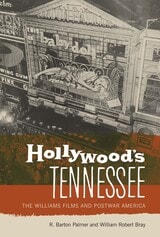
Hollywood's Tennessee
The Williams Films and Postwar AmericaBy R. Barton Palmer and William Robert Bray
University of Texas Press, 2009
No American dramatist has had more plays adapted than Tennessee Williams, and few modern dramatists have witnessed as much controversy during the adaptation process. His Hollywood legacy, captured in such screen adaptations as A Streetcar Named Desire, Cat on a Hot Tin Roof, and Suddenly, Last Summer, reflects the sea change in American culture in the mid-twentieth century. Placing this body of work within relevant contexts ranging from gender and sexuality to censorship, modernism, art cinema, and the Southern Renaissance, Hollywood's Tennessee draws on rarely examined archival research to recast Williams's significance.
Providing not only cultural context, the authors also bring to light the details of the arduous screenwriting process Williams experienced, with special emphasis on the Production Code Administration—the powerful censorship office that drew high-profile criticism during the 1950s—and Williams's innovative efforts to bend the code. Going well beyond the scripts themselves, Hollywood's Tennessee showcases findings culled from poster and billboard art, pressbooks, and other production and advertising material. The result is a sweeping account of how Williams's adapted plays were crafted, marketed, and received, as well as the lasting implications of this history for commercial filmmakers and their audiences.
Home Is Where Your Politics Are
Queer Activism in the U.S. South and South AfricaJessica A. Scott
Rutgers University Press, 2024
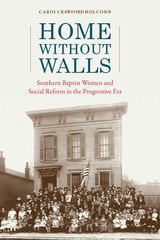
Home without Walls
Southern Baptist Women and Social Reform in the Progressive EraCarol Crawford Holcomb
University of Alabama Press, 2020
The Woman’s Missionary Union (WMU), founded in 1888, carved out a uniquely feminine space within the Southern Baptist Convention during the tumultuous years of the Progressive Era when American theologians were formulating the social gospel. These women represented the Southern Baptist elite and as such had the time to read, write, and discuss ideas with other Southern progressives. They rubbed shoulders with more progressive Methodist and Presbyterian women in clubs and ecumenical missionary meetings. Baptist women studied the missionary publications of these other denominations and adopted ideas for a Southern Baptist audience.
Home without Walls: Southern Baptist Women and Social Reform in the Progressive Era shows how the social attitudes of women were shaped at the time. By studying primary documents—including personal letters, official exchanges and memoranda, magazine publications, newsletters, and editorials—Carol Crawford Holcomb uncovers ample evidence that WMU leaders, aware of the social gospel and sympathetic to social reform, appropriated the tools of social work and social service to carry out their missionary work.
Southern Baptist women united to build a financial empire that would sustain the Southern Baptists through the Great Depression and beyond. Their social attitudes represented a kaleidoscope of contrasting opinions. By no stretch of the imagination could WMU leaders be characterized as liberal social gospel advocates. However, it would also be wrong to depict them as uniformly hostile to progressivism or ignorant of contemporary theological ideas. In the end, they were practical feminists in their determination to provide a platform for women’s views and a space for women to do meaningful work.

Honeypot
Black Southern Women Who Love WomenE. Patrick Johnson
Duke University Press, 2019