870 books match the query 'Sports & Recreation' and 34 start with h

cover of Hard Driving: The 1908 Auto Race From New York to Paris

Hard Driving

The 1908 Auto Race From New York to Paris

Dermot Cole

University of Alaska Press, 2020

In the winter of 1908, six cars left Times Square bound for Paris. They were embarking on a remarkable motor race across the world that would capture everyone’s imagination. In this book, Dermot Cole weaves a thrilling account of the improbable journey west from New York to Paris, the varied characters, and the nascent automobile industry. Drawing from the drivers’ journals and extensive newspaper reports, Cole details the many hardships, triangulations, and physical extremes encountered along the route as the drivers attempted to race from coast to coast, cross the Bering Strait to Russia, traverse Siberia, and onward.

Hard Driving delves beyond the riveting headlines to explore the race’s implications for global politics and diplomacy and how the automobile became a viable mode of transportation.

[more]
cover of Hardwood Glory: A Life of John Wooden

Hardwood Glory

A Life of John Wooden

Barbara Olenyik Morrow

Indiana Historical Society Press, 2014
The tenth volume in the Indiana Historical Society Press’s celebrated Youth Biography Series examines the life of a man who helped define college basketball in the twentieth century and became an icon of American sports—John Wooden. He was born in the small Indiana town of Martinsville near the start of the last century. His claim to fame came first as an accomplished athlete, helping his high school basketball team compete in three state championship games, then earning All-American honors three times in his home state as a starting guard at Purdue University. After briefly teaching high school English and coaching several sports in Dayton, Kentucky, Wooden returned to Indiana, where he launched a successful career coaching basketball at South Bend Central High School and later at Indiana State Teachers College (now Indiana State University) in Terre Haute. In 1948, at age thirty-seven, Wooden moved west, as did many Americans in the post-World War II era. He took over the head basketball job at the University of California at Los Angeles, a school with virtually no basketball tradition. He took his family and his coaching skills with him. He also took his midwestern values. For the next six decades he remained in Southern California, creating a basketball dynasty at UCLA and solidifying his place as one of the sporting world’s greats. When he died on June 4, 2010, at the Ronald Reagan UCLA Medical Center, he was four months shy of his hundredth birthday. Wooden’s success as a college coach was unprecedented and, in pure numbers, staggering. From 1964 to 1975, he led the UCLA Bruins men’s basketball team to ten National Collegiate Athletic Association national basketball championships, including seven in a row—a feat that may never be matched. During that string of championships, he coached the Bruins to four perfect 30–0 seasons, an NCAA men’s record that still stands. He also coached UCLA to an eighty-eight-game winning streak, yet another unrivaled men’s record. Over the course of his twenty-seven seasons at UCLA, he mentored All-Americans such as Kareem Abdul-Jabbar and Bill Walton, earned the respect of legions of players, and inspired countless would-be roundballers and coaches alike. These achievements put Wooden in the company of legendary coaches throughout the field of sports. Even in that elite company, he fared especially well. In 2009 Sporting News magazine asked more than one hundred coaches and sports experts to name the greatest coach of all time in any sport. Not surprisingly, coaching giants such as the Green Bay Packers’s Vince Lombardi, Notre Dame’s Knute Rockne, the Boston Celtics’s Red Auerbach, and New York Yankees’s Casey Stengel ranked in the top ten; Wooden stood at number one the list. Long before that ranking, however, awards and honors flowed Wooden’s way. In 1973 he was inducted into the Naismith Basketball Hall of Fame as coach, making him the first to be honored as both a player and a coach. (He received the honor as a player in 1960.) In 1977 college basketball’s annual player-of-the-year award was named for him. The NCAA bestowed its highest honor, the Theodore Roosevelt award, on Wooden in 1995. And in 2006 the National Collegiate Basketball Hall of Fame in Kansas City, Missouri, honored him as a member of the founding class, along with basketball inventor Doctor James Naismith. Accolades also poured in from outside the sports world. In 2003 President George W. Bush awarded Wooden the Presidential Medal of Freedom, American’s highest civilian honor. Two years later, Indiana bestowed on him its highest honor, the Sachem, an award recognizing a lifetime of excellence and virtue. In earlier decades, entities ranging from service clubs to faith-based organizations to universities rushed to salute not only his accomplishments but also his character.
[more]
cover of Haudenosaunee Women Lacrosse Players: Making Meaning through Rematriation

Haudenosaunee Women Lacrosse Players

Making Meaning through Rematriation

Sharity L. Bassett

Michigan State University Press, 2024

Since the 1970s lacrosse has become one of the fastest-growing sports in North America, and Haudenosaunee communities have worked at the international level to claim lacrosse as an important part of Haudenosaunee culture and tradition. Lacrosse is also known as the medicine game as it is part of a medicine ceremony named in creation narratives and the Great Law of Peace that binds the six nations of the Haudenosaunee Confederacy Six Nations. The number of Haudenosaunee women and girls playing the sport has burgeoned since the 1980s. This book roots lacrosse as a Haudenosaunee sport both within and outside of these communities. It shows how the concept of rematriation—a culturally relevant framework that articulates the work Haudenosaunee peoples are doing to reconnect to the power imbued with matrilineal and matrifocal societies—situates Haudenosaunee women who play lacrosse within a complex understanding of contemporary, traditional, and medicinal lacrosse. Because they cannot seamlessly claim this as their medicine game, as the Haudenosaunee Nationals and other men’s teams do, Haudenosaunee women players must articulate some of the most nuanced understandings of tradition and medicine. These articulations connect to larger conversations within Haudenosaunee communities regarding the power that women hold and the rematriation of that power to define and uphold tradition. Haudenosaunee Women Lacrosse Players demonstrates how the cycle of action and articulation—with the intergenerational help of female leadership—firmly roots lacrosse within Haudenosaunee cultural fabric.
[more]
cover of Haunted By Waters: Fly Fishing In North American Literature

Haunted By Waters

Fly Fishing In North American Literature

Mark Browning

Ohio University Press, 1998

Four essential questions: Why does one fish? How should one properly fish? What relations are created in fishing? And what effects does fishing have on the future? Haunted by Waters is a self-examination by the author as he constructs his own narrative and tries to answer these questions for himself. But it is also a thorough examination of the answers he uncovers in the course of reading what's been written on the subject.

As his own story unfolds, Mark Browning analyzes angling literature from the Bible to Norman Maclean, always bringing his inquiry back to the same source: the enigma of this sport.

Haunted by Waters is an exploration of the apparent compulsion of those who fish not only to read about the sport, but to write about it as well. Mark Browning's personal account as a fly fisherman and his perspective as a critic make him uniquely qualified to navigate these waters.
[more]
cover of Haunts Of the Black Masseur: The Swimmer as Hero

Haunts Of the Black Masseur

The Swimmer as Hero

Charles Sprawson

University of Minnesota Press, 2000

In a masterful work of cultural history, Charles Sprawson, himself an obsessional swimmer and fluent diver, explores the meaning that different cultures have attached to water. Sprawson compares the meaning various societies have assigned to swimming—from classical Greece and imperial Rome to nineteenth-century England and Germany and the U.S. and Japan in the last fifty years. Sprawson gives us fascinating glimpses of the great swimmer heroes: Byron leaping dramatically into the surf at Shelley’s beach funeral; Edgar Allen Poe’s lone and mysterious river-swims; Rupert Brooke swimming naked with Virginia Woolf; Hart Crane swallow-diving to his death in the Bay of Mexico; Johnny Weismuller as athlete and entertainer. Informed by the literature of Swinburne, Goethe, Scott Fitzgerald, and Yukio Mishima; the films of Reifenstahl and Vigo; the Hollywood “swimming musicals” of the 1930s; and delving in and out of Olympic history, Haunts of the Black Masseur is a celebration of swimming that explores aspects of culture in a heretofore unimagined way.

[more]
cover of Heavy Justice: The Trial of Mike Tyson

Heavy Justice

The Trial of Mike Tyson

J. Gregory Garrison

University of Arkansas Press, 0
Heavy Justice is the inside story of one of the great courtroom battles of our time. Gregory Garrison, the special prosecutor in the case, and Randy Roberts, historian and eminent boxing scholar, recount the trial that put heavyweight champion Mike Tyson behind bars. With all the drama, verve, and procedural detail of a novel by John Grisham or Scott Turow, this is also a highly topical morality play touching on all the issues of sex, race, celebrity, and justice that now so perplex our society. When he first heard about the Tyson case, Greg Garrison wanted nothing to do with it. Date rape? Always tough to prove. And one of the few facts already reported was that the young woman making the accusation had been in the defendant's hotel room at two o'clock in the morning. This case was dead on arrival, except that when Desiree Washington told her story, Garrison believed her. So drawing on this simple trust, and inspired by Desiree's courage and conviction, he accepted the challenge of this "unwinnable" case, stepping into the ring against not only Mike Tyson, multimillionaire sports celebrity and hero to millions, and Don King, cheerleader, but also the Washington law firm of Williams & Connolly, perhaps the slickest and most powerful defense counsel money could buy. Originally published in 1994, Heavy Justice brings together the worlds of big-time sports, lowlife sleaze, painstaking police work, and the lofty realms of Harvard's Alan Dershowitz to offer us a thoroughly absorbing account of one of the century's most important legal cases.
[more]
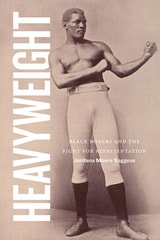
cover of Heavyweight: Black Boxers and the Fight for Representation

Heavyweight

Black Boxers and the Fight for Representation

Jordana Moore Saggese

Duke University Press, 2024

In Heavyweight, Jordana Moore Saggese examines images of Black heavyweight boxers to map the visual terrain of racist ideology in the United States, paying particular attention to the intersecting discourses of Blackness, masculinity, and sport. Looking closely at the “shadow archive” of portrayals across fine art, vernacular imagery, and public media at the turn of the twentieth century, shedemonstrates how the images of boxers reveal the racist stereotypes implicit in them, many of which continue to structure ideas of Black men today. With a focus on both anonymous fighters and notorious champions, including Jack Johnson, Saggese contends that popular images of these men provided white spectators a way to render themselves experts on Blackness and Black masculinity. These images became the blueprint for white conceptions of the Black male body—existing between fear and fantasy, simultaneously an object of desire and an instrument of violence. Reframing boxing as yet another way whiteness establishes the violent mythology of its supremacy, Saggese highlights the role of imagery in normalizing a culture of anti-Blackness.
[more]
cover of Hell of a Way to Make a Living: The Unvarnished Truth about What It's Like to Cover Major League Baseball

Hell of a Way to Make a Living

The Unvarnished Truth about What It's Like to Cover Major League Baseball

Paul Hagen

Temple University Press, 2027

For 50 years, Paul Hagen lived the dream of being a beat writer covering the Dodgers, Rangers, and Phillies. But, as Hell of a Way to Make a Living demonstrates, the enviable job isn’t always as glamorous as it seems.

This insider’s account gives readers an all-access pass to the press box, clubhouse, and dugout to discover what the experience is really about. It’s both a clear-eyed dissection of the daily grind and a breezy, occasionally gossipy, account of being to paid to watch baseball games.

Hagen features entertaining and insightful anecdotes such as confirming to manager Terry Francona that the Phillies were going to fire him two weeks before it happened and building trust with players from the last man on the roster to future Hall of Famers like Mike Schmidt, Ferguson Jenkins, Billy Wagner, and Scott Rolen. He also addresses the changing media landscape, what’s on the record and off, the ethics of reporting on a team fairly, and how sports writing has changed over the decades.

Covering all the bases, Hell of a Way to Make a Living is an ode to the importance of conscientious beat writing and building trust with readers.
[more]
cover of Hidden Nature: Wild Southern Caves

Hidden Nature

Wild Southern Caves

Michael Ray Taylor

Vanderbilt University Press, 2020

Reed Environmental Writing Award Finalist, Southern Environmental Law Center, 2021

More than ten thousand known caves lie beneath the state of Tennessee according to the Tennessee Cave Survey, a nonprofit organization that catalogs and maps them. Thousands more riddle surrounding states. In Hidden Nature, Michael Ray Taylor tells the story of this vast underground wilderness. In addition to describing the sheer physical majesty of the region’s wild caverns and the concurrent joys and dangers of exploring them, he examines their rich natural history and scientific import, their relationship to clean water and a healthy surface environment, and their uncertain future.

As a longtime caver and the author of three popular books related to caving—Cave Passages, Dark Life, and Caves—Taylor enjoys (for a journalist) unusual access to this secretive world. He is personally acquainted with many of the region’s most accomplished cave explorers and scientists, and they in turn are familiar with his popular writing on caves in books; in magazines such as Audubon, Outside, and Sports Illustrated; and on websites such as those of the Discovery Channel and the PBS science series Nova.

Hidden Nature is structured as a comprehensive work of well-researched fact that reads like a personal narrative of the author’s long attraction to these caves and the people who dare enter their hidden chambers.
[more]
cover of Hidden Nature: Wild Southern Caves

Hidden Nature

Wild Southern Caves

Michael Ray Taylor

Vanderbilt University Press, 2020

Reed Environmental Writing Award Finalist, Southern Environmental Law Center, 2021

More than ten thousand known caves lie beneath the state of Tennessee according to the Tennessee Cave Survey, a nonprofit organization that catalogs and maps them. Thousands more riddle surrounding states. In Hidden Nature, Michael Ray Taylor tells the story of this vast underground wilderness. In addition to describing the sheer physical majesty of the region’s wild caverns and the concurrent joys and dangers of exploring them, he examines their rich natural history and scientific import, their relationship to clean water and a healthy surface environment, and their uncertain future.

As a longtime caver and the author of three popular books related to caving—Cave Passages, Dark Life, and Caves—Taylor enjoys (for a journalist) unusual access to this secretive world. He is personally acquainted with many of the region’s most accomplished cave explorers and scientists, and they in turn are familiar with his popular writing on caves in books; in magazines such as Audubon, Outside, and Sports Illustrated; and on websites such as those of the Discovery Channel and the PBS science series Nova.

Hidden Nature is structured as a comprehensive work of well-researched fact that reads like a personal narrative of the author’s long attraction to these caves and the people who dare enter their hidden chambers.
[more]
cover of High, Wide, and Handsome: The River Journals of Norman D. Nevills

High, Wide, and Handsome

The River Journals of Norman D. Nevills

edited by Roy Webb

Utah State University Press, 2005

When he started taking paying passengers by boat through the rapids of the Colorado River's canyons, Norman Nevills invented whitewater tourism and the commercial river business. For twelve years, from 1938 until his death in a plane crash in 1949, he safely took, without a single life lost, friends, explorers, and customers down the Colorado, Green, San Juan, Salmon, and Snake Rivers in boats he designed. National media found him and his adventures irresistible and turned him into the personification of river running. Logging seven trips through the Grand Canyon when no one else had completed more than two, he was called the Fast Water Man. Boatmen he trained went on to found their own competing operations. Always controversial, Nevills had important critics and enemies as well as friends and supporters, but no one can dispute his tremendous impact on the history of western rivers and recreation.

Nevills's complete extant journals of those river expeditions are published for the first time in High, Wide, and Handsome. They contain vivid stories and images of still untamed-by-dams rivers and canyons in the Colorado River system and elsewhere, of wild rides in wooden boats, and of the few intrepid pioneers of adventure tourism who paid Nevills so they could experience it all. They have been transcribed and edited by river historian Roy Webb, author of If We Had a Boat: Green River Explorers, Adventurers, and Runners and Call of the
Colorado.
[more]
cover of High-Flying Birds: The 1942 St. Louis Cardinals

High-Flying Birds

The 1942 St. Louis Cardinals

Jerome M. Mileur

University of Missouri Press, 2009

1942: Americans suddenly found themselves at war but were not about to be distracted from the National Pastime. The Brooklyn Dodgers and New York Yankees were looking to continue their World Series rivalry from the 1941 season, and a youthful team from St. Louis was determined to stop them.
With only one player older than thirty, the St. Louis Cardinals were the youngest team to win the National League pennant and World Series. Built on good pitching and tremendous speed on the base paths and in the field, the team featured rookie Stan Musial, future Hall of Famer Enos Slaughter, and ace pitcher Mort Cooper, the National League’s Most Valuable Player of 1942. With their winningest season ever, posting 106 victories, the 1942 Redbirds have been called the greatest Cardinal team of all time.
Jerome Mileur was just a kid from downstate Illinois, but he well remembers his view of one game from the left-field grandstand—and the thrill of attending the second game of the World Series. In this book, he brings a sure and loving grasp of his subject to reconstructing one of the most remarkable pennant drives in modern baseball history, with the Cards winning forty-three of their last fifty-one games and clinching first place on the last day of the season.
Mileur provides a game-by-game account of the season with play-by-play action, not only capturing all the thrills on the Cards’ way to the top but also conveying the physical and mental demands that the players endured. Counted out by nearly everyone but themselves in August, the Redbirds caught fire in the season’s final weeks to pass the seemingly unbeatable Dodgers. And by winning four games out of five to defeat the New York Yankees for the championship, they handed Joe DiMaggio his only World Series defeat.
More than a recapitulation of a thrilling season, Mileur’s book is a reminder of how major-league baseball in 1942 differed in so many ways from today’s game—one startling example is Mileur’s account of how the absence of outfield warning tracks contributed to a devastating injury to Brooklyn’s star outfielder, Pete Reiser. The tenor of the times is reflected as well in the juxtaposition of the baseball season with the United States’ first year in the Second World War.
The 1942 Cardinals were not only a remarkable team unto themselves but also the beginning of a new baseball dynasty—1942’s pennant was the first of three in a row for the Cards, as well as the first of three World Series victories in a space of five seasons. This account of that tremendous season is a page-turner for anyone who loves the game and a must-read for Cardinals fans.
[more]
cover of Hikes Around Philadelphia

Hikes Around Philadelphia

Boyd Newman

Temple University Press, 1997

Want to walk for a leisurely hour or two with the kids? Take them to the Churchville Nature Center, with its re-created Lenape Indian village and children's exhibits. Or would you prefer a more strenuous all-day hike? Try the rocky woods trail at Bake Oven Knob, Bear Rocks, and The Cliffs. Or if you're interested in wildlife, hike Green Lane Reservoir where 260 species of birds have been sighted. Perhaps you'd simply like to hike from Pennsylvania to Delaware and back again. Then White Clay Creek Preserve is for you.

These are only five of the forty hiking trails described in Hikes Around Philadelphia. All are within an hour and a half's drive of the city. Ranging from 1.0 to 12.6 miles in length, they will take you through dense forests or wide-open meadows, past early farmsteads or a ringing boulder field from the last ice age. You can break your hike with a visit to a restored home or leave civilization behind on an isolated mountain ridge. Some of the trails are gravel or paved, or are canal towpaths, and are quite suitable for young children, older adults, or wheelchair hikers. Others are longer and more challenging, including rugged sections of the Appalachian Trail and the Horseshoe Trail.

For each hike Boyd Newman and Linda Newman provide a detailed write-up, a trail map showing the hike route on a USGS survey map, and directions to the trailhead. They also include information on distance, elevation, probable time, surface, interesting features, facililities, disability access, whether hunting is allowed in the vicinity, and availability to public transportation. This format allows you to browse through the book and easily locate the particular hike that appeals to you today.

In a concise introduction, the authors not only explain how to get the most out of the book but also give some hints on hiking safety and appropriate clothing and equipment. 

This handy reference offers:
*a detailed write-up of each hike
*easy-to-read trail maps
*directions to the trail heads
*information that are accessible by public transportation
*details about handicap accessibility
*lots of other pointers that make planned or last-minute hikes fun and easy for everyone

[more]
cover of Hiking the Road to Ruins: Day Trips and Camping Adventures to Iron Mines, Old Military Sites, and Things Abandoned in the New York City Area ... and Beyond

Hiking the Road to Ruins

Day Trips and Camping Adventures to Iron Mines, Old Military Sites, and Things Abandoned in the New York City Area ... and Beyond

Steinberg, David A

Rutgers University Press, 2007

In this user-friendly, beautifully illustrated, and occasionally eccentric guidebook, David A. Steinberg blazes the trail to more than twenty unusual landmarks and hard-to-find destinations-all within a two-hour drive of New York City. Geared for the experienced hiker or camping adventurer, the book includes hikes to a variety of urban ruins, including a World War II-era air force base, a vacant dairy farm, pine plantations, abandoned quarries, tunnels, cemeteries, and iron mines.

Each chapter contains detailed directions, a hand-drawn map, suggestions for the optimal time and season to visit, and GPS coordinates to specific sites. Bringing fifteen years of experience as a leader of hikes, Steinberg leaves no part of the trip unplanned. He even suggests ideal conditions for the outing. An overcast day, for instance, sets up the haunted atmosphere appropriate for visiting a water tower in Mountainside, New Jersey, that has links to a murder-suicide in the 1970s.

For less experienced hikers, the guide also includes a chapter on equipment and safety, detailed instructions on how to program a hand-held Global Positioning System receiver, and a glossary of terms.

Both a practical guide and a creative chronicle, this book is bound to please hikers and history buffs alike.
[more]
cover of Hiking the Road to Ruins: Daytrips and Camping Adventures to Iron Mines, Old Military Sites, and Things Abandoned in the New York City Area...and Beyond

Hiking the Road to Ruins

Daytrips and Camping Adventures to Iron Mines, Old Military Sites, and Things Abandoned in the New York City Area...and Beyond

Steinberg, David A

Rutgers University Press, 2015

In this easy to use, informative, and occasionally eccentric guidebook, David A. Steinberg blazes the trail to more than twenty-five unusual landmarks and hard-to-find destinations that are mostly within a two-hour drive of New York City. Suitable for the experienced hiker or camping adventurer—as well as anyone who has the desire to explore—Hiking the Road to Ruins includes many new ruins and historic sites to see: remnants of the two World’s Fairs in Queens, mysterious stone chambers scattered about northern Westchester County, winter adventuring in Harriman, and quarries that contain amazing artifacts. 

In this new edition, Steinberg adds four additional chapters and has revised throughout the book to include detailed directions, GPS coordinates to specific sites, a hand-drawn map, and suggestions for the optimal time and season to visit. Having led many types of hikes and trips over the past fifteen years, Steinberg leaves no part of the trip unplanned. He even suggests ideal conditions for outings. An overcast day, for instance, sets up the haunted atmosphere appropriate for visiting a water tower in Mountainside, New Jersey, that has links to a murder-suicide in the 1970s. 

Newcomers will gain experience as they make their way through the book, which includes a chapter on equipment and safety, detailed instructions on how to program a hand-held Global Positioning System receiver, and a glossary of terms. 

Both a practical guide and a creative chronicle, Hiking the Road to Ruins will inspire everyone to hit the trail in search of adventure.
[more]
cover of Hillside Fields: A History of Sports in West Virginia

Hillside Fields

A History of Sports in West Virginia

Bob Barnett

West Virginia University Press, 2013

West Virginia’s championship teams at WVU and Marshall and athletic superstars like Jerry West and Mary Lou Retton are familiar to all, but few know the untold story of sports in the Mountain State. Hillside Fields: A History of Sports in West Virginia chronicles the famous athletic triumphs and heart-breaking losses of local heroes and legendary teams, recording the titanic struggles of a small state competing alongside larger rivals.
Hillside Fields
provides a broad view of the development of sports in West Virginia, from one of the first golf clubs in America at Oakhurst Links to the Greenbrier Classic; from the first girls basketball championship in 1919 to post Title IX; from racially segregated sports to integrated teams; and from the days when West Virginia Wesleyan and Davis & Elkins beat the big boys in football to the championship teams at WVU, Marshall, West Virginia State and West Liberty.
Hillside Fields
explains how major national trends and events, as well as West Virginia’s economic, political, and demographic conditions, influenced the development of sports in the state. The story of the growth of sports in West Virginia is also a story of the tribulations, hopes, values and triumphs of a proud people.
[more]
cover of History Afield: Stories from the Golden Age of Wisconsin Sporting Life

History Afield

Stories from the Golden Age of Wisconsin Sporting Life

Robert C Willging

Wisconsin Historical Society Press, 2011
Stories of sportsmen past come to life in History Afield, an account of the many and varied sporting pursuits that are part of the Wisconsin tradition. Author and outdoorsman Robert Willging shares more than two dozen tales of Wisconsin sporting history, highlighting the hunt for waterfowl, upland birds, and deer; trout fishing in wild north Wisconsin rivers; and recreating at early Wisconsin lakeside resorts.
 
Anecdotes of fishing exploits on our plentiful waterways and presidential visits to northern Wisconsin reveal a unique slice of sporting culture, and chapters on live decoys and the American Water Spaniel demonstrate the human-animal bond that has played such a large part in that history. Tales of nature’s fury include a detailed account of the famous Armistice Day storm, as well as the dangers of ice fishing on Lake Superior. These historical musings and perspectives on sporting ethos provide a strong sense of the lifestyle that Willging has preserved for our new century.
 
Featuring first-hand interviews and a variety of historic photos depicting the Wisconsin sporting life, History Afield shows how the intimate relationship between humans and nature shaped this important part of the state’s heritage.
[more]
cover of History Walks in New Jersey

History Walks in New Jersey

Rosenfeld, Lucy D

Rutgers University Press, 2006

New Jersey has a varied and fascinating history-from its earliest Native American settlements, through its central role in the Revolutionary War, to its strategic position in the major events of our country's past. In History Walks in New Jersey, Lucy D. Rosenfeld and Marina Harrison treat readers to a comprehensive statewide guidebook that includes detailed information on forty-eight of the best sites for historical walks. These outings take the history enthusiast through beautiful green landscapes, natural preserves, and picturesque settlements.
  
 Whether you are an amateur historian, a weekend walker, or a teacher planning a class trip, this book will be an essential resource for ideas and information. Walks include the Kingston Loop, a long canal where George Washington, pen in hand, composed his post-Revolutionary War speech, "Farewell Orders to the Armies of the United States." Also included is a mountain walk that traces Native American Leni-Lenape history and one that wends its way into an old Moravian village in the town of Hope. A pirate cove, stops on the Underground Railroad, a Civil War cemetery, and the sites of duels, mines, canals, architectural innovations, estates and resorts, centuries-old agricultural and fishing settlements, and the Hindenburg crash are all here.

Each walk includes directions, information on tours, a brief history, and suggestions for additional places to visit in the area. Whether a New Jersey native or a visitor to the Garden State, readers will enjoy going beyond the highways and suburban towns to learn about history while discovering the state's natural beauty.

[more]
cover of Hockey Priest: Father David Bauer and the Spirit of the Canadian Game

Hockey Priest

Father David Bauer and the Spirit of the Canadian Game

Matt Hoven

Catholic University of America Press, 2024

Born in Waterloo, Ontario, in 1924, to a prominent family, David Bauer attended St. Michael’s College-School run by the Basilian Fathers of Toronto. After serving in World War II, Bauer joined the religious community and coached its St. Michael’s Majors to a national championship in 1961. Influenced by philosophers like Jacques Maritain, Bauer tried to find solutions to problems created within elite hockey and thus founded Canada’s first ever National Team program. This team countered the cutthroat ideals of hockey’s powerbrokers and set out to return Canada to international glory. The team represented the nation at several global tournaments and three Winter Olympic Games. Bauer was posthumously inducted into the Hockey Hall of Fame in 1989. Hockey Priest looks past simply understanding Bauer as a do-gooder or hockey innovator. It shows how he attempted to create a different stream of hockey that could better support youth and so build up the nation. Archival research for the book uncovered Bauer-written hockey reports, speeches, and notes that detail his thinking about the game and his politicking to bring about change in it. Interviews with dozens of associates and family members told the story of his bold efforts to take on the National Hockey League. Despite his work being undermined by some supporters of the corporate game, Bauer offered a vision for Canada’s sport that remains an important counterpoint in the sport’s history and its ongoing challenges.
[more]
cover of Hockey: A Global History

Hockey

A Global History

Stephen H. Hardy, Andrew C. Holman

University of Illinois Press, 2018

Long considered Canadian, ice hockey is in truth a worldwide phenomenon--and has been for centuries. In Hockey: A Global History, Stephen Hardy and Andrew C. Holman draw on twenty-five years of research to present THE monumental end-to-end history of the sport. Here is the story of on-ice stars and organizational visionaries, venues and classic games, the evolution of rules and advances in equipment, and the ascendance of corporations and instances of bureaucratic chicanery. Hardy and Holman chart modern hockey's "birthing" in Montreal and follow its migration from Canada south to the United States and east to Europe. The story then shifts from the sport's emergence as a nationalist battlefront to the movement of talent across international borders to the game of today, where men and women at all levels of play lace 'em up on the shinny ponds of Saskatchewan, the wide ice of the Olympics, and across the breadth of Asia. Sweeping in scope and vivid with detail, Hockey: A Global History is the saga of how the coolest game changed the world--and vice versa.
[more]
cover of Home Field: Texas High School Football Stadiums from Alice to Zephyr

Home Field

Texas High School Football Stadiums from Alice to Zephyr

Photographs by Jeff Wilson

University of Texas Press, 2010

"The promise of an empty football field is an irresistible force for those who understand and revere the game," Jeff Wilson observes. Drawn by the sense of possibility and nostalgia inherent in every stadium, Wilson traveled the state of Texas to photograph high school stadiums for a photo essay that appeared in Texas Monthly in August 2005. The magazine's readers responded with an outpouring of enthusiasm, and Wilson's photo essay was nominated for a prestigious National Magazine Award.

In Home Field, Wilson creates a unique photo portrait of nearly eighty Texas high school football stadiums, ranging from the bright lights, artificial turf, and seating for thousands at Southlake Carroll to the lone set of bleachers under the wide open sky in Veribest. Shot from the fifty-yard line facing the home stands, these photographs invite us to view each stadium from the same vantage point and experience it as an evocative place that holds a community's collective memories. Accompanying the photographs are reminiscences about the fields from players, coaches, team physicians, athletic directors, sportswriters and announcers, school superintendents, principals and teachers, band directors, maintenance workers, booster club parents, students, and fans. Their stories—whether funny, nostalgic, or poignant—reveal just how important high school football is to Texans and how it creates an unforgettable sense of community and camaraderie.

Sure to bring back memories as soon as you open the book, Home Field captures what football is supposed to be—"simple and pure, like a perfect spiral arcing gracefully across the sky."
[more]
cover of Home Ice: Confessions of a Blackhawks Fan

Home Ice

Confessions of a Blackhawks Fan

Kevin Cunningham

University of Iowa Press, 2017

Unable to skate and surrounded by sports fans who cared more about Evel Knievel than hockey, Kevin Cunningham became obsessed with the Chicago Blackhawks as a confused eight year old. He has no idea why. Yet from that moment on he embarked on a fan’s journey that absorbed his childhood, destroyed his GPA, and made him seriously weigh romance against an away game at Calgary. What explains this fascination?

Home Ice combines memoir and history to explore how the mysteries of Blackhawks fandom explain big questions like tribal belonging, masculinity, and why you would ever trade Chris Chelios. In recounting the team’s—and his own—wins and losses (and ties), Cunningham covers everything from Keith Magnuson’s bachelor pad to the grim early aughts to Patrick Kane’s Cup-winner. Throughout, he explores how we come to love the things we love. Funny and touching, Home Ice is one Blackhawk fan’s attempt to understand why sports fandom is utterly ridiculous and entirely necessary. 
 
[more]
cover of Home and Away: The Rise and Fall of Professional Football on the Banks of the Ohio, 1919–1934

Home and Away

The Rise and Fall of Professional Football on the Banks of the Ohio, 1919–1934

Carl M. Becker

Ohio University Press, 1998
Early in this century, growing cities seeking to promote their communities came to view the budding local football team as an agent of civic progress and took the necessary measures to see that their interests were ably represented. As a result, semiprofessional clubs such as the Ironton Tanks and the Portsmouth Spartans faced off against such legendary teams as the Chicago Bears and the Green Bay Packers. Towns scrambled to raise subscription dollars to build new stadiums, buy contracts for prospective stars, and finance the many road trips. Capturing the local color of a region as well as the spirited charm of a sport as it came into its own—before the rules were formalized and the teams so strongly established—Carl Becker documents a rare time in American history when ideals were being formed and broken and the promise for greatness seemed just within reach of all who tried to grasp it. Home and Away is a unique chronicle, more than just a history of the game of football, it is also an intimate study of how the citizens and organizations that made up these cities worked to put themselves on the map of an ever-shifting American landscape.
[more]
cover of Home and Away: The Rise and Fall of Professional Football on the Banks of the Ohio, 1919–1934

Home and Away

The Rise and Fall of Professional Football on the Banks of the Ohio, 1919–1934

Carl M. Becker

Ohio University Press, 1998

Early in this century, growing cities seeking to promote their communities came to view the budding local football team as an agent of civic progress and took the necessary measures to see that their interests were ably represented. As a result, semiprofessional clubs such as the Ironton Tanks and the Portsmouth Spartans faced off against such legendary teams as the Chicago Bears and the Green Bay Packers. Towns scrambled to raise subscription dollars to build new stadiums, buy contracts for prospective stars, and finance the many road trips. Capturing the local color of a region as well as the spirited charm of a sport as it came into its own—before the rules were formalized and the teams so strongly established—Carl Becker documents a rare time in American history when ideals were being formed and broken and the promise for greatness seemed just within reach of all who tried to grasp it. Home and Away is a unique chronicle, more than just a history of the game of football, it is also an intimate study of how the citizens and organizations that made up these cities worked to put themselves on the map of an ever-shifting American landscape.
[more]
cover of Home of the Braves: The Battle for Baseball in Milwaukee

Home of the Braves

The Battle for Baseball in Milwaukee

Patrick W. Steele

University of Wisconsin Press, 2020

When the struggling Boston Braves relocated to Milwaukee in March 1953, the city went wild for its new baseball team. Soon, the Braves were winning games, drawing bigger crowds than any team but the Brooklyn Dodgers, and turning Hank Aaron, Eddie Mathews, and Warren Spahn into Hall of Famers. Within five years the team would win a World Series and two pennants.

It seemed the dawn of a new dynasty. Impassioned fans wore their hearts on their sleeves. Yet in October 1964 team owners made a shocking announcement: the Braves were moving to Atlanta.

In the decades since, many have tried to understand why the Braves left Milwaukee. Fans blamed greedy owners and the lure of Coca Cola cash. Team management claimed they weren't getting enough local support. Patrick Steele delves deeply into all facets of the story, looking at the changing business of baseball in the 1960s, the interactions of the team owners with the government officials who controlled County Stadium, the surging success of the Green Bay Packers, and much more, to understand how the "Milwaukee Miracle" went south.
[more]
cover of Homecourt: The True Story of the Best Basketball Team You've Never Heard Of

Homecourt

The True Story of the Best Basketball Team You've Never Heard Of

Larry Needle

Temple University Press, 2012

[more]
cover of Hooked on Oregon: Tales of Life, Death, and Fishing

Hooked on Oregon

Tales of Life, Death, and Fishing

Eben Pindyck

Oregon State University Press, 2027

Far from your average fishing book, Hooked on Oregon invites readers to visit unexpected places—behind prison walls, inside a bait factory, deep in a forbidden forest, up a mountain, and around a desert oasis—while introducing a troop of unforgettable fishing buddies. A German orphan adopted by an American war hero, a parolee busted for fishing without a license, and a Marine veteran, among others, help show what life looks like through the eyes of an inveterate angler.

Fishing stories in Oregon have never been greater than those told by Eben Pindyck. Whether casting a line on the Columbia River or visiting Herman the Sturgeon at the State Fair, there’s a real-life tale to capture the interest and fancy of anyone in search of a good story. These funny, honest, and elucidative essays take you to lakes, streams, and waterways throughout the state—and far beyond the anecdote about the one that got away.

[more]
cover of Hoop Crazy: The Lives of Clair Bee and Chip Hilton

Hoop Crazy

The Lives of Clair Bee and Chip Hilton

Dennis Gildea

University of Arkansas Press, 2013

Clair Bee (1896-1983) was a hugely successful basketball coach at Rider College and Long Island University with a 412 and 87 record before his career was derailed in 1951 by a point-shaving scandal. In the trial that sent his star player, Sherman White, to prison, the judge excoriated Bee for creating a morally lax culture that contributed to his players' involvement with gambling. To a certain extent, Bee agreed with the judge's scolding, concluding that coaches, himself included, had become so driven to succeed on the court that they had lost sight of the educational role sports should play. His coaching career effectively over, Bee launched an effort to reform the ills he saw in college sports, and he did so in the pages of the Chip Hilton novels for young readers. He began the series in 1948, but it was the post-scandal books that he used as teaching tools. The books mirrored some of the events of the gambling scandal and were Bee's attempt to reform the problems plaguing college sports. He used his fiction to posit a better sports world that he hoped his young readers would construct and inhabit. The Chip Hilton books were extremely popular and have become a classic series, with over two million copies sold to date. Hoop Crazy is the fascinating story of Clair Bee and his star character Chip Hilton and the ways in which their lives, real and fictional, were intertwined.
[more]
cover of Hot Hands, Draft Hype, and DiMaggio's Streak: Debunking America's Favorite Sports Myths

Hot Hands, Draft Hype, and DiMaggio's Streak

Debunking America's Favorite Sports Myths

Sheldon Hirsch

University Press of New England, 2017
In sports there are lies, damned lies, and statistics. Joe DiMaggio’s fifty-six-game hitting streak was magical. The three-point shot is an essential part of NBA basketball. Babe Ruth shouldn’t have attempted to steal second base in the ninth inning of the 1926 World Series. Scientist and researcher Sheldon Hirsch has taken a decidedly unorthodox approach to sports history. He looks at myths, legends, conventional wisdom, shibboleths, and firm convictions of all kinds that sports lovers hold to be true, and demonstrates how analysis of facts and figures disproves what tradition—and sportswriters—would have us believe. Divided into three parts, on baseball, basketball, and football, Hot Hands, Draft Hype, and DiMaggio’s Streak contains enough clear-sightedness and shocking conclusions to delight any sports lover.
[more]
cover of How You Played the Game: The Life of Grantland Rice

How You Played the Game

The Life of Grantland Rice

William Harper

University of Missouri Press, 1999

Centering around the life and times of the revered American sportswriter Grantland Rice (1880-1954), How You Played the Game takes us back to those magical days of sporting tales and mythic heroes. Through Rice's eyes we behold such sports as bicycle racing, boxing, golf, baseball, football, and tennis as they were played before 1950. We witness ups and downs in the careers of such legendary figures as Christy Mathewson, Jack Dempsey, Ty Cobb, Babe Ruth, Jim Thorpe, Red Grange, Bobby Jones, Bill Tilden, Notre Dame's Four Horsemen, Gene Tunney, and Babe Didrikson--all of whom Rice helped become household names.

Grantland Rice was a remarkably gifted and honorable sportswriter. From his early days in Nashville and Atlanta, to his famed years in New York, Rice was acknowledged by all for his uncanny grasp of the ins and outs of a dozen sports, as well as his personal friendship with hundreds of sportsmen and sportswomen. As a pioneer in American sportswriting, Rice helped establish and dignify the profession, sitting shoulder to shoulder in press boxes around the nation with the likes of Ring Lardner, Damon Runyon, Heywood Broun, and Red Smith.

Besides being a first-rate reporter, Rice was also a columnist, poet, magazine and book writer, film producer, family man, war veteran, fund-raiser, and skillful golfer. His personal accomplishments over a half century as an advocate for sports and good sportsmanship are astounding by any standard. What truly set Rice apart from so many of his peers, however, was the idea behind his sports reporting and writing. He believed that good sportsmanship was capable of lifting individuals, societies, and even nations to remarkable heights of moral and social action.

More than just a biography of Grantland Rice, How You Played the Game is about the rise of American sports and the early days of those who created the art and craft of sportswriting. Exploring the life of a man who perfectly blended journalism and sporting culture, this book is sure to appeal to all, sports lovers or not.
[more]
cover of How to Shoot the Longbow: A Guide from Historical and Applied Sources

How to Shoot the Longbow

A Guide from Historical and Applied Sources

Hugh D. H. Soar

Westholme Publishing, 2015

A Leading Expert on Traditional Archery Offers Insight Into How the Longbow Was Drawn from Medieval Sources to Modern Recreations
“Soar’s book [The Crooked Stick] is indispensible.”—Bernard Cornwell, New York Times bestselling author
Relying on more than fifty years’ experience in archery, historian Hugh D. H. Soar reflects on how the longbow was drawn and shot across the centuries through examining the design of the bow and early literature about the bow, combined with his and his colleagues’ applied knowledge using replica bows. No complete medieval longbow has survived, but those found aboard the Tudor warship Mary Rose provide the best archaeological evidence to the possible construction of the medieval bow. Contemporary treatises written about the proper manner of shooting the bow, together with the resurgence in interest and construction of replica bows beginning in the late sixteenth century that form part of the author’s collection provide the basis for this work. How to Shoot the Longbow: A Guide from Historical and Applied Sources is a fascinating and practical look at the use of a legendary invention.
[more]
cover of Human Nature: A Walking History of the Himalayan Landscape

Human Nature

A Walking History of the Himalayan Landscape

Thomas Bell

Haus Publishing, 2025

Combining travelogue, folklore, literature, art, and anthropology, this work explores the human and natural geography of the Himalayas and offers a nuanced portrait of life over the centuries in one of the world’s most enigmatic regions. 

In Human Nature, Thomas Bell embarks on four walks through the Himalayas, each in a different season, to explore the interplay between the land and the people who call it home. Bell’s decades in Nepal give him an unusual perspective that bridges the gap between insider and outsider. The stories he recounts touch on themes from religion to ecology and political economy, and span from prehistory to the present day. He also deftly examines the impact of British imperialism and the growing external pressures on the environment. Accompanied by Bell’s striking photographs and maps, Human Nature is a magnificently written account that spans big ideas and real lives. Erudite, intimate, and evocative, this is essential reading for anyone seeking to understand the relationship between communities and their environments.
[more]
cover of Human Resource Management for Sports and Recreation Programs

Human Resource Management for Sports and Recreation Programs

Richard Leonard

FiT Publishing, 2020

Human resource management is one of the most important components of business operations in any organization, and sport and recreation programs are no exception. This textbook provides the framework and principles necessary for undergraduate and graduate students to develop, implement, and maintain the human resource strategies and practices that are essential in managing a sport, recreation or athletics program, from community and youth centers, to intramural collegiate and professional sports.

Human Resource Management for Sport and Recreation Programs examines foundational concepts and the practical elements of human resource management, providing detailed insight, and a step by step look at overall program policies and plan development, program implementation and management, including personnel recruitment, onboarding and assessment techniques, planning and procedures for corrective action, as well as examining relevant legal, ethical, and safety considerations governing the employer—employee relationship. This text is essential in understanding how to successfully recruit, retain, reward, and maintain the most valuable resource of any organization: it’s people.

[more]
cover of Hunting Arkansas: The Sportsman's Guide to Natural State Game

Hunting Arkansas

The Sportsman's Guide to Natural State Game

Keith B. Sutton

University of Arkansas Press, 2002

Reading Hunting Arkansas is like walking alongside acclaimed Arkansas outdoorsman and writer Keith Sutton as he searches for the elusive woodcock in bottomland timber near the L'Anguille River, stalks deer across farmland, or treks through woodlands hunting black bears. Sutton weaves hunting know-how with personal stories and histories of various regions to produce this book telling you when, where, why and how to hunt in the Natural State.
[more]