Results by title
103 books match the query 'Violence against' and 9 start with h
Hear #MeToo in India
News, Social Media, and Anti-Rape and Sexual Harassment ActivismPallavi Guha
Rutgers University Press, 2021
This book examines the role media platforms play in anti-rape and sexual harassment activism in India. Including 75 interviews with feminist activists and journalists working across India, it proposes a framework of agenda-building and establishes a theoretical framework to examine media coverage of issues in the digitally emerging Global South.
[more]
Holocaust Mothers and Daughters
Family, History, and TraumaFederica K. Clementi
Brandeis University Press, 2013
In this brave and original work, Federica Clementi focuses on the mother-daughter bond as depicted in six works by women who experienced the Holocaust, sometimes with their mothers, sometimes not. The daughters’ memoirs, which record the “all-too-human” qualities of those who were persecuted and murdered by the Nazis, show that the Holocaust cannot be used to neatly segregate lives into the categories of before and after. Clementi’s discussions of differences in social status, along with the persistence of antisemitism and patriarchal structures, support this point strongly, demonstrating the tenacity of trauma—individual, familial, and collective—among Jews in twentieth-century Europe.
[more]
Home Safe Home
Housing Solutions for Survivors of Intimate Partner ViolenceBotein, Hilary
Rutgers University Press, 2016
Housing matters for everyone, as it provides shelter, security, privacy, and stability. For survivors of intimate partner violence (IPV), housing takes on an additional meaning; it is the key to establishing a new life, free from abuse. IPV survivors often face such inadequate housing options, however, that they must make excruciating choices between cycling through temporary shelters, becoming homeless, or returning to their abusers.
Home Safe Home offers a multifaceted analysis that accounts for both IPV survivors’ needs and the practical challenges involved in providing them with adequate permanent housing. Incorporating the varied perspectives of the numerous housing providers, activists, policymakers, and researchers who have a stake in these issues, the book also lets IPV survivors have their say, expressing their views on what housing and services can best meet their short and long-term goals. Researchers Hilary Botein and Andrea Hetling not only examine the federal and state policies and funding programs determining housing for IPV survivors, but also provide detailed case studies that put a human face on these policy issues.
As it traces how housing options and support mechanisms for IPV survivors have evolved over time, Home Safe Home also offers innovative suggestions for how policymakers and advocates might work together to better meet the needs of this vulnerable population.
[more]
Honor and the Political Economy of Marriage
Violence against Women in the Kurdistan Region of IraqJoanne Payton
Rutgers University Press, 2020
'Honor' is used as a justification for violence perpetrated against women and girls considered to have violated social taboos related to sexual behavior. Several ‘honor’-based murders of Kurdish women, such as Fadime Sahindal, Banaz Mahmod and Du’a Khalil Aswad, and campaigns against 'honor'-based violence by Kurdish feminists have drawn international attention to this phenomenon within Kurdish communities.
Honor and the Political Economy of Marriage provides a description of ‘honor’-based violence that focuses upon the structure of the family rather than the perpetrator’s culture. The author, Joanne Payton, argues that within societies primarily organized by familial and marital connections, women’s ‘honor’ is a form of symbolic capital within a ‘political economy’ in which marriage organizes intergroup connections.
Drawing on statistical analysis of original data contextualized with historical and anthropological readings, Payton explores forms of marriage and their relationship to ‘honor’, sketching changing norms around the familial control of women from agrarian/pastoral roots to the contemporary era.
[more]

How to Lose the Hounds
Maroon Geographies and a World beyond PolicingCeleste Winston
Duke University Press, 2023
In How to Lose the Hounds Celeste Winston explores marronage—the practice of flight from and placemaking beyond slavery—as a guide to police abolition. She examines historically Black maroon communities in the Maryland suburbs of Washington, DC, that have been subjected to violent excesses of police power from slavery until the present day. Tracing the long and ongoing historical geography of Black freedom struggles in the face of anti-Black police violence in these communities, Winston shows how marronage provides critical lessons for reimagining public safety and community well-being. These freedom struggles take place in what Winston calls maroon geographies—sites of flight from slavery and the spaces of freedom produced in multigenerational Black communities. Maroon geographies constitute part of a Black placemaking tradition that asserts life-affirming forms of community. Winston contends that maroon geographies operate as a central method of Black flight, holding ground, and constructing places of freedom in ways that imagine and plan a world beyond policing.
[more]
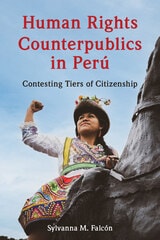
Human Rights Counterpublics in Perú
Sylvanna M. Falcón
University of Illinois Press, 2024
In 2003, Perú’s Comisión de la Verdad y Reconciliación (CVR) issued its groundbreaking final report on the human rights abuses perpetuated by two revolutionary groups and the country’s armed forces and police from 1980 to 2000. Sylvanna M. Falcón examines how local communities in Lima have formed oppositional spaces, movements, and communities to challenge a status quo that erases Perú’s history of internal violence. These counterpublics focus on human rights-oriented memory that acknowledges the legacies of racism and misogyny underlying the violence. Falcón’s decolonial feminist analysis challenges the rise of authoritarianism in democratic societies while exploring the limits of liberalism to counteract it. As she shows, projects shaped by counterpublic memory best equip Perúvians to enact real, liberatory, and transformative justice for human rights violations both past and present.
Engaging and intimate, Human Rights Counterpublics in Perú illuminates the power of human rights and memory work.
[more]
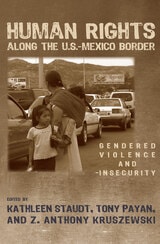
Human Rights along the U.S.–Mexico Border
Gendered Violence and InsecurityEdited by Kathleen Staudt, Tony Payan, and Z. Anthony Kruszewski
University of Arizona Press, 2009
Much political oratory has been devoted to safeguarding America’s boundary with Mexico, but policies that militarize the border and criminalize immigrants have overshadowed the region’s widespread violence against women, the increase in crossing deaths, and the lingering poverty that spurs people to set out on dangerous northward treks. This book addresses those concerns by focusing on gender-based violence, security, and human rights from the perspective of women who live with both violence and poverty.
From the Pacific to the Gulf of Mexico, scholars from both sides of the 2,000-mile border reflect expertise in disciplines ranging from international relations to criminal justice, conveying a more complex picture of the region than that presented in other studies.
Initial chapters offer an overview of routine sexual assaults on women migrants, the harassment of Central American immigrants at the hands of authorities and residents, corruption and counterfeiting along the border, and near-death experiences of border crossers. Subsequent chapters then connect analysis with solutions in the form of institutional change, social movement activism, policy reform, and the spread of international norms that respect human rights as well as good governance.
These chapters show how all facets of the border situation—globalization, NAFTA, economic inequality, organized crime, political corruption, rampant patriarchy—promote gendered violence and other expressions of hyper-masculinity. They also show that U.S. immigration policy exacerbates the problems of border violence—in marked contrast to the border policies of European countries.
By focusing on women’s everyday experiences in order to understand human security issues, these contributions offer broad-based alternative approaches and solutions that address everyday violence and inattention to public safety, inequalities, poverty, and human rights. And by presenting a social and democratic international feminist framework to address these issues, they offer the opportunity to transform today’s security debate in constructive ways.
[more]
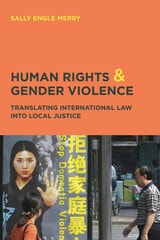
Human Rights and Gender Violence
Translating International Law into Local JusticeSally Engle Merry
University of Chicago Press, 2005
Human rights law and the legal protection of women from violence are still fairly new concepts. As a result, substantial discrepancies exist between what is decided in the halls of the United Nations and what women experience on a daily basis in their communities. Human Rights and Gender Violence is an ambitious study that investigates the tensions between global law and local justice.
As an observer of UN diplomatic negotiations as well as the workings of grassroots feminist organizations in several countries, Sally Engle Merry offers an insider's perspective on how human rights law holds authorities accountable for the protection of citizens even while reinforcing and expanding state power. Providing legal and anthropological perspectives, Merry contends that human rights law must be framed in local terms to be accepted and effective in altering existing social hierarchies. Gender violence in particular, she argues, is rooted in deep cultural and religious beliefs, so change is often vehemently resisted by the communities perpetrating the acts of aggression.
A much-needed exploration of how local cultures appropriate and enact international human rights law, this book will be of enormous value to students of gender studies and anthropology alike.
[more]
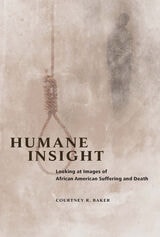
Humane Insight
Looking at Images of African American Suffering and DeathCourtney Baker
University of Illinois Press, 2017
In the history of black America, the image of the mortal, wounded, and dead black body has long been looked at by others from a safe distance. Courtney Baker questions the relationship between the spectator and victim and urges viewers to move beyond the safety of the "gaze" to cultivate a capacity for humane insight toward representations of human suffering. Utilizing the visual studies concept termed the "look," Baker interrogates how the notion of humanity was articulated and recognized in oft-referenced moments within the African American experience: the graphic brutality of the 1834 Lalaurie affair; the photographic exhibition of lynching, Without Sanctuary ; Emmett Till's murder and funeral; and the devastation caused by Hurricane Katrina. Contemplating these and other episodes, Baker traces how proponents of black freedom and dignity used the visual display of violence against the black body to galvanize action against racial injustice. An innovative cultural study that connects visual theory to African American history, Humane Insight asserts the importance of ethics in our analysis of race and visual culture, and reveals how representations of pain can become the currency of black liberation from injustice.
[more]