Results by title
18293 books match the query 'United States' and 552 start with h

House of Plenty
The Rise, Fall, and Revival of Luby's CafeteriasBy Carol Dawson and Carol Johnston
University of Texas Press, 2006
Violet Crown Award, Writers League of Texas, 2007
Citation, San Antonio Conservation Society, 2009
Scarred by the deaths of his mother and sisters and the failure of his father's business, a young man dreamed of making enough money to retire early and retreat into the secure world that his childhood tragedies had torn from him. But Harry Luby refused to be a robber baron. Turning totally against the tide of avaricious capitalism, he determined to make a fortune by doing good. Starting with that unlikely, even naive, ambition in 1911, Harry Luby founded a cafeteria empire that by the 1980s had revenues second only to McDonald's. So successfully did Luby and his heirs satisfy the tastes of America that Luby's became the country's largest cafeteria chain, creating more millionaires per capita among its employees than any other corporation of its size. Even more surprising, the company stayed true to Harry Luby's vision for eight decades, making money by treating its customers and employees exceptionally well.
Written with the sweep and drama of a novel, House of Plenty tells the engrossing story of Luby's founding and phenomenal growth, its long run as America's favorite family restaurant during the post-World War II decades, its financial failure during the greed-driven 1990s when non-family leadership jettisoned the company's proven business model, and its recent struggle back to solvency. Carol Dawson and Carol Johnston draw on insider stories and company records to recapture the forces that propelled the company to its greatest heights, including its unprecedented practices of allowing store managers to keep 40 percent of net profits and issuing stock to all employees, which allowed thousands of Luby's workers to achieve the American dream of honestly earned prosperity. The authors also plumb the depths of the Luby's drama, including a hushed-up theft that split the family for decades; the 1991 mass shooting at the Killeen Luby's, which splattered the company's good name across headlines nationwide; and the rapacious over-expansion that more than doubled the company's size in nine years (1987-1996), pushed it into bankruptcy, and drove president and CEO John Edward Curtis Jr. to violent suicide.
Disproving F. Scott Fitzgerald's adage that "there are no second acts in American lives," House of Plenty tells the epic story of an iconic American institution that has risen, fallen, and found redemption—with no curtain call in sight.
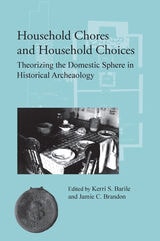
Household Chores and Household Choices
Theorizing the Domestic Sphere in Historical ArchaeologyEdited by Kerri S. Barile and James C. Brandon
University of Alabama Press, 2004
Discusses the concepts of “home,” “house,” and “household” in past societies
Because archaeology seeks to understand past societies, the concepts of "home," "house," and "household" are important. Yet they can be the most elusive of ideas. Are they the space occupied by a nuclear family or by an extended one? Is it a built structure or the sum of its contents? Is it a shelter against the elements, a gendered space, or an ephemeral place tied to emotion? We somehow believe that the household is a basic unit of culture but have failed to develop a theory for understanding the diversity of households in the historic (and prehistoric) periods.
In an effort to clarify these questions, this volume examines a broad range of households—a Spanish colonial rancho along the Rio Grande, Andrew Jackson's Hermitage in Tennessee, plantations in South Carolina and the Bahamas, a Colorado coal camp, a frontier Arkansas farm, a Freedman's Town eventually swallowed by Dallas, and plantations across the South—to define and theorize domestic space. The essays devolve from many disciplines, but all approach households from an archaeological perspective, looking at landscape analysis, excavations, reanalyzed collections, or archival records. Together, the essays present a body of knowledge that takes the identification, analysis, and interpretation of households far beyond current conceptions.
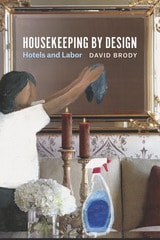
Housekeeping by Design
Hotels and LaborDavid Brody
University of Chicago Press, 2016
With Housekeeping by Design, David Brody introduces us to those people—the housekeepers whose labor keeps the rooms clean and the guests happy. Through unprecedented access to staff at several hotels, Brody shows us just how much work goes on behind the scenes—and how much management goes out of its way to make sure that labor stays hidden. We see the incredible amount of hard physical work that is involved in cleaning and preparing a room, how spaces, furniture, and other objects are designed to facilitate a smooth flow of hidden labor, and, crucially, how that design could be improved for workers and management alike if front-line staff were involved in the design process. After reading this fascinating exposé of the ways hotels work—or don’t for housekeepers—one thing is certain: checking in will never be the same again.
Houses of God
Region, Religion, and Architecture in the United StatesPeter W. Williams
University of Illinois Press, 1997
Housing America in the 1980s
John S. Adams
Russell Sage Foundation, 1987
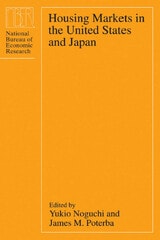
Housing Markets in the United States and Japan
Edited by Yukio Noguchi and James M. Poterba
University of Chicago Press, 1994
In this volume, ten essays discuss the evolution of housing prices, housing markets and personal savings, housing finance, commuting, and the impact of public policy on housing markets. The studies reveal surprising differences in housing investment in the two countries. For example, because down payments in Japan are much higher than in the United States, Japanese tend to delay home purchases relative to their American counterparts. In the United States, the advent of home equity credit may have reduced private saving overall.
This book is the first comparison of housing markets in Japan and the United States, and its findings illuminate the effects of housing markets on productivity growth, business investment, and trade.
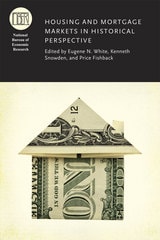
Housing and Mortgage Markets in Historical Perspective
Edited by Eugene N. White, Kenneth Snowden, and Price V. Fishback
University of Chicago Press, 2014
This volume begins to answer these questions, providing a much-needed context for understanding recent events by examining how historical housing and mortgage markets worked—and how they sometimes failed. Renowned economic historians Eugene N. White, Kenneth Snowden, and Price Fishback survey the foundational research on housing crises, comparing that of the 1930s to that of the early 2000s in order to authoritatively identify what contributed to each crisis. Later chapters explore notable historical experiences with mortgage securitization and the role that federal policy played in the surge in home ownership between 1940 and 1960. By providing a broad historical overview of housing and mortgage markets, the volume offers valuable new insights to inform future policy debates.
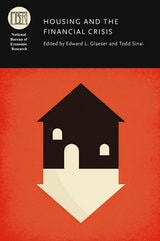
Housing and the Financial Crisis
Edited by Edward L. Glaeser and Todd Sinai
University of Chicago Press, 2013
Housing and the Financial Crisis looks at what happened to prices and construction both during and after the housing boom in different parts of the American housing market, accounting for why certain areas experienced less volatility than others. It then examines the causes of the boom and bust, including the availability of credit, the perceived risk reduction due to the securitization of mortgages, and the increase in lending from foreign sources. Finally, it examines a range of policies that might address some of the sources of recent instability.
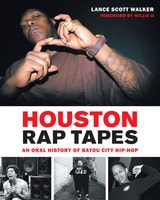
Houston Rap Tapes
An Oral History of Bayou City Hip-HopBy Lance Scott Walker, Foreword by Willie D
University of Texas Press, 2018
The neighborhoods of Fifth Ward, Fourth Ward, Third Ward, and the Southside of Houston, Texas, gave birth to Houston rap, a vibrant music scene that has produced globally recognized artists such as Geto Boys, DJ Screw, Pimp C and Bun B of UGK, Fat Pat, Big Moe, Z-Ro, Lil’ Troy, and Paul Wall. Lance Scott Walker and photographer Peter Beste spent a decade documenting Houston’s scene, interviewing and photographing the people—rappers, DJs, producers, promoters, record label owners—and places that give rap music from the Bayou City its distinctive character. Their collaboration produced the books Houston Rap and Houston Rap Tapes.
This second edition of Houston Rap Tapes amplifies the city’s hip-hop history through new interviews with Scarface, Slim Thug, Lez Moné, B L A C K I E, Lil’ Keke, and Sire Jukebox of the original Ghetto Boys. Walker groups the interviews into sections that track the different eras and movements in Houston rap, with new photographs and album art that reveal the evolution of the scene from the 1970s to today’s hip-hop generation. The interviews range from the specifics of making music to the passions, regrets, memories, and hopes that give it life. While offering a view from some of Houston’s most marginalized areas, these intimate conversations lay out universal struggles and feelings. As Willie D of Geto Boys writes in the foreword, “Houston Rap Tapes flows more like a bunch of fellows who haven’t seen each other for ages, hanging out on the block reminiscing, rather than a calculated literary guide to Houston’s history.”
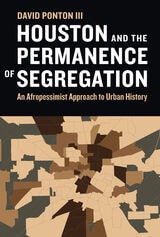
Houston and the Permanence of Segregation
An Afropessimist Approach to Urban HistoryDavid Ponton
University of Texas Press, 2024
2025 Most Significant Scholarly Book, Texas Institute of Letters
A history of racism and segregation in twentieth-century Houston and beyond.
Through the 1950s and beyond, the Supreme Court issued decisions that appeared to provide immediate civil rights protections to racial minorities as it relegated Jim Crow to the past. For black Houstonians who had been hoping and actively fighting for what they called a “raceless democracy,” these postwar decades were often seen as decades of promise. In Houston and the Permanence of Segregation, David Ponton argues that these were instead “decades of capture”: times in which people were captured and constrained by gender and race, by faith in the law, by antiblack violence, and even by the narrative structures of conventional histories. Bringing the insights of Black studies and Afropessimism to the field of urban history, Ponton explores how gender roles constrained thought in black freedom movements, how the “rule of law” compelled black Houstonians to view injustice as a sign of progress, and how antiblack terror undermined Houston’s narrative of itself as a “heavenly” place.
Today, Houston is one of the most racially diverse cities in the United States, and at the same time it remains one of the most starkly segregated. Ponton’s study demonstrates how and why segregation has become a permanent feature in our cities and offers powerful tools for imagining the world otherwise.
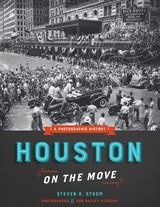
Houston on the Move
A Photographic HistoryBy Steven R. Strom, Photographs by Bob Bailey Studios
University of Texas Press, 2016
Houston completely transformed itself during the twentieth century, burgeoning from a regional hub into a world-class international powerhouse. This remarkable metamorphosis is captured in the Bob Bailey Studios Photographic Archive, an unparalleled visual record of Houston life from the 1930s to the early 1990s. Founded by the commercial photographer Bob Bailey in 1929, the Bailey Studios produced more than 500,000 photographs and fifty-two 16 mm films, making its archive the largest and most comprehensive collection of images ever taken in and around Houston. The Bob Bailey Studios Archive is now owned by the Dolph Briscoe Center for American History at the University of Texas at Austin.
Houston on the Move presents over two hundred of the Bailey archive’s most memorable and important photographs with extended captions that detail the photos’ subjects and the reasons for their significance. These images, most never before published, document everything from key events in Houston’s modern history—World War II; the Texas City Disaster; the building of the Astrodome; and the development of the Ship Channel, Medical Center, and Johnson Space Center—to nostalgic scenes of daily life. Bob Bailey’s expertly composed photographs reveal a great city in the making: a downtown striving to be the best, biggest, and tallest; birthday parties, snow days, celebrations, and rodeos; opulent department stores; Hollywood stars and political leaders; rapid industrial and commercial growth; and the inexorable march of the suburbs. An irresistible “remember that?” book for long-time Houstonians, Houston on the Move will also be an essential reference for historians, photographers, designers, and city planners.
How America Became Capitalist
Imperial Expansion and the Conquest of the WestJames Parisot
Pluto Press, 2019
Not so fast, says James Parisot. In How America Became Capitalist, he tells the little-known story of how our economic system came to be, and of the alternatives that were sidelined along the way. Capitalist elements were apparent from the first colonies of white settlers, but they were far from dominant, and they weren’t the driving factor in the advancement of colonies deeper into the continent. Even slavery, which was at the heart of both American capitalism and imperialism throughout much of the nation’s growth, was less a monolithic force than a series of complicated encounters that took different forms. Individual difference slowed the homogenization of capitalism as well, as transgender people, gays and lesbians, and people in interracial relationships all brought complexity to the market’s idea of the typical household.
At a moment when the long-term viability of capitalism is coming increasingly into question, How America Became Capitalist reminds us that the path to its dominance was never so smooth, nor so complete, as its champions would have us believe.

How America Gets Away with Murder
Illegal Wars, Collateral Damage and Crimes Against HumanityMichael Mandel
Pluto Press, 2004
How America Met the Jews
Hasia R. Diner
SBL Press, 2017
Explore how American conditions and Jewish circumstances collided in the nineteenth and early twentieth centuries
In this new book award-winning author Hasia R. Diner explores the issues behind why European Jews overwhelmingly chose to move to the United States between the 1820s and 1920s. Unlike books that tend to romanticize American freedom as the force behind this period of migration or that tend to focus on Jewish contributions to America or that concentrate on how Jewish traditions of literacy and self-help made it possible for them to succeed, Diner instead focuses on aspects of American life and history that made it the preferred destination for 90 percent of European Jews.
Features:
- Examination of the realities of race, immigration, color, money, economic development, politics, and religion in America
- Exploration of an America agenda that sought out white immigrants to help stoke economic development and that valued religion as a force for morality
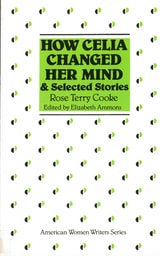
How Celia Changed Her Mind and Selected Stories
Rose Terry CookeAmmons, Elizabeth
Rutgers University Press, 1986
Cooke's stories are rich literarily and historically; her command of dialect, ear for dialogue, dramatic sense, and ability to draw interesting, memorable characters all distinguish her work. This reissue of some of her best work represents an important contribution to the canon of American literature.
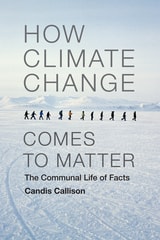
How Climate Change Comes to Matter
The Communal Life of FactsCandis Callison
Duke University Press, 2014
The disparate efforts of these groups illuminate the challenge of maintaining fidelity to scientific facts while transforming them into ethical and moral calls to action. Callison investigates the different vernaculars through which we understand and articulate our worlds, as well as the nuanced and pluralistic understandings of climate change evident in different forms of advocacy. As she demonstrates, climate change offers an opportunity to look deeply at how issues and problems that begin in a scientific context come to matter to wide publics, and to rethink emerging interactions among different kinds of knowledge and experience, evolving media landscapes, and claims to authority and expertise.
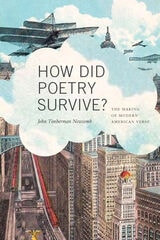
How Did Poetry Survive?
The Making of Modern American VerseJohn Timberman Newcomb
University of Illinois Press, 2013
This book traces the emergence of modern American poetry at the turn of the nineteenth century. With a particular focus on four "little magazines"--Poetry, The Masses, Others, and The Seven Arts--John Timberman Newcomb shows how each advanced ambitious agendas combining urban subjects, stylistic experimentation, and progressive social ideals. While subsequent literary history has favored the poets whose work made them distinct--individuals singled out usually on the basis of a novel technique--Newcomb provides a denser, richer view of the history that hundreds of poets made.
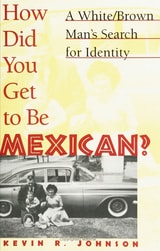
How Did You Get To Be Mexican
Kevin R. Johnson
Temple University Press, 1999
Johnson also grew up in the borderlands between classes. He spent his childhood with his mother, first on welfare and then with a racist working-class stepfather. As an adolescent, he moved to his father's home in a predominantly upper-middle-class suburb. His educational experiences too extend from a racially mixed elementary school to an all-white high school, and from Berkeley to Harvard Law School. From this vantage point, he analyzes the intersection of race and class in the United States.
This book looks not just at the question "Who is a Latino?" but also at the question of where persons of mixed Anglo-Latino heritage fit into the racial dynamics of the United States. Professor Johnson's mother was an ardent assimilationist who classified herself as "Spanish"; her failure to become a part o f middle America led her into depression and eventually mental illness. Her son has woven not just her experiences and his own, but also those of friends and relatives, into a complex and moving story of one white/brown man's search for identity.
How Do We Look?
Resisting Visual BiopoliticsFatimah Tobing Rony
Duke University Press, 2022
How Does Law Matter?
Fundamental Issues in Law And SocietyBryant G. Garth and Austin Sarat
Northwestern University Press, 1998
These essays show how law is relevant in both an "instrumental" and a "constitutive" sense, as a tool to accomplish particular purposes and as an important force in shaping the everyday worlds in which we live. Essays examine these issues by focusing on legal consciousness, the body, discrimination, and colonialism as well as on more traditional legal concerns such as juries and criminal justice.
How Failed Attempts to Amend the Constitution Mobilize Political Change
Roger C. Hartley
Vanderbilt University Press, 2017
This book is a demonstration of how social reformers and politicians have used the amendment process to achieve favorable political results even as their proposed amendments have failed to be adopted. For example, the ERA "failed" in the sense that it was never ratified, but the mobilization to ratify the ERA helped build the feminist movement (and also sparked a countermobilization). Similarly, the Supreme Court's ban on compulsory school prayer led to a barrage of proposed amendments to reverse the Court. They failed to achieve the requisite two-thirds support from Congress, but nevertheless had an impact on the political landscape. The definition of the relationship between Congress and the President in the conduct of foreign policy can also be traced directly to failed efforts to amend the Constitution during the Cold War.
Roger Hartley examines familiar examples like the ERA, balanced budget amendment proposals, and pro-life attempts to overturn Roe v. Wade, but also takes the reader on a three-century tour of lesser-known amendments. He explains how often the mere threat of calling a constitutional convention (at which anything could happen) effected political change.

How Free Can Religion Be?
Randall P. Bezanson
University of Illinois Press, 2010
In tracking the evolution of the First Amendment's Free Exercise and Establishment Clause doctrine through Key Supreme Court decisions on religious freedom, legal scholar Randall P. Bezanson focuses on the court's shift from strict separation of church and state to a position where the government accommodates and even fosters religion. Beginning with samples from the latter half of the nineteenth century, the detailed case studies present new problems and revisit old ones as well: the purported belief of polygamy in the Mormon Church; state support for religious schools; the teaching of evolution and creationism in public schools; Amish claims for exemption from compulsory education laws; comparable claims for Native American religion in relation to drug laws; and rights of free speech and equal access by religious groups in colleges and public schools.
How Free Can the Press Be?
Randall P. Bezanson
University of Illinois Press, 2003
The cases concerned matters ranging from The New York Times's publication of the Pentagon Papers to Hugo Zacchini's claim that TV broadcasts of his human cannonball act threatened his livelihood. Bezanson also examines the case of politician blackballed by the Miami Herald; the Pittsburgh Press's argument that it had the right to use gender based column headings in its classifieds; and a crime victim suing the Des Moines Register over the paper's publication of intimate details, including the victim's name.
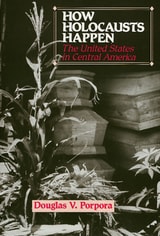
How Holocausts Happen
The United States in Central AmericaDouglas V. Porpora
Temple University Press, 1992
"History repeats itself, but it never repeats itself exactly," observes Douglas Porpora in this powerful indictment of U.S. intervention in Central America. Comparing the general public’s reaction to the Holocaust in Nazi Germany with American public opinion of U.S. participation in the genocidal policies of Nicaraguan counter-revolutionary forces, and the governments of Guatemala and El Salvador among others, Porpora demonstrates that moral indifference to the suffering of others was the common response. With reference to Hannah Arendt’s thesis of the banality of evil, he develops the concept of a "Holocaust-like event" and examines how even a democratic society can be capable of something on the order of a Holocaust.
Unlike other accounts of the Holocaust and genocide, this book focuses on the citizenry served or ruled by genocidal governments rather than on the governments themselves. Porpora argues that moral indifference and lack of interest in critical reflection are key factors that enable Holocaust-like events to happen And he characterizes American society as being typically indifferent to the fate of other people, uninformed, and anti-intellectual.
Porpora cites numerous horrifying examples of U.S.-backed Latin American government actions against their own peasants, Indians, and dissident factions. He offers finally a theory of public moral indifference and argues that although such indifference is socially created by government, the media, churches, and other institutions, we, the public, must ultimately take responsibility for it. How Holocausts Happen is at once a scholarly examination of the nature of genocide and a stinging indictment of American society.
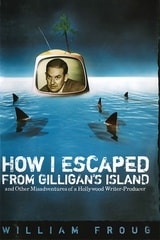
How I Escaped from Gilligan's Island
And Other Misadventures of a Hollywood Writer-ProducerWilliam Froug
University of Wisconsin Press, 2005
In the early 1950s writers were leaving radio en masse to try their hand at another promising medium—television. William Froug was in the thick of that exodus, a young man full of ideas in a Hollywood bursting with opportunities. In his forty-year career Froug would write and/or produce many of the shows that America has grown up with. From the drama of Playhouse 90 and the mind-bending premises of The Twilight Zone to the escapist scenarios of Adventures in Paradise, Gilligan’s Island, Bewitched, and Charlie’s Angels, Froug played a role in shaping his trade. He crossed paths with some of the memorable personalities in the industry, including Jack Benny, Lucille Ball, Agnes Moorehead, Elizabeth Montgomery, Robert Blake, Rod Serling, Gene Roddenberry, Aaron Spelling, and Sherwood Schwartz.
Froug reveals a post-WWII America giddy with the success of its newest medium—yet sobered at moments by strikes and union politics, McCarthyism and anti-Semitism. It was a world of hastily written scripts, sudden firings, thwarted creativity, and fickle tastes. And yet, while clearly exasperated with many aspects of Hollywood, Froug was a man utterly in his element, his frustration with the industry ultimately eclipsed by his dedication to his craft.
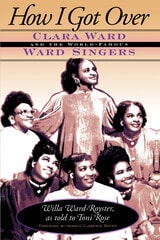
How I Got Over
Clara Ward and the World-Famous Ward SingersWilla Ward-Royster
Temple University Press, 2000
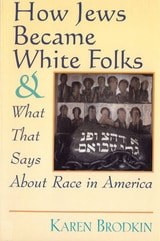
How Jews Became White Folks and What That Says About Race in America
Brodkin, Karen
Rutgers University Press, 1998
The history of Jews in the United States is one of racial change that provides useful insights on race in America. Prevailing classifications have sometimes assigned Jews to the white race and at other times have created an off-white racial designation for them. Those changes in racial assignment have shaped the ways American Jews of different eras have constructed their ethnoracial identities. Brodkin illustrates these changes through an analysis of her own family's multi-generational experience. She shows how Jews experience a kind of double vision that comes from racial middleness: on the one hand, marginality with regard to whiteness; on the other, whiteness and belonging with regard to blackness.
Class and gender are key elements of race-making in American history. Brodkin suggests that this country's racial assignment of individuals and groupsconstitutes an institutionalized system of occupational and residential segregation, is a key element in misguided public policy, and serves as a pernicious foundational principle in the construction of nationhood. Alternatives available to non-white and alien "others" have been either to whiten or to be consigned to an inferior underclass unworthy of full citizenship. The American ethnoracial map-who is assigned to each of these poles-is continually changing, although the binary of black and white is not. As a result, the structure within which Americans form their ethnoracial, gender, and class identities is distressingly stable. Brodkin questions the means by which Americans construct their political identities and what is required to weaken the hold of this governing myth.

How Knowledge Moves
Writing the Transnational History of Science and TechnologyEdited by John Krige
University of Chicago Press, 2019
This specialized knowledge is located at multiple sites and moves across borders via a dazzling array of channels, embedded in heads and hands, in artifacts, and in texts. In the United States, it shapes policies for visas, export controls, and nuclear weapons proliferation; in Algeria, it enhances the production of oranges by colonial settlers; in Vietnam, it facilitates the exploitation of a river delta. In India it transforms modes of agricultural production. It implants American values in Latin America. By concentrating on the conditions that allow for knowledge movement, these essays explore travel and exchange in face-to-face encounters and show how border-crossings mobilize extensive bureaucratic technologies.
How Lawyers Lose Their Way
A Profession Fails Its Creative MindsJean Stefancic and Richard Delgado
Duke University Press, 2005
Stefancic and Delgado dramatize the plight of modern lawyers by exploring the unlikely friendship between Archibald MacLeish, who gave up a successful but unsatisfying law career to pursue his literary yearnings, and Ezra Pound. Reading the forty-year correspondence between MacLeish and Pound, Stefancic and Delgado draw lessons about the difficulties of attorneys trapped in worlds that give them power, prestige, and affluence but not personal satisfaction, much less creative fulfillment. Long after Pound had embraced fascism, descended into lunacy, and been institutionalized, MacLeish took up his old mentor’s cause, turning his own lack of fulfillment with the law into a meaningful crusade and ultimately securing Pound’s release from St. Elizabeths Hospital. Drawing on MacLeish’s story, Stefancic and Delgado contend that literature, public interest work, and critical legal theory offer tools to contemporary attorneys for finding meaning and overcoming professional dissatisfaction.

How Libraries and Librarians Help
A Guide to Identifying User-Centered OutcomesMarian Bouch Hinton
American Library Association, 2005
How Machines Came to Speak
Media Technologies and Freedom of SpeechJennifer Petersen
Duke University Press, 2022

How Many Doctors Do We Need?
Duncan Yaggy and Patricia Hodgson, eds.
Duke University Press, 1986
How Many Is Too Many?
The Progressive Argument for Reducing Immigration into the United StatesPhilip Cafaro
University of Chicago Press, 2015
Cafaro roots his argument in human rights, equality, economic security, and environmental sustainability—hallmark progressive values. He shows us the undeniable realities of mass migration to which we have turned a blind eye: how flooded labor markets in sectors such as meatpacking and construction have driven down workers’ wages and driven up inequality; how excessive immigration has fostered unsafe working conditions and political disempowerment; how it has stalled our economic maturity by keeping us ever-focused on increasing consumption and growth; and how it has caused our cities and suburbs to sprawl far and wide, destroying natural habitats, driving other species from the landscape, and cutting us off from nature.
In response to these hard-hitting truths, Cafaro lays out a comprehensive plan for immigration reform that is squarely in line with progressive political goals. He suggests that we shift enforcement efforts away from border control and toward the employers who knowingly hire illegal workers. He proposes aid and foreign policies that will help people create better lives where they are. And indeed he supports amnesty for those who have, at tremendous risk, already built their lives here. Above all, Cafaro attacks our obsession with endless material growth, offering in its place a mature vision of America, not brimming but balanced, where all the different people who constitute this great nation of immigrants can live sustainably and well, sheltered by a prudence currently in short supply in American politics.
How New York Stole the Idea of Modern Art
Serge Guilbaut
University of Chicago Press, 1985
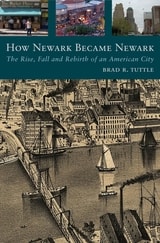
How Newark Became Newark
The Rise, Fall, and Rebirth of an American CityBrad R. Tuttle
Rutgers University Press, 2009
How Newark Became Newark is a fresh, unflinching popular history that spans the city's epic transformation from a tiny Puritan village into a manufacturing powerhouse, on to its desperate struggles in the twentieth century and beyond. After World War II, unrest mounted as the minority community was increasingly marginalized, leading to the wrenching civic disturbances of the 1960s. Though much of the city was crippled for years, How Newark Became Newark is also a story of survival and hope. Today, a real estate revival and growing population are signs that Newark is once again in ascendance.
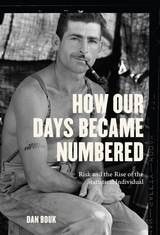
How Our Days Became Numbered
Risk and the Rise of the Statistical IndividualDan Bouk
University of Chicago Press, 2015
How Our Days Became Numbered tells a story of corporate culture remaking American culture--a story of intellectuals and professionals in and around insurance companies who reimagined Americans' lives through numbers and taught ordinary Americans to do the same. Making individuals statistical did not happen easily. Legislative battles raged over the propriety of discriminating by race or of smoothing away the effects of capitalism's fluctuations on individuals. Meanwhile, debates within companies set doctors against actuaries and agents, resulting in elaborate, secretive systems of surveillance and calculation.
Dan Bouk reveals how, in a little over half a century, insurers laid the groundwork for the much-quantified, risk-infused world that we live in today. To understand how the financial world shapes modern bodies, how risk assessments can perpetuate inequalities of race or sex, and how the quantification and claims of risk on each of us continue to grow, we must take seriously the history of those who view our lives as a series of probabilities to be managed.
How Partisan Media Polarize America
Matthew Levendusky
University of Chicago Press, 2013
In How Partisan Media Polarize America, Matthew Levendusky confirms—but also qualifies—both of these claims. Drawing on experiments and survey data, he shows that Americans who watch partisan programming do become more certain of their beliefs and less willing to weigh the merits of opposing views or to compromise. And while only a small segment of the American population watches partisan media programs, those who do tend to be more politically engaged, and their effects on national politics are therefore far-reaching.
In a time when politics seem doomed to partisan discord, How Partisan Media Polarize America offers a much-needed clarification of the role partisan media might play.
How Policies Make Interest Groups
Governments, Unions, and American EducationMichael T. Hartney
University of Chicago Press, 2022
As most American labor organizations struggle for survival and relevance in the twenty-first century, teachers unions appear to be an exception. Despite being all but nonexistent until the 1960s, these unions are maintaining members, assets—and political influence. As the COVID-19 epidemic has illustrated, today’s teachers unions are something greater than mere labor organizations: they are primary influencers of American education policy. How Policies Make Interest Groups examines the rise of these unions to their current place of influence in American politics.
Michael Hartney details how state and local governments adopted a new system of labor relations that subsidized—and in turn, strengthened—the power of teachers unions as interest groups in American politics. In doing so, governments created a force in American politics: an entrenched, subsidized machine for membership recruitment, political fundraising, and electoral mobilization efforts that have informed elections and policymaking ever since. Backed by original quantitative research from across the American educational landscape, Hartney shows how American education policymaking and labor relations have combined to create some of the very voter blocs to which it currently answers. How Policies Make Interest Groups is trenchant, essential reading for anyone seeking to understand why some voices in American politics mean more than others.
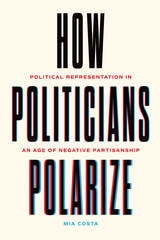
How Politicians Polarize
Political Representation in an Age of Negative PartisanshipMia Costa
University of Chicago Press, 2025
A fresh examination of political representation in an era of negative partisanship.
What does representation look like when politicians focus on "othering" the opposing party rather than the policy interests of their constituents? How do voters react to negative partisan rhetoric? And is policy responsiveness still the cornerstone of American representative democracy?
In How Politicians Polarize, Mia Costa draws on survey experiments, analysis of congressional newsletters and tweets, and data on fundraising and media coverage to examine how and why politicians rely so often on negative partisan attacks. Costa shows that most Americans do not like negative rhetoric, and politicians know this. Nonetheless, these kinds of attacks can reap powerful rewards from national media, donors, and party elites. Costa’s findings challenge the popular notion that Americans are motivated more by their partisan identities than by policy representation. Her research illuminates how the political ecosystem rewards negative representation and how this affects the quality of American democracy.
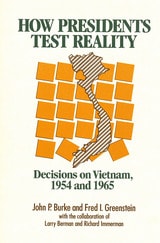
How Presidents Test Reality
Decisions on Vietnam, 1954 and 1965John P. Burke, Fred L. Greenstein, Larry Berman, and Richard Immerman
Russell Sage Foundation, 1991
Just as famines and plagues can provide opportunities for medical research, the unhappy course of United States relations with Vietnam is a prime source of evidence for students of American political institutions. How Presidents Test Reality draws on the record of American decision making about Vietnam to explore the capacity of top government executives and their advisers to engage in effective reality testing.
Authors Burke and Greenstein compare the Vietnam decisions of two presidents whose leadership styles and advisory systems diverged as sharply as any in the modern presidency. Faced with a common challenge—an incipient Communist take-over of Vietnam—presidents Eisenhower and Johnson engaged in intense debates with their aides and associates, some of whom favored intervention and some of whom opposed it. In the Dien Bien Phu Crisis of 1954, Eisenhower decided not to enter the conflict; in 1965, when it became evident that the regime in South Vietnam could not hold out much longer, Johnson intervened.
How Presidents Test Reality uses declassified records and interviews with participants to assess the adequacy of each president’s use of advice and information. This important book advances our historical understanding of the American involvement in Vietnam and illuminates the preconditions of effective presidential leadership in the modern world.
"An exceptionally thoughtful exercise in what ‘contemporary history’ ought to be. Illuminates the past in a way that suggests how we might deal with the present and the future." —John Lewis Gaddis
"Burke and Greenstein have written what amounts to an owner's manual for operating the National Security Council....This is a book Reagan's people could have used and George Bush ought to read." —Bob Schieffer, The Washington Monthly
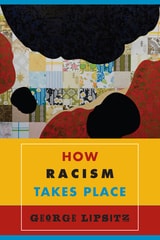
How Racism Takes Place
George Lipsitz
Temple University Press, 2011
White identity in the United States is place bound, asserts George Lipsitz in How Racism Takes Place. An influential scholar in American and racial studies, Lipsitz contends that racism persists because a network of practices skew opportunities and life chances along racial lines. That is, these practices assign people of different races to different spaces and therefore allow grossly unequal access to education, employment, transportation, and shelter.
Revealing how seemingly race-neutral urban sites contain hidden racial assumptions and imperatives, Lipsitz examines the ways in which urban space and social experience are racialized and emphasizes that aggrieved communities do not passively acquiesce to racism. He recognizes the people and communities that have reimagined segregated spaces in expressive culture as places for congregation.
How Racism Takes Place not only exposes the degree to which this white spatial imagining structures our society but also celebrates the black artists and activists who struggle to create a just and decent society.
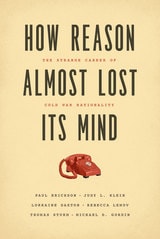
How Reason Almost Lost Its Mind
The Strange Career of Cold War RationalityPaul Erickson, Judy L. Klein, Lorraine Daston, Rebecca Lemov, Thomas Sturm, and Michael D. Gordin
University of Chicago Press, 2013
How Schools Meet Students' Needs
Inequality, School Reform, and Caring LaborKatie Kerstetter
Rutgers University Press, 2023
How Schools Really Matter
Why Our Assumption about Schools and Inequality Is Mostly WrongDouglas B. Downey
University of Chicago Press, 2020
A close look at the testing data in seasonal patterns bears this out. It turns out that achievement gaps in reading skills between high- and low-income children are nearly entirely formed prior to kindergarten, and schools do more to reduce them than increase them. And when gaps do increase, they tend to do so during summers, not during school periods. So why do both liberal and conservative politicians strongly advocate for school reform, arguing that the poor quality of schools serving disadvantaged children is an important contributor to inequality? It’s because discussing the broader social and economic reforms necessary for really reducing inequality has become too challenging and polarizing—it’s just easier to talk about fixing schools. Of course, there are differences that schools can make, and Downey outlines the kinds of reforms that make sense given what we know about inequality outside of schools, including more school exposure, increased standardization, and better and fairer school and teacher measurements.
How Schools Really Matter offers a firm rebuke to those who find nothing but fault in our schools, which are doing a much better than job than we give them credit for. It should also be a call to arms for educators and policymakers: the bottom line is that if we are serious about reducing inequality, we are going to have to fight some battles that are bigger than school reform—battles against the social inequality that is reflected within, rather than generated by—our public school system.
How Schools Work
Rebecca Barr and Robert Dreeben
University of Chicago Press, 1988
Viewing schools as part of a social organization with a hierarchy of levels—district, school, classroom, instructional group, and students—avoids the common pitfalls of lumping together any and all possible influences on student learning without regard to the actual processes of the classroom. Barr and Dreeben systematically explain how instructional groups originate, form, and change over time. Focusing on first grade reading instruction, their study shows that individual reading aptitude actually has little direct relation to group reading achievement and virtually none to the coverage of reading materials once the mean aptitude of groups is taken into consideration. Individual aptitude, they argue, is rather the basis on which teachers form reading groups that are given different instructional treatment. It is these differences in group treatment, they contend, that explain substantial differences in learning curricular material.
How States Shaped Postwar America
State Government and Urban PowerNicholas Dagen Bloom
University of Chicago Press, 2019
How States Shaped Postwar America
State Government and Urban PowerNicholas Dagen Bloom
University of Chicago Press, 2019
The history of public policy in postwar America tends to fixate on developments at the national level, overlooking the crucial work done by individual states in the 1960s and ’70s. In this book, Nicholas Dagen Bloom demonstrates the significant and enduring impact of activist states in five areas: urban planning and redevelopment, mass transit and highways, higher education, subsidized housing, and the environment. Bloom centers his story on the example set by New York governor Nelson Rockefeller, whose aggressive initiatives on the pressing issues in that period inspired others and led to the establishment of long-lived state polices in an age of decreasing federal power. Metropolitan areas, for both better and worse, changed and operated differently because of sustained state action—How States Shaped Postwar America uncovers the scope of this largely untold story.
How Strange It Seems
The Cultural Life of Jews in Small-Town New EnglandMichael Hoberman
University of Massachusetts Press, 2008
Jews have lived in small-town New England since the colonial era, but during the last hundred years they have been especially active contributors to the region's cultural life. Part oral history, part ethnography, and part literary portrait, How Strange It Seems tells the story of this often overlooked group, tracing its patterns of settlement, economic activity, civic involvement, and religious life since the late 1800s.
Based on more than fifty interviews with men and women of all ages from Maine, New Hampshire, Vermont, Massachusetts, and Connecticut, it seeks to understand what is distinctive—and not so distinctive—about contemporary Jewish communities outside the larger urban centers of the Northeast. Michael Hoberman weaves the personal stories of these individuals and families into a collective narrative that offers as much folklore as history and is equal parts Jewish and Yankee. He introduces us to Hiram Adelman, a Russian immigrant peddler and potato farmer who settled in northernmost Maine because its climate was comparable to his native Siberia, and to Shmuel Simenowitz, an urban transplant who produces kosher maple syrup in southern Vermont. We also meet Suzie Laskin, who moved to the White Mountains region of New Hampshire in the 1900s and soon established a local havurah, and Bob August of Whately, Massachusetts, who once ran what may have been the world's only Christmas tree farm owned by a Jewish family.
Each section of the book explores how small-town New England Jews have both departed from and mimicked the broader patterns of Jewish American experience, while also illustrating how they have acclimated themselves to local practices without relinquishing a strong sense of Jewish identity. Accompanying the text are photographs by Janice Sorensen that include portraits of many of the interviewees and lively glimpses of the region's present-day Jewish revival.
How We Became Our Data
A Genealogy of the Informational PersonColin Koopman
University of Chicago Press, 2019
In How We Became Our Data, Colin Koopman excavates early moments of our rapidly accelerating data-tracking technologies and their consequences for how we think of and express our selfhood today. Koopman explores the emergence of mass-scale record keeping systems like birth certificates and social security numbers, as well as new data techniques for categorizing personality traits, measuring intelligence, and even racializing subjects. This all culminates in what Koopman calls the “informational person” and the “informational power” we are now subject to. The recent explosion of digital technologies that are turning us into a series of algorithmic data points is shown to have a deeper and more turbulent past than we commonly think. Blending philosophy, history, political theory, and media theory in conversation with thinkers like Michel Foucault, Jürgen Habermas, and Friedrich Kittler, Koopman presents an illuminating perspective on how we have come to think of our personhood—and how we can resist its erosion.
How We Came to Be
An Intellectual Genealogy of Chicano ScholarsEdited by Teresa Córdova, Aída Hurtado, Francisco J. Hernández, Avelardo Valdez; Foreword by Juan González
University of Arizona Press, 2026
This work chronicles the lives and legacies of Chicana and Chicano scholars whose formative experiences in the Chicano Movement shaped the development of Chicano studies and transformed higher education. Originating from the Reuniónes de Colegas—gatherings of veteran scholars reflecting on their shared histories—the volume features sixteen essays organized into five thematic sections that explore the intersections of activism, scholarship, and institutional change.
The contributors document how grassroots organizing evolved into academic inquiry, leading to the creation of departments, student support systems, and policy reforms that advanced equity and representation in universities. Essays address how community-engaged research influenced urban planning, health advocacy, and cultural production, while also highlighting Indigenous and transnational epistemologies that redefined theoretical frameworks in Chicano studies. The volume concludes with reflections on academic leadership and the breaking of barriers by Chicana scholars in higher education administration.
Together, these essays offer a powerful intellectual history and a testament to a generation’s enduring commitment to social justice. How We Came to Be is both a scholarly archive and a call to action, preserving the legacy of those who built Chicano studies and inspiring future generations to continue the work of transformation within and beyond the academy.
Contributors
José Calderón
Gilberto Cárdenas
Teresa Carrillo
Teresa Córdova
Estevan Flores
Yvette G. Flores
Felipe Gonzales
Deena J. González
Francisco J. Hernández
Inés Hernández-Ávila
Francisco Hernández Vázquez
Aída Hurtado
Larry Trujillo
Avelardo Valdez
Carlos G. Vélez-Ibáñez
James Diego Vigil