Results by title
28164 books match the query 'History' and 906 start with h
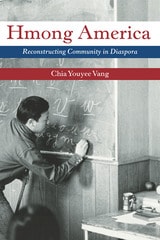
Hmong America
Reconstructing Community in DiasporaChia Youyee Vang
University of Illinois Press, 2010
Vang depicts Hmong experiences in Asia and examines aspects of community building in America to reveal how new Hmong identities have been formed and how they have challenged popular assumptions about race and ethnicity in multicultural America. Combining participant observation and archival research with personal experience, Vang constructs a nuanced and complex portrait of the more than 130,000 Hmong people who came to the United States as political refugees beginning in the mid-1970s. Her critique of previous representations of the Hmong community provides the sociological underpinnings for a bold reassessment of Hmong history in the greater context of globalization. This new understanding redefines concepts of Hmong homogeneity and characterizes ordinary Hmong migrants not as passive victims but as dynamic actors who have exercised much power over their political and social destinies.
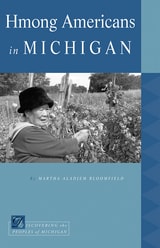
Hmong Americans in Michigan
Martha Aladjem Bloomfield
Michigan State University Press, 2014
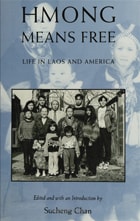
Hmong Means Free
Life in Laos and AmericaSucheng Chan
Temple University Press, 1994
This collection of evocative personal testimonies by three generations of Hmong refugees is the first to describe their lives in Laos as slash-and-burn farmers, as refugees after a Communist government came to power in 1975, and as immigrants in the United States. Reflecting on the homes left behind, their narratives chronicle the difficulties of forging a new identity.
From Jou Yee Xiong's Life Story:
"I stopped teaching my sons many of the Hmong ways because I felt my ancestors and I had suffered enough already. I thought that teaching my children the old ways would only place a burden on them."
From Ka Pao Xiong's (Jou Yee Xiong's son) Life Story:
"It has been very difficult for us to adapt because we had no professions or trades and we suffered from culture shock. Here in America, both the husband and wife must work simultaneously to earn enough money to live on. Many of our children are ignorant of the Hmong way of life…. Even the old people are forgetting about their life in Laos, as they enjoy the prosperity and good life in America."
From Xang Mao Xiong's Life Story:
"When the Communists took over Laos and General Vang Pao fled with his family, we, too, decided to leave. Not only my family, but thousands of Hmong tried to flee. I rented a car for thirty thousand Laotian dollars, and it took us to Nasu…. We felt compelled to leave because many of us had been connected to the CIA…. Thousands of Hmong were traveling on foot. Along the way, many of them were shot and killed by Communist soldiers. We witnessed a bloody massacre of civilians."
From Vue Vang's Life Story:
"Life was so hard in the [Thai refugee] camp that when we found out we could go to the United States, we did not hesitate to grasp the chance. We knew that were we to remain in the camp, there would be no hope for a better future. We would not be able to offer our children anything better than a life of perpetual poverty and anguish."
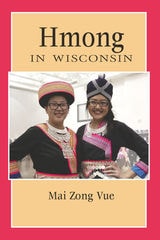
Hmong in Wisconsin
Mai Zong Vue
Wisconsin Historical Society Press, 2020
Many of these families found homes in Wisconsin, which now has the third largest Hmong population in the country, following California and Minnesota. As one of the most recent cultural groups to arrive in the Badger State, the Hmong have worked hard to establish a new life here, building support systems to preserve traditions and to help one another as they enrolled in schools, started businesses, and strived for independence.
Told with a mixture of scholarly research, interviews, and personal experience of the author, this latest addition to the popular People of Wisconsin series shares the Hmong’s varied stories of survival and hope as they have become an important part of Wisconsin communities.
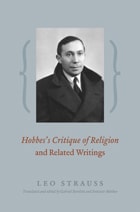
Hobbes's Critique of Religion and Related Writings
Leo Strauss
University of Chicago Press, 2011
Leo Strauss’s The Political Philosophy of Hobbes deservedly ranks among his most widely acclaimed works. In it Strauss argues that the basis for Hobbes’s natural and political science is his interest in “self-knowledge of man as he really is.” The writings collected in this book, each written prior to that classic volume, complement that account. Thus at long last, this book allows us to have a complete picture of Strauss’s interpretation of Hobbes, the thinker pivotal to the fundamental theme of his life’s work: the conflicting demands of philosophy and revelation, or as he termed it, “the theologico-political problem.”
It is no exaggeration to say that Strauss’s work on Hobbes’s critique of religion is essential to his analysis of Hobbes’s political philosophy, and vice versa. This volume will spark new interest in Hobbes’s explication of the Bible and in his understanding of religion by revealing previously neglected dimensions and motives of Hobbes’s “theology.” At the same time, scholars interested in the intellectual development of Leo Strauss will find in these writings the missing link, as it were, between his two early books,Spinoza’s Critique of Religion and The Political Philosophy of Hobbes.
In addition, this volume makes available for the first time in English a letter, a book outline, an extended review, an engagement with legal positivism, and an account of Strauss’s work on Hobbes by Heinrich Meier, all of which shed light on Strauss’s concerns and his approach to Hobbes in particular, as well as to modern political thought and life.
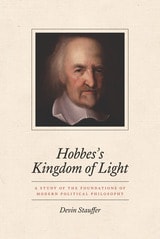
Hobbes's Kingdom of Light
A Study of the Foundations of Modern Political PhilosophyDevin Stauffer
University of Chicago Press, 2018
In Hobbes’s Kingdom of Light, Stauffer argues that Hobbes was engaged in a struggle on multiple fronts against forces, both philosophic and religious, that he thought had long distorted philosophy and destroyed the prospects of a lasting peace in politics. By exploring the twists and turns of Hobbes’s arguments, not only in his famous Leviathan but throughout his corpus, Stauffer uncovers the details of Hobbes’s critique of an older outlook, rooted in classical philosophy and Christian theology, and reveals the complexity of Hobbes’s war against the “Kingdom of Darkness.” He also describes the key features of the new outlook—the “Kingdom of Light”—that Hobbes sought to put in its place. Hobbes’s venture helped to prepare the way for the later emergence of modern liberalism and modern secularism. Hobbes’s Kingdom of Light is a wide-ranging and ambitious exploration of Hobbes’s thought.
Hobomok and Other Writings on Indians
Karcher, Carolyn L
Rutgers University Press, 1986

Hobsbawm
History and PoliticsGregory Elliott
Pluto Press, 2010
Historian Eric Hobsbawm is possibly the foremost chronicler of the modern age. His panoramic studies of the nineteenth and twentieth centuries, stretching from the French Revolution to the fall of Soviet communism, have informed the historical consciousness of scholars and general readers alike. At the same time, his writings on labour movements and socialist politics have occupied a central place in left-wing debates. Despite this, no extended study of Hobsbawm's work has yet been attempted Gregory Elliott fills this gap in exemplary fashion.
Elliott analyses both the scholarly record of Hobsbawm and the intellectual and political journey that his life represents. In doing so, he seeks to situate Hobsbawm's thought within the context of a generalised crisis of confidence on the Left after the fall of the Berlin Wall.
Rich in content and written in Elliott's authoritative and highly readable style, this book is a must for anyone with an interest in Hobsbawm and the crisis of the Left.
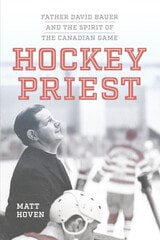
Hockey Priest
Father David Bauer and the Spirit of the Canadian GameMatt Hoven
Catholic University of America Press, 2024
Hockey
A Global HistoryStephen H. Hardy, Andrew C. Holman
University of Illinois Press, 2018
Hoecakes, Hambone, and All That Jazz
African American Traditions in MissouriRose M. Nolen
University of Missouri Press, 2003
Nolen writes, “Instead of the bond of common ancestors and a common language, which families had shared in Africa, the enslaved in the United States were bound together by skin color, hair texture, and condition of bondage. Out of this experience a strong sense of community was born.” Nolen traces the cultural traditions shaped by African Americans in Missouri from the early colonial period through the Civil War and Reconstruction and shows how those traditions were reshaped through the struggles of the civil rights movement and integration. Nolen demonstrates how the strong sense of community built on these traditions has sustained African Americans throughout their history.
Hog Wild
The Battle for Workers' Rights at the World's Largest SlaughterhouseLynn Waltz
University of Iowa Press, 2018
Author and journalist Lynn Waltz reveals how these aggressive tactics went unchecked for years until Sherri Buffkin, a higher-up manager at Smithfield, blew the lid off the company’s corrupt practices. Through meticulous reporting, in-depth interviews with key players, and a mind for labor and environmental histories, Waltz weaves a fascinating tale of the nearly two-decade struggle that eventually brought justice to the workers and accountability to the food giant, pitting the world’s largest slaughterhouse against the world’s largest meatpacking union.
Following in a long tradition of books that expose the horrors of the meatpacking industry—from Upton Sinclair’s The Jungle to Eric Schlosser’s Fast Food Nation—Hog Wild uncovers rampant corporate environmental hooliganism, labor exploitation, and union-busting by one of the nation’s largest meat producers. Waltz’s eye-opening examination sheds new light on the challenges workers face not just in meatpacking, but everywhere workers have lost their power to collectively bargain with powerful corporations.
Hogs, Mules, and Yellow Dogs
Growing Up on a Mississippi Subsistence FarmJimmye Hillman; Foreword by Robert Hass
University of Arizona Press, 2012
"It's in the nature of things that whole worlds disappear," writes the poet Robert Hass in the foreword to Jimmye Hillman's insightful memoir. "Their vanishings, more often than not, go unrecorded or pass into myth, just as they slip from the memory of the living."
To ensure that the world of Jimmye Hillman's childhood in Greene County, Mississippi during the Great Depression doesn't slip away, he has gathered together accounts of his family and the other people of Old Washington village. There are humorous stories of hog hunting and heart-wrenching tales of poverty set against a rural backdrop shaded by the local social, religious, and political climate of the time. Jimmye and his family were subsistence farmers out of bare-bones necessity, decades before discussions about sustainability made such practices laudable.
More than just childhood memories and a family saga, though, this book serves as a snapshot of the natural, historical, and linguistic details of the time and place. It is a remarkable record of Southern life. Observations loaded with detail uncover broader themes of work, family loyalty, and the politics of changing times.
Hillman, now eighty-eight, went on to a distinguished career as an economist specializing in agriculture. He realizes the importance of his story as an example of the cultural history of the Deep South but allows readers to discover the significance on their own by witnessing the lives of a colorful cast of characters. Hogs, Mules, and Yellow Dogs is unique, a blend of humor and reflection, wisdom and sympathy—but it's also a hard-nosed look at the realities of living on a dirt farm in a vanished world.
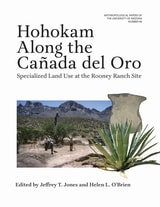
Hohokam Along the Cañada del Oro
Specialized Land Use at the Rooney Ranch SiteEdited by Jeffrey T. Jones and Helen L. O’Brien
University of Arizona Press, 2026
This work presents the results of more than a decade of archaeological fieldwork at the Rooney Ranch site in Oro Valley, Arizona—an upland Hohokam village that played a key role in regional agave production. Edited by Jeffrey T. Jones and Helen L. O’Brien, this volume synthesizes extensive data collected by the Pima Community College Centre for Archaeological Field Training, offering a rare and richly detailed look at how small peripheral settlements contributed to the sustainability of larger Hohokam communities in the Sonoran Desert. Through GIS-based mapping and the analysis of ceramics, lithics, and faunal and botanical remains, the book reveals how specialized land use shaped the economic and social fabric of the region for centuries.
This legacy project stands out not only for its depth but also for its educational significance. As one of the few long-term, community-college-led excavations in the Southwest, the Rooney Ranch project highlights the vital role of student training and local collaboration in archaeological research. With more than seventy data-rich tables and contributions from leading specialists, this volume is an essential resource for archaeologists, historians, and anyone interested in Indigenous land use, desert adaptation, and the enduring legacy of the Hohokam in southern Arizona.
Contributors
Jon Boyd
Chance Copperstone
Michael W. Diehl
Linda M. Gregonis
Lea Mason-Kohlmeyer
Christine H. Virden-Lange
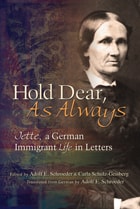
Hold Dear, As Always
Jette, a German Immigrant Life in LettersAdolf E. Schroeder and Carla Schulz-Geisberg
University of Missouri Press, 1988
Henriette Geisberg Bruns was twenty-three when she arrived in 1836 at the isolated Westphalia Settlement in central Missouri with her husband, baby son, two brothers, and a maid. Jette, as she was known to her family and friends, had not come to America by inclination, but from duty. Her husband Bernhard, a physician, had fallen victim to the emigration fever sweeping Germany in the 1830s and was convinced that he could provide a better life for his family in the American Free States where land was plentiful, the soil was fertile, and taxes were low. Born into a large, prosperous, closely knit family, Jette had set out for the New World reluctantly; but once in Missouri, she was determined not to give up and go back home, as a neighboring family did.
Although she maintained her resolve, this collection of letters written to her family in Germany shows that her life in America was often beset by deprivation, disease, and loneliness. Jette had been persuaded to emigrate for the sake of her children’s future; however, of the ten born in central Missouri, five died in childhood, three within three weeks in September and October 1841.Despite the family responsibilities and the hardships she faced in Missouri, Jette maintained a lively interest in American political and social life. For fifteen years in Westphalia and almost fifty in Jefferson City and St. Louis, she observed and offered astute—if sometimes acerbic—commentary on the historic as well as the daily events of nineteenth-century life. Left destitute by the death of her husband, who had served as mayor of Jefferson City during the Civil War, she opened a boarding-house in her home across from the state capitol to support her own children and those of her brother. There the German radicals in state government gathered to argue and debate.This rare collection of personal family letters, combined with an autobiographical sketch Jette wrote after the Civil War, illuminates the experience of one immigrant woman in a land that was always foreign to her.
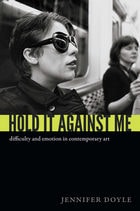
Hold It Against Me
Difficulty and Emotion in Contemporary ArtJennifer Doyle
Duke University Press, 2013
Doyle explores ideologies of emotion and how emotion circulates in and around art. Throughout, she gives readers welcoming points of entry into artworks that they may at first find off-putting or confrontational. Doyle offers new insight into how the discourse of controversy serves to shut down discussion about this side of contemporary art practice, and counters with a critical language that allows the reader to accept emotional intensity in order to learn from it.
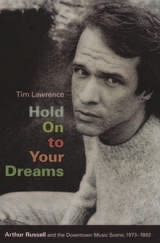
Hold On to Your Dreams
Arthur Russell and the Downtown Music Scene, 1973-1992Tim Lawrence
Duke University Press, 2009
Tim Lawrence traces Russell's odyssey from his hometown of Oskaloosa, Iowa, to countercultural San Francisco, and eventually to New York, where he lived from 1973 until his death from AIDS-related complications in 1992. Resisting definition while dreaming of commercial success, Russell wrote and performed new wave and disco as well as quirky rock, twisted folk, voice-cello dub, and hip-hop-inflected pop. “He was way ahead of other people in understanding that the walls between concert music and popular music and avant-garde music were illusory,” comments the composer Philip Glass. "He lived in a world in which those walls weren't there." Lawrence follows Russell across musical genres and through such vital downtown music spaces as the Kitchen, the Loft, the Gallery, the Paradise Garage, and the Experimental Intermedia Foundation. Along the way, he captures Russell's openness to sound, his commitment to collaboration, and his uncompromising idealism.
Holding Fast
Resilience and Civic Engagement Among Latino ImmigrantsJames A. McCann
Russell Sage Foundation, 2020
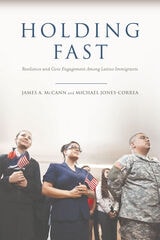
Holding Fast draws largely from a yearlong survey of Latino immigrants, including both citizens and noncitizens, conducted before and after the 2016 election. The survey gauges immigrants’ attitudes about the direction of the country and the emotional underpinnings of their political involvement. While survey respondents expressed pessimism about the direction of the United States following the 2016 election, there was no evidence of their withdrawal from civic life. Instead, immigrants demonstrated remarkable resilience in their political engagement, and their ties to America remained robust.
McCann and Jones-Correa examine Latino immigrants’ trust in government as well as their economic concerns and fears surrounding possible deportations of family members and friends. They find that Latino immigrants who were concerned about the likelihood of deportation were more likely to express a lack of trust in government. Concerns about personal finances were less salient. Disenchantment with the U.S. government did not differ based on citizenship status, length of stay in America, or residence in immigrant-friendly states. Foreign-born Latinos who are naturalized citizens shared similar sentiments to those with fewer political rights, and immigrants in California, for example, express views similar to those in Texas.
Addressing the potential influence immigrant voters may wield in in the coming election, the authors point to signs that the turnout rate for naturalized Latino immigrant may be higher than that for Latinos born in the United States. The authors further underscore the importance of the parties' platforms and policies, noting the still-tenuous nature of Latino immigrants’ affiliations with the Democratic Party.
Holding Fast outlines the complex political situation in which Latino immigrants find themselves today. Despite well-founded feelings of anger, fear, and skepticism, in general they maintain an abiding faith in the promise of American democracy. This book provides a comprehensive account of Latino immigrants’ political opinions and a nuanced, thoughtful outlook on the future of Latino civic participation. It will be an important contribution to scholarly work on civic engagement and immigrant integration.
Holding Up More Than Half the Sky
Chinese Women Garment Workers in New York City, 1948-92Xiaolan Bao
University of Illinois Press, 2001
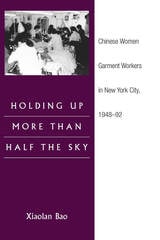
In 1982, 20,000 Chinese-American garment workers—most of them women—went on strike in New York City. Every Chinese garment industry employer in the city soon signed a union contract. The successful action reflected the ways women's changing positions within their families and within the workplace galvanized them to stand up for themselves.
Xiaolan Bao's now-classic study penetrates to the heart of Chinese American society to explain how this militancy and organized protest, seemingly so at odds with traditional Chinese female behavior, came about. Drawing on more than one hundred interviews, Bao blends the poignant personal stories of Chinese immigrant workers with the interwoven history of the garment industry and the city's Chinese community. Bao shows how the high rate of married women employed outside the home profoundly transformed family culture and with it the image and empowerment of Chinese American women. At the same time, she offers a complex and subtle discussion of the interplay of ethnic and class factors within New York's garment industry.
Passionately told and prodigiously documented, Holding Up More Than Half the Sky examines the journey of a community's women through an era of change in the home, on the shop floor, and walking the picket line.
Holding the World Together
African Women in Changing PerspectiveEdited by Nwando Achebe and Claire Robertson
University of Wisconsin Press, 2021
Contributors: Nwando Achebe, Ousseina Alidou, Signe Arnfred, Andrea L. Arrington-Sirois, Henryatta Ballah, Teresa Barnes, Josephine Beoku-Betts, Emily Burril, Abena P. A. Busia, Gracia Clark, Alicia Decker, Karen Flint, December Green, Cajetan Iheka, Rachel Jean-Baptiste, Elizabeth M. Perego, Claire Robertson, Kathleen Sheldon, Aili Mari Tripp, Cassandra Veney
Holiday in Mexico
Critical Reflections on Tourism and Tourist EncountersDina Berger and Andrew Grant Wood, eds.
Duke University Press, 2009
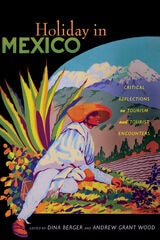
Essays feature research on prototourist American soldiers of the mid-nineteenth century, archaeologists who excavated Teotihuacán, business owners who marketed Carnival in Veracruz during the 1920s, American tourists in Mexico City who promoted goodwill during the Second World War, American retirees who settled San Miguel de Allende, restaurateurs who created an “authentic” cuisine of Central Mexico, indigenous market vendors of Oaxaca who shaped the local tourist identity, Mayan service workers who migrated to work in Cancun hotels, and local officials who vied to develop the next “it” spot in Tijuana and Cabo San Lucas. Including insightful studies on food, labor, art, diplomacy, business, and politics, this collection illuminates the many processes and individuals that constitute the tourism industry. Holiday in Mexico shows tourism to be a complicated set of interactions and outcomes that reveal much about the nature of economic, social, cultural, and environmental change in Greater Mexico over the past two centuries.
Contributors. Dina Berger, Andrea Boardman, Christina Bueno, M. Bianet Castellanos, Mary K. Coffey, Lisa Pinley Covert, Barbara Kastelein, Jeffrey Pilcher, Andrew Sackett, Alex Saragoza, Eric M. Schantz, Andrew Grant Wood
Hollow and Home
A History of Self and PlaceE. Fred Carlisle
West Virginia University Press, 2017
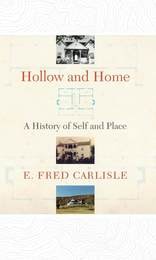
Carlisle incorporates perspectives from writers like Edward S. Casey, Christian Norberg-Schulz, Yi-Fu Tuan, and Witold Rybczynski, but he applies theory with a light touch. Placing this literature in dialog with personal experience, he concentrates on two places that profoundly influenced him and enabled him to overcome a lifelong sense of always leaving his pasts behind. The first is Clover Hollow in Appalachian Virginia, where the author lived for ten years among fifth-, sixth-, and seventh-generation residents. The people and places there enabled him to value his own past and primary places in a new way. The story then turns to Carlisle’s life growing up in Delaware, Ohio. He describes in rich detail the ways the town shaped him in both enabling and disabling ways. In the end, after years of moving from place to place, Carlisle’s experience in Appalachia helped him rediscover his hometown—both the Old Delaware, where he grew up, and the New Delaware, a larger, thriving small city—as his true home.
The themes of the book transcend specific localities and speak to the relationship of self and place everywhere.
Hollywood Asian
Philip Ahn and the Politics of Cross-Ethnic PerformanceHye Seung Chung
Temple University Press, 2006
Hollywood Diplomacy
Film Regulation, Foreign Relations, and East Asian RepresentationsHye Seung Chung
Rutgers University Press, 2020
Hollywood Exiles in Europe
The Blacklist and Cold War Film CulturePrime, Rebecca
Rutgers University Press, 2014
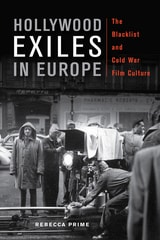
Rebecca Prime documents the untold story of the American directors, screenwriters, and actors who exiled themselves to Europe as a result of the Hollywood blacklist. During the 1950s and 1960s, these Hollywood émigrés directed, wrote, or starred in almost one hundred European productions, their contributions ranging from crime film masterpieces like Du rififi chez les hommes (1955, Jules Dassin, director) to international blockbusters like The Bridge on the RiverKwai (1957, Carl Foreman and Michael Wilson, screenwriters) and acclaimed art films like The Servant (1963, Joseph Losey, director).
At once a lively portrait of a lesser-known American “lost generation” and an examination of an important transitional moment in European cinema, the book offers a compelling argument for the significance of the blacklisted émigrés to our understanding of postwar American and European cinema and Cold War relations. Prime provides detailed accounts of the production and reception of their European films that clarify the ambivalence with which Hollywood was regarded within postwar European culture. Drawing upon extensive archival research, including previously classified material, Hollywood Exiles in Europe suggests the need to rethink our understanding of the Hollywood blacklist as a purely domestic phenomenon. By shedding new light on European cinema’s changing relationship with Hollywood, the book illuminates the postwar shift from national to transnational cinema.
Hollywood Incoherent
Narration in Seventies CinemaBy Todd Berliner
University of Texas Press, 2010
In the 1970s, Hollywood experienced a creative surge, opening a new era in American cinema with films that challenged traditional modes of storytelling. Inspired by European and Asian art cinema as well as Hollywood's own history of narrative ingenuity, directors such as Martin Scorsese, Robert Altman, William Friedkin, Stanley Kubrick, Woody Allen, and Francis Ford Coppola undermined the harmony of traditional Hollywood cinema and created some of the best movies ever to come out of the American film industry. Critics have previously viewed these films as a response to the cultural and political upheavals of the 1970s, but until now no one has explored how the period's inventive narrative design represents one of the great artistic accomplishments of American cinema.
In Hollywood Incoherent, Todd Berliner offers the first thorough analysis of the narrative and stylistic innovations of seventies cinema and its influence on contemporary American filmmaking. He examines not just formally eccentric films—Nashville; Taxi Driver; A Clockwork Orange; The Godfather, Part II; and the films of John Cassavetes—but also mainstream commercial films, including The Exorcist, The Godfather, The French Connection, Willy Wonka and the Chocolate Factory, Dog Day Afternoon, Chinatown, The Bad News Bears, Patton, All the President's Men, Annie Hall, and many others. With persuasive revisionist analyses, Berliner demonstrates the centrality of this period to the history of Hollywood's formal development, showing how seventies films represent the key turning point between the storytelling modes of the studio era and those of modern American cinema.

Hollywood Independents
The Postwar Talent TakeoverDenise Mann
University of Minnesota Press, 2008
Hollywood Independents explores the crucial period from 1948 to 1962 when independent film producers first became key components of the modern corporate entertainment industry. Denise Mann examines the impact of the radically changed filmmaking climate—the decline of the studios, the rise of television, and the rise of potent talent agencies like MCA—on a group of prominent talent-turned-producers including Burt Lancaster, Joseph Mankiewicz, Elia Kazan, and Billy Wilder.
In order to show how these newly independent filmmakers negotiated through an increasingly fraught, reactionary creative atmosphere, Mann analyzes the reflexive portraits of their altered working conditions in such films as A Face in the Crowd, Sweet Smell of Success, and Will Success Spoil Rock Hunter? These artists, she shows, took on the corporate middle-managers at television networks and talent agencies as a way of challenging the status quo without risking censorship or blacklisting.
This period saw the evolution of film production from the studio-governed system to one of entrepreneurs. Out of this new arrangement, which encouraged greater creative freedom, emerged a nascent form of independent art cinema that sowed the seeds of the Hollywood Renaissance that followed.
Denise Mann is associate professor of film, TV and digital media at UCLA. She is coeditor of Private Screenings: Television and the Female Consumer (Minnesota, 1992).
Hollywood Modernism
Film & Politics In Age Of New DealSaverio Giovacchini
Temple University Press, 2001
Seeing Hollywood as a forcefield, Giovacchini examines the social networks, working relationships, and political activities of artists, intellectuals, and film workers who flocked to Hollywood from Europe and the eastern United States before and during the second world war. He creates a complex and nuanced portrait of this milieu, adding breadth and depth to the conventional view of the era's film industry as little more than an empire for Jewish moguls or the major studios. In his rendering Hollywood's newcomers joined with its established elite to develop a modernist aesthetic for film that would bridge popular and avant-garde sensibilities; for them, realism was the most effective vehicle for conveying their message and involving a mass audience in the democratic struggle for process.
Hollywood Outsiders
The Adaptation of the Film Industry, 1913-1934Anne Morey
University of Minnesota Press, 2003
An innovative approach to the relationship between filmmaking and society during Hollywood’s golden age
The 1910s and 1920s witnessed the inception of a particular brand of negotiation between filmdom and its public in the United States. Hollywood, its proponents, and its critics sought to establish new connections between audience and industry, suggesting means by which Hollywood outsiders could become insiders. Hollywood Outsiders looks at how four disparate entities—the Palmer Photoplay correspondence school of screenwriting, juvenile series fiction about youngsters involved in the film industry, film appreciation and character education programs for high school students, and Catholic and Protestant efforts to use and influence filmmaking—conceived of these connections, and thus of the relationship of Hollywood to the individual and society. Anne Morey’s exploration of the diverse discourses generated by these different conjunctions leads to a fresh and compelling interpretation of Hollywood’s place in American cultural history.
In its analysis of how four distinct groups, each addressing constituencies of various ages and degrees of social authority, defined their interest in the film industry, Hollywood Outsiders combines concrete discussions of cultural politics with a broader argument about how outsiders viewed the film industry as a vehicle of self-validation and of democratic ideals.
Hollywood Renegade
Elaine May, Mikey and Nicky, and the Making of a MasterpieceTodd Berliner
University of Texas Press, 2026
Examines the career and unorthodox filmmaking practices of director Elaine May, whose Mikey and Nicky, over a span of fifty years, transformed from a fiasco to a masterpiece of seventies cinema.
Elaine May’s Mikey and Nicky stands out in the history of Hollywood. After a troubled production, massive cost overruns, and lawsuits between May and the studio, the film received scathing reviews and failed at the box office. But the very qualities that initially alienated viewers and reviewers led later generations to regard the film as an overlooked masterpiece.
Written and directed by the period’s only female New Hollywood filmmaker, Mikey and Nicky has not received the attention given to other unconventional films of the 1970s. But May worked for years to give each moment of the movie multiple areas of interest. She made every character, even peripheral ones, nuanced and memorable. And she designed every scene, even minor ones, as a performance event. Her lead actors, Peter Falk and John Cassavetes, thrived under her unorthodox directing style, earning acclaim even from reviewers who hated the movie. Decades in the making—years of scriptwriting, a shoot that spanned ten months, and three years spent editing—Mikey and Nicky shows us what Hollywood cinema can accomplish when talented filmmakers challenge Hollywood’s limited notion of professionalism, rejecting the harsh time pressures of commercial filmmaking in order to get the most out of every scene.
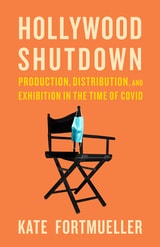
Hollywood Shutdown
Production, Distribution, and Exhibition in the Time of COVIDBy Kate Fortmueller
University of Texas Press, 2021
By March 2020, the spread of COVID-19 had reached pandemic proportions, forcing widespread shutdowns across industries, including Hollywood. Studios, networks and production companies, and the thousands of workers who make film and television possible, were forced to adjust their time-honored business and labor practices. In this book, Kate Fortmueller asks what happened when the coronavirus closed Hollywood.
Hollywood Shutdown examines how the COVID-19 pandemic affected film and television production, influenced trends in distribution, reshaped theatrical exhibition, and altered labor practices. From January movie theater closures in China to the bumpy September release of Mulan on the Disney+ streaming platform, Fortmueller probes various choices made by studios, networks, unions and guilds, distributors, and exhibitors during the evolving crisis. In seeking to explain what happened in the first nine months of 2020, this book also considers how the pandemic will transform Hollywood practices in the twenty-first century.
Hollywood Speaks
Deafness and the Film Entertainment IndustryJohn S. Schuchman
University of Illinois Press, 1988
a remarkable book. Schuchman's inquiry into how deafness has been treated in
movies provides us with yet another window onto social history in addition to
a fresh angle from which to view Hollywood. Moreover, he joins the ranks of
the few scholars who have made use of Hollywood studio archives."
-- Thomas Cripps, author of Slow Fade to Black: The Negro in American
Film, 1900-1942
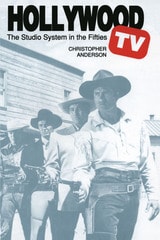
Hollywood TV
The Studio System in the FiftiesBy Christopher Anderson
University of Texas Press, 1994
The 1950s was one of the most turbulent periods in the history of motion pictures and television. During the decade, as Hollywood's most powerful studios and independent producers shifted into TV production, TV replaced film as America's principal postwar culture industry.
This pioneering study offers the first thorough exploration of the movie industry's shaping role in the development of television and its narrative forms. Drawing on the archives of Warner Bros. and David O. Selznick Productions and on interviews with participants in both industries, Christopher Anderson demonstrates how the episodic telefilm series, a clear descendant of the feature film, became and has remained the dominant narrative form in prime-time TV.
This research suggests that the postwar motion picture industry was less an empire on the verge of ruin—as common wisdom has it—than one struggling under unsettling conditions to redefine its frontiers. Beyond the obvious contribution to film and television studies, these findings add an important chapter to the study of American popular culture of the postwar period.
Hollywood Unions
Kate Fortmueller
Rutgers University Press, 2025
Hollywood and Broadcasting
From Radio to CableMichelle Hilmes
University of Illinois Press, 1990
an excellent introduction to a most important subject. This is an invaluable
work for both scholars and students that places film, radio, and television
within the context of the national culture experience."
--- American Historical Review
"Hilmes is one of the few historians
of broadcasting to move beyond a political economy of the media. . . . Her work
should serve as a model for future histories of broadcasting."
--- Journal of Communication
"All media historians will
find this work a critical addition to their bookshelves."
--- American Journalism
"A major addition to media
history literature."
--- Journalism History
Hollywood at the Intersection of Race and Identity
Delia Malia Caparoso Konzett
Rutgers University Press, 2020
Hollywood in Havana
US Cinema and Revolutionary Nationalism in Cuba before 1959Megan Feeney
University of Chicago Press, 2018
Megan Feeney argues that the freedom fighting extolled in American World War II dramas and the rebellious values and behaviors seen in postwar film noir helped condition Cuban audiences to expect and even demand purer forms of Cuban democracy and national sovereignty. At the same time, influential Cuban intellectuals worked to translate Hollywood ethics into revolutionary rhetoric—which, ironically, led to pointed critiques and subversions of the US presence in Cuba. Hollywood in Havana not only expands our notions of how American cinema was internalized around the world—it also broadens our view of the ongoing history of US-Cuban interactions, both cultural and political.
Hollywood in San Francisco
Location Shooting and the Aesthetics of Urban DeclineBy Joshua Gleich
University of Texas Press, 2018
One of the country’s most picturesque cities and conveniently located just a few hours’ drive from Hollywood, San Francisco became the most frequently and extensively filmed American city beyond the production hubs of Los Angeles and New York in the three decades after World War II. During those years, the cinematic image of the city morphed from the dreamy beauty of Vertigo to the nightmarish wasteland of Dirty Harry, although San Francisco itself experienced no such decline. This intriguing disconnect gives impetus to Hollywood in San Francisco, the most comprehensive study to date of Hollywood’s move from studio to location production in the postwar era.
In this thirty-year history of feature filmmaking in San Francisco, Joshua Gleich tracks a sea change in Hollywood production practices, as location shooting overtook studio-based filming as the dominant production method by the early 1970s. He shows how this transformation intersected with a precipitous decline in public perceptions of the American city, to which filmmakers responded by developing a stark, realist aesthetic that suited America’s growing urban pessimism and superseded a fidelity to local realities. Analyzing major films set in San Francisco, ranging from Dark Passage and Vertigo to The Conversation, The Towering Inferno, and Bullitt, as well as the TV show The Streets of San Francisco, Gleich demonstrates that the city is a physical environment used to stage urban fantasies that reveal far more about Hollywood filmmaking and American culture than they do about San Francisco.
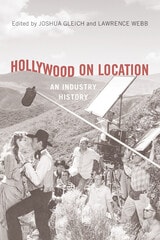
Hollywood on Location
An Industry HistoryGleich, Joshua
Rutgers University Press, 2019
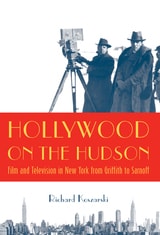
Hollywood on the Hudson
Film and Television in New York from Griffith to SarnoffKoszarski, Richard
Rutgers University Press, 2008
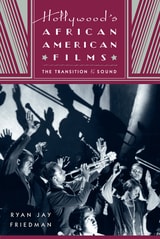
Hollywood's African American Films
The Transition to SoundRyan Friedman
Rutgers University Press, 2011
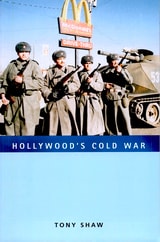
Hollywood's Cold War
Tony Shaw
University of Massachusetts Press, 2007
At a moment when American film reflects a deepening preoccupation with the Bush administration's War on Terror, this authoritative and timely book offers the first comprehensive account of Hollywood's propaganda role during the defining ideological conflict of the twentieth century: the Cold War. In an analysis of films dating from America's first Red Scare in the wake of the 1917 Bolshevik Revolution to the collapse of the Berlin Wall in 1989, Tony Shaw examines the complex relationship between filmmakers, censors, politicians, and government propagandists.
Movies, Shaw demonstrates, were at the center of the Cold War's battle for hearts and minds. Hollywood's comedies, love stories, musicals, thrillers, documentaries, and science fiction shockers played a critical dual role: on the one hand teaching millions of Americans why communism represented the greatest threat their country had ever faced, and on the other selling America's liberal-capitalist ideas around the globe. Drawing on declassified government documents, studio archives, and filmmakers' private papers, Shaw reveals the different ways in which cinematic propaganda was produced, disseminated, and received by audiences during the Cold War. In the process, he addresses subjects as diverse as women's fashions, McCarthyism, drug smuggling, Christianity, and American cultural diplomacy in India. Anyone seeking to understand wartime propaganda today will find striking contemporary resonance in his conclusions about Hollywood's versatility and power.
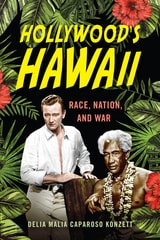
Hollywood's Hawaii
Race, Nation, and WarDelia Malia Caparoso Konzett
Rutgers University Press, 2017
Delia Malia Caparoso Konzett highlights films that mirror the cultural and political climate of the country over more than a century—from the era of U.S. imperialism on through Jim Crow racial segregation, the attack on Pearl Harbor and WWII, the civil rights movement, the contemporary articulation of consumer and leisure culture, as well as the buildup of the modern military industrial complex. Focusing on important cultural questions pertaining to race, nationhood, and war, Konzett offers a unique view of Hollywood film history produced about the national periphery for mainland U.S. audiences. Hollywood’s Hawaii presents a history of cinema that examines Hawaii and the Pacific and its representations in film in the context of colonialism, war, Orientalism, occupation, military buildup, and entertainment.
Hollywood's New Deal
Giuliana Muscio
Temple University Press, 1997
Despite the economic hardship of the thirties, people flocked to the movies in unprecedented numbers. At the same time, the Roosevelt Administration was trying to implement the New Deal and increase the influence and power of the federal government. Weaving together film and political history, Giuliana Muscio traces the connections between Depression Era Hollywood and the popularity of FDR, asserting that politics transformed its public into spectators while the movie industry transformed its spectators into a public. Hollywood's New Deal reveals the ways in which this reciprocal relationship between politics and film evolved into a strategic effort to stabilize a nation in the clutches of economic unrest by creating a unified American consciousness through national cinema.
Muscio analyzes such regulatory practices as the Hays Code, and the government's scrutinizing of monopolistic practices such as block booking and major studio ownership of movie theaters. Hollywood's New Deal, focusing on the management and structure of the film industry, delves deep into the Paramount case, detailing the behind-the-scenes negotiations and the public statements that ended with film industry leaders agreeing to self regulate and to eliminate monopolistic practices.
Hollywood's acquiescence and the government's retreat from antitrust action show that they had found a mutually beneficial way of preserving their own spheres of power and influence. This book is indispensable for understanding the growth of the film industry and the increasing political importance of mass media.
In the series Culture and the Moving Image, edited by Robert Sklar.

Hollywood's Unofficial Film Corps
American Jewish Moviemakers and the War EffortMichael Berkowitz
University of Wisconsin Press, 2025
Hollywood’s Unofficial Film Corps shows that Rosten, Schulberg, and others—including Garson Kanin, George Cukor, Stanley Kramer, and Jules Buck—created movies that were both entertaining and politically expeditious for US war aims. At the same time, in an effort to unify the American public, they avoided focusing on the fate of European Jews, even while addressing racism and antisemitism in the United States. Jewish themes were often downplayed, and Jewish directors, writers, and other contributors frequently went uncredited. As Berkowitz writes, “Rosten’s cohort changed feature films forever.” Thanks to his research, we now have a better understanding of how and why.
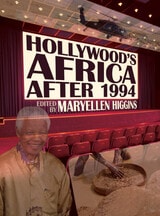
Hollywood’s Africa after 1994
MaryEllen Higgins
Ohio University Press, 2012
Hollywood’s Africa after 1994 investigates Hollywood’s colonial film legacy in the postapartheid era, and contemplates what has changed in the West’s representations of Africa. How do we read twenty-first-century projections of human rights issues—child soldiers, genocide, the exploitation of the poor by multinational corporations, dictatorial rule, truth and reconciliation—within the contexts of celebrity humanitarianism, “new” military humanitarianism, and Western support for regime change in Africa and beyond? A number of films after 1994, such as Black Hawk Down, Hotel Rwanda, Blood Diamond, The Last King of Scotland, The Constant Gardener, Shake Hands with the Devil, Tears of the Sun, and District 9, construct explicit and implicit arguments about the effects of Western intervention in Africa. Do the emphases on human rights in the films offer a poignant expression of our shared humanity? Do they echo the colonial tropes of former “civilizing missions?” Or do human rights violations operate as yet another mine of sensational images for Hollywood’s spectacular storytelling?
The volume provides analyses by academics and activists in the fields of African studies, English, film and media studies, international relations, and sociology across continents. This thoughtful and highly engaging book is a valuable resource for those who seek new and varied approaches to films about Africa.
Contributors
Harry Garuba and Natasha Himmelman
Margaret R. Higonnet, with Ethel R. Higgonet
Joyce B. Ashuntantang
Kenneth W. Harrow
Christopher Odhiambo
Ricardo Guthrie
Clifford T. Manlove
Earl Conteh-Morgan
Bennetta Jules-Rosette, J. R. Osborn, and Lea Marie Ruiz-Ade
Christopher Garland
Kimberly Nichele Brown
Jane Bryce
Iyunolu Osagie
Dayna Oscherwitz
Holocaust Education
Contemporary Challenges and ControversiesEdited by Stuart Foster, Andy Pearce, and Alice Pettigrew
University College London, 2020
Teaching and learning about the Holocaust is central to school curriculums across the globe. But the history of the Holocaust remains controversial and can render teaching it daunting, even to the most experienced instructors. Drawing on landmark research into teaching practices and students’ knowledge, Holocaust Education provides unique insights about classroom learning. It sheds light on key challenges in Holocaust education, including the impact of misconceptions and misinformation, the dilemma posed by images of atrocity, and how to approach teaching in ethnically diverse environments. Overviews of the most significant debates in Holocaust education provide wider context for the classroom evidence. Holocaust Education offers a vital guide, leading readers through some of the most vexed areas of Holocaust challenges and controversies for teachers, researchers, and policymakers.
Holocaust Graphic Narratives
Generation, Trauma, and MemoryVictoria Aarons
Rutgers University Press, 2020
Holocaust Icons
Symbolizing the Shoah in History and MemoryOren Baruch Stier
Rutgers University Press, 2015
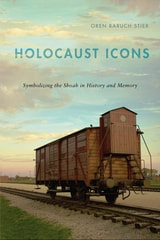
Jewish studies scholar Oren Stier offers in this volume new insight into symbols and the symbol-making process, as he traces the lives and afterlives of certain remnants of the Holocaust and their ongoing impact. Stier focuses in particular on four icons: the railway cars that carried Jews to their deaths, symbolizing the mechanics of murder; the Arbeit Macht Frei (“work makes you free”) sign over the entrance to Auschwitz, pointing to the insidious logic of the camp system; the number six million that represents an approximation of the number of Jews killed as well as mass murder more generally; and the persona of Anne Frank, associated with victimization. Stier shows how and why these icons—an object, a phrase, a number, and a person—have come to stand in for the Holocaust: where they came from and how they have been used and reproduced; how they are presently at risk from a variety of threats such as commodification; and what the future holds for the memory of the Shoah.
In illuminating these icons of the Holocaust, Stier offers valuable new perspective on one of the defining events of the twentieth century. He helps readers understand not only the Holocaust but also the profound nature of historical memory itself.
Holocaust Literature
A History and GuideDavid G. Roskies and Naomi Diamant
Brandeis University Press, 2013