Results by title
3576 books match the query 'American' and 120 start with h

Hemingway
The Writer’s Art of Self-DefenseJackson J. Benson
University of Minnesota Press, 1970
Hemingway was first published in 1970. Minnesota Archive Editions uses digital technology to make long-unavailable books once again accessible, and are published unaltered from the original University of Minnesota Press editions.
In a close critical analysis of five of Ernest Hemingway's novels and a number of his most important short stories, Professor Benson provides a fascinating new view of his work. The novels discussed are The Sun Also Rises, A Farewell to Arms, For Whom the Bell Tolls, Across the River and into the Trees,and the Old Man and the Sea.
Hemingway's art of self-defense, which Professor Benson refers to in his subtitle, was, as he demonstrates in his perceptive criticism, the writer's use of style and technique to attack the sentimentalities which were Hemingway's own weakness. Emotion was central to the task which Hemingway defined for himself, Professor Benson explains, and a critical appraisal of his work must, therefore, focus particularly on the ways in which he dealt with and expressed emotion.
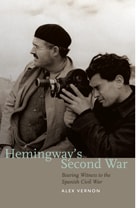
Hemingway’s Second War
Bearing Witness to the Spanish Civil WarAlex Vernon
University of Iowa Press, 2011
In 1937 and 1938, Ernest Hemingway made four trips to Spain to cover its civil war for the North American News Alliance wire service and to help create the pro-Republican documentary film The Spanish Earth. Hemingway’s Second War is the first book-length scholarly work devoted to this subject.
Hemisphere
PoemsEllen Hagan
Northwestern University Press, 2015
Winner, 2015 Seven Sisters Book Award for Poetry
The poems in Hemisphere explore what it means to be a daughter and what it means to bear new life. Ellen Hagan investigates the world historical hemispheres of a family legacy from around the globe and moves down to the most intimate hemisphere of impending motherhood. Her poems reclaim the female body from the violence, both literal and literary, done to it over the years. Hagan acknowledges the changing body of a mother from the strains of birth—from the growing body of a child, to the scars left most visibly by a C-section—as well as the changes wrought by age and, too often, abuse. The existence of a hemisphere implies a part seeking a whole, and as a collection, Hemisphere is a coherent and cogent journey toward reclamation and wholeness.
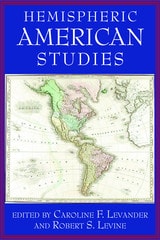
Hemispheric American Studies
Levander, Caroline F
Rutgers University Press, 2007
With essays that examine stamps, cartoons, novels, film, art, music, travel documents, and governmental publications, Hemispheric American Studies seeks to excavate the complex cultural history of texts and discourses across the ever-changing and stratified geopolitical and cultural fields that collectively comprise the American hemisphere. This collection promises to chart new directions in American literary and cultural studies.
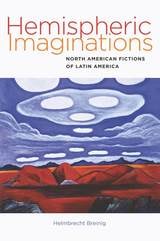
Hemispheric Imaginations
North American Fictions of Latin AmericaHelmbrecht Breinig
Dartmouth College Press, 2016
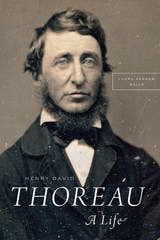
Henry David Thoreau
A LifeLaura Dassow Walls
University of Chicago Press, 2017
But there was much more to Thoreau than his brief experiment in living at Walden Pond. A member of the vibrant intellectual circle centered on his neighbor Ralph Waldo Emerson, he was also an ardent naturalist, a manual laborer and inventor, a radical political activist, and more. Many books have taken up various aspects of Thoreau’s character and achievements, but, as Laura Dassow Walls writes, “Thoreau has never been captured between covers; he was too quixotic, mischievous, many-sided.” Two hundred years after his birth, and two generations after the last full-scale biography, Walls restores Henry David Thoreau to us in all his profound, inspiring complexity.
Walls traces the full arc of Thoreau’s life, from his early days in the intellectual hothouse of Concord, when the American experiment still felt fresh and precarious, and “America was a family affair, earned by one generation and about to pass to the next.” By the time he died in 1862, at only forty-four years of age, Thoreau had witnessed the transformation of his world from a community of farmers and artisans into a bustling, interconnected commercial nation. What did that portend for the contemplative individual and abundant, wild nature that Thoreau celebrated?
Drawing on Thoreau’s copious writings, published and unpublished, Walls presents a Thoreau vigorously alive in all his quirks and contradictions: the young man shattered by the sudden death of his brother; the ambitious Harvard College student; the ecstatic visionary who closed Walden with an account of the regenerative power of the Cosmos. We meet the man whose belief in human freedom and the value of labor made him an uncompromising abolitionist; the solitary walker who found society in nature, but also found his own nature in the society of which he was a deeply interwoven part. And, running through it all, Thoreau the passionate naturalist, who, long before the age of environmentalism, saw tragedy for future generations in the human heedlessness around him.
“The Thoreau I sought was not in any book, so I wrote this one,” says Walls. The result is a Thoreau unlike any seen since he walked the streets of Concord, a Thoreau for our time and all time.
Henry James and the Queerness of Style
Kevin Ohi
University of Minnesota Press, 2010
For Ohi, there are many elements in the style that make James’s writing queer. But if there is a thematic marker, Ohi shows through his careful engagements with these texts, it is belatedness. The recurrent concern with belatedness, Ohi explains, should be understood not psychologically but stylistically, not as confessing the sad predicament of being out of sync with one’s life but as revealing the consequences of style’s refashioning of experience. Belatedness marks life’s encounter with style, and it describes an experience not of deprivation but of the rich potentiality of the literary work that James calls “freedom.” In Ohi’s reading, belatedness is the indicator not of sublimation or repression, nor of authorial self-sacrifice, but of the potentiality of the literary—and hence of the queerness of style.
Presenting original readings of a series of late Jamesian texts, the book also represents an exciting possibility for queer theory and literary studies in the future: a renewed attention to literary form and a new sounding—energized by literary questions of style and form—of the theoretical implications of queerness.
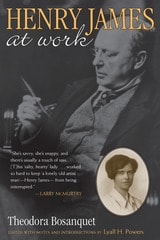
Henry James at Work
Theodora Bosanquet
University of Michigan Press, 2010
Theodora Bosanquet was Henry James's secretary from 1907 until his death in 1916, one of the most significant periods of his long writing career. Her memoir Henry James at Work, originally published by Leonard and Virginia Woolf's Hogarth Press in 1924, recounts Bosanquet's association with James and provides a lively and engaging commentary on James's milieu, preferences, and attitudes, as well as on his process of writing and revision. Bosanquet is an intelligent and observant witness and reporter, and her objective and comparatively unbiased point of view makes the memoir especially valuable.
This enlarged and annotated edition rescues Bosanquet from the shadows of literary history and shows her to be a fascinating figure in her own right, a skilled writer and editor, an early feminist, and a contemporary of the Bloomsbury literary community. The book is enhanced by an essay about Bosanquet and her circle, and fascinating snippets from her diaries and letters, now in the Harvard University archives.
Soon after Henry James hired Theodora Bosanquet in 1907, the well-educated and dedicated Bosanquet became indispensable to James. In addition to the memoir Henry James at Work she published two other books, critical studies on Harriet Martineau and Paul Valéry. Following James’s death she became Executive Secretary of the International Federation of University Women and traveled extensively in support of the women’s suffrage movement. From 1935 to 1958 she was literary editor, then director, of the publication Time and Tide.
Lyall H. Powers is Professor of English Emeritus at the University of Michigan and author of numerous books, including Alien Heart: The Life and Work of Margaret Laurence.
Praise for Henry James at Work:
—Larry McMurtry
“I’m sure [your book] ought to have a success with anyone who cared for Henry James and his work, and I think we are very lucky to get it.”
—Letter from Virginia Woolf to Theodora Bosanquet, 1924
“It's fascinating to encounter, in the era just before high modernism, a female intellectual like Bosanquet—one as fully engaged in the life of ideas and cultural production as her male counterparts—making as much of her putatively secondary status as she possibly could. The book is important as a primary document in its own right as well as a gloss on the methods and material of the magisterial James.”
—Jonathan Freedman, University of Michigan
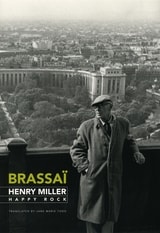
Henry Miller, Happy Rock
Brassaï
University of Chicago Press, 2002
That's Henry Miller's advice for young aspiring artists, as remembered by his very good friend Brassaï in this lively book. One of two that Brassaï wrote about the man who called himself a "happy rock," this volume covers their lives and friendship from the 1950s to 1973. Over the course of a number of warm, intimate conversations, Brassaï and Miller revisit their careers; discuss art, literature, Paris, Greece, Japan, World War II, and more; and consider the lives and works of many others in their circle, including Lawrence Durrell, Henri Matisse, Salvador Dalí, Georges Simenon, André Malraux, Hans Reichel, Paul Klee, and Amedeo Modigliani. Throughout Miller's zest for life shines through, as do his love of art and his passionate intensity for just about everything he does, from discussing a movie or play he'd just seen to reminiscing about a decades-long love.
Brassaï's Henry Miller, Happy Rock presents a vivid portrait of two close friends who thoroughly enjoy each other's company—and just happen to be world—famous artists too.
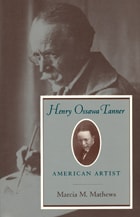
Henry Ossawa Tanner
American ArtistMarcia M. Mathews
University of Chicago Press, 1995
"[Tanner] ranks not only as the first truly distinguished Negro American artist but as one of America's first outstanding successes in the salons of Europe. In this work [Mathews] has significantly added to our knowledge of the history of American art."—John Hope Franklin, from the Foreword
"The book gives the main facts of Tanner's life and successfully places his artistic work in its historic context....It is a welcome and useful volume."—August Meier, Journal of American History
Here
Sydney Lea
Four Way Books, 2019
Here
Women Writing on Michigan's Upper PeninsulaRonald Riekki
Michigan State University Press, 2015
Heresy and the Ideal
On Contemporary PoetryDavid Baker
University of Arkansas Press, 2000
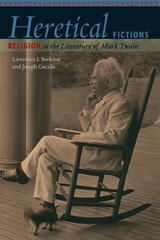
Heretical Fictions
Religion in the Literature of Mark TwainLAWRENCE I. BERKOVE
University of Iowa Press, 2010
Challenging the prevailing belief that Mark Twain’s position on religion hovered somewhere between skepticism and outright heresy, Lawrence Berkove and Joseph Csicsila marshal biographical details of Twain’s life alongside close readings of his work to explore the religious faith of America’s most beloved writer and humorist. They conclude not only that religion was an important factor in Twain’s life but also that the popular conception of Twain as agnostic, atheist, or apostate is simply wrong.
Heretical Fictions is the first full-length study to assess the importance of Twain’s heretical Calvinism as the foundation of his major works, bringing to light important thematic ties that connect the author’s early work to his high period and from there to his late work. Berkove and Csicsila set forth the main elements of Twain’s “countertheological” interpretation of Calvinism and analyze in detail the way it shapes five of his major books—Roughing It, The Adventures of Tom Sawyer, Adventures of Huckleberry Finn, A Connecticut Yankee in King Arthur's Court, and No. 44, The Mysterious Stranger—as well as some of his major short stories. The result is a ground-breaking and unconventional portrait of a seminal figure in American letters.
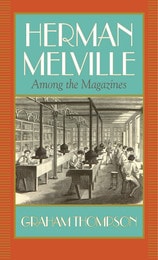
Herman Melville
Among the MagazinesGraham Thompson
University of Massachusetts Press, 2018
What I feel most moved to write, that is banned,—it will not pay. Yet, altogether, write the other way I cannot. Herman Melville wrote these words as he struggled to survive as a failing novelist. Between 1853 and 1856, he did write “the other way,” working exclusively for magazines. He earned more money from his stories than from the combined sales of his most well known novels, Moby-Dick, Pierre, and The Confidence-Man.
In Herman Melville Graham Thompson examines the author's magazine work in its original publication context, including stories that became classics, such as “Bartelby, the Scrivener” and “Benito Cereno,” alongside lesser-known work. Using a concept he calls “embedded authorship,” Thompson explores what it meant to be a magazine writer in the 1850s and discovers a new Melville enmeshed with forgotten materials, editors, writers, and literary traditions. He reveals how Melville responded to the practical demands of magazine writing with dazzling displays of innovation that reinvented magazine traditions and helped create the modern short story.
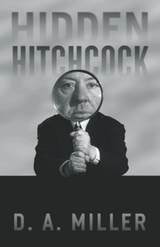
Hidden Hitchcock
D. A. Miller
University of Chicago Press, 2016
Focusing on three films—Strangers on a Train, Rope, and The Wrong Man—Miller shows how Hitchcock anticipates, even demands a “Too-Close Viewer.” Dwelling within us all and vigilant even when everything appears to be in good order, this Too-Close Viewer attempts to see more than the director points out, to expand the space of the film and the duration of the viewing experience. And, thanks to Hidden Hitchcock, that obsessive attention is rewarded. In Hitchcock’s visual puns, his so-called continuity errors, and his hidden appearances (not to be confused with his cameos), Miller finds wellsprings of enigma.
Hidden Hitchcock is a revelatory work that not only shows how little we know this best known of filmmakers, but also how near such too-close viewing comes to cinephilic madness.

Hide and Seek
The Child between Psychoanalysis and FictionVirginia L. Blum
University of Illinois Press, 1995
Concentrating on the "go-between" function of the child in nineteenth- and twentieth-century American and British fiction, Virginia Blum shows how selected children in the works of L. P. Hartley, Charles Dickens, Henry James, and Vladimir Nabokov were actually fictional messengers who ultimately were unsuccessful at reconciling impasses in the adult world.
Throughout her book Blum draws on pop images of real and fictional children, ranging from the Baby Jessica case, in which the idea of "real" paternity and family bonds comes to the mythic fore, to the film Home Alone, in which the abandoned child becomes protector of his family's hearth and home. Hide and Seek raises provocative questions about the ways in which our culture fetishizes the idea of the child at the same time that we treat with comparative indifference the conditions under which many real children actually live.
"A work of striking originality and consistent intellectual honesty, forcing us into genuinely profound and darkly uncomfortable areas of speculation." -- James R. Kincaid, author of Child-Loving: The Erotic Child and Victorian
Culture
Highlights in the History of the American Press
A Book of ReadingsEdwin H. Ford and Edwin Emery, Editors
University of Minnesota Press, 1954
Highlights in the History of the American Press was first published in 1954. Minnesota Archive Editions uses digital technology to make long-unavailable books once again accessible, and are published unaltered from the original University of Minnesota Press editions.
The articles collected in this volume present a vivid panorama of American journalistic history from its antecedents in the English ballad singers to the press giants of modern times. Since there is probably no single force that has played a greater role in the history of America than its newspapers, the history of journalism tells, in large measure, the story of this country's political, social, and economic development. Therefore, this book of readings offers much to the students of the American scene, past and present, whether they are general readers or specialists in journalism, history, American studies, or any of the social sciences.
The 27 articles included here have been chosen particularly for their readability and authenticity. They are by many different writers and are from a wide variety of periodicals published over the past 100 years. They are arranged according to six historical periods, covering the rise of the English press, the Colonial press, the nationalistic press of Revolutionary times, the popular press of the Jacksonian democracy, the transition press following the Civil War, and the modern era of mass circulation. An introductory essay for each group of articles places the individual studies in historical perspective and examines briefly the journalistic events not covered in detail by the articles themselves. The article authors include such notable names in American letters as Gamaliel Bradford, Will Irwin, William Allen White, John Dos Passos, and Henry F. Pringle.
The coherent presentation of this diverse material should help anyone interested in the American newspaper get a better view of its broad scope, its lively color, and its profound influence on the course of history.
Hijra
Hala Alyan
Southern Illinois University Press, 2016
The reader sees war, diaspora, and immigration, and hears the marginalized voices of women of color. The poems use lyrical diction and striking imagery to evoke the weight of an emotional and visceral journey. They grow and build in length and form, reflecting the gains the women in the poems make in re-creating selfhood through endurance and strength.
In prose, narrative, and confessional-style poems, Alyan reflects on how physical space is refashioned, transmitted, and remembered. Her voice is distinct, fresh, relevant, and welcoming.
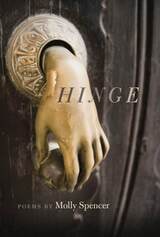
Hinge
Molly Spencer
Southern Illinois University Press, 2020
Finding joy and beauty in the face of suffering
Readers enter “a stunted world,” where landmarks—a river, a house, a woman’s own body—have become unrecognizable in a place as distorted and dangerous as any of the old tales poet Molly Spencer remasters in this elegant, mournful collection. In myth and memory, through familiar stories reimagined, she constructs poetry for anyone who has ever stumbled, unwillingly, into a wilderness. In these alluring poems, myth becomes part of the arsenal used to confront the flaws and failures of our fallible bodies. Shadowing the trajectory of an elegy, this poetry collection of lament, remembrance, and solace wrestles with how we come to terms with suffering while still finding joy, meaning, and beauty.
Spencer alternates between the clinical and the domestic, disorientation and reorientation, awe and awareness. With the onset of a painful chronic illness, the body and mental geography turn hostile and alien. In loss and grief, in physical and psychological landscapes, Spencer searches the relationship between a woman’s body and her house—places where she is both master and captive—and hunts for the meaning of suffering. Finally, with begrudging acceptance, we have a hypothesis for all seasons: there is suffering, there is mercy; they are not separate but are for and of one another.
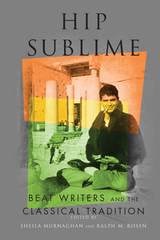
Hip Sublime
Beat Writers and the Classical TraditionEdited by Sheila Murnaghan and Ralph M. Rosen
The Ohio State University Press, 2018
In this volume, a diverse group of contributors explore for the first time the fascinating tensions and paradoxes that arose from interactions between these avant-garde writers and a literary tradition often seen as conservative and culturally hegemonic. With essays that cover the canonical Beat authors—such as Allen Ginsberg, Jack Kerouac, and William Burroughs—along with less well-known figures—including Kenneth Rexroth, Ed Sanders, and Diane di Prima—Hip Sublime: Beat Writers and the Classical Tradition brings long overdue attention to the Beat movement’s formative appropriation of the Greek and Latin classics.
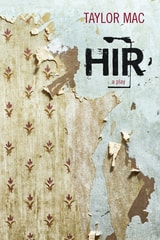
Hir
A PlayTaylor Mac
Northwestern University Press, 2015
Finalist, 2015 Lambda Literary Award for LGBT Drama
Discharged from the Marines under suspicious circumstances, Isaac comes home from the wars, only to find the life he remembers upended. Isaac’s father, who once ruled the family with an iron fist, has had a debilitating stroke; his younger sister, Maxine, is now his brother, Max; and their mother, Paige, is committed to revolution at any cost. Determined to be free of any responsibility toward her formerly abusive husband—or the home he created—Paige fervently believes she can lead the way to a "new world order." Hir, Taylor Mac’s subversive comedy, leaves many of our so-called normative and progressive ideas about gender, families, the middle class—and cleaning—in hilarious and ultimately tragic disarray.

Hired Pens
Professional Writers in America’s Golden Age of PrintRonald Weber
Ohio University Press, 1997
Just as mass-market magazines and cheap books have played important roles in the creation of an American identity, those skilled craftsmen (and women) whose careers are the subjects of Ronald Weber’s narrative profoundly influenced the outlook and strategies of the high-culture writers who are generally the focus of literary studies.
Hired Pens, a history of the writing profession in the United States, recognizes the place of independent writers who wrote for their livelihood from the 1830s and 1840s, with the first appearance of a broad-based print culture, to the 1960s.
Many realist authors began on this American Grub Street. Jack London turned out hackwork for any paying market he could find, while Scott Fitzgerald’s stories in slick magazines in the 1920s and early ’30s established his name as a writer.
From Edgar Allen Poe’s earliest forays into writing for pay to Sylvia Plath’s attempts to produce fiction for mass-circulation journals, Hired Pens documents without agenda the evolution of professional writing in all its permutations—travel accounts, sport, popular biography and history, genre and series fiction—and the culture it fed.
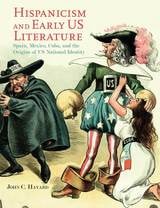
Hispanicism and Early US Literature
Spain, Mexico, Cuba, and the Origins of US National IdentityJohn C. Havard
University of Alabama Press, 2018
Revealing how Spain, Mexico, and Cuba helped shape the literary origins of American national identity.
In Hispanicism and Early US Literature, author John C. Havard posits that representations of Spain, Spanish America, Spanishness, and Spanish Americanness are integral elements in the evolution of early national and antebellum US literature. He argues that Spanish-speaking countries have long held a broad fascination for Americans and that stock narratives regarding these peoples were central to the period’s US literature.
Beginning with the work of eighteenth-century literary nationalists such as Joel Barlow, US literature has been drawn to reflect on Spain and Spanish America. Such reflection was often inspired by geopolitical conflicts such as US expansion into Spanish Louisiana and the US-Mexican War. Havard terms the discourse emerging from these reflections “Hispanicism.” This discourse was used to portray the dominant viewpoint of classical liberalism that propounded an American exceptionalism premised on the idea that Hispanophone peoples were comparatively lacking the capacity for self-determination, hence rationalizing imperialism. On the conservative side were warnings against progress through conquest.
Havard delves into selected works of early national and antebellum literature on Spain and Spanish America to illuminate US national identity. Poetry and novels by Joel Barlow, James Fenimore Cooper, and Herman Melville are mined to further his arguments regarding identity, liberalism, and conservatism. Understudied authors Mary Peabody Mann and José Antonio Saco are held up to contrast American and Cuban views on Hispanicism and Cuban annexation as well as to develop the focus on nationality and ideology via differences in views on liberalism.
More than just a work of literary criticism, there is a substantial amount of cultural and political history discussed. Havard’s use of archival sources such as political articles and personal correspondence elucidates not just literary genres and movements such as early national epic poetry, abolitionist fiction, and the American Renaissance, but also US prominent culture.
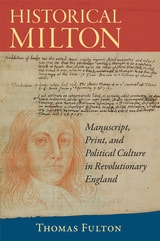
Historical Milton
Manuscript, Print, and Political Culture in Revolutionary EnglandThomas Fulton
University of Massachusetts Press, 2010
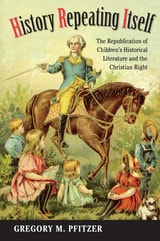
History Repeating Itself
The Republication of Children's Historical Literature and the Christian RightGregory M. Pfitzer
University of Massachusetts Press, 2014
Recently publishers on the Christian Right have been reprinting nineteenth-century children's history books and marketing them to parents as “anchor texts” for homeschool instruction. Why, Gregory M. Pfitzer asks, would books written more than 150 years ago be presumed suitable for educating twenty-first-century children? The answer, he proposes, is that promoters of these recycled works believe that history as a discipline took a wrong turn in the early twentieth century, when progressive educators introduced social studies methodologies into public school history classrooms, foisting upon unsuspecting and vulnerable children ideologically distorted history books.
In History Repeating Itself, Pfitzer tests these assertions by scrutinizing and contextualizing the original nineteenth-century texts on which these republications are based. He focuses on how the writers borrowed from one another to produce works that were similar in many ways yet differed markedly in terms of pedagogical strategy and philosophy of history. Pfitzer demonstrates that far from being non-ideological, these works were rooted in intense contemporary debates over changing conceptions of childhood.
Pfitzer argues that the repurposing of antiquated texts reveals a misplaced resistance to the idea of a contested past. He also raises essential philosophical questions about how and why curricular decisions are shaped by the “past we choose to remember” on behalf of our children.
History of Hurricanes
PoemsTeresa Cader
Northwestern University Press, 2009
In her third collection of poems, Teresa Cader spins a complete universe of lyrical, probing verse that reaches out to readers and invites them to come inside. These poems deal with love and loss in particularly striking ways, as Cader uses rigorously controlled verse to express chaotic emotion. Stylistically adventurous, her work moves gracefully from intricate, slant-rhymed couplets to elliptical, lanky free verse. Geographically, she takes readers on a ride with stops in Kraków’s rock clubs, colonial New England’s sites, and shrines of contemporary Japan. The shadow of death, especially the loss of Cader’s mother, falls across many of her poems, but her verse reacts viscerally to such events, her emotion resounding out from each line to move through pain or desire.
History, Memory, and the Literary Left
Modern American Poetry, 1935-1968John Lowney
University of Iowa Press, 2006
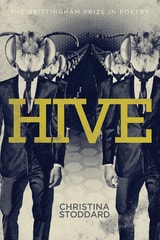
Hive
Christina Stoddard
University of Wisconsin Press, 2015
Winner, Poetry, Association for Mormon Letters Awards
Finalist, da Vinci Eye Book Design Award
Finalist, Washington State Book Award for Poetry, Washington Center for the Book
Hobomok and Other Writings on Indians
Karcher, Carolyn L
Rutgers University Press, 1986
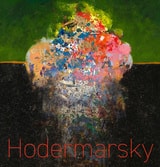
Hodermarsky
Daniel Hodermarsky
The Artist Book Foundation, 2024
Daniel Hodermarsky's work embraces both the representational and the abstract, reflecting the intricate spaces of both his psyche and shared human experience.
Daniel Hodermarsky was the son of Slovak immigrants who emigrated from Hačava to settle and work in the coal fields of Pennsylvania and later in the auto-manufacturing industries of Ohio. He served in World War II on the Western front and was awarded two presidential citations, two Croix de Guerre, and one combat star. He returned home with severe and persistent post-traumatic stress disorder that left an indelible mark on his life and art.
Throughout his career, Hodermarsky’s work embraced both the representational and the abstract. His early works experimented with new media (such as Dayglo paint) and new styles such as Op Art and performance. In the 1970s and beyond, he engaged landscape—rural, urban, and imaginary—wherein he explored the interplay of terrain (land or water, horizon, and sky). The human figure—Slovak farmers, wounded or dismembered soldiers, and mythical and historical figures—were among his favorite subjects. He was fascinated by how age, human nature, and personality combine to create the physical form. His eclectic themes mirror his own unique complexities and experiences. Later in his career, he focused on abstract works that reflect the intricate spaces of both his psyche and shared human experience.
A deeply spiritual man with a strong religious faith, Hodermarsky’s abstract paintings ask the existential questions that have challenged humankind across millennia. By showing us his own experience of these great mysteries, his art underscores life’s abiding beauty. Over his long career of interpreting the world in which he lived, Hodermarsky invites us to inhabit a realm filled with joy, reverence, and passion.
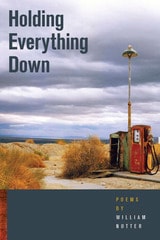
Holding Everything Down
William Notter
Southern Illinois University Press, 2009
William Notter’s stunning collection Holding Everything Down explores the everyday struggles, triumphs, and desires of rural Americans. With disarming humor and remarkable honesty, Notter delves into the most personal longings of those who inhabit America’s countrysides: places bound by secrets and ghosts, where joy is discovered in the most unlikely of locations, and even the land itself has a story to tell. These highly accessible poems traverse the world of weekend rodeos, lonely highways, and windswept battlefields; they follow the twin paths of addiction and obsession, and the trials of newfound sobriety. Connections are forged beneath weathered ceilings, and love can be found over a plate of barbecue. Also explored are the depths of humanity’s relationship with nature and freedom, be it the smell of freshly threshed wheat, the purple thunderheads of an approaching storm, or a sunset viewed from Mississippi’s highest peak.
From the muddy deltas of the deep South to the crags of the Big Horn Mountains, Notter’s deeply candid portraits transcend stereotypes to expose an often unseen side of Americana. Hairdresser or handyman, rodeo rider or rancher’s wife, each voice ultimately echoes with the most human of experiences, unveiling the common threads that bind us to our world and to each other.
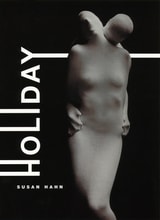
Holiday
Susan Hahn
University of Chicago Press, 2001
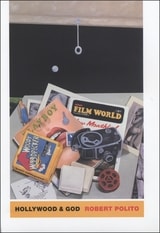
Hollywood & God
Robert Polito
University of Chicago Press, 2009
Hollywood & God is a virtuosic performance, filled with crossings back and forth from cinematic chiaroscuro to a kind of unsettling desperation and disturbing—even lurid—hallucination. From the Baltimore Catechism to the great noir films of the last century to today’s Elvis impersonators and Paris Hilton (an impersonator of a different sort), Robert Polito tracks the snares, abrasions, and hijinks of personal identities in our society of the spectacle, a place where who we say we are, and who (we think) we think we are fade in and out of consciousness, like flickers of light dancing tantalizingly on the silver screen. Mixing lyric and essay, collage and narrative, memoir and invention, Hollywood & God is an audacious book, as contemporary as it is historical, as sly and witty as it is devastatingly serious.
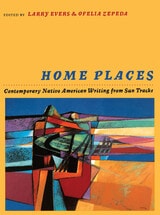
Home Places
Contemporary Native American Writing from Sun TracksEdited by Larry Evers and Ofelia Zepeda
University of Arizona Press, 1995
Some are stories from oral traditions, others are autobiographical writings, and some are songs or poems. But all are contemporary, and all have as a unifying element a strong central theme in Native American writing: home places. Some of the contributors define the home place as a center of established values, while others speak of its cultural or physical geography. Healing powers are often found at home places. Home is a place to defend against those who would reduce it to insignificance, a place to reclaim, or a place reclaimed but not yet realized.
One writer recalls a home that must be pulled from deep beneath the waters of the Columbia River. By listening to these stories of home places, the reader can gain a new appreciation of the contemporary verbal expressions of Native American communities. Home Places, note the editors, "asks you to listen to Native American signers, storytellers, and writers, and in this way to celebrate the wellsprings of creativity that continue to flow from the home places in Native America."

Homemade
Finnish Rye, Feed Sack Fashion, and Other Simple Ingredients from My Life in FoodBeatrice Ojakangas
University of Minnesota Press, 2018
Beatrice Ojakangas, the oldest of ten children, came by it naturally—the cooking but also the pluck and perseverance that she's served up with her renowned Scandinavian dishes over the years. In the wake of the Moose Lake fires and famine of 1918, Ojakangas tells us in this delightful memoir-cum-cookbook, her grandfather sent for a Finnish mail-order bride—and got one who’d trained as a chef.
Ojakangas’s stories, are, unsurprisingly, steeped in food lore: tales of cardamom and rye, baking salt cake at the age of five on a wood-burning stove, growing up on venison, making egg rolls for Chun King, and sending off a Pillsbury Bake Off–winning recipe without ever making it. And from here, how those early roots flourished through hard work and dedication to a successful (but never easy) career in food writing and a much wider world, from working for pizza roll king Jeno Paulucci to researching food traditions in Finland and appearing with Julia Child and Martha Stewart—all without ever leaving behind the lessons learned on the farm. As she says, “first you have to start with good ingredients and a good idea.”
Chock-full of recipes, anecdotes, and a kind humor that bring to vivid life the Finnish culture of northern Minnesota as well as the wider culinary world, Homemade delivers the savory and the sweet in equal measures and casts a warm light on a rich slice of the country’s cooking heritage.
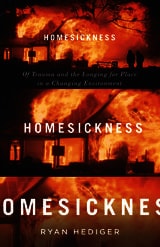
Homesickness
Of Trauma and the Longing for Place in a Changing EnvironmentRyan Hediger
University of Minnesota Press, 2019
Introducing a posthumanist concept of nostalgia to analyze steadily widening themes of animality, home, travel, slavery, shopping, and war in U.S. literature after 1945
In the Anthropocene, as climate change renders environments less stable, the human desire for place underscores the weakness of the individual in the face of the world. In this book, Ryan Hediger introduces a distinctive notion of homesickness, one in which the longing for place demonstrates not only human vulnerability but also intersubjectivity beyond the human. Arguing that this feeling is unavoidable and characteristically posthumanist, Hediger studies the complex mix of attitudes toward home, the homely, and the familiar in an age of resurgent cosmopolitanism, especially eco-cosmopolitanism.
Homesickness closely examines U.S. literature mostly after 1945, including prominent writers such as Annie Proulx, Marilynne Robinson, and Ernest Hemingway, in light of the challenges and themes of the Anthropocene. Hediger argues that our desire for home is shorthand for a set of important hopes worth defending—serious and genuine relationships to places and their biotic regimes and landforms; membership in vital cultures, human and nonhuman; resistance to capital-infused forms of globalization that flatten differences and turn life and place into mere resources. Our homesickness, according to Hediger, is inevitable because the self is necessarily constructed with reference to the material past. Therefore, homesickness is not something to dismiss as nostalgic or reactionary but is rather a structure of feeling to come to terms with and even to cultivate.
Recasting an expansive range of fields through the lens of homesickness—from ecocriticism to animal studies and disability studies, (eco)philosophy to posthumanist theory—Homesickness speaks not only to the desire for a physical structure or place but also to a wide range of longings and dislocations, including those related to subjectivity, memory, bodies, literary form, and language.
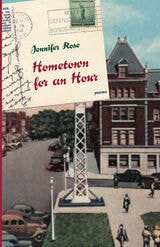
Hometown for an Hour
PoemsJennifer Rose
Ohio University Press, 2006
In her second collection of poems, Jennifer Rose writes primarily of places and displacement. Using the postcard’s conventions of brevity, immediacy, and, in some instances, humor, these poems are greetings from destinations as disparate as Cape Cod, Kentuckiana, and Croatia. Rich in imagery, deftly crafted, and imbued with a lightness of voice, these poems are also postmarked from poetry’s more familiar provinces of love, nature, and loss.
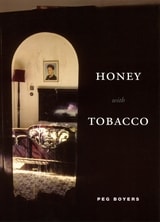
Honey with Tobacco
Peg Boyers
University of Chicago Press, 2007
Pietà
This time the migraine came with a vision
bathed in night sweat:
I was sitting on the Eames chair,
your man’s body on my lap, legs
and arms white as casein draped over
mine, spilling onto the cassock, new sores
on your legs, dried blood
on your feet and hands,
from your chalk mouth
the words forgive me,
from mine, the impossible
no
Hard Bread,Peg Boyers’s debut poetry collection, with verse spoken in the imagined voice of the Italian writer Natalia Ginzburg, was widely praised for its inspired ventriloquism and its brilliant lyricism. In Honey with Tobacco, Boyers’s own intensely personal voice emerges in three strikingly distinctive variants. The first part of the book is the most explicitly autobiographical, bringing together poems that explore the poet’s Cuban American experience and a childhood marked by travel, the tropics, and varieties of disenchantment. The middle sequence of poems concerns a mother, a father, and a son, a postmodern holy family whose ordeals are evoked in a terse, terrifying narrative. In familiar tableaux drawn from the Bible that have inspired great works of art—the Annunciation, the Pieta, and Judgment Day—Boyers explores what it means in contemporary America to be “blessed among women” and whether and how art can contain grief. The final section of the book confronts age, desire, and regret in a series of personal poems that plumb baser human instincts and the speakers’ determination to dwell in darkness, when necessary, without abandoning the sacred.
Praise for Hard Bread:
“A great achievement of poetic voice . . . . It’s absolutely clear what these poems are ‘about,’ and they are unapologetic in their devotion to subject, clarity, precision, and accessibility.”—Steven Cramer, Poetry
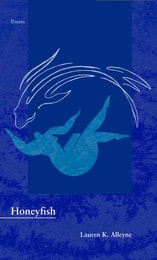
Honeyfish
Lauren K. Alleyne
New Issues Poetry and Prose, 2018
days that we want to remember. Or forget. But don’t. Thus in our
sister’s memory, we survive in the luxury of dying. The courage of
loving. The re-imagining of our souls for another generation. Thank
you, my dear sister for your words saluting our living, our lives.”
—Sonia Sanchez, winner of the 2018 Lifetime Achievement Award
from the Academy of American Poets
“In exquisitely crafted poems of heart-accelerating candor and
clarity, Lauren K. Alleyne says to all the black bodies slain by hatred
and militarized fear, ‘Nothing I say will save you, but how can I say
nothing?’ Honeyfish is an elegy for all the countless lost, and a praise
song for the many black lives that persist in their wish to give and
receive love.”
— Tracy K. Smith, Poet Laureate of the United States of America
“Even in the places we think of as most beautiful, the endless gong
of the body being broken and defiled will find us. How can we see
the sun and the ocean and the clear blue sky as anything other than
a kind of cruel joke in the face of so much suffering? The extraordinary gift of Lauren K Alleyne’s, Honeyfish is that she shows
the world in all its brutality and loss and somehow lets us mourn within the poems, which in
turn allows us to begin some kind of healing. These are poems whose elegy is ongoing, whose
elegy need never happened but for hatred. The waves go in and out and so many people keep
being killed. And here is this extraordinary poet, making a heaven that is freedom, that is the
dream of being welcomed and loved and tended to. This is a book for our times and for the
day when these times are over and we can rejoice.”
— Gabrielle Calvacoressi, author of Rocket Fantastic
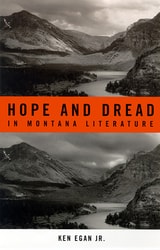
Hope And Dread In Montana Literature
Ken Egan
University of Nevada Press, 2003
This literary survey from a third-generation Montanan includes a thoughtful discussion on the now infamous events of the mid- to late-nineties. The rich literary tradition of Montana, contends author Ken Egan Jr., reflects a catastrophic vision of the West that shows the "horrors of domination" and "the foolish and destructive habits of the imperial heart." Since the 1860s, Montana’s writers have depicted struggles for survival in the state’s dramatic landscape, and for decency in a region characterized by the headlong exploitation of both natural and human resources.
Hope Isn't Stupid
Utopian Affects in Contemporary American LiteratureSean Austin Grattan
University of Iowa Press, 2017
Novelists William S. Burroughs, Dennis Cooper, John Darnielle, Toni Morrison, Thomas Pynchon, and Colson Whitehead are deeply invested in the creation of utopian possibilities. A return to reading the utopian wager in literature from the postmodern to the contemporary period reinvigorates critical forms that imagine reading as an act of communication, friendship, solace, and succor. These forms also model richer modes of belonging than the diluted and impoverished ones on display in the neoliberal present. Simultaneously, by linking utopian studies and affect studies, Grattan’s work resists the tendency for affect studies to codify around the negative, instead reorienting the field around the messy, rich, vibrant, and ambivalent affective possibilities of the world. Hope Isn’t Stupid insists on the centrality of utopia not only in American literature, but in American life as well.
Horizon Note
Robin Behn
University of Wisconsin Press, 2001
A son is born too early, as if coming up over the horizon before his own dawn. An elderly father lingers at life’s other horizon. In language dense and clear, playful and somber, and with a formal exactitude and emotional amplitude suggestive of her own musical training, Behn traverses these horizons “extracting,” like the horizon note that drones through traditional Indian music, “a red needle from the sky.”
Horrors of Slavery
Or, The American Tars in TripoliBlum, Hester
Rutgers University Press, 2008
Hester Blum's introduction situates Horrors of Slavery in its literary, historical, and political contexts, bringing to light a crucial episode in the early history of our country's relations with Islamic states.
A volume in the Subterranean Lives series, edited by Bradford Verter

Host
Lisa Fay Coutley
University of Wisconsin Press, 2024
light can pour warm through a cold bay
window while water under sun is dark
as a closed door. A man’s hand
erases a girl’s thigh. The trees start starving
themselves into everyone’s favorite color.
Her darkest room digs itself
below her throne. The body knows no
wrong move. The more love, the more.
—Excerpt from “Oubliette”
Hot Music, Ragmentation, and the Bluing of American Literature
Steven C. Tracy
University of Alabama Press, 2015
Exploring the deep and enduring relationship between music and literature, Hot Music, Ragmentation, and the Bluing of American Literature examines the diverse ways in which African American “hot” music influenced American culture—particularly literature—in early twentieth century America. Steven C. Tracy provides a history of the fusion of African and European elements that formed African American “hot” music, and considers how terms like ragtime, jazz, and blues developed their own particular meanings for American music and society. He draws from the fields of literature, literary criticism, cultural anthropology, American studies, and folklore to demonstrate how blues as a musical and poetic form has been a critical influence on American literature.
Hot Music, Ragmentation, and the Bluing of American Literature begins by highlighting instances in which American writers, including Herman Melville, Stephen Crane, and Gertrude Stein, use African American culture and music in their work, and then characterizes the social context of the Jazz Age, discussing how African American music reflected the wild abandon of the time. Tracy focuses on how a variety of schools of early twentieth century writers, from modernists to members of the Harlem Renaissance to dramatists and more, used their connections with “hot” music to give their own work meaning.
Tracy’s extensive and detailed understanding of how African American “hot” music operates has produced a fresh and original perspective on its influence on mainstream American literature and culture. An experienced blues musician himself, Tracy draws on his performance background to offer an added dimension to his analysis. Where another blues scholar might only analyze blues language, Tracy shows how the language is actually performed.
Hot Music, Ragmentation, and the Bluing of American Literature is the first book to offer such a refreshingly broad interdisciplinary vision of the influence of African American “hot” music on American literature. It is an essential addition to the library of serious scholars of American and African American literature and culture and blues aficionados alike.
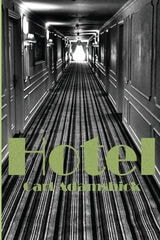
Hotel
Carl Adamshick
Four Way Books, 2021
Adamshick’s poems are characteristically accessible and navigable. From the political to the erotic and everywhere in between, these poems take us on a sometimes sober, sometimes raunchy ride.

Hotel Malabar
Brendan Galvin
University of Iowa Press, 1998
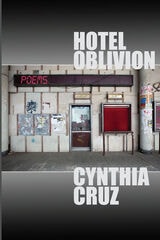
Hotel Oblivion
Cynthia Cruz
Four Way Books, 2022
A specter, haunting the edges of society: because neoliberalism insists there are no social classes, thus, there is no working class, the main subject of Hotel Oblivion, a working class subject, does not exist. With no access to a past, she has no home, no history, no memory. And yet, despite all this, she will not assimilate. Instead, this book chronicles the subject’s repeated attempts at locating an exit from capitalist society via acts of negative freedom and through engagement with the death drive, whose aim is complete destruction in order to begin all over again. In the end, of course, the only true exit and only possibility for emancipation for the working class subject is through a return to one’s self. In Hotel Oblivion, through a series of fragments and interrelated poems, Cruz resists invisibilizing forces, undergoing numerous attempts at transfiguration in a concerted effort to escape her fate.
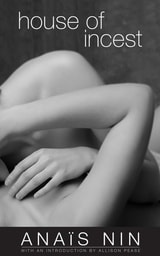
House Of Incest
Anaïs Nin
Ohio University Press, 1958
With an introduction by Allison Pease, this new edition of House of Incest is a lyrical journey into the subconscious mind of one of the most celebrated feminist writers of the twentieth-century.
Originally published in 1936, House of Incest is Anaïs Nin’s first work of fiction. Based on Nin’s dreams, the novel is a surrealistic look within the narrator’s subconscious as she attempts to distance herself from a series of all-consuming and often taboo desires she cannot bear to let go. The incest Nin depicts is a metaphor—a selfish love wherein a woman can appreciate only qualities in a lover that are similar to her own. Through a descriptive exploration of romances and attractions between women, between a sister and her beloved brother, and with a Christ-like man, Nin’s narrator discovers what she thinks is truth: that a woman’s most perfect love is of herself. At first, this self-love seems ideal because it is attainable without fear and risk of heartbreak. But in time, the narrator’s chosen isolation and self-possessed anguish give way to a visceral nightmare from which she is unable to wake.