Results by title
22279 books match the query 'Social Science' and 635 start with h

Handbook of Medical Sociology, Sixth Edition
Chloe E. Bird
Vanderbilt University Press, 2010
• social networks, neighborhoods, and social capital
• disability
• dying and "the right to die"
• health disparities
• the growing influence of the pharmaceutical industry
• the Internet
• evidence-based medicine and quality of care
• health social movements
• genetics
• religion, spirituality, and health
Handbook of Middle American Indians, Volume 12
Guide to Ethnohistorical Sources, Part OneRobert Wauchope, series editor; Howard F. Cline, volume editor
University of Texas Press, 1972
Guide to Ethnohistorical Sources comprises Volumes 12 through 15 of the Handbook of Middle American Indians, published in cooperation with the Middle American Research Institute of Tulane University under the general editorship of Robert Wauchope (1909–1979). The Guide has been assembled under the volume editorship of the late Howard F. Cline, Director of the Hispanic Foundation in the Library of Congress, with Charles Gibson, John B. Glass, and H. B. Nicholson as associate volume editors. It covers geography and ethnogeography, especially the Relaciones Geográficas (Volume 12); sources in the European tradition: printed collections, secular and religious chroniclers, biobibliographies (Volume 13); sources in the native tradition: prose and pictorial materials, checklist of repositories, title and synonymy index, and annotated bibliography on native sources (Volumes 14 and 15).
Volume 12, which is Part One of the Guide, contains the following: “Introduction: Reflections on Ethnohistory,” “Introductory Notes on Territorial Divisions of Middle America,” “Viceroyalty to Republics, 1786–1952: Historical Notes on the Evolution of Middle American Political Units,” “Ethnohistorical Regions of Middle America,” “The Relaciones Geográficas of the Spanish Indies, 1577–1648,” “A Census of the Relaciones Geográficas of New Spain, 1579–1616,” and “The Relaciones Geográficas of Spain, New Spain, and the Spanish Indies: An Annotated Bibliography,” all the foregoing by Howard F. Cline. In addition it includes: “Colonial New Spain, 1519–1786: Historical Notes on the Evolution of Minor Political Jurisdictions” by Peter Gerhard; “The Pinturas (Maps) of the Relaciones Geográficas, with a Catalog” by Donald Robertson; “The Relaciones Geográficas, 1579–1586: Native Languages” by H. R. Harvey; and “The Relaciones Geográficas of Mexico and Central America, 1740–1792” by Robert C. West.
The Handbook of Middle American Indians was assembled and edited at the Middle American Research Institute of Tulane University with the assistance of grants from the National Science Foundation and under the sponsorship of the National Research Council Committee on Latin American Anthropology.
Handbook of Middle American Indians, Volume 13
Guide to Ethnohistorical Sources, Part TwoRobert Wauchope, series editor; Howard F. Cline, volume editor,; John B. Glass, assoc vol. ed.
University of Texas Press, 1973
Volume 13 of the Handbook of Middle American Indians, published in cooperation with the Middle American Research Institute of Tulane University under the general editorship of Robert Wauchope (1909–1979), constitutes Part 2 of the Guide to Ethnohistorical Sources. The Guide has been assembled under the volume editorship of the late Howard F. Cline, Director of the Hispanic Foundation in the Library of Congress, with Charles Gibson, John B. Glass, and H. B. Nicholson as associate volume editors. It covers geography and ethnogeography (Volume 12); sources in the European tradition (Volume 13); and sources in the native tradition (Volumes 14 and 15).
The present volume contains the following studies on sources in the European tradition:
- “Published Collections of Documents Relating
- to Middle American Ethnohistory,” by Charles Gibson
- “An Introductory Survey of Secular Writings in the European Tradition on Colonial Middle America, 1503–1818,” by J. Benedict Warren
- “Religious Chroniclers and Historians: A Summary with Annotated Bibliography,” by Ernest J.
- Burrus, S.J.
- “Bernardino de Sahagún,” by Luis Nicolau d’Olwer, Howard F. Cline, and H. B. Nicholson
- “Antonio de Herrera,” by Manuel Ballesteros Gaibrois
- “Juan de Torquemada,” by José Alcina Franch
- “Francisco Javier Clavigero,” by Charles E. Ronan, S.J.
- “Charles Etienne Brasseur de Bourbourg,” by Carroll Edward Mace
- “Hubert Howe Bancroft,” by Howard F. Cline
- “Eduard Georg Seler,” by H. B. Nicholson
- “Selected
The Handbook of Middle American Indians was assembled and edited at the Middle American Research Institute of Tulane University with the assistance of grants from the National Science Foundation and under the sponsorship of the National Research Council Committee on Latin American Anthropology.
Handbook of Middle American Indians, Volume 16
Sources Cited and Artifacts IllustratedRobert Wauchope, series editor; Margaret A.L. Harrison, volume editor
University of Texas Press, 1976
The publication of Volume 16 of this distinguished series brings to a close one of the largest research and documentation projects ever undertaken on the Middle American Indians.
Since the publication of Volume 1 in 1964, the Handbook of Middle American Indians has provided the most complete information on every aspect of indigenous culture, including natural environment, archaeology, linguistics, social anthropology, physical anthropology, ethnology, and ethnohistory.
Culminating this massive project is Volume 16, divided into two parts. Part I, Sources Cited, by Margaret A. L. Harrison, is a listing in alphabetical order of all the bibliographical entries cited in Volumes 1-11. (Volumes 12-15, comprising the Guide to Ethnohistorical Sources, have not been included, because they stand apart in subject matter and contain or constitute independent bibliographical material.) Part II, Location of Artifacts Illustrated, by Marjorie S. Zengel, details the location (at the time of original publication) of the owner of each pre-Columbian American artifact illustrated in Volumes 1-11 of the Handbook, as well as the size and the catalog, accession, and/or inventory number that the owner assigns to the object. The two parts of Volume 16 provide a convenient and useful reference to material found in the earlier volumes.
The Handbook of Middle American Indians was assembled and edited at the Middle American Research Institute of Tulane University with the assistance of grants from the National Science Foundation and under the sponsorship of the National Research Council Committee on Latin American Anthropology.
Handbook of Middle American Indians, Volume 1
Natural Environment and Early CulturesRobert Wauchope, series editor; Robert C. West, volume editor
University of Texas Press, 1964
This is the first volume of the monumental Handbook of Middle American Indians, a definitive encyclopaedia of the environment, archaeology, ethnology, social anthropology, ethnohistory, linguistics, and physical anthropology of the native peoples of Mexico and Central America. The Handbook was published in cooperation with the Middle American Research Institute of Tulane University under the general editorship of Robert Wauchope (1909–1979). This volume of the Handbook was edited by Dr. Robert C. West (1913–2001), Boyd Professor of Geography at Louisiana State University, an outstanding authority on Latin America. He was formerly cultural geographer for the Smithsonian Institution.
Included in this first volume are chapters written by leading authorities in various fields of the natural and social sciences that are concerned with the natural environment of Middle America, its role in the shaping of Indian cultures, the earliest primitive hunters of this area, the beginnings of agriculture, and the broad patterns of prehistoric civilizations there.
There are articles on the geohistory and paleogeography of Middle America, its surface configuration and associated geology, hydrography, the American Mediterranean, oceanography and marine life along the Pacific coast, weather and climate, natural vegetation, the soils and their relation to the Indian peoples and cultures, fauna , the natural regions of Middle America, the primitive hunters, the food-gathering and incipient agricultural stage of prehistoric Middle America, origins of agriculture there, and the patterns of farming life and civilization.
The Handbook of Middle American Indians was assembled and edited at the Middle American Research Institute of Tulane University with the assistance of grants from the National Science Foundation and under the sponsorship of the National Research Council Committee on Latin American Anthropology.
Handbook of Middle American Indians, Volume 4
Archaeological Frontiers and External ConnectionsRobert Wauchope, series editor; Gordon F. Ekholm and Gordon R. Willey, volume editors
University of Texas Press, 1966
Archaeological Frontiers and External Connections is the fourth volume in the Handbook of Middle American Indians, published in cooperation with the Middle American Research Institute of Tulane University under the general editorship of Robert Wauchope (1909–1979). Volume editors are Gordon R. Willey (1913–2002), Bowditch Professor of Mexican and Central American Archaeology and Ethnology at Harvard University, and Gordon F. Ekholm (1909–1987), Associate Curator of Mexican Archaeology of the American Museum of Natural History in New York.
This volume presents an intensive study of matters of significance in various areas: archaeology and ethnohistory of the Northern Sierra, Sonora, Lower California, and northeastern Mexico; external relations between Mesoamerica and the southwestern United States and eastern United States; archaeology and ethnohistory of El Salvador, western Honduras, and lower Central America; external relations between Mesoamerica and the Caribbean area, Ecuador, and the Andes; and the case for and against Old World pre-Columbian contacts via the Pacific. Many photographs accompany the text.
The Handbook of Middle American Indians was assembled and edited at the Middle American Research Institute of Tulane University with the assistance of grants from the National Science Foundation and under the sponsorship of the National Research Council Committee on Latin American Anthropology.
Handbook of Middle American Indians, Volume 6
Social AnthropologyRobert Wauchope, series editor; Manning Nash, volume editor
University of Texas Press, 1967
Social Anthropology is the sixth volume in the Handbook of Middle American Indians, published in cooperation with the Middle American Research Institute of Tulane University under the general editorship of Robert Wauchope (1909–1979). The volume editor is Manning Nash (1924–2001), Professor of Anthropology at the Center for Study of Economic Development and Cultural Change, University of Chicago.
This volume provides a synthetic and comparative summary of native ethnography and ethnology of Mexico and Central America, written by authorities in a number of broad fields: the native population and its identification, agricultural systems and food patterns, economies, crafts, fine arts, kinship and family, compadrinazgo, local and territorial units, political and religious organizations, levels of communal relations, annual and fiesta cycles, sickness, folklore, religion, mythology, psychological orientations, ethnic relationships, and topics of especial modern significance such as acculturation, nationalization, directed change, urbanization and industrialization.
The articles rely on the accumulated ethnography of the region, but instead of being essentially historical in treatment, they aim toward generalizations about the uniformities and varieties of culture, society, and personality found in Middle America. The collection is an invaluable reference work on Middle America and a provocative guide to scholars engaged in furthering understanding of humans and society.
The Handbook of Middle American Indians was assembled and edited at the Middle American Research Institute of Tulane University with the assistance of grants from the National Science Foundation and under the sponsorship of the National Research Council Committee on Latin American Anthropology.
Handbook of Middle American Indians, Volume 9
Physical AnthropologyRobert Wauchope, series editor; T. Dale Stewart, volume editor
University of Texas Press, 1970
Physical Anthropology is the ninth volume in the Handbook of Middle American Indians, published in cooperation with the Middle American Research Institute of Tulane University under the general editorship of Robert Wauchope (1909–1979). The volume editor is T. Dale Stewart (1901–1997), senior physical anthropologist of the United States National Museum, Smithsonian Institution, former director of its Museum of Natural History, and a past president of the American Association of Physical Anthropologists.
The articles in this volume, together with illustrations, tabular data, bibliographies, and index, constitute an invaluable reference work on the human biology of Middle America and its relationships to human society and culture.
Contents include the following articles:
- “History of Physical Anthropology,” by Juan Comas
- “Preceramic Human Remains,” by Arturo Romano
- “Anthropometry of Late Prehistoric Human Remains,” by Santiago Genovés T.
- “Dental Mutilation, Trephination, and Cranial Deformation,” by Javier Romero
- “Pre-Hispanic Osteopathology,” by Eusebio Dávalos Hurtado
- “Anthropometry of Living Indians,” by Johanna Faulhaber
- “Distribution of Blood Groups,” by G. Albin Matson
- “Physiological Studies,” by D. F. Roberts and Marshall T. Newman
- “Skin, Hair, and Eyes,” a series including “Introduction,” by T. D. Stewart; “Dermatoglyphics,” by Marshall T. Newman; “Hair,” by Mildred Trotter and Oliver H. Duggins; and “Color of Eyes and Skin,” by T. D.
- Stewart
- “Physical Plasticity and Adaptation,” by T. D. Stewart
- “Pathology of Living Indians as Seen in Guatemala,” by Nevin S. Scrimshaw and Carlos Tejada
- “Psychobiometry,” by Javier Romero
The Handbook of Middle American Indians was assembled and edited at the Middle American Research Institute of Tulane University with the assistance of grants from the National Science Foundation and under the sponsorship of the National Research Council Committee on Latin American Anthropology.
Handbook of Middle American Indians, Volumes 10 and 11
Archaeology of Northern MesoamericaRobert Wauchope, series editor; Gordon F. Ekholm and Ignacio Bernal, volume editors
University of Texas Press, 1971
Archaeology of Northern Mesoamerica comprises the tenth and eleventh volumes in the Handbook of Middle American Indians, published in cooperation with the Middle American Research Institute of Tulane University under the general editorship of Robert Wauchope (1909–1979). Volume editors of Archaeology of Northern Mesoamerica are Gordon F. Ekholm and Ignacio Bernal. Gordon F. Ekholm (1909–1987) was curator of anthropology at The American Museum of Natural History, New York, and a former president of the Society for American Archaeology. Ignacio Bernal (1910–1992), former director of the Instituto Nacional de Antropología e Historia, Mexico, was director of the Museo Nacional de Antropología in Mexico and also a past president of the Society for American Archaeology.
Volumes 10 and 11 describe the pre-Aztec and Aztec cultures of Mexico, from central Veracruz and the Gulf Coast, through the Valley of Mexico, to western Mexico and the northern frontiers of these ancient American civilizations.
The thirty-two articles, lavishly illustrated and accompanied by bibliography and index, were prepared by authorities on prehistoric settlement patterns, architecture, sculpture, mural painting, ceramics and minor arts and crafts, ancient writing and calendars, social and political organization, religion, philosophy, and literature. There are also special articles on the archaeology and ethnohistory of selected regions within northern Mesoamerica.
The Handbook of Middle American Indians was assembled and edited at the Middle American Research Institute of Tulane University with the assistance of grants from the National Science Foundation and under the sponsorship of the National Research Council Committee on Latin American Anthropology.
Handbook of Middle American Indians, Volumes 14 and 15
Guide to Ethnohistorical Sources, Parts Three and FourRobert Wauchope, series editor; Howard F. Cline, volume editor; Charles Gibson and H. B. Nicholson, volume editors
University of Texas Press, 1975
Volumes 14 and 15 of the Handbook of Middle American Indians, published in cooperation with the Middle American Research Institute of Tulane University under the general editorship of Robert Wauchope (1909–1979), constitute Parts 3 and 4 of the Guide to Ethnohistorical Sources. The Guide has been assembled under the volume editorship of the late Howard F. Cline, Director of the Hispanic Foundation in the Library of Congress, with Charles Gibson, John B. Glass, and H. B. Nicholson as associate volume editors. It covers geography and ethnogeography (Volume 12); sources in the European tradition (Volume 13); and sources in the native tradition: prose and pictorial materials, checklist of repositories, title and synonymy index, and annotated bibliography on native sources (Volumes 14 and 15).
The present volumes contain the following studies on sources in the native tradition:
“A Survey of Native Middle American Pictorial Manuscripts,” by John B. Glass
“A Census of Native Middle American Pictorial Manuscripts,” by John B. Glass in collaboration with Donald Robertson
“Techialoyan Manuscripts and Paintings, with a Catalog,” by Donald Robertson
“A Census of Middle American Testerian Manuscripts,” by John B. Glass
“A Catalog of Falsified Middle American Pictorial Manuscripts,” by John B. Glass
“Prose Sources in the Native Historical Tradition,” by Charles Gibson and John B. Glass
“A Checklist of Institutional Holdings of Middle American Manuscripts in the Native Historical Tradition,” by John B. Glass
“The Botutini Collection,” by John B. Glass
“Middle American Ethnohistory: An Overview” by H. B. Nicholson
The Handbook of Middle American Indians was assembled and edited at the Middle American Research Institute of Tulane University with the assistance of grants from the National Science Foundation and under the sponsorship of the National Research Council Committee on Latin American Anthropology.
Handbook of Middle American Indians, Volumes 2 and 3
Archaeology of Southern MesoamericaRobert Wauchope, series editor; Gordon R. Willey, volume editor
University of Texas Press, 1965
Archaeology of Southern Mesoamerica comprises the second and third volumes in the Handbook of Middle American Indians, published in cooperation with the Middle American Research Institute of Tulane University under the general editorship of Robert Wauchope (1909–1979). The volume editor is Gordon R. Willey (1913–2002), Bowditch Professor of Mexican and Central American Archaeology and Ethnology at Harvard University.
Volumes Two and Three, with more than 700 illustrations, contain archaeological syntheses, followed by special articles on settlement patterns, architecture, funerary practices, ceramics, artifacts, sculpture, painting, figurines, jades, textiles, minor arts, calendars, hieroglyphic writing, and native societies at the time of the Spanish conquest of the Guatemala highlands, the southern Maya lowlands, the Pacific coast of Guatemala, Chiapas, the upper Grijalva basin, southern Veracruz, Tabasco, and Oaxaca.
The Handbook of Middle American Indians was assembled and edited at the Middle American Research Institute of Tulane University with the assistance of grants from the National Science Foundation and under the sponsorship of the National Research Council Committee on Latin American Anthropology.
Handbook of Middle American Indians, Volumes 7 and 8
EthnologyRobert Wauchope, series editor; Evon Z. Vogt, volume editor
University of Texas Press, 1975
Ethnology comprises the seventh and eighth volumes in the Handbook of Middle American Indians, published in cooperation with the Middle American Research Institute of Tulane University under the general editorship of Robert Wauchope (1909–1979). The editor of the Ethnology volumes is Evon Z. Vogt (1918–2004), Professor of Anthropology in the Department of Social Relations, Harvard University.
These two books contain forty-three articles, all written by authorities in their field, on the ethnology of the Maya region, the southern Mexican highlands and adjacent regions, the central Mexican highlands, western Mexico, and northwest Mexico. Among the topics described for each group of Indians are the history of ethnological investigations, cultural and linguistic distributions, major postcontact events, population, subsistence systems and food patterns, settlement patterns, technology, economy, social organization, religion and world view, aesthetic and recreational patterns, life cycle and personality development, and annual cycle of life.
The volumes are illustrated with photographs and drawings of contemporary and early historical scenes of native Indian life in Mexico and Central America.
The Handbook of Middle American Indians was assembled and edited at the Middle American Research Institute of Tulane University with the assistance of grants from the National Science Foundation and under the sponsorship of the National Research Council Committee on Latin American Anthropology.

HandiLand
The Crippest Place on EarthElizabeth A. Wheeler
University of Michigan Press, 2019
HandiLand looks at young adult novels, fantasy series, graphic memoirs, and picture books of the last 25 years in which characters with disabilities take center stage for the first time. These books take what others regard as weaknesses—for instance, Harry Potter’s headaches or Hazel Lancaster’s oxygen tank—and redefine them as part of the hero’s journey. HandiLand places this movement from sidekick to hero in the political contexts of disability rights movements in the United States, the United Kingdom, and Ghana.
Elizabeth A. Wheeler invokes the fantasy of HandiLand, an ideal society ready for young people with disabilities before they get there, as a yardstick to measure how far we’ve come and how far we still need to go toward the goal of total inclusion. The book moves through the public spaces young people with disabilities have entered, including schools, nature, and online communities. As a disabled person and parent of children with disabilities, Wheeler offers an inside look into families who collude with their kids in shaping a better world. Moving, funny, and beautifully written, HandiLand: The Crippest Place on Earth is the definitive study of disability in contemporary literature for young readers.
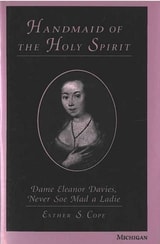
Handmaid of the Holy Spirit
Dame Eleanor Davies, Never Soe Mad a LadieEsther S. Cope
University of Michigan Press, 1993
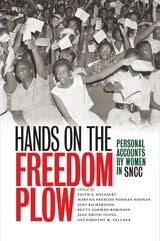
Hands on the Freedom Plow
Personal Accounts by Women in SNCCFaith S. Holsaert
University of Illinois Press, 2012
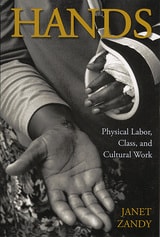
Hands
Physical Labor, Class, and Cultural WorkZandy, Janet
Rutgers University Press, 2004
In linking forms of cultural expression to labor, occupational injuries, and deaths, Hands: Physical Labor, Class, and Cultural Work centers what is usually decentered--the complex culture of working-class people. Janet Zandy begins by examining the literal loss of lives to unsafe jobs and occupational hazards. She asks critical and timely questions about worker representation--who speaks for employees when the mills, mines, factories, and even white-collar cubicles shut down? She presents the voices of working-class writers and artists, and discusses their contribution to knowledge and culture.
This innovative study reveals the flesh and bone beneath the abstractions of labor, class, and culture. It is an essential contribution to the emerging field of working-class studies, offering a hybrid model for bridging communities and non-academic workers to scholars and institutions of knowledge.
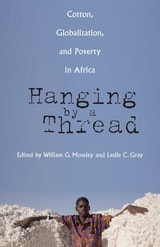
Hanging by a Thread
Cotton, Globalization, and Poverty in AfricaWilliam G. Moseley
Ohio University Press, 2008
The textile industry was one of the first manufacturing activities to become organized globally, as mechanized production in Europe used cotton from the various colonies. Africa, the least developed of the world’s major regions, is now increasingly engaged in the production of this crop for the global market, and debates about the pros and cons of this trend have intensified.
Hanging by a Thread: Cotton, Globalization, and Poverty in Africa illuminates the connections between Africa and the global economy. The editors offer a compelling set of linked studies that detail one aspect of the globalization process in Africa, the cotton commodity chain.
From global policy debates, to impacts on the natural environment, to the economic and social implications of this process, Hanging by a Thread explores cotton production in the postcolonial period from different disciplinary perspectives and in a range of national contexts. This approach makes the globalization process palpable by detailing how changes at the macroeconomic level play out on the ground in the world’s poorest region. Hanging by a Thread offers new insights on the region in a global context and provides a critical perspective on current and future development policy for Africa.
Contributors: Thomas J. Bassett, Jim Bingen, Duncan Boughton, Brian M. Dowd, Marnus Gouse, Leslie C. Gray, Dolores Koenig, Scott M. Lacy, William G. Moseley, Colin Poulton, Bhavani Shankar, Corinne Siaens, Colin Thirtle, David Tschirley, and Quentin Wodon.

Hannah Arendt
A Critical IntroductionFinn Bowring
Pluto Press, 2011
Hannah Arendt is one of the most famous political theorists of the twentieth century, yet in the social sciences her work has rarely been given the attention it deserves. This careful and comprehensive study introduces Arendt to a wider audience.
Finn Bowring shows how Arendt's writings have engaged with and influenced prominent figures in the sociological canon, and how her ideas may shed light on some of the most pressing social and political problems of today. He explores her critique of Marx, her relationship to Weber, the influence of her work on Habermas and the parallels and discrepancies between her and Foucault. This is a clearly written and scholarly text which surveys the leading debates over Arendt’s work, including discussions of totalitarianism, the public sphere and the nature of political responsibility.
This book will bring new perspectives to students and lecturers in sociology and politics.

Hannah Ryggen
Threads of DefianceMarit Paasche
University of Chicago Press, 2019
A widely recognized authority on Ryggen, Marit Paasche brings this important Scandinavian artist to the foreground in this biography, the first published on Ryggen in English. Paasche looks at Ryggen within the social, political, and cultural contexts of her time and explores how these issues informed her work, from her anti-fascist tapestry that depicted a spear piercing Mussolini’s head to one protesting the war in Vietnam. Published to correspond with a major retrospective in Frankfurt, of which Paasche is one of the curators, Hannah Ryggen is a foundational book that will provide a crucial introduction of this artist to a broader audience.

Hanoi Jane
War, Sex, and Fantasies of BetrayalJerry Lembcke
University of Massachusetts Press, 2010
From Aristophanes' Lysistrata to the notorious Mata Hari and the legendary Tokyo Rose, stories of female betrayal during wartime have recurred throughout human history. The myth of Hanoi Jane, Jerry Lembcke argues, is simply the latest variation on this enduring theme. Like most of the iconic femmes fatales who came before, it is based on a real person, Jane Fonda. And also like its predecessors, it combines traces of fact with heavy doses of fiction to create a potent symbol of feminine perfidy—part erotic warrior-woman Barbarella, part savvy antiwar activist, and part powerful entrepreneur.
Hanoi Jane, the book, deconstructs Hanoi Jane, the myth, to locate its origins in the need of Americans to explain defeat in Vietnam through fantasies of home-front betrayal and the emasculation of the national will-to-war. Lembcke shows that the expression “Hanoi Jane” did not reach the eyes and ears of most Americans until five or six years after the end of the war in Vietnam. By then, anxieties about America's declining global status and deteriorating economy were fueling a populist reaction that pointed to the loss of the war as the taproot of those problems. Blaming the antiwar movement for undermining the military's resolve, many found in the imaginary Hanoi Jane the personification of their stab-in-the- back theories.
Ground zero of the myth was the city of Hanoi itself, which Jane Fonda had visited as a peace activist in July 1972. Rumors surrounding Fonda's visits with U.S. POWs and radio broadcasts to troops combined to conjure allegations of treason that had cost American lives. That such tales were more imagined than real did not prevent them from insinuating themselves into public memory, where they have continued to infect American politics and culture.
Hanoi Jane is a book about the making of Hanoi Jane by those who saw a formidable threat in the Jane Fonda who supported soldiers and veterans opposed to the war they fought, in the postcolonial struggle of the Vietnamese people to make their own future, and in the movements of women everywhere for gender equality.
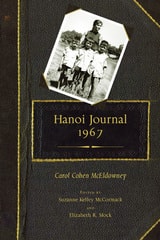
Hanoi Journal, 1967
Carol McEldowney
University of Massachusetts Press, 2007
McEldowney first gained the respect of her fellow activists as a student organizer at the University of Michigan. High regard for her intelligence, skill, and hard work with SDS's Economic Recovery Action Program during the years following her graduation in 1964 earned her an invitation to attend an international conference in Czechoslovakia and an offer to continue on to North Vietnam. Though her journal displays only traces of the feminist consciousness that would mark her later political activism, she recorded her observations of North Vietnam clearly aware that she was an outsider—a woman not subject to the military draft, not married to a soldier, and without the heartache of a brother or even a close friend serving in the war.
McEldowney searched for glimpses of everyday life that would help her to better relate to women in Hanoi and the hardships they faced during wartime. As she traveled in North Vietnam, she sought a deeper understanding of the events of her time. Her journal provides readers with a unique lens through which to study those events and gain a new perspective on the Vietnam War era.

Hans Staden's True History
An Account of Cannibal Captivity in BrazilHans Staden
Duke University Press, 2008
Staden’s narrative is a foundational text in the history and European “discovery” of Brazil, the earliest European account of the Tupi Indians, and a touchstone in the debates on cannibalism. Yet the last English-language edition of Staden’s True History was published in 1929. This new critical edition features a new translation from the sixteenth-century German along with annotations and an extensive introduction. It restores to the text the fifty-six woodcut illustrations of Staden’s adventures and final escape that appeared in the original 1557 edition.
In the introduction, Neil L. Whitehead discusses the circumstances surrounding the production of Staden’s narrative and its ethnological significance, paying particular attention to contemporary debates about cannibalism. Whitehead illuminates the value of Staden’s True History as an eyewitness account of Tupi society on the eve before its collapse, of ritual war and sacrifice among Native peoples, and of colonial rivalries in the region of Rio de Janeiro. He chronicles the history of the various editions of Staden’s narrative and their reception from 1557 until the present. Staden’s work continues to engage a wide range of readers, not least within Brazil, where it has recently been the subject of two films and a graphic novel.

Hapa Girl
A MemoirMay-lee Chai
Temple University Press, 2008
In the mid-1960s, Winberg Chai, a young academic and the son of Chinese immigrants, married an Irish-American artist. In Hapa Girl ("hapa" is Hawaiian for "mixed") their daughter tells the story of this loving family as they moved from Southern California to New York to a South Dakota farm by the 1980s. In their new Midwestern home, the family finds itself the object of unwelcome attention, which swiftly escalates to violence. The Chais are suddenly socially isolated and barely able to cope with the tension that arises from daily incidents of racial animosity, including random acts of cruelty.
May-lee Chai's memoir ends in China, where she arrives just in time to witness a riot and demonstrations. Here she realizes that the rural Americans' "fears of change, of economic uncertainty, of racial anxiety, of the unknowable future compared to the known past were the same as China's. And I realized finally that it had not been my fault."

Happy Days and Wonder Years
The Fifties and the Sixties in Contemporary Cultural PoliticsMarcus, Daniel
Rutgers University Press, 2004
From Ronald Reagan's image as a Fifties Cold Warrior to Bill Clinton's fandom for Elvis Presley and John F. Kennedy, politicians have invoked the Fifties and the Sixties to connect to their public. Marcus shows how films, television, music, and memoirs have responded to the political nostalgia of today, and why our entertainment remains immersed in reruns, revivals, and references to earlier times. This book offers a new understanding of how politics and popular culture have influenced our notions of the past, and how events from long ago continue to shape our understanding of the present day.

Harambee City
The Congress of Racial Equality in Cleveland and the Rise of Black Power PopulismNishani Frazier
University of Arkansas Press, 2017
BLACK POWER!
It was a phrase that consumed the American imagination in the 1960s and 70s and inspired a new agenda for black freedom. Dynamic and transformational, the black power movement embodied more than media stereotypes of gun-toting, dashiki-wearing black radicals; the movement opened new paths to equality through political and economic empowerment.
In Harambee City, Nishani Frazier chronicles the rise and fall of black power within the Congress of Racial Equality (CORE) by exploring the powerful influence of the Cleveland CORE chapter. Frazier explores the ways that black Clevelanders began to espouse black power ideals including black institution building, self-help, and self-defense. These ideals challenged CORE’s philosophy of interracial brotherhood and nonviolent direct action, spawning ideological ambiguities in the Cleveland chapter. Later, as Cleveland CORE members rose to national prominence in the organization, they advocated an open embrace of black power and encouraged national CORE to develop a notion of black community uplift that emphasized economic populism over political engagement. Not surprisingly, these new empowerment strategies found acceptance in Cleveland.
By providing an understanding of the tensions between black power and the mainstream civil rights movement as they manifested themselves as both local and national forces, Harambee City sheds new light on how CORE became one of the most dynamic civil rights organizations in the black power era.

Harbin and Manchuria
Place, Space, and Identity, Volume 99Thomas Lahusen, ed.
Duke University Press, 0
Crossing the boundaries of their specializations, contributors respond to the complexity of this history while considering the concrete concept of place and its relation to the more abstract idea of space. A rare encounter between scholars of East Asian and Slavic studies, this well-illustrated collections includes discussions of history, politics, economics, anthropology, sociology, cinema, and cultural studies. An eclectic and comprehensive exploration of memory and its reconstruction in the Harbin-Manchuria diaspora, Harbin and Manchuria provides the first full treatment of this colonial encounter.
Contributors. Olga Bakich, Sabine Breuillard, James Carter, Elena Chernolutskaya, Prasenjit Duara, Thomas Lahusen, Hyun-Ok Park, Andre Schmid, Mariko Asano Tamanoi, David Wolff

Hard Bargains
The Coercive Power of Drug Laws in Federal CourtMona Lynch
Russell Sage Foundation, 2016
As a result of the War on Drugs, the number of drug cases prosecuted each year in federal courts has increased fivefold since 1980. Lynch goes behind the scenes in three federal court districts and finds that federal prosecutors have considerable discretion in adjudicating these cases. Federal drug laws are wielded differently in each district, but with such force to overwhelm defendants’ ability to assert their rights. For drug defendants with prior convictions, the stakes are even higher since prosecutors can file charges that incur lengthy prison sentences—including life in prison without parole. Through extensive field research, Lynch finds that prosecutors frequently use the threat of extremely severe sentences to compel defendants to plead guilty rather than go to trial and risk much harsher punishment. Lynch also shows that the highly discretionary ways in which federal prosecutors work with law enforcement have led to significant racial disparities in federal courts. For instance, most federal charges for crack cocaine offenses are brought against African Americans even though whites are more likely to use crack. In addition, Latinos are increasingly entering the federal system as a result of aggressive immigration crackdowns that also target illicit drugs.
Hard Bargains provides an incisive and revealing look at how legal reforms over the last five decades have shifted excessive authority to federal prosecutors, resulting in the erosion of defendants’ rights and extreme sentences for those convicted. Lynch proposes a broad overhaul of the federal criminal justice system to restore the balance of power and retreat from the punitive indulgences of the War on Drugs.

Hard Luck and Heavy Rain
The Ecology of Stories in Southeast TexasJoseph C. Russo
Duke University Press, 2023

Hard Right
Muscular Rhetoric and the New NationalismCasey Ryan Kelly
The Ohio State University Press, 2026
A groundbreaking examination of far-right rhetoric around fitness and the human body and how such rhetoric serves white nationalist, masculinist aims.
In recent years, far-right, white-nationalist groups in the US have churned out streams of discourse glorifying “muscularity” as the ideal masculine form. This preoccupation with physical fitness—along with expressed fears of declining testosterone levels in men, race-mixing, and transgender women—all reveal the masculine bodily fantasies and anxieties that underwrite the political unconscious of the far right. In Hard Right, Casey Ryan Kelly examines the link between extreme fitness culture and fascist organizations, arguing that the human body operates as a privileged signifier of national belonging in the rhetoric of the far right.
Drawing from psychoanalytic theory, Kelly shows that far-right rhetoric constructs fantasies of recovering the “natural” or primal masculine body. These fantasies are frequently accompanied by anxieties about “soft,” disabled, and ambiguously gendered bodies, all of which are seen as signs of degeneracy that must be transformed, exiled, or eradicated for the sake of national and racial health. Through its examination of “Red Pill” fitness influencers, “bro science” conspiracy theories, far-right podcasts, and more, Hard Right ultimately shows how the cultural logics of men’s health and physical fitness converge with the political logics of white nationalism and late fascism.
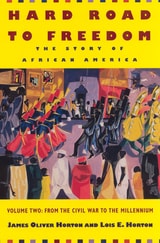
Hard Road to Freedom
The Story of African America, The Civil War to the MillenniumHorton, Lois E
Rutgers University Press, 2002
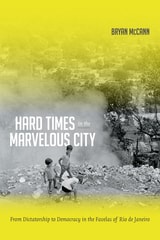
Hard Times in the Marvelous City
From Dictatorship to Democracy in the Favelas of Rio de JaneiroBryan McCann
Duke University Press, 2013
Hard Work
The Making of Labor HistoryMelvyn Dubofsky
University of Illinois Press, 2000
A career-spanning collection of writings by the legendary labor historian
One of American labor history's most prominent scholars, Melvyn Dubofsky curated an accessible style and historical reach that have long marked his work as required reading for students and scholars.
This collection juxtaposes Dubofsky's early writings with scholarship from the 1990s. Selections include work on western working-class radicalism, U.S. labor history in transnational and comparative settings, and the impact of technological change on American worker’s movements. Throughout, the writings provide an invaluable eyewitness perspective on the academic and political climate of the 1960s and 1970s while tracing the development of labor history as a discipline.
An exploration of important themes in labor history, Hard Work combines essential scholarship with the story of how past and present interact in the work of historians.

Hard at Work
Life in SingaporeGerard Sasges and Ng Shi Wen
National University of Singapore Press, 2019
Through first-person narratives based on detailed interviews, vividly augmented with color photographs, Hard at Work reminds us of the everyday labor that continually goes on around us, and that every job can reveal something interesting if we just look closely enough. It shows us too the ways inequalities of status and income are felt and internalized in this highly globalized society.

Hard-Core Romance
"Fifty Shades of Grey," Best-Sellers, and SocietyEva Illouz
University of Chicago Press, 2014
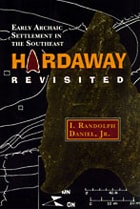
Hardaway Revisited
Early Archaic Settlement in the SoutheastI. Randolph Daniel, Jr.
University of Alabama Press, 1998
A landmark reassessment of Early Archaic settlement and adaptation in the southeastern United States.
Since the early 1970s, southeastern archaeologists have focused their attention on identifying the function of prehistoric sites and settlement practices during the Early Archaic period (ca. 9,000-10,500 B.P.). The Hardaway site in the North Carolina Piedmont, one of the most important archaeological sites in eastern North America, has not yet figured notably in this research. Daniel's reanalysis of the Hardaway artifacts provides a broad range of evidence—including stone tool morphology, intrasite distributions of artifacts, and regional distributions of stoneraw material types—that suggests that Hardaway played a unique role in Early Archaic settlement.
The Hardaway site functioned as a base camp where hunting and gathering groups lived for extended periods. From this camp they exploited nearby stone outcrops in the Uwharrie Mountains to replenish expended toolkits. Based on the results of this study, Daniel's new model proposes that settlement was conditioned less by the availability of food resources than by the limited distribution of high-quality knappable stone in the region. These results challenge the prevalent view of Early Archaic settlement that group movement was largely confined by the availability of food resources within major southeastern river valleys.
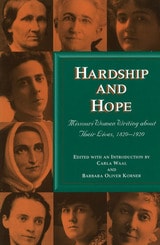
Hardship and Hope
Missouri Women Writing about Their Lives, 1820-1920Carla Waal and Barbara Oliver Korner, eds.
University of Missouri Press, 1997
Over the years Missouri women have endured many hardships: Civil War troops in their homes, the harshness of westward travel, the loneliness of the Gold Rush, and slavery. They have also greatly influenced the state's history. Marie Watkins Oliver made the state flag; Margaret Nelson Stephens was a gifted politician; Carry A. Nation fought for prohibition; and Mary Ezit Bulkley was active in the woman suffrage movement.
Hardship and Hope brings to life these and other known and unknown Missouri women through their own writings in journals, letters, diaries, and memoirs. Most of these pieces have never been published or have long been out of print. Carla Waal and Barbara Oliver Korner have skillfully crafted this anthology to represent myriad Missouri women. There are pieces representing the experiences of Jewish, Irish, and German immigrants, African Americans, well-educated women, and deeply religious women. Preceding each entry is a useful introduction that provides history and background on the woman and her work.
Readers will meet women like Phoebe Wilson Couzins, who was the first woman law graduate in Missouri. She went on to work with Susan B. Anthony for the suffrage movement but died in poverty, physically handicapped and emotionally unstable. Emma J. Ray was born a slave just before the Civil War. She and her husband did missionary work in jails and on the streets of Kansas City. Other women represented are Laura Ingalls Wilder, Kate Chopin, Fannie Hurst, and Henriette Geisberg Bruns.
Hardship and Hope began as a series of performances around the state of Missouri through which the book's editors demonstrated the roles women played in that state's past. Because of the enthusiastic response to their performances, Waal and Korner continued searching for documents by Missouri women and now share their discoveries in book form. Covering a little more than a century, from just before Missouri's admission to the Union in 1821 to the ratification of the Nineteenth Amendment that gave women the right to vote in 1920, the excerpts here both captivate and inform.
This anthology will appeal to those interested in women's studies, Missouri and midwestern history, and oral interpretation.
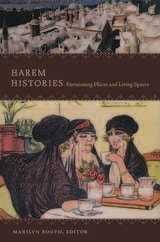
Harem Histories
Envisioning Places and Living SpacesMarilyn Booth, ed.
Duke University Press, 2010
Contributors. Asma Afsaruddin, Orit Bashkin, Marilyn Booth, Nadia Maria El Cheikh, Julia Clancy-Smith, Joan DelPlato, Jateen Lad, Nancy Micklewright, Yaseen Noorani, Leslie Peirce, Irvin Cemil Schick, A. Holly Schissler, Heghnar Zeitlian Watenpaugh

Harlem Between Heaven And Hell
Monique M. Taylor
University of Minnesota Press, 2002
A hard-hitting look at race, class, and black gentrification in this emblematic community.
Harlem brings to mind a kaleidoscope of images-the jazz clubs and cultural ferment of the 1920s and 1930s, the urban decay of the 1960s and 1970s, and the revitalization of the past twenty years, with artists, writers, professionals, and even an ex-president moving to a community often seen as the capital of black America. Integral to the ongoing transformation of Harlem has been the return of the African-American middle class to what had become an overwhelmingly poor area. In this lively book, Monique M. Taylor explores the stresses created by this influx, the surprising ways class differences manifest themselves and are managed, and what we can learn from examining a community in which race and class are so closely intertwined.
Harlem between Heaven and Hell is told through a look at history, literature, redevelopment strategies, community activism, and extensive interviews with black professionals-married and single, with children and without, long-term residents and recent arrivals. In their voices we hear of the cultural legacy, political commitments, economic considerations, and desire for community that drew them to Harlem. They tell us of the complexities of gentrification and their own role in it: the trepidation and distrust that often greeted their arrival, the challenges of renovating Harlem’s historic brownstones in the face of entrenched neighborhood decay, learning and shaping the social mores of the area. Two key questions underlie these accounts: What does it mean when blacks move in alongside blacks of a different social class? How can a neighborhood successfully balance racial and class diversity in the face of rapid change? Taylor places this intraracial class conflict within the context of America’s changing race relations, showing how the feelings and issues that have arisen-to oppose, embrace, or participate in gentrification-reveal unsettled questions surrounding race, racism, class, and culture in a changing urban landscape. Through her incisive description of the everyday ways race and class are experienced, she has created a vivid exploration of black middle-class identity in the post-civil rights era.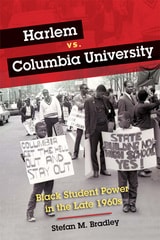
Harlem vs. Columbia University
Black Student Power in the Late 1960sStefan M. Bradley
University of Illinois Press, 2012

Harlem's Theaters
A Staging Ground for Community, Class, and Contradiction, 1923-1939Adrienne Macki Braconi
Northwestern University Press, 2015
Honorable Mention, 2016 Errol Hill Book Award for Outstanding Scholarship in African American Theater, Drama and/or Performance
Based on a vast amount of archival research, Adrienne Macki Braconi’s illuminating study of three important community-based theaters in Harlem shows how their work was essential to the formation of a public identity for African Americans and the articulation of their goals, laying the groundwork for the emergence of the Civil Rights movement. Macki Braconi uses textual analysis, performance reconstruction, and audience reception to examine the complex dynamics of productions by the Krigwa Players, the Harlem Experimental Theatre, and the Negro Theatre of the Federal Theatre Project. Even as these theaters demonstrated the extraordinary power of activist art, they also revealed its limits. The stage was a site in which ideological and class differences played out, theater being both a force for change and a collision of contradictory agendas. Macki Braconi’s book alters our understanding of the Harlem Renaissance, the roots of the Civil Rights movement, and the history of community theater in America.

Harlem
The Unmaking of a GhettoCamilo José Vergara
University of Chicago Press, 2013
Photographer Camilo José Vergara has been chronicling the neighborhood for forty-three years, and Harlem: The Unmaking of a Ghetto is an unprecedented record of urban change. Vergara began his documentation of Harlem in the tradition of such masters as Helen Levitt and Aaron Siskind, and he later turned his focus on the neighborhood’s urban fabric, both the buildings that compose it and the life and culture embedded in them. By repeatedly returning to the same locations over the course of decades, Vergara is able to show us a community that is constantly changing—some areas declining, as longtime businesses give way to empty storefronts, graffiti, and garbage, while other areas gentrify, with corporate chain stores coming in to compete with the mom-and-pops. He also captures the ever-present street life of this densely populated neighborhood, from stoop gatherings to graffiti murals memorializing dead rappers to impersonators honoring Michael Jackson in front of the Apollo, as well as the growth of tourism and racial integration.
Woven throughout the images is Vergara’s own account of his project and his experience of living and working in Harlem. Taken together, his unforgettable words and images tell the story of how Harlem and its residents navigated the segregation, dereliction and slow recovery of the closing years of the twentieth century and the boom and racial integration of the twenty-first century. A deeply personal investigation, Harlem will take its place with the best portrayals of urban life.
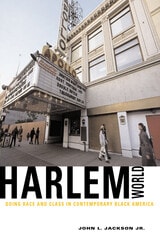
Harlemworld
Doing Race and Class in Contemporary Black AmericaJohn L. Jackson Jr.
University of Chicago Press, 2001

Harlots, Hussies, and Poor Unfortunate Women
Crime, Transportation, and the Servitude of Female Convicts, 1718-1783Edith M. Ziegler
University of Alabama Press, 2014
In Harlots, Hussies, and Poor Unfortunate Women, Edith M. Ziegler recounts the history of British convict women involuntarily transported to Maryland in the eighteenth century.
Great Britain’s forced transportation of convicts to colonial Australia is well known. Less widely known is Britain’s earlier program of sending convicts—including women—to North America. Many of these women were assigned as servants in Maryland. Titled using epithets that their colonial masters applied to the convicts, Edith M. Ziegler’s Harlots, Hussies, and Poor Unfortunate Women examines the lives of this intriguing subset of American immigrants.
Basing much of her powerful narrative on the experiences of actual women, Ziegler restores individual faces to women stripped of their basic freedoms. She begins by vividly invoking the social conditions of eighteenth-century Britain, which suffered high levels of criminal activity, frequently petty thievery. Contemporary readers and scholars will be fascinated by Ziegler’s explanation of how gender-influenced punishments were meted out to women and often ensnared them in Britain’s system of convict labor.
Ziegler depicts the methods and operation of the convict trade and sale procedures in colonial markets. She describes the places where convict servants were deployed and highlights the roles these women played in colonial Maryland and their contributions to the region’s society and economy. Ziegler’s research also sheds light on escape attempts and the lives that awaited those who survived servitude.
Mostly illiterate, convict women left few primary sources such as diaries or letters in their own words. Ziegler has masterfully researched the penumbra of associated documents and accounts to reconstruct the worlds of eighteenth-century Britain and colonial Maryland and the lives of these unwilling American settlers. In illuminating this little-known episode in American history, Ziegler also discusses not just the fact that these women have been largely forgotten, but why. Harlots, Hussies, and Poor Unfortunate Women makes a valuable contribution to American history, women’s studies, and labor history.
Harold D. Lasswell on Political Sociology
Harold D. Lasswell
University of Chicago Press, 1977
Harriet Hosmer
A Cultural BiographyKate Culkin
University of Massachusetts Press, 2010
In 1852 Hosmer moved from Boston to Rome, where she shared a house with actress Charlotte Cushman and soon formed close friendships with such prominent expatriates as Robert and Elizabeth Barrett Browning and fellow sculptors John Gibson, Emma Stebbins, and William Wetmore Story. References to Hosmer or characters inspired by her appear in the work of Nathaniel Hawthorne, Louisa May Alcott, and Kate Field among others. Culkin argues that Hosmer's success was made possible by her extensive network of supporters, including her famous friends, boosters of American gentility, and women's rights advocates. This unlikely coalition, along with her talent, ambition, and careful maintenance of her public profile, ultimately brought her great acclaim. Culkin also addresses Hosmer's critique of women's position in nineteenth-century culture through her sculpture, women's rights advocates' use of high art to promote their cause, the role Hosmer's relationships with women played in her life and success, and the complex position a female artist occupied within a country increasingly interested in proving its gentility.
Harriet Tubman
The Life and the Life StoriesJean M. Humez
University of Wisconsin Press, 2005
Harriet Tubman’s name is known world-wide and her exploits as a self-liberated Underground Railroad heroine are celebrated in children’s literature, film, and history books, yet no major biography of Tubman has appeared since 1943. Jean M. Humez’s comprehensive Harriet Tubman is both an important biographical overview based on extensive new research and a complete collection of the stories Tubman told about her life—a virtual autobiography culled by Humez from rare early publications and manuscript sources. This book will become a landmark resource for scholars, historians, and general readers interested in slavery, the Underground Railroad, the Civil War, and African American women.
Born in slavery in Maryland in or around 1820, Tubman drew upon deep spiritual resources and covert antislavery networks when she escaped to the north in 1849. Vowing to liberate her entire family, she made repeated trips south during the 1850s and successfully guided dozens of fugitives to freedom. During the Civil War she was recruited to act as spy and scout with the Union Army. After the war she settled in Auburn, New York, where she worked to support an extended family and in her later years founded a home for the indigent aged. Celebrated by her primarily white antislavery associates in a variety of private and public documents from the 1850s through the 1870s, she was rediscovered as a race heroine by woman suffragists and the African American women’s club movement in the early twentieth century. Her story was used as a key symbolic resource in education, institutional fundraising, and debates about the meaning of "race" throughout the twentieth century.
Humez includes an extended discussion of Tubman’s work as a public performer of her own life history during the nearly sixty years she lived in the north. Drawing upon historiographical and literary discussion of the complex hybrid authorship of slave narrative literature, Humez analyzes the interactive dynamic between Tubman and her interviewers. Humez illustrates how Tubman, though unable to write, made major unrecognized contributions to the shaping of her own heroic myth by early biographers like Sarah Bradford. Selections of key documents illustrate how Tubman appeared to her contemporaries, and a comprehensive list of primary sources represents an important resource for scholars.

Harry Reasoner
A Life in the NewsBy Douglass K. Daniel
University of Texas Press, 2007
Harry Reasoner was one of the most trusted and well-liked journalists of the golden age of network television news. Whether anchoring the evening newscast on CBS in the 1960s or on ABC in the 1970s, providing in-depth reporting on 60 Minutes, or hosting numerous special programs covering civil rights struggles, the Vietnam War, and Watergate, Reasoner had "that almost mystical quality it seems to take for good television reporting, exuding this atmosphere of truth and believability," in the words of Walter Cronkite. Yet his reassuring manner and urbane, often witty, on-air persona masked a man who was far more complex and contradictory. Though gifted with the intelligence and drive to rise to the top of his profession, Reasoner was regarded by many colleagues as lazy and self-indulgent, a man who never achieved his full potential despite his many accomplishments.
Harry Reasoner: A Life in the News covers the entire sweep of this enigmatic journalist's life and career. Douglass K. Daniel opens with Reasoner's Depression-era Midwestern upbringing and follows him through his early work in newspapers and radio before he joined CBS in 1956. Focusing on Reasoner's thirty-five-year tenure in television news, Daniel presents fascinating, behind-the-scenes accounts of Reasoner's key role in founding the top-rated newsmagazine 60 Minutes. He also explores Reasoner's highly publicized move to ABC in 1970, where he anchored the nightly newscast, first with Howard K. Smith and later with Barbara Walters—a disastrous pairing from which Reasoner's career never fully recovered.
Based on scores of interviews and unpublished letters, memos, and other primary sources, this first biography of the man once rated second in credibility only to Walter Cronkite illuminates an entire era in broadcast journalism, as well as many of the unique personalities, from Andy Rooney to Mike Wallace, who made that era distinctive.
Harry T. Burleigh
From the Spiritual to the Harlem RenaissanceJean E. Snyder
University of Illinois Press, 2021

Harvest of Hazards
Family Farming, Accidents, and Expertise in the Corn Belt, 1940-1975Derek S. Oden
University of Iowa Press, 2017
In this study of the farm safety movement in the Corn Belt, historian Derek Oden examines why agriculture was so dangerous and why improvements were so difficult to achieve. Because farmers were self-employed business owners whose employees were mainly family members; because they lived far from aid such as hospitals and fire stations; and because they had to manage such a diverse array of new technologies, they could not easily adopt the workplace safety and public health reforms designed for factories and urban settings. In response, beginning in the 1940s, farmers and a new breed of farm safety specialists relied upon an increasingly elaborate educational campaign to lessen injuries and illnesses on the farm.
Several government, business, and nonprofit organizations—from the US Department of Agriculture to the National Safety Council and 4-H and the Future Farmers of America—worked together to publicize both the dangers of farming and the information farmers needed to stay safe while driving tractors, applying anhydrous ammonia, or repairing machinery. By the 1960s, however, the partnership began to break down, and by the 1970s the safety movement became increasingly contested as professional and policy divisions emerged. This groundbreaking study incorporates agriculture into the histories of occupational safety and public health.
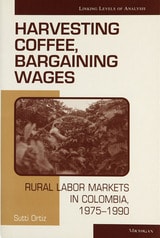
Harvesting Coffee, Bargaining Wages
Rural Labor Markets in Colombia, 1975-1990Sutti Ortiz
University of Michigan Press, 1999