Results by title
5159 books match the query 'Biography' and 171 start with h
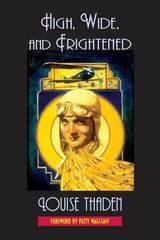
High, Wide, and Frightened
Louise Thaden
University of Arkansas Press, 2004
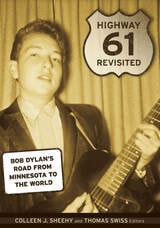
Highway 61 Revisited
Bob Dylan’s Road from Minnesota to the WorldColleen J. Sheehy
University of Minnesota Press, 2009
New essays consider Dylan’s latest work, his Minnesota roots, and his global reach
The young man from Hibbing released Highway 61 Revisited in 1965, and the rest, as they say, is history. Or is it? From his roots in Hibbing, to his rise as a cultural icon in New York, to his prominence on the worldwide stage, Colleen J. Sheehy and Thomas Swiss bring together the most eminent Dylan scholars at work today—as well as people from such far-reaching fields as labor history, African American studies, and Japanese studies—to assess Dylan’s career, influences, and his global impact on music and culture.
The Dylan effect has extended far beyond the United States in recent decades, and the essays here analyze his contribution to the people and cultures of the United Kingdom, Italy, and Japan. With a special focus on his Minnesota roots, including Greil Marcus’s spectacular tour of Dylan’s hometown, authors also take into account his most recent work and Martin Scorsese’s documentary No Direction Home.The first cultural and historical geography of his dramatic rise, storied career, and unmatched iconic status, Highway 61 Revisited maps the terrain of Bob Dylan’s music in the world.Contributors: John Barner, U of Georgia; Daphne Brooks, Princeton U; Court Carney, Stephen F. Austin State U; Alessandro Carrera, U of Houston; Michael Cherlin, U of Minnesota; Marilyn J. Chiat; Susan Clayton; Mick Cochrane, Canisius College; Thomas Crow, New York U; Kevin J. H. Dettmar, Pomona College, Carbondale; Sumanth Gopinath, U of Minnesota; Charles Hughes; C. P. Lee, U of Salford, Manchester, England; Alex Lubet, U of Minnesota; Greil Marcus, U of California, Berkeley; Aldon Lynn Nielsen, Pennsylvania State U; Roberto Polito, The New School; Robert Reginio, Frostburg State U; Heather Stur, U of Southern Mississippi; Mikiko Tachi, Chiba U, Japan; Gayle Wald, George Washington U; Anne Waldman, Naropa U; David Yaffe, Syracuse U.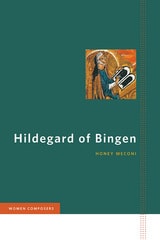
Hildegard of Bingen
Honey Meconi
University of Illinois Press, 2018
Honey Meconi draws on her own experience as a scholar and performer of Hildegard's music to explore the life and work of this foundational figure. Combining historical detail with musical analysis, Meconi delves into Hildegard's mastery of plainchant, her innovative musical drama, and her voluminous writings. Hildegard's distinctive musical style still excites modern listeners through wide-ranging, sinuous melodies set to her own evocative poetry. Together with her passionate religious texts, her music reveals a holistic understanding of the medieval world still relevant to today's readers.
Hillbilly Realist
Herman Clarence Nixon of Possum TrotSarah Newman Shouse
University of Alabama Press, 1986
Nixon’s life offers insight into one southerner’s efforts to comprehend and interpret the conflict and change of his time and illuminates for contemporary Americans a classical view of life—one lived fully, right in strength, beauty, courage, compassion, adventure, and thought.
Clarence Nixon was first and foremost a Southern intellectual, deeply involved in the region’s cultural renaissance, and his life reveals an intellectual odyssey from Victorianism to Modernism. As his personality, ideology, and social environment interacted, a new world view emerged. But he was an ambivalent modernist, like many intellectuals who were reared in the nineteenth-century South, he never abandoned certain Victorian ideals and values.
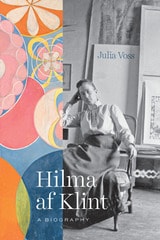
Hilma af Klint
A BiographyJulia Voss
University of Chicago Press, 2022
The Swedish painter Hilma af Klint (1862–1944) was forty-four years old when she broke with the academic tradition in which she had been trained to produce a body of radical, abstract works the likes of which had never been seen before. Today, it is widely accepted that af Klint was one of the earliest abstract academic painters in Europe.
But this is only part of her story. Not only was she a working female artist, she was also an avowed clairvoyant and mystic. Like many of the artists at the turn of the twentieth century who developed some version of abstract painting, af Klint studied Theosophy, which holds that science, art, and religion are all reflections of an underlying life-form that can be harnessed through meditation, study, and experimentation. Well before Kandinsky, Mondrian, and Malevich declared themselves the inventors of abstraction, af Klint was working in a nonrepresentational mode, producing a powerful visual language that continues to speak to audiences today. The exhibition of her work in 2018 at the Guggenheim Museum in New York City attracted more than 600,000 visitors, making it the most-attended show in the history of the institution.
Despite her enormous popularity, there has not yet been a biography of af Klint—until now. Inspired by her first encounter with the artist’s work in 2008, Julia Voss set out to learn Swedish and research af Klint’s life—not only who the artist was but what drove and inspired her. The result is a fascinating biography of an artist who is as great as she is enigmatic.
Hippie Homesteaders
Arts, Crafts, Music and Living on the Land in West VirginiaCarter Taylor Seaton
West Virginia University Press, 2014
It’s the 1960s. The Vietnam War is raging and protests are erupting across the United States. In many quarters, young people are dropping out of society, leaving their urban homes behind in an attempt to find a safe place to live on their own terms, to grow their own food, and to avoid a war they passionately decry. During this time, West Virginia becomes a haven for thousands of these homesteaders—or back-to-the-landers, as they are termed by some. Others call them hippies.
When the going got rough, many left. But a significant number remain to this day. Some were artisans when they arrived, while others adopted a craft that provided them with the cash necessary to survive. Hippie Homesteaders tells the story of this movement from the viewpoint of forty artisans and musicians who came to the state, lived on the land, and created successful careers with their craft. There’s the couple that made baskets coveted by the Smithsonian Institution’s Renwick Gallery. There’s the draft-dodger that fled to Canada and then became a premier furniture maker. There’s the Boston-born VISTA worker who started a quilting cooperative. And, there’s the immigrant Chinese potter who lived on a commune.
Along with these stories, Hippie Homesteaders examines the serendipitous timing of this influx and the community and economic support these crafters received from residents and state agencies in West Virginia. Without these young transplants, it’s possible there would be no Tamarack: The Best of West Virginia, the first statewide collection of fine arts and handcrafts in the nation, and no Mountain Stage, the weekly live musical program broadcast worldwide on National Public Radio since 1983. Forget what you know about West Virginia.
Hippie Homesteaders isn’t about coal or hillbillies or moonshine or poverty. It is the story of why West Virginia was—and still is—a kind of heaven to so many.
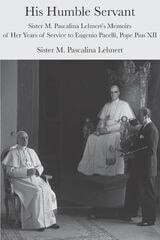
His Humble Servant
Sister M. Pascalina Lehnert's Memoirs of Her Years of Service to Eugenio Pacelli, Pope Pius XIIM. Pascalina Lehnert
St. Augustine's Press, 2012
This is a personal and insightful portrait of Pope Pius XII, the memories of Sister M. Pascalina Lehnert, who served as his housekeeper for forty years. Her book, most of it written just a few months after the Pope’s death, shares insights into the person, the life, and the thinking of Pius XII, from his time as Nuncio in Munich until his death. Much of Sister’s motivation in writing this work was to correct the many distortions of fact and interpretation regarding this great pope.
This book was a best seller in the original German, as well as in the Italian and French translations. This is the first edition in English.
These reminiscences were written down at the instructions of Sister’s Superior General, but were not made known to the public until 1982, when it was published in German at the express wishes of Pope John Paul II to publish the work without any changes. So the work remained a lively, flowing account of memories and anecdotes in a simple, spontaneous style. It is a powerful and insightful account of Pius’s daily life, his treatment of those around him, and his concern for the upholding of the traditional teaching of the Church in the face of his awesome burden to lead the Church during World War II.

History Continues
Georges Duby
University of Chicago Press, 1994
Since its beginning in the 1940s, Duby's career has been rich and varied, encompassing economic history, social history, the history of mentalites, art history, microhistory, urban history, the history of women and sexuality, and, most recently, the Church's influence on feudal society. In retracing this singular career path, Duby candidly remembers his life's most formative influences, including the legendary historians Marc Bloch and Lucien Febvre, the Annales School so closely associated with them, and the College de France.
Duby also offers insights about the proper methods of gathering and using archival data and on constructing penetrating interpretations of the documents. Indeed, his discussion of how he chose his subjects, collected his materials, developed the arguments, erected the scaffolding and constructed his theses offers the best introduction to the craft available to aspiring historians.
Candid and charming, this book is both a memoir of one of this century's great scholars and a history of the French historical school since the mid-twentieth century. It will be required reading for anyone interested in the French academic milieu, medieval history, French history, or the recording of history in general.
Georges Duby, a member of the Academie francaise, for many years held the distinguished chair in medieval history at the College de France. His numerous books include The Age of Cathedrals; The Knight, the Lady, and the Priest; Love and Marriage in the Middle Ages; and The Three Orders—all published by the University of Chicago Press.
History Of Louisa Barnes Pratt
The Autobiography of a Mormon Missionary Widow and PioneerGeorge S Ellsworth
Utah State University Press, 1998
Volume 3, Life Writings of Frontier Women series, ed. Maureen Ursenbach Beecher
In her memoir, and 1870s revision of her journal and diary, Louisa Barnes Pratt tells of childhood in Massachusetts and Canada during the War of 1812, and independent career as a teacher and seamstress in New England, and her marriage to the Boston seaman Addison Pratt.
Converting to the LDS Church, the Pratts moved to Nauvoo, Illinois, from where Brigham Young sent Addison on the first of the long missions to the Society Islands that would leave Louisa on her own. As a sole available parent, she hauled her children west to Winter Quarters, to Utah in 1848, to California, and, in Addison's wake, to Tahiti in 1850.
The Pratts joined the Mormon colony at San Bernardino, California. When in 1858 a federal army's march on Utah led to the colonists' recall, Addision—alienated from the Mormon Church after long absences—chose not to go. Mostly separated thereafter (Addison died in 1872), Louisa settled in Beaver, Utah, where she campaigned for women's rights, contributed to the Woman's Exponent, and depended on her own means, as she had much of her life, until her death in 1880.
History and Hope in the Heart of Dixie
Scholarship, Activism, and Wayne Flynt in the Modern SouthEdited by Gordon E. Harvey, Richard D. Starnes and Glenn Feldman
University of Alabama Press, 2006
Exploring the history, challenges, and promise of a changing South through the legacy of Wayne Flynt.
This collection of essays on the social and political history of the modern South consider the region’s poor, racial mores and race relations, economic opportunity, Protestant activism, political coalitions and interest groups, social justice, and progressive reform. History and Hope in the Heart of Dixie illuminates the dual role of historian and public advocate in modern America. In a time when the nation’s eyes have been focused by Hurricanes Katrina and Rita onto the vulnerability and dire condition of poor people in the South, the applicability of research, teaching, and activism for this voiceless element seems all the more relevant.
Responding to the example of Wayne Flynt, whose fierce devotion to his state of Alabama and its region has not blinded his recognition of the inequities and despair that define southern life for so many, the scholars assembled in this work present contributions to the themes Flynt so passionately explored in his own work.Two seasoned observers of southern history and culture—John Shelton Reed and Dan T. Carter—offer assessments of Flynt’s influence on the history profession as a whole and on the region of the South in particular.
History in My Life
A Memoir of Three ErasIvan T. Berend is Distinguished Research Professor at the History Department of the University of California Los Angeles.
Central European University Press, 2009
Ivan T. Berend is Distinguished Professor at the University of California Los Angeles, Director of the European Studies Program. He was one of the masterminds of regime change in Hungary. He made a career in Hungary as a university professor, Rector of the University of Economics (1973–79), and President of the Hungarian Academy of Sciences (1985–90). He was President of the International Committee of Historical Sciences (1995–2000), and Vice-President of the International Economic History Association (1986–1994). His research interests are the complex economic, social, ideological, and cultural history of Central and Eastern Europe in the 19th–20th century; economic modernization; problems of European backwardness; transition from state socialism to capitalism. He published and 26 books and more than 120 studies.
Before he became a professor at UCLA, Ivan Berend had survived five regime changes and two revolutions in Hungary, had been in prison and German concentration camp in 1944–45.
His memoir offers an interesting case study, a subjective addition to the “objective” historical works on Central and Eastern European state socialism. It describes the hard choices of intellectuals in a dictatorial state: 1. remain in isolation, concentrate on scholarly works, and exclude politics in your personal life; 2. be in opposition, criticize and unveil the regime, accept discrimination and exclusion; 3. remain within the establishment and work for reforming the country using legal possibilities to criticize the regime and to achieve changes from within.
Berend’s book raises basic historical questions and debates, compares East European and American higher education systems, and presents an eyewitness’ insights on life in the United States.
History of the American Negro
West Virginia EditionA. B. Caldwell
West Virginia University Press, 2012
History, Historians, and Autobiography
Jeremy D. Popkin
University of Chicago Press, 2005
Drawing on the theoretical work of contemporary critics of autobiography and the philosophy of Paul Ricoeur, Popkin reads the autobiographical classics of Edward Gibbon and Henry Adams and the memoirs of contemporary historians such as Emmanuel Le Roy Ladurie, Peter Gay, Jill Ker Conway, and many others, he reveals the contributions historians' life stories make to our understanding of the human experience. Historians' autobiographies, he shows, reveal how scholars arrive at their vocations, the difficulties of writing about modern professional life, and the ways in which personal stories can add to our understanding of historical events such as war, political movements, and the traumas of the Holocaust.
An engrossing overview of the way historians view themselves and their profession, this work will be of interest to readers concerned with the ways in which we understand the past, as well as anyone interested in the art of life-writing.
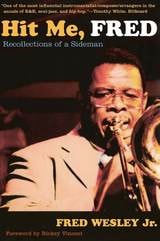
Hit Me, Fred
Recollections of a SidemanFred Wesley Jr.
Duke University Press, 2005
Wesley’s distinctive sound reverberates through rap and hip-hop music today. In Hit Me, Fred, he recalls the many musicians whose influence he absorbed, beginning with his grandmother and father—both music teachers—and including mentors in his southern Alabama hometown and members of the Army band. In addition to the skills he developed working with James Brown, George Clinton, Bootsy Collins, and the many talented musicians in their milieu, Wesley describes the evolution of his trombone playing through stints with the Ike and Tina Turner Revue, Hank Ballard, and Count Basie’s band. He also recounts his education in the music business, particularly through his work in Los Angeles recording sessions.
Wesley is a virtuoso storyteller, whether he's describing the electric rush of performances when the whole band is in the groove, the difficulties of trying to make a living as a rhythm and blues musician, or the frustrations often felt by sidemen. Hit Me, Fred is Wesley’s story of music-making in all its grit and glory.
Hitler in History
Eberhard Jäckel
Brandeis University Press, 2000
Hmong Americans in Michigan
Martha Aladjem Bloomfield
Michigan State University Press, 2014
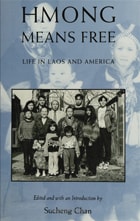
Hmong Means Free
Life in Laos and AmericaSucheng Chan
Temple University Press, 1994
This collection of evocative personal testimonies by three generations of Hmong refugees is the first to describe their lives in Laos as slash-and-burn farmers, as refugees after a Communist government came to power in 1975, and as immigrants in the United States. Reflecting on the homes left behind, their narratives chronicle the difficulties of forging a new identity.
From Jou Yee Xiong's Life Story:
"I stopped teaching my sons many of the Hmong ways because I felt my ancestors and I had suffered enough already. I thought that teaching my children the old ways would only place a burden on them."
From Ka Pao Xiong's (Jou Yee Xiong's son) Life Story:
"It has been very difficult for us to adapt because we had no professions or trades and we suffered from culture shock. Here in America, both the husband and wife must work simultaneously to earn enough money to live on. Many of our children are ignorant of the Hmong way of life…. Even the old people are forgetting about their life in Laos, as they enjoy the prosperity and good life in America."
From Xang Mao Xiong's Life Story:
"When the Communists took over Laos and General Vang Pao fled with his family, we, too, decided to leave. Not only my family, but thousands of Hmong tried to flee. I rented a car for thirty thousand Laotian dollars, and it took us to Nasu…. We felt compelled to leave because many of us had been connected to the CIA…. Thousands of Hmong were traveling on foot. Along the way, many of them were shot and killed by Communist soldiers. We witnessed a bloody massacre of civilians."
From Vue Vang's Life Story:
"Life was so hard in the [Thai refugee] camp that when we found out we could go to the United States, we did not hesitate to grasp the chance. We knew that were we to remain in the camp, there would be no hope for a better future. We would not be able to offer our children anything better than a life of perpetual poverty and anguish."
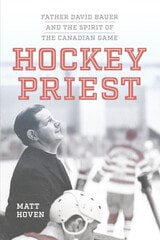
Hockey Priest
Father David Bauer and the Spirit of the Canadian GameMatt Hoven
Catholic University of America Press, 2024
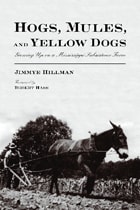
Hogs, Mules, and Yellow Dogs
Growing Up on a Mississippi Subsistence FarmJimmye Hillman; Foreword by Robert Hass
University of Arizona Press, 2012
"It's in the nature of things that whole worlds disappear," writes the poet Robert Hass in the foreword to Jimmye Hillman's insightful memoir. "Their vanishings, more often than not, go unrecorded or pass into myth, just as they slip from the memory of the living."
To ensure that the world of Jimmye Hillman's childhood in Greene County, Mississippi during the Great Depression doesn't slip away, he has gathered together accounts of his family and the other people of Old Washington village. There are humorous stories of hog hunting and heart-wrenching tales of poverty set against a rural backdrop shaded by the local social, religious, and political climate of the time. Jimmye and his family were subsistence farmers out of bare-bones necessity, decades before discussions about sustainability made such practices laudable.
More than just childhood memories and a family saga, though, this book serves as a snapshot of the natural, historical, and linguistic details of the time and place. It is a remarkable record of Southern life. Observations loaded with detail uncover broader themes of work, family loyalty, and the politics of changing times.
Hillman, now eighty-eight, went on to a distinguished career as an economist specializing in agriculture. He realizes the importance of his story as an example of the cultural history of the Deep South but allows readers to discover the significance on their own by witnessing the lives of a colorful cast of characters. Hogs, Mules, and Yellow Dogs is unique, a blend of humor and reflection, wisdom and sympathy—but it's also a hard-nosed look at the realities of living on a dirt farm in a vanished world.
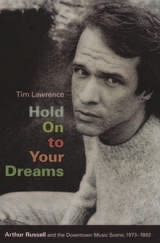
Hold On to Your Dreams
Arthur Russell and the Downtown Music Scene, 1973-1992Tim Lawrence
Duke University Press, 2009
Tim Lawrence traces Russell's odyssey from his hometown of Oskaloosa, Iowa, to countercultural San Francisco, and eventually to New York, where he lived from 1973 until his death from AIDS-related complications in 1992. Resisting definition while dreaming of commercial success, Russell wrote and performed new wave and disco as well as quirky rock, twisted folk, voice-cello dub, and hip-hop-inflected pop. “He was way ahead of other people in understanding that the walls between concert music and popular music and avant-garde music were illusory,” comments the composer Philip Glass. "He lived in a world in which those walls weren't there." Lawrence follows Russell across musical genres and through such vital downtown music spaces as the Kitchen, the Loft, the Gallery, the Paradise Garage, and the Experimental Intermedia Foundation. Along the way, he captures Russell's openness to sound, his commitment to collaboration, and his uncompromising idealism.
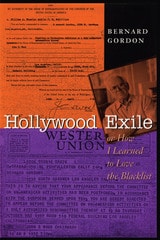
Hollywood Exile, or How I Learned to Love the Blacklist
By Bernard Gordon
University of Texas Press, 2000
The Hollywood blacklist, which began in the late 1940s and ran well into the 1960s, ended or curtailed the careers of hundreds of people accused of having ties to the Communist Party. Bernard Gordon was one of them. In this highly readable memoir, he tells a engrossing insider's story of what it was like to be blacklisted and how he and others continued to work uncredited behind the scenes, writing and producing many box office hits of the era.
Gordon describes how the blacklist cut short his screenwriting career in Hollywood and forced him to work in Europe. Ironically, though, his is a success story that includes the films El Cid, 55 Days at Peking, The Thin Red Line, Krakatoa East of Java, Day of the Triffids, Earth vs. the Flying Saucers, Horror Express, and many others. He recounts the making of many movies for which he was the writer and/or producer, with wonderful anecdotes about stars such as Charlton Heston, David Niven, Sophia Loren, Ava Gardner, and James Mason; directors Nicholas Ray, Frank Capra, and Anthony Mann; and the producer-studio head team of Philip Yordan and Samuel Bronston.

Hollywood Notebook
EssaysWendy C. Ortiz
Northwestern University Press, 2025
A daylight traipse through early-aughts Los Angeles, Hollywood Notebook encapsulates the powerful feelings and hopeful futures of twentysomething Wendy C. Ortiz. In this boundary-defying sister memoir to Bruja, Ortiz navigates internal maps as she traverses external palm-treed streets, moving through her youthful twenties and into the pensiveness of her thirties. Peering at what lies ahead while dipping her toes into the past, Ortiz shows us that there is no place like Hollywood to unearth the joys of success and the blows of mistakes—both realized and denied. An innovative and bold examination of the daytime roaming mind, Hollywood Notebook is a cartography of love, loss, and transformation in the face of a brilliant psyche in a vibrant city.
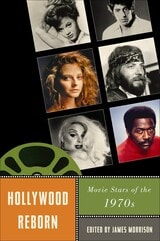
Hollywood Reborn
Movie Stars of the 1970sMorrison, James
Rutgers University Press, 2010
Hollywood Reborn examines this question, with contributors focusing on many of the era's key figures — noteworthy actors such as Jane Fonda, Al Pacino, Faye Dunaway, and Warren Beatty, and unexpected artists, among them Donald Sutherland, Shelley Winters, and Divine. Each essay offers new perspectives through the lens of an important star, illuminating in the process some of the most fascinating and provocative films of the decade.
Holocaust Literature
A History and GuideDavid G. Roskies and Naomi Diamant
Brandeis University Press, 2013
Holocaust Mothers and Daughters
Family, History, and TraumaFederica K. Clementi
Brandeis University Press, 2013
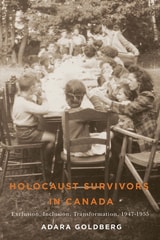
Holocaust Survivors in Canada
Exclusion, Inclusion, Transformation, 1947-1955Adara Goldberg
University of Manitoba Press, 2015
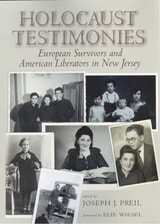
Holocaust Testimonies
European Survivors and American Liberators in New JerseyPreil, Joseph J
Rutgers University Press, 2001
A project of the Holocaust Resource Center of Kean University, New Jersey, this book is a reference tool for teaching the Holocaust, for Holocaust survivors and their families, and for the general reader. Drawing on the center’s central missions is to produce and preserve a series of oral-history videotapes based on the personal experiences of Holocaust survivors who reside in New Jersey. Joseph J. Preil brings together the most compelling testimonies of 153 Holocaust survivors as well as twenty concentration-camp liberators. Through these riveting accounts, the book traces the mass murder of the Jews across Europe in a geographical as well as chronological order. The testimonies in each chapter are grouped by the witnesses’ country or region of origin, preceded by a brief introduction of the history of events in a particular area. In the last part of the book, American soldiers recount their impressions of being present at the liberation of the camps.
“If you can imagine that the Jew to the German was like a cockroach. In the United States, if you step on a cockroach . . . it doesn’t mean anything to you. The same thing, exactly the same thing, the Jew was to the German—a cockroach. . . . One particular Shabbos (Sabbath), they shot twelve or thirteen people in my area. In other words, the German had the right, if he saw me, any Jew that he saw in the street, he could go over to you calmly, take out his revolver, and put it to your head, and shoot you down like a . . . roach. . . . It was a free-for-all.”—Testimony of Sol Einhorn, cited in Holocaust Testimonies: European Survivors and American Liberators in New Jersey
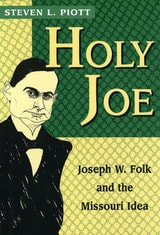
Holy Joe
Joseph W. Folk and the Missouri IdeaSteven L. Piott
University of Missouri Press, 1997
One of Missouri's best-known leaders of the Progressive Era, Joseph W. Folk epitomized the moral reformer in politics. As a crusading district attorney in St. Louis, Folk won national acclaim for his investigations of wrongdoing in municipal government. With the help of muckraking journalist Lincoln Steffens, Folk revealed for the first time the extent of political corruption then plaguing America's cities and helped bring about a popular demand for the regeneration of municipal government nationwide.
A firm believer that the law was a weapon with which to check political corruption and restrain powerful special interests, Folk popularized the "Missouri Idea," the doctrine that public office is a public trust, not merely an opportunity for private gain. Elected as governor of Missouri in 1904, Folk orchestrated a remarkable record of legislative accomplishment. He established himself as one of Missouri's outstanding governors and one of the nation's leading progressive reformers.
In asserting that traditional moral values could be applied to politics, Folk became known among friends and enemies as Holy Joe. His refusal to make any distinction between public and private morality, however, alienated some Missourians, while his disregard for party organization angered politicians. His idealism cost him political advancement and ultimately a place in national politics.
Whereas some studies of the Progressive Era have minimized the moral dimension of Progressivism and downplayed the importance of reformers like Joseph W. Folk, Holy Joe establishes him as a major leader of the Progressive movement. This biography will be a welcome addition to the literature on the subject.
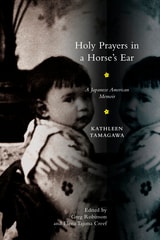
Holy Prayers in a Horse's Ear
A Japanese American MemoirKathleen Tamagawa, Edited by Greg Robinson and Elena Tajima Creef
Rutgers University Press, 2008
Originally published in 1932, Kathleen Tamagawa’s pioneering Asian American memoir is a sensitive and thoughtful look at the personal and social complexities of growing up racially mixed during the early twentieth century. Born in 1893 to an Irish American mother and a Japanese father and raised in Chicago and Japan, Tamagawa reflects on the difficulty she experienced fitting into either parent’s native culture.
She describes how, in America, her every personal quirk and quality was seen as quintessentially Japanese and how she was met unpredictably with admiration or fear—perceived as a “Japanese doll” or “the yellow menace.” When her family later moved to Japan, she was viewed there as a “Yankee,” and remained an outsider in that country as well. As an adult she came back to the United States as an American diplomat’s wife, but had trouble feeling at home in any place.
This edition, which also includes Tamagawa’s recently rediscovered short story, “A Fit in Japan,” and a critical introduction, will challenge readers to reconsider how complex ethnic identities are negotiated and how feelings of alienation limit human identification in any society.

Home Bound
Growing Up With A DisabilityCass Irvin
Temple University Press, 2003
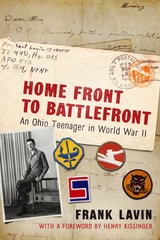
Home Front to Battlefront
An Ohio Teenager in World War IIFrank Lavin
Ohio University Press, 2016
Carl Lavin was a high school senior when Pearl Harbor was attacked. The Canton, Ohio, native was eighteen when he enlisted, a decision that would take him with the US Army from training across the United States and Britain to combat with the 84th Infantry Division in the Battle of the Bulge. Home Front to Battlefront is the tale of a foot soldier who finds himself thrust into a world where he and his unit grapple with the horrors of combat, the idiocies of bureaucracy, and the oddities of life back home—all in the same day. The book is based on Carl’s personal letters, his recollections and those of the people he served beside, official military history, private papers, and more.
Home Front to Battlefront contributes the rich details of one soldier’s experience to the broader literature on World War II. Lavin’s adventures, in turn disarming and sobering, will appeal to general readers, veterans, educators, and students of the war. As a history, the book offers insight into the wartime career of a Jewish Ohioan in the military, from enlistment to training through overseas deployment. As a biography, it reflects the emotions and the role of the individual in a total war effort that is all too often thought of as a machine war in which human soldiers were merely interchangeable cogs.
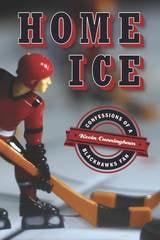
Home Ice
Confessions of a Blackhawks FanKevin Cunningham
University of Iowa Press, 2017
Home Ice combines memoir and history to explore how the mysteries of Blackhawks fandom explain big questions like tribal belonging, masculinity, and why you would ever trade Chris Chelios. In recounting the team’s—and his own—wins and losses (and ties), Cunningham covers everything from Keith Magnuson’s bachelor pad to the grim early aughts to Patrick Kane’s Cup-winner. Throughout, he explores how we come to love the things we love. Funny and touching, Home Ice is one Blackhawk fan’s attempt to understand why sports fandom is utterly ridiculous and entirely necessary.
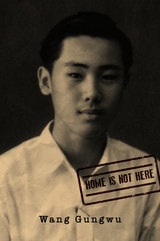
Home Is Not Here
Wang Gungwu
National University of Singapore Press, 2018
As someone who has studied history for much of my life, I have found the past fascinating. But it has always been some grand and even intimidating universe that I wanted to unpick and explain to myself.
Wang Gungwu is one of Asia’s most important public intellectuals. He is best known for his explorations of Chinese history in the long view and for his writings on the Chinese diaspora. With Home is Not Here, the historian of grand themes turns to a single life history: his own.
Wang writes about his multicultural upbringing and life under British rule. He was born in Surabaya, Java, but his parents’ orientation was always to China. Wang grew up in the plural, multi-ethnic town of Ipoh, Malaya (now Malaysia). He learned English in colonial schools and was taught the Confucian classics at home. After the end of WWII and the Japanese occupation, he left for the National Central University in Nanjing to study alongside some of the finest of his generation of Chinese undergraduates. The victory of Mao Zedong’s Communist Party interrupted his education, and he ends this volume with his return to Malaya.
Wise and moving, Home Is Not Here speaks to the ability of the individual to find a place amid the historical currents that have shaped Asia and the world.
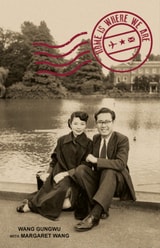
Home Is Where We Are
Wang Gungwu and Margaret Wang
National University of Singapore Press, 2020
Wang Gungwu’s account of his university education in Singapore and the UK, and the early years of his career as an academic in Malaysia captures the excitement, the ambition, and the choices of a generation that saw it their responsibility to build the new nations of Southeast Asia.
The exploration of the emotional and intellectual journey towards the formation of an identity, treasured by readers of Wang's Home Is Not Here, extends in this volume into an appreciation of love, family life, and the life of the mind. We also see these years from Margaret’s perspective, her own fascinating family story, and her early impressions of this young bearded poet. Wise and moving, this is a fascinating reflection on identity and belonging, and on the ability of the individual to find a place amidst the historical currents that have shaped Asia.

Home Stand
Growing Up in SportsJames McKean
Michigan State University Press, 2005
If he had not fouled out, maybe Washington State University’s center, James McKean, might have held Lew Alcindor (now Kareem Abdul-Jabbar) to only forty points. It was 1967, a transition year for college athletics in a dramatic time for those coming ofage. In this memoir set in the 1950s and 1960s, McKean revisits his years growing up in a family dedicated to sports and the outdoors, his playing basketball at Washington State University (for coaches Marv Harshman and Jud Heathcote), and his fashioning a life during and after basketball.
Driven by the energy and spirit of athletics, the language in Home Stand lights up McKean’s wonderfully eclectic work—the aunt who won a bronze medal in the 1936 Olympics in Berlin, his last run as a misguided drag racer, his playing basketball for a washing machine factory in Bologna, Italy, or against the prisoners in Walla Walla State Penitentiary—all seen in the context of turbulent times. Needless to say, Lew Alcindor scored his points and UCLA won, which they did every game that season. What James McKean took home was five fouls and a good story.
Home Stand delivers a lyrical, thoughtful reflection of what it is to be an athlete—inside as well as outside the game—and how one man’s love of basketball evolved into a love of poetry, "good turns of speech," writing, and teaching.
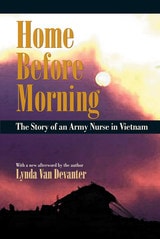
Home before Morning
The Story of an Army Nurse in VietnamLynda Van Devanter
University of Massachusetts Press, 2001
Lynda Van Devanter was the girl next door, the cheerleader who went to Catholic schools, enjoyed sports, and got along well with her four sisters and parents. After high school she attended nursing school and then did something that would shatter her secure world for the rest of her life: in 1969, she joined the army and was shipped to Vietnam. When she arrived in Vietnam her idealistic view of the war vanished quickly. She worked long and arduous hours in cramped, ill-equipped, understaffed operating rooms. She saw friends die. Witnessing a war close-up, operating on soldiers and civilians whose injuries were catastrophic, she found the very foundations of her thinking changing daily.
After one traumatic year, she came home, a Vietnam veteran. Coming home was nearly as devastating as the time she spent in Asia. Nothing was the same -- including Lynda herself. Viewed by many as a murderer instead of a healer, she felt isolated and angry. The anger turned to depression; like many other Vietnam veterans she suffered from delayed stress syndrome. Working in hospitals brought back chilling scenes of hopelessly wounded soldiers. A marriage ended in divorce. The war that was fought physically halfway around the world had become a personal, internal battle.
Home before Morning is the story of a woman whose courage, stamina, and personal history make this a compelling autobiography. It is also the saga of others who went to war to aid the wounded and came back wounded -- physically and emotionally -- themselves. And, it is the true story of one person's triumphs: her understanding of, and coming to terms with, her destiny.
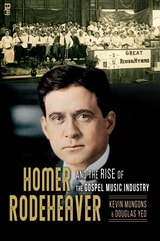
Homer Rodeheaver and the Rise of the Gospel Music Industry
Kevin Mungons and Douglas Yeo
University of Illinois Press, 2021
Homer Rodeheaver merged evangelical hymns and African American spirituals with popular music to create a potent gospel style. Kevin Mungons and Douglas Yeo examine his enormous influence on gospel music against the backdrop of Christian music history and Rodeheaver's impact as a cultural and business figure. Rodeheaver rose to fame as the trombone-playing song leader for evangelist Billy Sunday. As revivalism declined after World War I, Rodeheaver leveraged his place in America's newborn celebrity culture to start the first gospel record label and launch a nationwide radio program. His groundbreaking combination of hymnal publishing and recording technology helped define the early Christian music industry. In his later years, he influenced figures like Billy Graham and witnessed the music's split into southern gospel and black gospel.
Clear-eyed and revealing, Homer Rodeheaver and the Rise of the Gospel Music Industry is an overdue consideration of a pioneering figure in American music.

Homesteader's Portfolio
Alice Day Pratt
Oregon State University Press, 1993
Homing Instincts
Dionisia Morales
Oregon State University Press, 2018
Although Morales migrated from one North American coast to another, the questions she raises are relevant to migrations of any scale and place, whether across town or around the world. What does it mean to be a newcomer? Who has the right to claim a sense of place? What is gained or lost when we try to fit in? In a world where people are migrating more than ever for social, economic, personal, and political reasons, these questions take on a new urgency.
A wife and mother as well as a professional writer and editor, Morales writes with grace and resolve about a broad range of topics, including pregnancy, people watching, rock climbing, and bee colony collapse. She channels a spirit of adventure and adaptability while acknowledging how certain habits and mindsets are indelibly ingrained and are—like it or not—forever part of where, what, and who we call home.
As issues of migration and social integration play out in national and international politics, Morales provides a personal lens through which readers can appreciate that at one time or another we have all been in the process of arriving. Homing Instincts is a remarkable debut from a gifted prose stylist. It will be warmly received by lovers of the essay form and anyone who has sought, or still seeks, a place to call home.
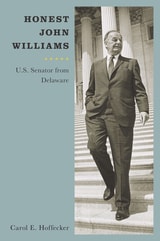
Honest John Williams
U.S. Senator from DelawareCarol E. Hoffecker
University of Delaware Press, 2024
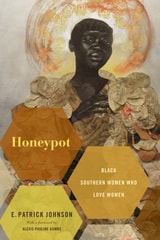
Honeypot
Black Southern Women Who Love WomenE. Patrick Johnson
Duke University Press, 2019
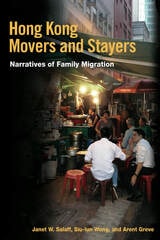
Hong Kong Movers and Stayers
Narratives of Family MigrationJanet W. Salaff, Siu-lun Wong, and Arent Greve
University of Illinois Press, 2010
Half a million Hong Kong residents fled their homeland during the thirteen years before Hong Kong's reversion to China in 1997. Nearly half of those returned within the next several years. Filled with detailed, first-hand stories of nine Hong Kong families over nearly two decades, Hong Kong Movers and Stayers is a multifaceted yet intimate look at the forces behind Hong Kong families' successful, and failed, efforts at migration and settlement.
Defining migration as a process, not a single act of leaving, Hong Kong Movers and Stayers provides an antidote to ethnocentric and simplistic theories by uncovering migration stories as they relate to social structures and social capital. The authors meld survey analysis, personal biography, and sociology and compare multiple families in order to give voice to the interplay of gender, age, and diverse family roles as motivating factors in migration.
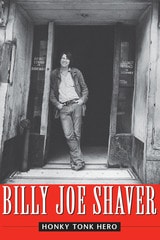
Honky Tonk Hero
By Billy Joe Shaver
University of Texas Press, 2005
Billy Joe Shaver was the real deal. Many agree with him that his songs are pure poetry. Shaver sang about a life that was full of hard times, wild living, and a forty-year-long passion for his late wife Brenda. His songs are raw, honest, and so true that people hear the story of their own lives in his music. No wonder, then, that his songs have also been recorded by artists such as Johnny Cash, Willie Nelson, Waylon Jennings, Kris Kristofferson, George Jones, Bob Dylan, Elvis Presley, Patty Loveless, John Anderson, Tom T. Hall, the Allman Brothers, the Oak Ridge Boys, and Tex Ritter.
In this compelling autobiography written with the assistance of Brad Reagan, Billy Joe Shaver looks back over a life that some might call a miracle of survival. His father abandoned the family before Billy Joe was born. Troubles in school and in the military turned him into a fighter, and a sawmill accident claimed two fingers and part of a third on his right hand. Yet his innate musical talent and the encouragement of an English teacher set him on the road to being a songwriter—and he never looked back. Shaver recounts his long struggle to break into the music business in Nashville and the success that came when Waylon Jennings recorded his songs on the 1973 album Honky Tonk Heroes, which became a landmark of outlaw country music. Shaver movingly describes his own up-and-down career as a singer-songwriter in Nashville and Texas; his bouts with alcohol and drugs; his pleasure in touring with his son, Eddy, and their band, Shaver, during the 1990s; and the pain of losing Eddy, Brenda, and Billy Joe's mother all within the year 1999–2000.
As full of life, heartbreak, and drama as any of Billy Joe Shaver’s songs, Honky Tonk Hero is the story of a man who not only walked on the wild side and lived to tell about it, but also got it all down in songs that many people consider to be some of the finest country music ever written.
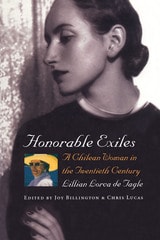
Honorable Exiles
A Chilean Woman in the Twentieth CenturyBy Lillian Lorca de Tagle
University of Texas Press, 2000
Lillian Lorca de Tagle is living proof of women's progress in the twentieth century. Born into a privileged, yet circumscribed world in 1914 as the daughter of a wealthy Chilean diplomat, she became a translator and journalist at a time when few women of her class held jobs. Ordered into exile in the United States by her disapproving mother, she became a successful reporter, translator, and editor, while raising two daughters as a single working mother.
In this beautifully written memoir, de Tagle looks back over a fascinating, cosmopolitan life. She describes how her upbringing in various European capitals prepared her for a life of continual change. She remembers the restrictions that upper class Chilean society placed on women and how these ultimately propelled her to a career in the United States that included an editorship at Américas magazine and work for the State Department, as well as a series of posts with the USIA/Voice of America.
Woven throughout her memoir are vivid glimpses of family, friends, husbands, and lovers, including the artist Roberto Matta. This spicy blend of personalities, work, and culture tells a quintessential coming-of-age story of a thoroughly modern woman.

Hoop Crazy
The Lives of Clair Bee and Chip HiltonDennis Gildea
University of Arkansas Press, 2013
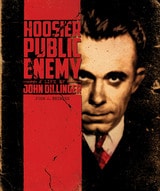
Hoosier Public Enemy
A Life of John DillingerJohn Beineke
Indiana Historical Society Press, 2014
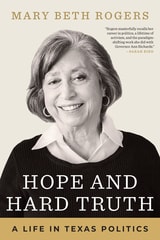
Hope and Hard Truth
A Life in Texas PoliticsMary Beth Rogers
University of Texas Press, 2022
Mary Beth Rogers has led an eventful life rooted in the weeds of Texas politics, occasionally savoring a few victories—particularly the 1990 governor’s race when, as campaign manager for Ann Richards, she did the impossible and put a Democratic woman in office. She also learned to absorb her losses—after all, she was a liberal feminist in America’s most aggressively conservative state.
Rogers’s road to a political life was complex. Candidly and vulnerably, she shares both public and private memories of how she tried to maintain a rich family life with growing children and a husband with a debilitating illness. She goes on to provide an insider’s account of her experiences as Richards’s first chief of staff while weaving her way through the highs and lows of political intrigue and legislative maneuvering.
Reflecting on her family heritage and nascent spiritual quest, Rogers discovers a reality at once sobering and invigorating: nothing is ever completely lost or completely won. It is a constant struggle to create humane public policies built on a foundation of fairness and justice—particularly in her beloved Texas.
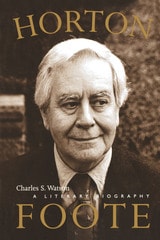
Horton Foote
A Literary BiographyBy Charles S. Watson
University of Texas Press, 2003
Winner of the Pulitzer Prize for Drama for The Young Man from Atlanta and Academy Awards for the screen adaptation of To Kill a Mockingbird and the original screenplay Tender Mercies, as well as the recipient of an Academy Award nomination for the screenplay of The Trip to Bountiful and the William Inge Lifetime Achievement Award, Horton Foote is one of America's most respected writers for stage and screen. The deep compassion he shows for his characters, the moral vision that infuses his social commentary, and the kindness and humanity that Foote himself radiates have also made him one of our most revered artists—the father-figure who understands our longings for home, for human connections, and for certainty in a world largely bereft of these.
This literary biography thoroughly investigates how Horton Foote's life and worldview have shaped his works for stage, television, and film. Tracing the whole trajectory of Foote's career from his small-town Texas upbringing to the present day, Charles Watson demonstrates that Foote has created a fully imagined mythical world from the materials supplied by his own and his family's and friends' lives in Wharton, Texas, in the early twentieth century. Devoting attention to each of Foote's major works in turn, he shows how this world took shape in Foote's writing for the New York stage, Golden Age television, Hollywood films, and in his nine-play masterpiece, The Orphan's Home Cycle. Throughout, Watson's focus on Foote as a master playwright and his extensive use of the dramatist's unpublished correspondence make this literary biography required reading for all who admire the work of Horton Foote.
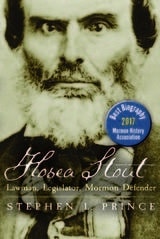
Hosea Stout
Lawman, Legislator, Mormon DefenderStephen L. Prince
Utah State University Press, 2016
Stout joined the Mormons in Missouri in 1838 and followed them to Nauvoo, where he rose quickly to become a top leader in the Nauvoo Legion and chief of police, a position he also held at Winter Quarters. He became the first attorney general for the Territory of Utah, was elected to the Utah Territorial Legislature, and served as regent for the University of Deseret (which later became the University of Utah) and as judge advocate of the Nauvoo Legion in Utah. In 1862, Stout was appointed US attorney for the Territory of Utah by President Abraham Lincoln. In 1867, he became city attorney of Salt Lake City and he was elected to the Utah House of Representatives in 1881.
But Stout’s history also had its troubled moments. Known as a violent man and aggressive enforcer, he was often at the center of controversy during his days on the police force and was accused of having a connection with deaths in Nauvoo and Utah. Ultimately, however, none of these allegations ever found traction, and the leaders of the LDS community, especially Brigham Young, saw to it that Stout was promoted to roles of increasing responsibility throughout his life. When he died in 1889, Hosea Stout left a complicated legacy of service to his state, his church, and the members of his faith community.
Hospital Time
Amy Hoffman
Duke University Press, 1997
Hoffman became central to Riegle’s caregiving when he asked her to be his health-care proxy, and although she willingly chose to do this, she explores her conflicting feelings about herself in this role and about her involvement with Riegle and his grueling struggle with hospitalization, illness, and, finally, death. She tells of the waves of grief that echoed throughout her life, awakening memories of other losses, entering her dreams and fantasies, and altering her relationships with friends, family, and even total strangers.
Hoffman’s memoir gives voice to the psychological and emotional havoc AIDS creates for those in the difficult role of caring for the terminally ill and it gives recognition to the role that lesbians continue to play in the AIDS emergency. A foreword by Urvashi Vaid, former executive director of the National Gay and Lesbian Task Force, offers a meditation on the politics of AIDS and the role of family in the lives of lesbians and gay men.