4413 books match the query 'Anthropology' and 154 start with h
cover of Hybrid Cultures: Strategies for Entering and Leaving Modernity

Hybrid Cultures

Strategies for Entering and Leaving Modernity

Nestor Garcia Canclini

University of Minnesota Press, 1995
Garcia Canclini questions whether Latin America can compete in a global marketplace without losing its cultural identity. He moves with ease from the ideas of Gramsci and Foucault to economic analysis, from appraisals of the exchanges between Octavio Paz and Jorge Luis Borges to Chicano film and grafitti. Hybrid Cultures at once clarifies the development of democratic institutions in Latin America and reveals that the most destructive ideological trends are still going strong.
[more]
cover of Hybrid Cultures: Strategies for Entering and Leaving Modernity

Hybrid Cultures

Strategies for Entering and Leaving Modernity

Nestor Garcia Canclini

University of Minnesota Press, 2005

When it was originally published, Hybrid Cultures was foundational to Latin American cultural studies. This now-classic work features a new introduction in which Nestor Garcia Canclini calls for a cultural politics to contain the damaging effects of globalization and responds to relevant theoretical developments over the past decade.Garcia Canclini questions whether Latin America can compete in a global marketplace without losing its cultural identity. He moves with ease from the ideas of Gramsci and Foucault to economic analysis, from appraisals of the exchanges between Octavio Paz and Jorge Luis Borges to Chicano film and grafitti. Hybrid Cultures at once clarifies the development of democratic institutions in Latin America and reveals that the most destructive ideological trends are still going strong.
[more]
cover of Hybrid Renaissance: Culture, Language, Architecture

Hybrid Renaissance

Culture, Language, Architecture

Peter Burke

Central European University Press, 2016

Hybrid Renaissance introduces the idea that the Renaissance in Italy, elsewhere in Europe, and in the world beyond Europe is an example of cultural hybridization.

The two key concepts used in this book are “hybridization” and “Renaissance”. Roughly speaking, hybridity refers to something new that emerges from the combination of diverse older elements. (The term “hybridization” is preferable to “hybridity” because it refers to a process rather than to a state, and also because it encourages the writer and the readers alike to think in terms of degree: where there is more or less, rather than presence versus absence.)

The book begins with a discussion of the concept of cultural hybridization and a cluster of other concepts related to it. Then comes a geography of cultural hybridization focusing on three locales: courts, major cities (whether ports or capitals) and frontiers. The following seven chapters describe the hybridity of the Renaissance in different fields: architecture, painting and sculpture, languages, literature, music, philosophy and law and finally religion. The essay concludes with a brief account of attempts to resist hybridization or to purify cultures or domains from what was already hybridized.
[more]
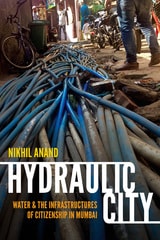
cover of Hydraulic City: Water and the Infrastructures of Citizenship in Mumbai

Hydraulic City

Water and the Infrastructures of Citizenship in Mumbai

Nikhil Anand

Duke University Press, 2017

In Hydraulic City Nikhil Anand explores the politics of Mumbai's water infrastructure to demonstrate how citizenship emerges through the continuous efforts to control, maintain, and manage the city's water. Through extensive ethnographic fieldwork in Mumbai's settlements, Anand found that Mumbai's water flows, not through a static collection of pipes and valves, but through a dynamic infrastructure built on the relations between residents, plumbers, politicians, engineers, and the 3,000 miles of pipe that bind them. In addition to distributing water, the public water network often reinforces social identities and the exclusion of marginalized groups, as only those actively recognized by city agencies receive legitimate water services. This form of recognition—what Anand calls "hydraulic citizenship"—is incremental, intermittent, and reversible. It provides residents an important access point through which they can make demands on the state for other public services such as sanitation and education. Tying the ways Mumbai's poorer residents are seen by the state to their historic, political, and material relations with water pipes, the book highlights the critical role infrastructures play in consolidating civic and social belonging in the city.
[more]