Results by title
617 books match the query 'Civil War Period (1850-1877)' and 18 start with i
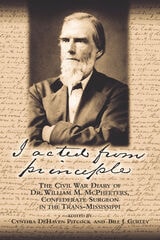
I Acted from Principle
The Civil War Diary of Dr. William M. McPheeters, Confederate Surgeon in the Trans-MississippiCynthia DeHaven Pitcock
University of Arkansas Press, 2000
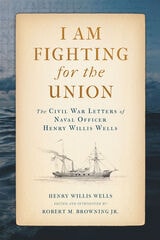
I Am Fighting for the Union
The Civil War Letters of Naval Officer Henry Willis WellsHenry Willis Wells, edited and introduced by Robert M. Browning Jr.
University of Alabama Press, 2023
A young officer’s insightful, detailed and steadfast devotion to the Union Navy—told in his own words.
On May 18, 1862, Henry Willis Wells wrote a letter to his mother telling her in clear terms, “I am fighting for the Union.” Since August 1861, when he joined the US Navy as a master’s mate he never wavered in his loyalty. He wrote to his family frequently that he considered military service a necessary and patriotic duty, and the career that ensued was a dramatic one, astutely and articulately documented by Wells in more than 200 letters home, leaving an invaluable account of daily life in the Union Navy.
Wells joined the navy shortly after the war began, initially on board the Cambridge, attached to the North Atlantic Blockading Squadron, which patrolled the waters of the Chesapeake Bay. He witnessed the Battle of Hampton Roads and the fight between the ironclads CSS Virginia and the USS Monitor. Next, the Cambridge assisted in the blockade of Wilmington, North Carolina. In one instance, the warship chased the schooner J. W. Pindar ashore during her attempt to run the blockade, and Confederate forces captured Henry’s boarding party. After a short prison stay in the infamous Libby Prison in Richmond, his Confederate captors paroled Henry. He travelled back to Brookline, and soon thereafter the Navy Department assigned him to the gunboat Ceres, which operated on the sounds and rivers of North Carolina, protecting army positions ashore. Henry was on board during the Confederate attempt to capture Washington, North Carolina. During this April 1863 attack, Henry was instrumental in the town’s defense, commanding a naval battery ashore during the latter part of the fight.
His exceptional service gained him a transfer to a larger warship, the USS Montgomery, again on the blockade of Wilmington. Later the service assigned him to the Gem of the Sea, part of the East Gulf Blockading Squadron. Through his hard work and professionalism, he finally earned his first command. In September 1864, he became the commanding officer of the Rosalie, a sloop used as a tender to the local warships. Later he commanded the schooner Annie, also a tender. At the end of December 1864, however, the Annie suffered a massive explosion, killing all hands, including Wells. He was twenty-three years old when his life and career ended tragically. Wells’s letters document both his considerable achievements and his frustrations. His challenges, triumphs, and disappointments are rendered with candor. I Am Fighting for the Union is a vital and deeply personal account of a momentous chapter in the history of the Civil War and its navies.
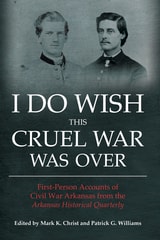
I Do Wish This Cruel War Was Over
First-Person Accounts of Civil War Arkansas from the Arkansas Historical QuarterlyMark K. Christ
University of Arkansas Press, 2014

Illinois in the Civil War
Victor Hicken
University of Illinois Press, 1991
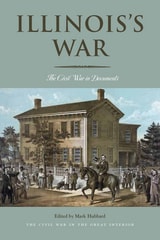
Illinois’s War
The Civil War in DocumentsMark Hubbard
Ohio University Press, 2013
On the eve of the Civil War and after, Illinois was one of the most significant states in the Union. Its history is, in many respects, the history of the Union writ large: its political leaders figured centrally in the war’s origins, progress, and legacies; and its diverse residents made sacrifices and contributions—both on the battlefield and on the home front—that proved essential to Union victory.
The documents in Illinois’s War reveal how the state and its people came to assume such a prominent role in this nation’s greatest conflict. In these crucial decades Illinois experienced its astonishing rise from rural frontier to economic and political powerhouse. But also in these years Illinois was, like the nation itself, a “house divided” over the expansion of slavery, the place of blacks in society, and the policies of the federal government both during and after the Civil War. Illinois’s War illuminates these conflicts in sharp relief, as well as the ways in which Illinoisans united in both saving the Union and transforming their state. Through the firsthand accounts of men and women who experienced these tumultuous decades, Illinois’s War presents the dramatic story of the Prairie State’s pivotal role in the sectional crisis, as well as the many ways in which the Civil War era altered the destiny of Illinois and its citizens.
Illinois’s War is the first book-length history of the state during the Civil War years since Victor Hicken’s Illinois in the Civil War, first published in 1966. Mark Hubbard has compiled a rich collection of letters, editorials, speeches, organizational records, diaries, and memoirs from farmers and workers, men and women, free blacks and runaway slaves, native-born and foreign-born, common soldiers and decorated generals, state and nationally recognized political leaders. The book presents fresh details of Illinois’s history during the Civil War era, and reflects the latest interpretations and evidence on the state’s social and political development.
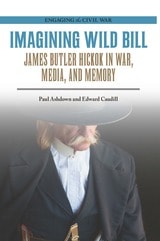
Imagining Wild Bill
James Butler Hickok in War, Media, and MemoryPaul Ashdown and Edward Caudill
Southern Illinois University Press, 2020
When it came to the Wild West, the nineteenth-century press rarely let truth get in the way of a good story. James Butler “Wild Bill” Hickok’s story was no exception. Mythologized and sensationalized, Hickok was turned into the deadliest gunfighter of all, a so-called moral killer, a national phenomenon even while he was alive.
Rather than attempt to tease truth from fiction, coauthors Paul Ashdown and Edward Caudill investigate the ways in which Hickok embodied the culture of glamorized violence Americans embraced after the Civil War and examine the process of how his story emerged, evolved, and turned into a viral multimedia sensation full of the excitement, danger, and romance of the West.
Journalists, the coauthors demonstrate, invented “Wild Bill” Hickok, glorifying him as a civilizer. They inflated his body count and constructed his legend in the midst of an emerging celebrity culture that grew up around penny newspapers. His death by treachery, at a relatively young age, made the story tragic, and dime-store novelists took over where the press left off. Reimagined as entertainment, Hickok’s legend continued to enthrall Americans in literature, on radio, on television, and in the movies, and it still draws tourists to notorious Deadwood, South Dakota.
American culture often embraces myths that later become accepted as popular history. By investigating the allure and power of Hickok’s myth, Ashdown and Caudill explain how American journalism and popular culture have shaped the way Civil War–era figures are remembered and reveal how Americans have embraced violence as entertainment.
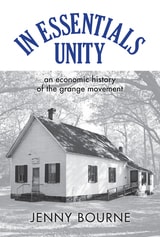
In Essentials, Unity
An Economic History of the Grange MovementJenny Bourne
Ohio University Press, 2017
The Patrons of Husbandry—or the Grange—is the longest-lived US agricultural society and, since its founding shortly after the Civil War, has had immeasurable influence on social change as enacted by ordinary Americans. The Grange sought to relieve the struggles of small farmers by encouraging collaboration. Pathbreaking for its inclusion of women, the Grange is also well known for its association with Gilded Age laws aimed at curbing the monopoly power of railroads.
In Essentials, Unity takes as its focus Grange founder Oliver Kelley and his home organization in Minnesota. Jenny Bourne draws upon numerous historical records to present a lively picture of a fraternal organization devoted to improving the lot of farmers but whose legacies extend far beyond agriculture. From struggles over minimum wage, birth control, and environmental regulation to the conflicts surrounding the Affordable Care Act, and from lunch-counter sit-ins to Occupy Wall Street, the Grange has shaped the very notion of collective action and how it is deployed even today. As this compact book so effectively illustrates, the history of the Patrons of Husbandry exposes the classic tension between the desires for achieving overall economic success and determining how the spoils are split.
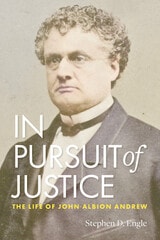
In Pursuit of Justice
The Life of John Albion AndrewStephen D. Engle
University of Massachusetts Press, 2023
Widely known as the “poor man’s lawyer” in antebellum Boston, John Albion Andrew (1818–1867) was involved in nearly every cause and case that advanced social and racial justice in Boston in the years preceding the Civil War. Inspired by the legacies of John Quincy Adams and Ralph Waldo Emerson, and mentored by Charles Sumner, Andrew devoted himself to the battle for equality. By day, he fought to protect those condemned to the death penalty, women seeking divorce, and fugitives ensnared by the Fugitive Slave Law. By night, he coordinated logistics and funding for the Underground Railroad as it ferried enslaved African Americans northward.
In this revealing and accessible biography, Stephen D. Engle traces Andrew’s life and legacy, giving this important, but largely forgotten, figure his due. Rising to national prominence during the Civil War years as the governor of Massachusetts, Andrew raised the African American regiment known as the Glorious 54th and rallied thousands of soldiers to the Union cause. Upon his sudden death in 1867, a correspondent for Harper’s Weekly wrote, “Not since the news came of Abraham Lincoln’s death were so many hearts truly smitten.”
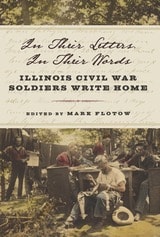
In Their Letters, in Their Words
Illinois Civil War Soldiers Write HomeEdited by Mark Flotow
Southern Illinois University Press, 2019
A vital lifeline to home during the Civil War, the letters of soldiers to their families and friends remain a treasure for those seeking to connect with and understand the most turbulent period of American history. Rather than focus on the experiences of a few witnesses, this impressively researched book documents 165 Illinois Civil War soldiers’ and sailors’ lives through the lens of their personal letters. Editor Mark Flotow chose a variety of letter writers who hailed from counties throughout the state, served in different branches of the military at different ranks, and represented the gamut of social experiences and war outcomes.
Flotow provides extensive quotations from the letters. By allowing the soldiers to speak for themselves, he captures what mattered most to them. Illinois soldiers wrote about their reasons for enlisting; the nature of training and duties; necessities like eating, sleeping, marching, and making the best of often harsh and chaotic circumstances; Southern culture; slavery; their opinions of commanding officers and the president; disease, medicine, and hospitals; their prisoner-of-war experiences; and the ways they left the army. Through letters from afar, many soldiers sought to manage their homes and farms, while some single men attempted to woo their sweethearts.
Flotow includes brief biographies for each soldier quoted in the book, weaves historical context and analysis with the letters, and organizes them by topic. Thus, intimate details cited in individual letters reveal their significance for those who lived and shaped this tumultuous era. The result is not only insightful history but also compelling reading.
Indiana Quakers Confront the Civil War
Jacquelyn S. Nelson
Indiana Historical Society Press, 1991
Indiana in the Civil War Era, 1850-1880
Emma Lou Thornbrough
Indiana Historical Society Press, 1965
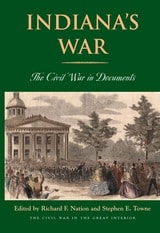
Indiana’s War
The Civil War in DocumentsRichard F. Nation
Ohio University Press, 2009
Indiana’s War is a primary source collection featuring the writings of Indiana’s citizens during the Civil War era. Using private letters, official records, newspaper articles, and other original sources, the volume presents the varied experiences of Indiana’s participants in the war both on the battlefield and on the home front. Starting in the 1850s, the documents show the sharp political divisions over issues such as slavery, race, and secession in Indiana, divisions that boiled over into extraordinary strife and violence in the state during the rebellion. This conflict touched all levels and members of society, including men, women, and children, whites and African Americans, native-born citizens and immigrants, farmers and city and town dwellers.
Collecting the writings of Indiana’s peoples on a wide range of issues, chapters focus on the politics of race prior to the war, the secession crisis, war fever in 1861, the experiences of soldiers at the front, homefront hardships, political conflict between partisan foes and civil and military authorities, reactions to the Emancipation Proclamation, and antiwar dissent, violence, and conspiracy.
Indiana’s War is an excellent accompanying primary source text for undergraduate and graduate courses on the American Civil War. It documents the experiences of Indiana’s citizens, from the African American soldier to the antiwar dissenter, from the prewar politician to the postwar veteran, from the battle-scarred soldier to the impoverished soldier’s wife, all showing the harsh realities of the war.
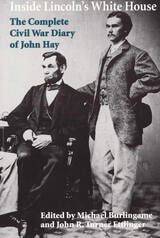
Inside Lincoln's White House
The Complete Civil War Diary of John HayEdited by Michael Burlingame and John R. Turner Ettlinger
Southern Illinois University Press, 1999
On 18 April 1861, assistant presidential secretary John Hay recorded in his diary the report of several women that "some young Virginian long haired swaggering chivalrous of course. . . and half a dozen others including a daredevil guerrilla from Richmond named Ficklin would do a thing within forty eight hours that would ring through the world."
The women feared that the Virginian planned either to assassinate or to capture the president. Calling this a "harrowing communication," Hay continued his entry: "They went away and I went to the bedside of the Chief couché. I told him the yarn; he quietly grinned."
This is but one of the dramatic entries in Hay’s Civil War diary, presented here in a definitive edition by Michael Burlingame and John R. Turner Ettlinger. Justly deemed the most intimate record we will ever have of Abraham Lincoln in the White House, the Hay diary is, according to Burlingame and Ettlinger, "one of the richest deposits of high-grade ore for the smelters of Lincoln biographers and Civil War historians." While the Cabinet diaries of Salmon P. Chase, Edward Bates, and Gideon Welles also shed much light on Lincoln’s presidency, as does the diary of Senator Orville Hickman Browning, none of these diaries has the literary flair of Hay’s, which is, as Lincoln’s friend Horace White noted, as "breezy and sparkling as champagne." An aspiring poet, Hay recorded events in a scintillating style that the lawyer-politician diarists conspicuously lacked.
Burlingame and Ettlinger’s edition of the diary is the first to publish the complete text of all of Hay’s entries from 1861 through 1864. In 1939 Tyler Dennett published Lincoln and the Civil War in the Diaries and Letters of John Hay, which, as Civil War historian Allan Nevins observed, was "rather casually edited." This new edition is essential in part because Dennett omitted approximately 10 percent of Hay’s 1861–64 entries.
Not only did the Dennett edition omit important parts of the diaries, it also introduced some glaring errors. More than three decades ago, John R. Turner Ettlinger, then in charge of Special Collections at the Brown University Library, made a careful and literal transcript of the text of the diary, which involved deciphering Hay’s difficult and occasionally obscure writing. In particular, passages were restored that had been canceled, sometimes heavily, by the first editors for reasons of confidentiality and propriety. Ettlinger’s text forms the basis for the present edition, which also incorporates, with many additions and much updating by Burlingame, a body of notes providing a critical apparatus to the diary, identifying historical events and persons.
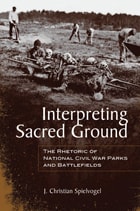
Interpreting Sacred Ground
The Rhetoric of National Civil War Parks and BattlefieldsJ. Christian Spielvogel
University of Alabama Press, 2013
A rhetorical analysis of Civil War battlefields and parks, and the ways various commemorative traditions—and their ideologies of race, reconciliation, emancipation, and masculinity—compete for dominance.
The National Park Service (NPS) is known for its role in the preservation of public sites deemed to have historic, cultural, and natural significance. In Interpreting Sacred Ground, J. Christian Spielvogel studies the NPS’s secondary role as an interpreter or creator of meaning at such sites, specifically Gettysburg National Military Park, Harpers Ferry National Historical Park, and Cold Harbor Visitor Center.
Spielvogel studies in detail the museums, films, publications, tours, signage, and other media at these sites, and he studies and analyzes how they shape the meanings that visitors are invited to construct. Though the NPS began developing interpretive exhibits in the 1990s that highlighted slavery and emancipation as central facets to understanding the war, Spielvogel argues that the NPS in some instances preserves outmoded narratives of white reconciliation and heroic masculinity, obscuring the race-related causes and consequences of the war as well as the war’s savagery.
The challenges the NPS faces in addressing these issues are many, from avoiding unbalanced criticism of either the Union or the Confederacy, to foregrounding race and violence as central issues, preserving clear and accurate renderingsof battlefield movements and strategies, and contending with the various public constituencies with their own interpretive stakes in the battle for public memory.
Spielvogel concludes by arguing for the National Park Service’s crucial role as a critical voice in shaping twentieth-first-century Civil War public memory and highlights the issues the agency faces as it strives to maintain historical integrity while contending with antiquated renderings of the past.
Intimacy in America
Dreams of Affiliation in Antebellum LiteraturePeter Coviello
University of Minnesota Press, 2005
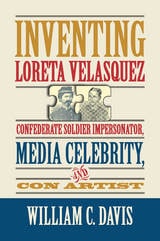
Inventing Loreta Velasquez
Confederate Soldier Impersonator, Media Celebrity, and Con ArtistWilliam C. Davis
Southern Illinois University Press, 2016
This groundbreaking biography reveals a woman quite different from the public persona she promoted. In her bestselling memoir, The Woman in Battle, Velasquez claimed she was an emphatic Confederate patriot, but in fact she never saw combat. Instead, during the war she manufactured bullets for the Union and persuaded her Confederate husband to desert the Army.
After the Civil War ended, she wore many masks, masterminding ambitious confidence schemes worth millions, such as creating a phony mining company, conning North Carolina residents to back her financially in a fake immigration scheme, and attracting investors to build a railroad across western Mexico. With various husbands, Velasquez sought her fortune both in the American West and in the Klondike, though her endeavors cost one husband his life. She also became a social reformer advocating on behalf of better prison conditions, the Cuban revolt against Spain, and the plight of Cuban refugees. Further, Velasquez was one of the first women to venture into journalism and presidential politics. Always a sensational press favorite, she displayed throughout her life an uncanny ability to manipulate popular media and to benefit from her fame in a way that prefigured celebrities of our own time, including using her testimony in a Congressional inquiry about Civil War counterfeiting as a means of promoting her latest business ventures.
So little has been known of Velasquez’s real life that some postmodern scholars have glorified her as a “woman warrior” and used her as an example in cross-gender issues and arguments concerning Hispanic nationalism. Davis firmly refutes these notions by bringing the historical Velasquez to the surface. The genuine story of Velasquez’s life is far more interesting than misguided interpretations and her own fanciful inventions.
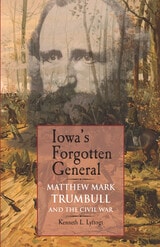
Iowa's Forgotten General
Matthew Mark Trumbull and the Civil WarKenneth L. Lyftogt
University of Iowa Press, 2005
Matthew Mark Trumbull was a Londoner who immigrated at the age of twenty. Within ten years of his arrival in America, he had become a lawyer in Butler County, Iowa; two years later a member of the state legislature; and two years after that a captain in the Union Army. By the end of the Civil War, he was a brevet brigadier general, and in his later years he was an author and lecturer. Kenneth Lyftogt’s biography details the amazing life of this remarkable man, also shedding light on the histories of the Third Iowa Volunteer Infantry and the Ninth Iowa Volunteer Cavalry.
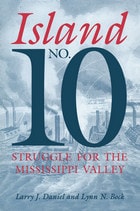
Island No. 10
Struggle for the Mississippi ValleyLynn N. Bock
University of Alabama Press, 1996
A definitive study of strategy, river warfare, and Union triumph in the Mississippi Valley.
Island No. 10: Struggle for the Mississippi Valley is a deeply researched, narrative-driven history of the Civil War New Madrid–Island No. 10 campaign in 1862—an episode overshadowed by Fort Donelson and Shiloh yet vital to Union mastery of the Mississippi River. The authors argue that the campaign was far more consequential than its marginalization in traditional Civil War histories suggests, demonstrating that the fall of Island No. 10 consolidated Union control of the upper Mississippi, accelerated the collapse of Confederate fortunes in the West, and highlighted the transformative power of joint Army–Navy operations.
The book’s strengths lie in its rich use of diaries, letters, official military records, and contemporary press accounts, weaving together strategy, engineering, naval innovation, politics, and the lived experience of soldiers. Vivid descriptions of fortification design, the ironclad flotilla, the dramatic night battery runs, and the grueling canal‑cutting operation offer readers a ground‑level and command‑level view of the campaign. Larry J. Daniel, an acclaimed Civil War historian and award‑winning author of Cannoneers in Gray and Soldiering in the Army of Tennessee, together with Lynn N. Bock, a historian, attorney, and longtime steward of New Madrid’s local history, bring scholarly authority and regional expertise to the subject.
This book will captivate readers interested in Civil War military history, riverine warfare, engineering feats, and the Western theater. It is especially valuable for scholars, buffs seeking a fresh perspective on neglected campaigns, students of joint operations, and anyone exploring how geography, logistics, and technology shaped the course of the war.