Results by title
14 books match the query 'Passage'
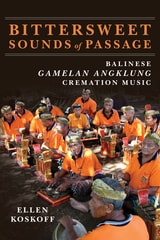
Bittersweet Sounds of Passage
Balinese Gamelan Angklung Cremation MusicEllen Koskoff
University of Illinois Press, 2025
Koskoff examines the history, cultural significance, and musical structures of contemporary gamelan angklung cremation music through the lens of three intertwined stories: existing scholarship on this music, written mostly by Western composers and scholars; the views of those performing and experiencing the music who regard it as dharma--ritual obligation, a basic concept in Balinese Hinduism; and the music itself, with a musical analysis focusing on changes in rasa--feeling, flavor and musical flow.
A journey inside a tradition, Bittersweet Sounds of Passage reveals the overlooked music of an important ritual in Balinese village life.
Companions for the Passage
Stories of the Intimate Privilege of Accompanying the DyingMarjorie Ryerson
University of Michigan Press, 2005
Some of the interviewees are religious, some not; some encouraged their loved ones to accept death, others to fight it to the end. There are stories of heroic nurses and of indifferent hospital bureaucracies, of deaths that came too soon, and those that came at the end of a long, rich life. Possessing an affirmative quality that is anything but sentimental, ultimately these stories celebrate the experience of being present at the death of a loved one.
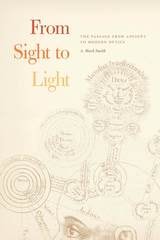
From Sight to Light
The Passage from Ancient to Modern OpticsA. Mark Smith
University of Chicago Press, 2014
Breaking from previous scholarship that sees Johannes Kepler as the culmination of a long-evolving optical tradition that traced back to Greek antiquity via the Muslim Middle Ages, Smith presents Kepler instead as marking a rupture with this tradition, arguing that his theory of retinal imaging, which was published in 1604, was instrumental in prompting the turn from sight to light. Kepler’s new theory of sight, Smith reveals, thus takes on true historical significance: by treating the eye as a mere light-focusing device rather than an image-producing instrument—as traditionally understood—Kepler’s account of retinal imaging helped spur the shift in analytic focus that eventually led to modern optics.
A sweeping survey, From Sight to Light is poised to become the standard reference for historians of optics as well as those interested more broadly in the history of science, the history of art, and cultural and intellectual history.
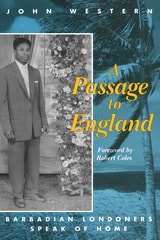
Passage To England
Barbadian Londoners Speak of HomeJohn Western
University of Minnesota Press, 1992
Since World War II London has become a significantly multiracial city. Some of the earliest agents of its transformation were young men and women recruited in the late 1950s from Barbados, then a British colony, to work in the metropolis’s nationalized public transportation system and in its hospitals. These Barbadians met, married, settled in London, and raised Londoner children. In 1987-88 John Western conducted a series of interviews with twelve such families--both parents and children. Their vivid words fill A Passage to England with insight, human, and, often, poignancy. Here is a rich perspective on thirty years or more of London social history.
Western structured the interviews to allow the Barbadians a lot of freedom to discuss whatever came to mind concerning either their own life histories and achievements, or wider themes of culture, politics, and society. Topics covered range from matters of “race” to Margaret Thatcher and the change her decade in power has wrought in Britain. One development, for example, is the strikingly entrepreneurial spirit now embraced by some of the young British blacks, veritably “Mrs. Thatcher’s Children.” Ultimately, many of the interviewees focused on the changes they see in their ancestral island in the Caribbean, to which all of them have returned for visits. For this migrant generation especially, as the prospect of retirement begins to grow increasingly important, inevitable questions regard the definitions of “home” and “belonging” must be confronted: Does one stay in London--with one’s children and grandchildren--or does one return to Barbados, which for many seems no longer the same island as the one they left a working lifetime ago? Within the context of an ever-increasing complement of geographically mobile people worldwide, Western’s study provides unique insights into the particular ambiguities a particular set of person have wrestled with at a particular moment in history...but the import of the Barbadian Londoners’ story is universal.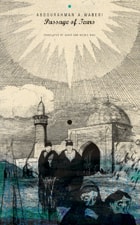
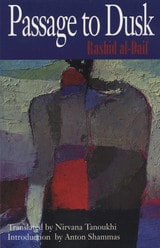
Passage of Tears
Abdourahman A. Waberi
Seagull Books, 2011
Passage to Dusk
By Rashid al-Daif
University of Texas Press, 2001
Passage to Dusk deals with the Lebanese civil war of the 1970s in a postmodern, poetic style. The narrative focuses on the deranged, destabilized, confused, and hyper-perceptive state of mind created by living on the scene through a lengthy war. The story is filled with details that transcend the willed narcissism of the main character, while giving clues to the culture of the time. It is excellent fiction, written in a surrealistic mode, but faithful to the characters of the people of Lebanon, their behavior during the war, and their contradictions. Issues of gender and identity are acutely portrayed against Lebanon's shifting national landscape.
The English-language reader has not been much exposed to Lebanese literature in translation, and Rashid al-Daif is one of Lebanon's leading writers. He has been translated into eight languages, including French, German, Italian, Polish, and Spanish. Translator Nirvana Tanoukhi manages to preserve Daif's unusual, moving, and at times humorous style in her English rendition.
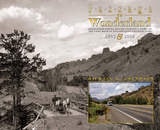
Passage to Wonderland
Rephotographing Joseph Stimson's Views of the Cody Road to Yellowstone National Park, 1903 and 2008Michael A. Amundson
University Press of Colorado, 2012
Amundson examines the physical changes along "the most scenic fifty miles in America" and explores the cultural and natural history behind them. This careful analysis of the paired images make Passage to Wonderland more than a "then and now" photography book--it is a unique exploration of the interconnectedness between the Old West and the New West. It will be a wonderful companion for those touring the Cody Road as well as those armchair tourists who can follow the road on Google Earth using the provided GPS coordinates.
The University Press of Colorado gratefully acknowledges the generous support of the Charles Redd Center for Western Studies at Brigham Young University toward the publication of this book.
Passage to the Plaza
Sahar Khalifeh
Seagull Books, 2020
In the furnace of conflict at the heart of the 1987 Intifada, notions of freedom, love, respectability, nationhood, the rights of women, and Palestinian identity—both among the reluctant residents of the house and the inhabitants of the quarter at large—will be melted and re-forged. Vividly recounted through the eyes of its female protagonists, Passage to the Plaza is a groundbreaking story that shatters the myth of a uniform gendered experience of conflict.
Routes of Passage
Rethinking the African Diaspora: Volume 1, Part 1Ruth Simms Hamilton
Michigan State University Press, 2007
Routes of Passage provides a conceptual, substantive, and empirical orientation to the study of African people worldwide. The book addresses issues of geographical mobility and geosocial displacement; changing culture, political, and economic relationships between Africa and its diaspora; interdiaspora relations; political and economic agency and social mobilization, including cultural production and psychocultural transformation; existence in hostile and oppressive political and territorial space; and confronting interconnected relations of social inequality, especially class, gender, nationality, and race.
Routes of Passage
Rethinking the African Diaspora: Volume 1, Part 2Ruth Simms Hamilton
Michigan State University Press, 2007
Routes of Passage provides a conceptual, substantive, and empirical orientation to the study of African people worldwide. Routes of Passage addresses issues of geographical mobility and geosocial displacement; changing cultural, political, and economic relationships between Africa and its diaspora; interdiaspora relations; political and economic agency and social mobilization, including cultural production and psychocultural transformation; existence in hostile and oppressive political and territorial space; and confronting interconnected relations of social inequality, especially class, gender, nationality, and race.
The Passage to Cosmos
Alexander von Humboldt and the Shaping of AmericaLaura Dassow Walls
University of Chicago Press, 2009
Explorer, scientist, writer, and humanist, Alexander von Humboldt was the most famous intellectual of the age that began with Napoleon and ended with Darwin. With Cosmos, the book that crowned his career, Humboldt offered to the world his vision of humans and nature as integrated halves of a single whole. In it, Humboldt espoused the idea that, while the universe of nature exists apart from human purpose, its beauty and order, the very idea of the whole it composes, are human achievements: cosmos comes into being in the dance of world and mind, subject and object, science and poetry.
Humboldt’s science laid the foundations for ecology and inspired the theories of his most important scientific disciple, Charles Darwin. In the United States, his ideas shaped the work of Emerson, Thoreau, Poe, and Whitman. They helped spark the American environmental movement through followers like John Muir and George Perkins Marsh. And they even bolstered efforts to free the slaves and honor the rights of Indians.
Laura Dassow Walls here traces Humboldt’s ideas for Cosmos to his 1799 journey to the Americas, where he first experienced the diversity of nature and of the world’s peoples—and envisioned a new cosmopolitanism that would link ideas, disciplines, and nations into a global web of knowledge and cultures. In reclaiming Humboldt’s transcultural and transdisciplinary project, Walls situates America in a lively and contested field of ideas, actions, and interests, and reaches beyond to a new worldview that integrates the natural and social sciences, the arts, and the humanities.
To the end of his life, Humboldt called himself “half an American,” but ironically his legacy has largely faded in the United States. The Passage to Cosmos will reintroduce this seminal thinker to a new audience and return America to its rightful place in the story of his life, work, and enduring legacy.
The Rites of Passage
Arnold van Gennep
University of Chicago Press, 1961
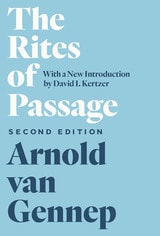
The Rites of Passage, Second Edition
Arnold van Gennep
University of Chicago Press, 2019
With a new introduction by Pulitzer Prize–winner David I. Kertzer
Arnold van Gennep’s masterwork, The Rites of Passage, has been a staple of anthropological education for more than a century. First published in French in 1909, and translated into English by the University of Chicago Press in 1960, this landmark book explores how the life of an individual in any society can be understood as a succession of transitions: birth, puberty, marriage, parenthood, old age, and, finally, death. Van Gennep’s great insight was discerning a common structure in each of these seemingly different transitions, involving rituals of separation, liminality, and incorporation. With compelling precision, he set out the terms that would both define twentieth-century ritual theory and become a part of our everyday lexicon.
This new edition of his work demonstrates how we can still make use of its enduring critical tools to understand our own social, religious, and political worlds, and even our personal and professional lives. In his new introduction, Pulitzer Prize–winning historian and anthropologist David I. Kertzer sheds new light on van Gennep, on the battles he fought, and on the huge impact the book has had since publication of the first English edition.
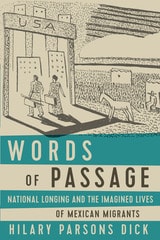
Words of Passage
National Longing and the Imagined Lives of Mexican MigrantsBy Hilary Parsons Dick
University of Texas Press, 2018
Migration fundamentally shapes the processes of national belonging and socioeconomic mobility in Mexico—even for people who never migrate or who return home permanently. Discourse about migrants, both at the governmental level and among ordinary Mexicans as they envision their own or others’ lives in “El Norte,” generates generic images of migrants that range from hardworking family people to dangerous lawbreakers. These imagined lives have real consequences, however, because they help to determine who can claim the resources that facilitate economic mobility, which range from state-sponsored development programs to income earned in the North.
Words of Passage is the first full-length ethnography that examines the impact of migration from the perspective of people whose lives are affected by migration, but who do not themselves migrate. Hilary Parsons Dick situates her study in the small industrial city of Uriangato, in the state of Guanajuato. She analyzes the discourse that circulates in the community, from state-level pronouncements about what makes a “proper” Mexican to working-class people’s talk about migration. Dick shows how this migration discourse reflects upon and orders social worlds long before—and even without—actual movements beyond Mexico. As she listens to men and women trying to position themselves within the migration discourse and claim their rights as “proper” Mexicans, she demonstrates that migration is not the result of the failure of the Mexican state but rather an essential part of nation-state building.