62 books match the query 'Discrimination' and 4 start with i
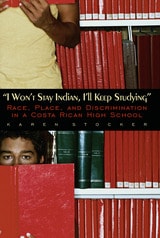
cover of I Won't Stay Indian, I'll Keep Studying: Race, Place, and Discrimination in a Costa Rican High School

I Won't Stay Indian, I'll Keep Studying

Race, Place, and Discrimination in a Costa Rican High School

Karen Stocker

University Press of Colorado, 2005

While teaching and researching on an indigenous reservation in Costa Rica, Karen Stocker discovered that for Native students who attended the high school outside the reservation, two extreme reactions existed to the predominantly racist high school environment. While some maintained their indigenous identity and did poorly in school, others succeeded academically, but rejected their Indianness and the reservation. Between these two poles lay a whole host of responses. In "I Won't Stay Indian, I'll Keep Studying," Stocker addresses the institutionalized barriers these students faced and explores the interaction between education and identity.

Stocker reveals how overt and hidden curricula taught ethnic, racial, and gendered identities and how the dominant ideology of the town, present in school, conveyed racist messages to students.

"I Won't Stay Indian, I'll Keep Studying" documents how students from the reservation reacted to, coped with, and resisted discrimination. Considering the students' experiences in the context of the Costa Rican educational system as a whole, Stocker discusses policy shifts that might reduce institutionalized discrimination. Her interpretation of the experiences of these students makes a significant contribution to anthropology, Latin American studies, critical race theory, and educational theory.
[more]
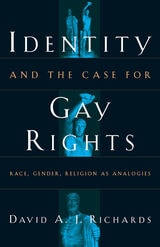
cover of Identity and the Case for Gay Rights: Race, Gender, Religion as Analogies

Identity and the Case for Gay Rights

Race, Gender, Religion as Analogies

David A. J. Richards

University of Chicago Press, 1999

How should we chart a course toward legal recognition of gay rights as basic human rights? In this enlightening study, legal scholar David Richards explores the connections between gay rights and three successful civil rights movements—black civil rights, feminism, and religious toleration—to determine how these might serve as analogies for the gay rights movement.

Richards argues that racial and gender struggles are informative but partial models. As in these movements, achieving gay rights requires eliminating unjust stereotypes and allowing one's identity to develop free from intolerant views. Richards stresses, however, that gay identity is an ethical choice based on gender equality. Thus the right to religious freedom offers the most compelling analogy for a gay rights movement because gay identity should be protected legally as an ethical decision of conscience.

A thoughtful and highly original voice in the struggle for gay rights, David Richards is the first to argue that discrimination is like religious intolerance-denial of full humanity to individuals because of their identity and moral commitments to gender equality.
[more]
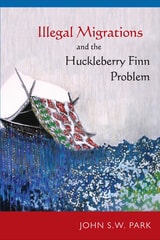
cover of Illegal Migrations and the Huckleberry Finn Problem

Illegal Migrations and the Huckleberry Finn Problem

John S W Park

Temple University Press, 2013
Throughout American history, citizens have encountered people who are "illegal"-- that is, people who have no legal right to be in the United States or to freedom of movement because of their immigration status or race. Like Mark Twain's Huckleberry Finn, these citizens face the conflict between sympathy for the unlawful other and the force of the law. 
In Illegal Migrations and the Huckleberry Finn Problem, John Park explores problems of status and illegality in American law and society by examining on-going themes in American legal history, comparative ethnic studies, and American literature. He observes that in reconsidering racially discriminatory laws, Americans have celebrated persons who were "out of status," as well as the citizens who had helped them avoid American law. Similarly, in confronting illegal immigrants in our own time, many Americans have chosen to ignore or to violate federal laws in favor of assisting such persons. In light of these experiences, Park insists that the U.S. ought to rethink policies that have criminalized millions of immigrants, as the injustice of such rules has encouraged people to disobey the law, thereby undermining broader commitments to principles of equality and to the rule of law itself.
[more]
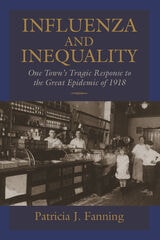
cover of Influenza and Inequality: One Town's Tragic Response to the Great Epidemic of 1918

Influenza and Inequality

One Town's Tragic Response to the Great Epidemic of 1918

Patricia J. Fanning

University of Massachusetts Press, 2010

The influenza epidemic of 1918 was one of the worst medical disasters in human history, taking close to thirty million lives worldwide in less than a year, including more than 500,000 in the United States. What made this pandemic even more frightening was the fact that it occurred when death rates for most common infectious diseases were diminishing. Still, an epidemic is not merely a medical crisis; it has sociological, psychological, and political dimensions as well. In Influenza and Inequality, Patricia J. Fanning examines these other dimensions and brings to life this terrible episode of epidemic disease by tracing its path through the town of Norwood, Massachusetts.

By 1918, Norwood was a small, ethnically diverse, industrialized, and stratified community. Ink, printing, and tanning factories were owned by wealthy families who lived privileged lives. These industries attracted immigrant laborers who made their homes in several ethnic neighborhoods and endured prejudice and discrimination at the hands of native residents. When the epidemic struck, the immigrant neighborhoods were most affected; a fact that played a significant role in the town's response—with tragic results.

This close analysis of one town's struggle illuminates how even well-intentioned elite groups may adopt and implement strategies that can exacerbate rather than relieve a medical crisis. It is a cautionary tale that demonstrates how social behavior can be a fundamental predictor of the epidemic curve, a community's response to crisis, and the consequences of those actions.
[more]