Results by title
438 books match the query 'Hispanic & Latino' and 11 start with i
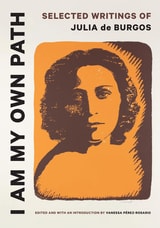
I Am My Own Path
Selected Writings of Julia de BurgosEdited and with an introduction by Vanessa Pérez-Rosario
University of Texas Press, 2023
2026 Silver Medal for the Victor Villaseñor Best Latino Focused Nonfiction Book Award – Spanish, Conference on Latin American History (CLAH)
A definitive, bilingual selection of poetry, essays, and letters by one of Puerto Rico’s most beloved poets.
Julia de Burgos (1914–1953) is best known for her poetry, but she is also an important cultural figure famous for her commitment to social justice, feminist ideas, and the independence of Puerto Rico. Admirers cultivated her legacy to bring to light the real Julia de Burgos, the woman behind the public figure, which this remarkable collection further illuminates by supplying a complex portrait using her own powerful and imaginative words.
Beginning with a critical introduction to Burgos's life and work, Vanessa Pérez-Rosario then presents a selection of poems, essays, and letters, that offer a glimpse into this formidable talent and intellect. Burgos left Puerto Rico, spending the 1940s in both New York City and Havana, where she cultivated a new kind of identity refracted through her pathbreaking work as a poet and journalist. Both poetry and prose are alive with politically charged insights into the struggle of national liberation, literary creation, and being a woman in a patriarchal society. I Am My Own Path is essential reading for anyone interested in Puerto Rican literature and culture as well as a foundational text of Latinx literature and culture in the United States.

If I Die in Juárez
Stella Pope Duarte
University of Arizona Press, 2008
Based on the author’s interviews with relatives of murdered women, If I Die in Juárez is brilliantly crafted to give readers the experience of walking in the shoes of women who daily risk being abducted and murdered in the “capital city of murdered women,” joining thousands of others who for more than a decade have disappeared from Juárez, las desaparecidas, brutally murdered by assassins who have gone unpunished. The agony of one of the darkest tales in human history brings to light a strange hope, illusive yet constant, resisting lies, betrayal, and the desert’s silent sentence of death.
Read an in-depth review of If I Die in Juárez here or click here for a study guide. If I Die in Juárez was also reviewed on KNAU's Southwest Book Review program. Listen here!
In Search of Snow
Luis Alberto Urrea
University of Arizona Press, 1999
In Search of Snow is an explosive coming-of-age adventure, full of hilarious episodes and still, poignant moments. Like a blue-collar Don Quixote, Mike must blow up his windmills before he can set off to find the things he lacks, especially the snow that will temper the passion he has just set aflame.
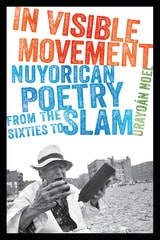
In Visible Movement
Nuyorican Poetry from the Sixties to SlamUrayoan Noel
University of Iowa Press, 2014
The first book-length study specifically devoted to Nuyorican poetry, In Visible Movement is unique in its historical and formal breadth, ranging from the foundational poets of the 1960s and 1970s to a variety of contemporary poets emerging in and around the Nuyorican Poets Cafe “slam” scene of the 1990s and early 2000s. It also unearths a largely unknown corpus of poetry performances, reading over forty years of Nuyorican poetry at the intersection of the printed and performed word, underscoring the poetry’s links to vernacular and Afro-Puerto Rican performance cultures, from the island’s oral poets to the New York sounds and rhythms of Latin boogaloo, salsa, and hip-hop. With depth and insight, Urayoán Noel analyzes various canonical Nuyorican poems by poets such as Pedro Pietri, Victor Hernández Cruz, Miguel Algarín, Miguel Piñero, Sandra María Esteves, and Tato Laviera. He discusses historically overlooked poets such as Lorraine Sutton, innovative poets typically read outside the Nuyorican tradition such as Frank Lima and Edwin Torres, and a younger generation of Nuyorican-identified poets including Willie Perdomo, María Teresa Mariposa Fernández, and Emanuel Xavier, whose work has received only limited critical consideration. The result is a stunning reflection of how New York Puerto Rican poets have addressed the complexity of identity amid diaspora for over forty years.
In an Angry Season
Lisa D. Chávez
University of Arizona Press, 2001
A white woman navigates her fear and uncertainty to learn the ways of the people she called savages, until she begins to dream “in Dakota, syllables sliding / on my tongue like tender pieces of meat.” An African man, on display as a cannibal at the World’s Columbian Exposition in 1893, sees into the future: “humiliations heaped up / as on overfilled plates . . . / . . . a country that casually / consumes its own.” A woman holds the gray-blue barrel of a gun in her mouth, “the taste familiar / as her own blood.”
With an unexcelled command of narrative verse, Lisa Chávez tells the stories of American lives across more than a century. Whether retelling nineteenth-century captivity narratives or depicting contemporary American women confronting addiction and despair, Chávez investigates issues of identity and self-definition in the face of an often harsh and unremitting history.
Her story-poems explore the ways in which people have been made captive—whether to racism or national policy, to bad marriages or alcoholism, to poverty or emotion—from the Inuit woman birthing a son among strangers to the wife now deranged by desire for another man: “He’s the smoky slow-burn of chipotle on the tongue. My golden idol. My gospel revival. He’s hashish sweet and languorous—my body’s one desire.”
In the end, Chávez shows us a New World of promise in which an alchemist’s assistant summons stories from stones by calling their names with “clicks of her tongue, / syllables of silver, turquoise, and jade,” and a Native woman discovers her true power in an Alaskan bar. Passionate and political, In an Angry Season is a work of startling depth and breadth—an American history in poetry—that asks us what it means to be civilized.
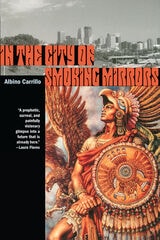
In the City of Smoking Mirrors
Albino Carrillo
University of Arizona Press, 2004
In the City of Smoking Mirrors relates H.'s adventures as he hovers between life and death, revisiting his homeland and ancestors. He issues letters and edicts—to the faithful, to his dead amigos—and chronicles his circumnavigation of the Land of the Dead and "what he saw there that made him write this book." In tantalizing verse that walks the edge of dream, Albino Carrillo takes readers on a lyrical exploration of a dark netherworld, a quest for hope in a universe overshadowed by impending doom—a place where "The demons you'll have to defeat on your inward journey / Are like so many little yellow hornets buzzing about / Window screens in summer, angry but looking / For anything sweet, any way out . . . ." Through the unforgettable persona of Huitzilopochtli, Carrillo shows us the transitory nature of our passions and wounds as he chisels a new headstone for our times.
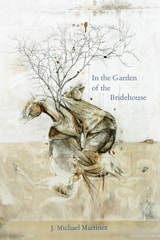
In the Garden of the Bridehouse
J. Michael Martinez
University of Arizona Press, 2014
Turning the page into a visual field, as in the deconstructed musical score telling the tale of La Llorona, In the Garden of the Bridehouse questions the line between visual art and poetry. The work employs the vernacular, the stylized language of theory, and the blank canvas of the page in its exploration of the known and unknowable.
Throughout the work, Martinez paradoxically exercises both a lyrical minimalism and a baroque poetic, uniting Mesoamerican preconquest imaginary with the sensuality of the Biblical Song of Songs, cultivating a lyrical space wherein contrasting potentials are—as one—realized in their shared promise.
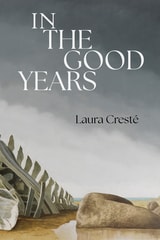
In the Good Years
Laura Cresté
Four Way Books, 2025
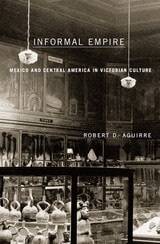
Informal Empire
Mexico And Central America In Victorian CultureRobert D. Aguirre
University of Minnesota Press, 2004
Behind the ancient artifacts exhibited in our museums lies a secret past—of travel, desire, the quest for knowledge, and even theft. Such is the case with the objects of Mesoamerican culture so avidly collected, cataloged, and displayed by the British in the nineteenth century. Informal Empire recaptures the history of those artifacts from Mexico and Central America that stirred Victorian interest—a history that reveals how such objects and the cultures they embodied were incorporated into British museum collections, panoramas, freak shows, adventure novels, and records of imperial administrators.
Robert D. Aguirre draws on a wealth of previously untapped historical information to show how the British colonial experience in Africa and the Near East gave rise to an “informal imperialism” in Mexico and Central America. Aguirre’s work helps us to understand what motivated the British to beg, borrow, buy, and steal from peripheral cultures they did not govern. With its original insights, Informal Empire points to a new way of thinking about British imperialism and, more generally, about the styles and forms of imperialism itself.
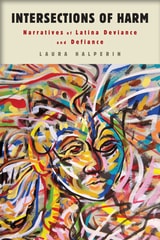
Intersections of Harm
Narratives of Latina Deviance and DefianceHalperin, Laura
Rutgers University Press, 0
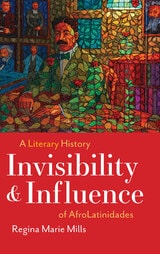
Invisibility and Influence
A Literary History of AfroLatinidadesRegina Marie Mills
University of Texas Press, 2024
2026 Honorable Mention, Latinx Studies Section, Social Sciences Category, Latin American Studies Association (LASA)
A rich literary study of AfroLatinx life writing, this book traces how AfroLatinxs have challenged their erasure in the United States and Latin America over the last century.
Invisibility and Influence demonstrates how a century of AfroLatinx writers in the United States shaped life writing, including memoir, collective autobiography, and other formats, through depictions of a wide range of “Afro-Latinidades.” Using a woman-of-color feminist approach, Regina Marie Mills examines the work of writers and creators often excluded from Latinx literary criticism. She explores the tensions writers experienced in being viewed by others as only either Latinx or Black, rather than as part of their own distinctive communities. Beginning with Arturo (Arthur) Schomburg, who contributed to wider conversations about autobiographical technique, Invisibility and Influence examines a breadth of writers, including Jesús Colón; members of the Young Lords; Piri Thomas; Lukumi santera and scholar Marta Moreno Vega; and Black Mexican American poet Ariana Brown. Mills traces how these writers confront the distorted visions of AfroLatinxs in the United States, Latin America, and the Caribbean, and how they created and expressed AfroLatinx spirituality, politics, and self-identity, often amidst violence. Mapping how AfroLatinx writers create their own literary history, Mills reveals how AfroLatinx life writing shapes and complicates discourses on race and colorism in the Western Hemisphere.
Dialogues in AfroLatinidad Podcast:https://www.youtube.com/watch?v=FIhF-pdeW3A