Results by title
28 books match the query 'Hegel'
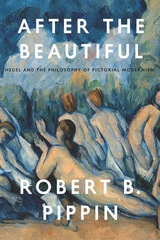
After the Beautiful
Hegel and the Philosophy of Pictorial ModernismRobert B. Pippin
University of Chicago Press, 2013
While Hegel could never engage modernist painting, he did have an understanding of modernity, and in it, art—he famously asserted—was “a thing of the past,” no longer an important vehicle of self-understanding and no longer an indispensable expression of human meaning. Pippin offers a sophisticated exploration of Hegel’s position and its implications. He also shows that had Hegel known how the social institutions of his day would ultimately fail to achieve his own version of genuine equality, a mutuality of recognition, he would have had to explore a different, new role for art in modernity. After laying this groundwork, Pippin goes on to illuminate the dimensions of Hegel’s aesthetic approach in the path-breaking works of Manet, the “grandfather of modernism,” drawing on art historians T. J. Clark and Michael Fried to do so. He concludes with a look at Cézanne, the “father of modernism,” this time as his works illuminate the relationship between Hegel and the philosopher who would challenge Hegel’s account of both modernity and art—Martin Heidegger.
Elegantly inter-weaving philosophy and art history, After the Beautiful is a stunning reassessment of the modernist project. It gets at the core of the significance of modernism itself and what it means in general for art to have a history. Ultimately, it is a testament, via Hegel, to the distinctive philosophical achievements of modernist art in the unsettled, tumultuous era we have inherited.

An Introduction To Hegel
The Stages of Modern PhilosophyHoward P. Kainz
Ohio University Press, 1996
In a sense it would be inappropriate to speak of “Hegel’s system of philosophy,” because Hegel thought that in the strict sense there is only one system of philosophy evolving in the Western world. In Hegel’s view, although at times philosophy’s history seems to be a chaotic series of crisscrossing interpretations of meanings and values, with no consensus, there has been a teleological development and consistent progress in philosophy and philosophizing from the beginning; Hegel held that his own version of “German idealism” was simply bringing to final expression the latest refinements of an ongoing, perennial system.
If we take Hegel at his word, then one of the best entries into his system would be through the history of philosophy, showing how systems and schools of thought prior to Hegel led up to his system. The most important currents to focus on, however, would be in modern philosophy, in which especially intensive changes led ultimately to German idealism and Hegel’s immediate predecessors.
Fortunately, Hegel lectured extensively on the history of modern philosophy and structured his lectures in such a way as to throw light on the status of the “one system” of Western philosophy at the time — the status to which Hegel felt he had been contributing and was continuing to contribute. These lectures are of interest, first of all, as a systematic chronicle of philosophical positions in the heyday of modern philosophy, from Bacon to Hegel. Second, they are interesting because Hegel’s critical comments on his predecessors clarify his own positions: for example, the dialectic method and the importance of triplicity, the relationship of philosophy to the scientific method, the necessity for avoidance of the extremes of empiricism and of idealism, the subject/object problematic, the “identity” of rationality and reality, and the technical meaning in Hegel’s philosophy of “absolute,” “infinity,” and the “idea.”
Endings
Questions of Memory in Hegel and HeideggerEdited by Rebecca Comay and John McCumber
Northwestern University Press, 1999
Beginning at the point where Heidegger encountered Hegel, this volume of provocative essays addresses the respective philosophies of the two men. Leading scholars provide a variety of models from which to view the unique relationship between the bodies of thought of Heidegger and Hegel: bodies of thought that cannot be taken as two objects to be compared, contrasted, and finally evaluated but that must be viewed in dynamic terms, as a relationship in which self-transformations lead to mutual transformations and vice versa.
Experience and Empiricism
Hegel, Hume, and the Early DeleuzeRussell Ford
Northwestern University Press, 2023
A clarifying examination of Gilles Deleuze’s first book shows how he would later transform the problem of immanence into the problem of difference
Despite the wide reception Gilles Deleuze has received across the humanities, research on his early work has remained scant. Experience and Empiricism remedies that gap with a detailed study of Deleuze’s first book, Empiricism and Subjectivity, which is devoted to the philosophical project of David Hume. Russell Ford argues that this work is poorly understood when read simply as a stand-alone study on Hume. Its significance only becomes apparent within the context of a larger problematic that dominated, and continues to inform, modern European philosophy: the conceptual constitution of a purely immanent account of existence. While the importance of this debate is recognized in contemporary scholarship, its genealogy—including Deleuze’s place within it—has been underappreciated. This book shows how Deleuze directly engages in an ongoing debate between his teachers Jean Wahl and Jean Hyppolite over experience and empiricism, an intervention that restages the famous encounter between rationalism and empiricism that yielded Kant’s critical philosophy. What, Deleuze effectively asks, might have happened had Hume been the one roused from his empirical dogmatic slumber by the rationalist challenge of Kant?

Hegel and Deleuze
Together Again for the First TimeKaren Houle
Northwestern University Press, 2013
Hegel and Deleuze cannily examines the various resonances and dissonances between these two major philosophers. The collection represents the best in contemporary international scholarship on G. W. F. Hegel and Gilles Deleuze, and the contributing authors inhabit the as-yet uncharted space between the two thinkers, collectively addressing most of the major tensions and resonances between their ideas and laying a solid ground for future scholarship.
The essays are organized thematically into two groups: those that maintain a firm but nuanced disjunction or opposition between Hegel and Deleuze, and those that chart possible connections, syntheses, or both. As is clear from this range of texts, the challenges involved in grasping, appraising, appropriating, and developing the systems of Deleuze and Hegel are varied and immense. While neither Hegel nor Deleuze gets the last word, the contributors ably demonstrate that partisans of either can no longer ignore the voice of the other.
Hegel and Spinoza
Substance and NegativityGregor Moder, with a foreword by Mladen Dolar
Northwestern University Press, 2017
Hegel and Spinoza traces the historical roots of these alternatives and shows how contemporary discussions between Heideggerians and Althusserians, Lacanians and Deleuzians are a variation of the disagreement between Hegel and Spinoza. Throughout, Moder persuasively demonstrates that the best way to read Hegel and Spinoza is not in opposition or contrast but together: as Hegel and Spinoza.
Hegel and the Arts
Stephen Houlgate
Northwestern University Press, 2007
Addressing a range of important topics, the essays examine the conceptual bases of Hegel's organization of his aesthetics, his treatment of various specific arts (architecture, sculpture, painting, music, and tragedy), and several of the most famous issues in the literature--including the "end of art" thesis, the relation between art and religion, and the vexed relationship between Hegel and the romantics. Together they shed light on the profound reflections on art contained in Hegel's philosophy and also suggest ways in which his aesthetics might resonate well beyond the field of philosophical aesthetics, perhaps beyond philosophy itself.
Hegel and the Freedom of Moderns
Domenico Losurdo
Duke University Press, 2004
Hegel and the Freedom of Moderns persuasively argues that the tug of war between “conservative” and “liberal” interpretations of Hegel has obscured and distorted the most important aspects of his political thought. Losurdo unravels this misleading dualism and provides an illuminating discussion of the relation between Hegel’s political philosophy and the thinking of Karl Marx and Friedrich Engels. He also discusses Hegel’s ideas in relation to the pertinent writings of other major figures of modern political philosophy such as Jean-Jacques Rousseau, John Locke, Edmund Burke, John Stuart Mill, Jeremy Bentham, Karl Popper, Norberto Bobbio, and Friedrich Hayek.
Hegel and the Problem of Multiplicity
Andrew Haas
Northwestern University Press, 2000
Hegel on Hamann
G. W. F. Hegel
Northwestern University Press, 2008
In 1828, G. W. F. Hegel published a critical review of Johann George Hamann, a retrospective of the life and works of one of Germany's most enigmatic and challenging thinkers and writers. While Hegel's review had enjoyed a central place in Hamann studies since its appearance, Hegel on Hamann is the first English translation of the important work. Philosophers, theologians, and literary critics welcome Anderson's stunning translation since Hamann is gaining renewed attention, not only as a key figure of German intellectual history, but also as an early forerunner of postmodern thought. Relationships between Enlightenment, Counter Enlightenment, and Idealism come to the fore as Hegel reflects on Hamann's critiques of his contemporaries Immanuel Kant, Moses Mendelssohn, J. G. Herder, and F. H. Jacobi. Hegel on Hamann also includes an introduction to Hegel's review, as well as an essay on the role of friendship in Hamann's life, in Hegel's thought, and in German intellectual culture more broadly. Rounding out the volume are its extensive annotations and bibliography, which facilitate further study of eighteenth- and nineteenth-century philosophy in English and German. This book is essential both for readers of Hegel or Hamann and for those interested in the history of German thought, the philosophy of religion, language and hermeneutics, or friendship as a philosophical category.
Hegel on Political Identity
Patriotism, Nationality, CosmopolitanismLydia L. Moland
Northwestern University Press, 2012

Hegel or Spinoza
Pierre Macherey
University of Minnesota Press, 2011
Hegel or Spinoza is the first English-language translation of the modern classic Hegel ou Spinoza. Published in French in 1979, it has been widely influential, particularly in the work of the philosophers Alain Badiou, Antonio Negri, and Gilles Deleuze.
Hegel or Spinoza is a surgically precise interrogation of the points of misreading of Spinoza by Hegel. Pierre Macherey explains the necessity of Hegel’s misreading in the kernel of thought that is “indigestible” for Hegel, which makes the Spinozist system move in a way that Hegel cannot grasp. In doing so, Macherey exposes the limited and situated truth of Hegel’s perspective—which reveals more about Hegel himself than about his object of analysis. Against Hegel’s characterization of Spinoza’s work as immobile, Macherey offers a lively alternative that upsets the accepted historical progression of philosophical knowledge. He finds in Spinoza an immanent philosophy that is not subordinated to the guarantee of an a priori truth.
Not simply authorizing a particular reading—a “good” Spinoza against a “bad” Hegel—Hegel or Spinoza initiates an encounter that produces a new understanding, a common truth that emerges in the interval that separates the two.
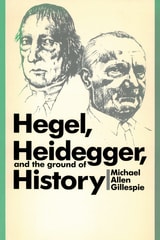
Hegel, Heidegger, and the Ground of History
Michael Allen Gillespie
University of Chicago Press, 1984
Hegel, Marx, and the Laughing Matter of Spirit
R. A. Aumiller
Northwestern University Press, 2026
What happens when those who have been denied political subjectivity fully play out their negative role in a historical drama that damned them from the beginning? Hegel, Marx, and the Laughing Matter of Spirit locates the eruption of revolutionary laughter in historical cracks across nineteenth- and twentieth-century Europe, where exiled philosophers, partisan fighters, and artists framed their political resistance as a historical comedy. Hegelian comedy fuels the Young Hegelian critique of Prussian censorship, Walter Benjamin’s staging of the anti-fascist resistance, and the Yugoslavian partisan attempt to begin again in fascism’s aftermath. Revolution erupts from a historical stage that can no longer look on its own contradictions with a straight face. Drawing on the defiant spirit of comedy, this Hegelian feminist manifesto defies political despair, overturning the perception that history tragically repeats itself. Invoking the phrase “Nothing changes” as a mantra, R. A. Aumiller turns a concession of defeat into a battle cry for political resistance.
Hegel
The Restlessness Of The NegativeJean-Luc Nancy
University of Minnesota Press, 2002
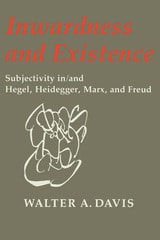
Inwardness and Existence
Subjectivity in/and Hegel, Heidegger, Marx, and FreudWalter A. Davis
University of Wisconsin Press, 1989
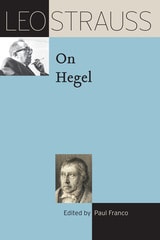
Leo Strauss on Hegel
Leo Strauss
University of Chicago Press, 2019
Leo Strauss on Hegel reconstructs Strauss’s seminar on Hegel, supplemented by passages from an earlier version of the seminar from which only fragments of a transcript remain. Strauss focused his seminar on the lectures collected in The Philosophy of History, which he considered more accessible than Hegel’s written works. In his own lectures on Hegel, Strauss continues his project of demonstrating how modern philosophers related to ancient thought and explores the development and weaknesses of modern political theory. Strauss is especially concerned with the relationship in Hegel between empirical history and his philosophy of history, and he argues for the primacy of religion in Hegel’s understanding of history and society. In addition to a relatively complete transcript, Leo Strauss on Hegel also includes annotations, which bring context and clarity to the text.
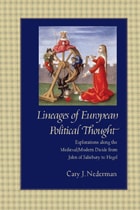
Lineages of European Political Thought
Explorations along the Medieval/Modern Divide from John of Salisbury to HegelCary J. Nederman
Catholic University of America Press, 2009

Metaracial
Hegel, Antiblackness, and Political IdentityRei Terada
University of Chicago Press, 2023
Exploring anxieties raised by Atlantic slavery in radical enlightenment literature concerned about political unfreedom in Europe, Metaracial argues that Hegel's philosophy assuages these anxieties for the left. Interpreting Hegel beside Rousseau, Kant, Mary Shelley, and Marx, Terada traces Hegel's transposition of racial hierarchy into a hierarchy of stances toward reality. By doing so, she argues, Hegel is simultaneously antiracist and antiblack. In dialogue with Black Studies, psychoanalysis, and critical theory, Metaracial offers a genealogy of the limits of antiracism.
Philosophical Legacies
Essays on the Thought of Kant, Hegel, and Their Contemporaries (Studies in Philosophy and the History of Philosophy, Volume 50)Daniel O. Dahlstrom
Catholic University of America Press, 2008
Subject Lessons
Hegel, Lacan, and the Future of MaterialismEdited by Russell Sbriglia and Slavoj Zizek
Northwestern University Press, 2020
Responding to the ongoing “objectal turn” in contemporary humanities and social sciences, the essays in Subject Lessons present a sustained case for the continued importance— indeed, the indispensability—of the category of the subject for the future of materialist thought.
Approaching matters through the frame of Hegel and Lacan, the contributors to this volume, including the editors, as well as Andrew Cole, Mladen Dolar, Nathan Gorelick, Adrian Johnston, Todd McGowan, Borna Radnik, Molly Anne Rothenberg, Kathryn Van Wert, and Alenka Zupančič—many of whom stand at the forefront of contemporary Hegel and Lacan scholarship—agree with neovitalist thinkers that material reality is ontologically incomplete, in a state of perpetual becoming, yet they maintain that this is the case not in spite of but, rather, because of the subject.
Incorporating elements of philosophy, psychoanalysis, and literary and cultural studies, Subject Lessons contests the movement to dismiss the subject, arguing that there can be no truly robust materialism without accounting for the little piece of the Real that is the subject.
Tarrying with the Negative
Kant, Hegel, and the Critique of IdeologySlavoj Zizek
Duke University Press, 1993
In Tarrying with the Negative, Žižek challenges the contemporary critique of ideology, and in doing so opens the way for a new understanding of social conflict, particularly the recent outbursts of nationalism and ethnic struggle. Are we, Žižek asks, confined to a postmodern universe in which truth is reduced to the contingent effect of various discursive practices and where our subjectivity is dispersed through a multitude of ideological positions? No is his answer, and the way out is a return to philosophy. This revisit to German Idealism allows Žižek to recast the critique of ideology as a tool for disclosing the dynamic of our society, a crucial aspect of which is the debate over nationalism, particularly as it has developed in the Balkans—Žižek's home. He brings the debate over nationalism into the sphere of contemporary cultural politics, breaking the impasse centered on nationalisms simultaneously fascistic and anticolonial aspirations. Provocatively, Žižek argues that what drives nationalistic and ethnic antagonism is a collectively driven refusal of our own enjoyment.
Using examples from popular culture and high theory to illuminate each other—opera, film noir, capitalist universalism, religious and ethnic fundamentalism—this work testifies to the fact that, far more radically than the postmodern sophists, Kant and Hegel are our contemporaries.
The Company of Words
Hegel, Language, and Systematic PhilosophyJohn McCumber
Northwestern University Press, 1993
The Critique of Pure Modernity
Hegel, Heidegger, and AfterDavid Kolb
University of Chicago Press, 1986
Kolb offers his own views, proposing the possibility of a meaningful life that is free but still rooted in shared contexts. He concludes with comments on "postmodernity" as discussed by Lyotard and others, arguing persuasively against the presupposition of a unified Modern or Postmodern Age.
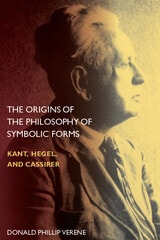
The Origins of the Philosophy of Symbolic Forms
Kant, Hegel, and CassirerDonald Phillip Verene
Northwestern University Press, 2012
Verene takes as his departure point that Cassirer never wishes to argue Kant over Hegel. Instead he takes from each what he needs, realizing that philosophical idealism itself did not stop with Kant but developed to Hegel, and that much of what remains problematic in Kantian philosophy finds particular solutions in Hegel’s philosophy. Cassirer never replaces transcendental reflection with dialectical speculation, but he does transfer dialectic from a logic of illusion, that is, the form of thinking beyond experience as Kant conceives it in the Critique of Pure Reason, to a logic of consciousness as Hegel employs it in the Phenomenology of Spirit. Cassirer rejects Kant’s thing-in-itself but he also rejects Hegel’s Absolute as well as Hegel’s conception of Aufhebung. Kant and Hegel remain the two main characters on his stage, but they are accompanied by a large secondary cast, with Goethe in the foreground. Cassirer not only contributes to Goethe scholarship, but in Goethe he finds crucial language to communicate his assertions. Verene introduces us to the originality of Cassirer’s philosophy so that we may find access to the riches it contains.
The Philosophy of Hegel as a Doctrine of the Concreteness of God and Humanity
Volume One: The Doctrine of GodI. A. Il’in, Translated by Philip T. Grier
Northwestern University Press, 2010
This landmark two-volume translation from Russian of The Philosophy of Hegel as a Doctrine of the Concreteness of God and Humanity marks the first appearance in English of any of the works of Russian philosopher Ivan Aleksandrovich Il’in (Ilyin). Originally published in 1918, on the eve of the Russian civil war, Il'in's commentary on Hegel marked both an apogee of Russian Silver Age philosophy and a significant manifestation of the resurgence of interest in Hegel that began in the early twentieth century.
A. F. Losev accurately observed in the same year it appeared: “Neither the study of Hegel nor the study of contemporary Russian philosophical thought is any longer thinkable without this book of I. A. Il’in’s.” Some Hegel scholars may know this work through the abridged translation into German that Il’in produced himself in 1946. However, that edition omitted most of the original volume two. Noted Hegel scholar Philip T. Grier’s edition—with an introduction setting Il’in’s work in its proper historical, cultural, and philosophical contexts and annotation throughout—represents the first opportunity for non-Russian-speaking readers to acquaint themselves with the full scope of Il’in’s still provocative interpretation of Hegel.
Volume 1 is "The Doctrine of God." Volume 2 is "The Doctrine of Humanity."
The Philosophy of Hegel as a Doctrine of the Concreteness of God and Humanity
Volume Two: The Doctrine of HumanityI. A. Il’in, Translated by Philip T. Grier
Northwestern University Press, 2011
The publication of volume 2 of Philip T. Grier’s translation of The Philosophy of Hegel as a Doctrine of the Concreteness of God and Humanity completes the first appearance in English of any of the works of Russian philosopher I. A. Il’in (Ilyin).
Most of the contents of volume 2 will be unknown even to those who have read the 1946 German version prepared by Il’in, because in that version he omitted eight of the original ten chapters. These omitted chapters provide an extended reflection on the central categories of Hegel’s moral, legal, and political philosophies, as well as of the philosophy of history. The topics examined are, in order: freedom, humanity, will, right, morality, ethical life, personhood and its virtue, and the state. Contained within these chapters are some notably insightful expositions of core doctrines in Hegel’s philosophy.
Il’in’s colleague A. F. Losev accurately observed in the same year the text first appeared: “Neither the study of Hegel nor the study of contemporary Russian philosophical thought is any longer thinkable without this book of I. A. Il’in’s.”
Tropes of Transport
Hegel and EmotionKatrin Pahl
Northwestern University Press, 2012
Intervening in the multidisciplinary debate on emotion, Tropes of Transport offers a fresh analysis of Hegel’s work that becomes an important resource for Pahl’s cutting-edge theory of emotionality. If it is usually assumed that the sincerity of emotions and the force of affects depend on their immediacy, Pahl explores to what extent mediation—and therefore a certain degree of manipulation but also of sympathy—is constitutive of emotionality. Hegel serves as a particularly helpful interlocutor not only because he offers a sophisticated analysis of mediation, but also because, rather than locating emotion in the heart, he introduces impersonal tropes of transport, such as trembling, release, and shattering.