Results by title
28164 books match the query 'History' and 997 start with i
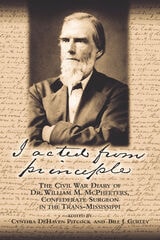
I Acted from Principle
The Civil War Diary of Dr. William M. McPheeters, Confederate Surgeon in the Trans-MississippiCynthia DeHaven Pitcock
University of Arkansas Press, 2000
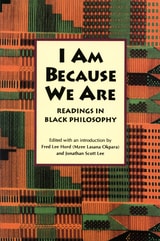
I Am Because We Are
Readings in Africana PhilosophyFred Lee Hord
University of Massachusetts Press, 2016
First published in 1995, I Am Because We Are has been recognized as a major, canon-defining anthology and adopted as a text in a wide variety of college and university courses. Bringing together writings by prominent Black thinkers from Africa, the Caribbean, and North America, Fred Lee Hord and Jonathan Scott Lee made the case for a tradition of “relational humanism” distinct from the philosophical preoccupations of the West.
Over the past twenty years, however, new scholarly research has uncovered other contributions to the discipline now generally known as “Africana philosophy” that were not included in the original volume. In this revised and expanded edition, Hord and Lee build on the strengths of the earlier anthology while enriching the selection of readings to bring the text into the twenty-first century. In a new introduction, the editors reflect on the key arguments of the book's central thesis, refining them in light of more recent philosophical discourse. This edition includes important new readings by Kwame Gyekye, Oyeronke Oy ewumi, Paget Henry, Sylvia Wynter, Toni Morrison, Charles Mills, and Tommy Curry, as well as extensive suggestions for further reading.
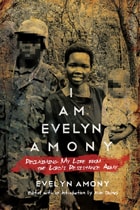
I Am Evelyn Amony
Reclaiming My Life from the Lord's Resistance ArmyEvelyn Amony, Edited with an introduction by Erin Baines
University of Wisconsin Press, 2015
Abducted at the age of eleven, Evelyn Amony spent nearly eleven years inside the Lord’s Resistance Army, becoming a forced wife to Joseph Kony and mother to his children. She takes the reader into the inner circles of LRA commanders and reveals unprecedented personal and domestic details about Joseph Kony. Her account unflinchingly conveys the moral difficulties of choosing survival in a situation fraught with violence, threat, and death.
Amony was freed following her capture by the Ugandan military. Despite the trauma she endured with the LRA, Amony joined a Ugandan peace delegation to the LRA, trying to convince Kony to end the war that had lasted more than two decades. She recounts those experiences, as well as the stigma she and her children faced when she returned home as an adult.
This extraordinary testimony shatters stereotypes of war-affected women, revealing the complex ways that Amony navigated life inside the LRA and her current work as a human rights advocate to make a better life for her children and other women affected by war.
Best books for public & secondary school libraries from university presses, American Library Association
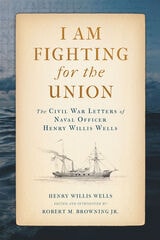
I Am Fighting for the Union
The Civil War Letters of Naval Officer Henry Willis WellsHenry Willis Wells, edited and introduced by Robert M. Browning Jr.
University of Alabama Press, 2023
A young officer’s insightful, detailed and steadfast devotion to the Union Navy—told in his own words.
On May 18, 1862, Henry Willis Wells wrote a letter to his mother telling her in clear terms, “I am fighting for the Union.” Since August 1861, when he joined the US Navy as a master’s mate he never wavered in his loyalty. He wrote to his family frequently that he considered military service a necessary and patriotic duty, and the career that ensued was a dramatic one, astutely and articulately documented by Wells in more than 200 letters home, leaving an invaluable account of daily life in the Union Navy.
Wells joined the navy shortly after the war began, initially on board the Cambridge, attached to the North Atlantic Blockading Squadron, which patrolled the waters of the Chesapeake Bay. He witnessed the Battle of Hampton Roads and the fight between the ironclads CSS Virginia and the USS Monitor. Next, the Cambridge assisted in the blockade of Wilmington, North Carolina. In one instance, the warship chased the schooner J. W. Pindar ashore during her attempt to run the blockade, and Confederate forces captured Henry’s boarding party. After a short prison stay in the infamous Libby Prison in Richmond, his Confederate captors paroled Henry. He travelled back to Brookline, and soon thereafter the Navy Department assigned him to the gunboat Ceres, which operated on the sounds and rivers of North Carolina, protecting army positions ashore. Henry was on board during the Confederate attempt to capture Washington, North Carolina. During this April 1863 attack, Henry was instrumental in the town’s defense, commanding a naval battery ashore during the latter part of the fight.
His exceptional service gained him a transfer to a larger warship, the USS Montgomery, again on the blockade of Wilmington. Later the service assigned him to the Gem of the Sea, part of the East Gulf Blockading Squadron. Through his hard work and professionalism, he finally earned his first command. In September 1864, he became the commanding officer of the Rosalie, a sloop used as a tender to the local warships. Later he commanded the schooner Annie, also a tender. At the end of December 1864, however, the Annie suffered a massive explosion, killing all hands, including Wells. He was twenty-three years old when his life and career ended tragically. Wells’s letters document both his considerable achievements and his frustrations. His challenges, triumphs, and disappointments are rendered with candor. I Am Fighting for the Union is a vital and deeply personal account of a momentous chapter in the history of the Civil War and its navies.
I Am Here You Are Not I Love You
Andrew Topolski, Cindy Suffoletto, and Their Life in the ArtsAidan Ryan
University of Iowa Press, 2025
The book presents a critical reexamination of Andrew Topolski, an overlooked luminary of intermedia and postminimalism. In repositioning Topolski’s legacy and vast body of work, Ryan makes compelling findings about the interplay of talent, luck, and community support in the making or breaking of artistic careers. At the same time, the story shares the significant and never-before-seen body of work by Cindy Suffoletto, a talented and inventive artist little shown and never cataloged during her short life. Ultimately, Ryan argues that the time is right for both to take up a privileged place among the great artists of their generation.
I Am Looking to the North for My Life
Sitting Bull 1876 - 1881Joseph Manzione
University of Utah Press, 1991
What happened to the Sioux after Little Bighorn? In the winter of 1877, many escaped with Sitting Bull to Canada, precipitating an international incident and setting three governments at each other for five years. Resolution came only in 1881 with the demise of the buffalo herds in the Northwest Territories. Faced with starvation, the Sioux returned to the United States.
Relying upon primary source documents in both the United States and Canada, Manzione skillfully illustrates how two countries struggled to control a potentially explosive border situation while steadfastly looking the other way as a valiant culture came to its bitter fate.

I Am an Architect
Paul R. Williams and His ArchiveLeRonn P. Brooks
J. Paul Getty Trust, The, 0
Discover the visionary legacy of the groundbreaking architect Paul R. Williams, FAIA, one of the most prolific Black architects of the 20th century.
Paul R. Williams (1894–1980), among the first Black members of the American Institute of Architects, was a defining force in shaping the city of Los Angeles and Southern California, yet his impact was undoubtedly global.
Threading together Williams’s biography, social histories of Los Angeles, and transformations in the profession, this richly researched monograph traces his remarkable career against the evolving landscape of Los Angeles and the wider architectural world.
- Presents the first research-driven monograph on preeminent architect Paul R. Williams.
- Features nearly 200 images, including many never-before published drawings, renderings, and archival materials.
- Williams’s expansive oeuvre spans everything from early residential commissions in the 1920s to civic, religious, commercial, and cultural landmarks that came to define Los Angeles’s identity at midcentury.
- Examines the intersection of race, space, and professional practice in twentieth-century American architecture.
- Highlights Williams’s commitment to designing for Black communities and advancing social change through architecture.
Step into the world of a visionary who transformed cities and challenged barriers—this volume invites you to get to know Paul R. Williams and the enduring power of architecture to shape society.
This volume is published to accompany an exhibition on view at the Fisher Museum of Art at the University of Southern California from August 18, 2026, to March 13, 2027, Los Angeles County Museum of Art from November 15, 2026, to May 31, 2027, and Getty Research Institute at the Getty Center from December 15, 2026, to March 14, 2027.
I Am of Ireland
Women of the North Speak OutElizabeth Shannon
University of Massachusetts Press, 1997
I Ask for Justice
Maya Women, Dictators, and Crime in Guatemala, 1898–1944By David Carey Jr.
University of Texas Press, 2013
This study of the Guatemalan legal system during the regimes of two of Latin America’s most repressive dictators reveals the surprising extent to which Maya women used the courts to air their grievances and defend their human rights.
Winner, Bryce Wood Book Award, Latin American Studies Association, 2015
Given Guatemala’s record of human rights abuses, its legal system has often been portrayed as illegitimate and anemic. I Ask for Justice challenges that perception by demonstrating that even though the legal system was not always just, rural Guatemalans considered it a legitimate arbiter of their grievances and an important tool for advancing their agendas. As both a mirror and an instrument of the state, the judicial system simultaneously illuminates the limits of state rule and the state’s ability to co-opt Guatemalans by hearing their voices in court.
Against the backdrop of two of Latin America’s most oppressive regimes—the dictatorships of Manuel Estrada Cabrera (1898–1920) and General Jorge Ubico (1931–1944)—David Carey Jr. explores the ways in which indigenous people, women, and the poor used Guatemala’s legal system to manipulate the boundaries between legality and criminality. Using court records that are surprisingly rich in Maya women’s voices, he analyzes how bootleggers, cross-dressers, and other litigants crafted their narratives to defend their human rights. Revealing how nuances of power, gender, ethnicity, class, and morality were constructed and contested, this history of crime and criminality demonstrates how Maya men and women attempted to improve their socioeconomic positions and to press for their rights with strategies that ranged from the pursuit of illicit activities to the deployment of the legal system.

I Believe I'll Go Back Home
Roots and Revival in New England Folk MusicThomas S. Curren
University of Massachusetts Press, 2021
Fueled by interviews with key players from the folk music scene, I Believe I'll Go Back Home traces a direct line from Yankee revolutionaries, up-country dancers, and nineteenth-century pacifists to the emergence of blues and rock 'n' roll, ultimately landing at the period of the folk revival. Thomas S. Curren presents the richness and diversity of the New England folk tradition, which continues to provide perspective, inspiration, and healing in the present day.
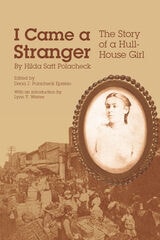
I Came a Stranger
The Story of a Hull-House GirlHilda Satt Polacheck
University of Illinois Press, 1989
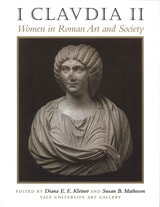
I Claudia II
Women in Roman Art and SocietyEdited by Diana E. E. Kleiner and Susan B. Matheson
University of Texas Press, 2000
I, Claudia: Women in Ancient Rome—an exhibition and catalog produced by the Yale University Art Gallery—provided the first comprehensive study of the lives of Roman women as revealed in Roman art. Responding to the popular success of the exhibit and catalog, Diana E. E. Kleiner and Susan B. Matheson here gather ten additional essays by specialists in art history, history, and papyrology to offer further reflections on women in Roman society based on the material evidence provided by art, archaeology, and ancient literary sources.
In addition to the editors, the contributors are Cornelius C. Vermeule, Rolf Winkes, Mary T. Boatwright, Susan Wood, Eve D'Ambra, Andrew Oliver, Diana Delia, and Ann Ellis Hanson. Their essays, illustrated with black-and-white photos of the art under discussion, treat such themes as mothers and sons, marriage and widowhood, aging, adornment, imperial portraiture, and patronage.
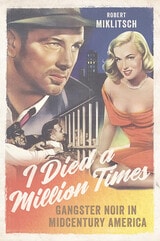
I Died a Million Times
Gangster Noir in Midcentury AmericaRobert Miklitsch
University of Illinois Press, 2020
With the Senate's organized crime hearings and the brighter-than-bright myth of the American Dream as a backdrop, Miklitsch examines the style and history, and the production and cultural politics, of classic pictures from The Big Heat and The Asphalt Jungle to lesser-known gems like 711 Ocean Drive and post-Fifties movies like Ocean’s Eleven. Miklitsch pays particular attention to trademark leitmotifs including the individual versus the collective, the family as a locus of dissension and rapport, the real-world roots of the heist picture, and the syndicate as an octopus with its tentacles deep into law enforcement, corporate America, and government. If the memes of gangster noir remain prototypically dark, the look of the films becomes lighter and flatter, reflecting the influence of television and the realization that, under the cover of respectability, crime had moved from the underworld into the mainstream of contemporary everyday life.
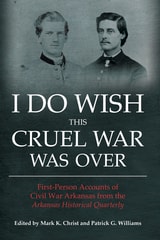
I Do Wish This Cruel War Was Over
First-Person Accounts of Civil War Arkansas from the Arkansas Historical QuarterlyMark K. Christ
University of Arkansas Press, 2014
I Fight for a Living
Boxing and the Battle for Black Manhood, 1880-1915Louis Moore
University of Illinois Press, 2017
Louis Moore draws on the life stories of African American fighters active from 1880 to 1915 to explore working-class black manhood. As he details, boxers bought into American ideas about masculinity and free enterprise to prove their equality while using their bodies to become self-made men. The African American middle class, meanwhile, grappled with an expression of public black maleness they saw related to disreputable leisure rather than respectable labor. Moore shows how each fighter conformed to middle-class ideas of masculinity based on his own judgment of what culture would accept. Finally, he argues that African American success in the ring shattered the myth of black inferiority despite media and government efforts to defend white privilege.
I Fought a Good Fight
A History of the Lipan ApachesSherry Robinson
University of North Texas Press, 2013
I Give You Half the Road
Carol Spindel
University of Wisconsin Press, 2021
Once considered the most stable country in West Africa, Ivory Coast was split by an armed rebellion in 2002 and endured a decade of instability and a violent conflict. Spindel provides an intimate glimpse into this turbulent period by weaving together the daily lives and paths of five neighbors. Their stories reveal Ivorians determined to reunite a divided country through reliance on mutual respect and obligation even while power-hungry politicians pursued xenophobic and anti-immigrant platforms for personal gain. Illuminating democracy as a fragile enterprise that must be continually invented and reinvented, I Give You Half the Road emphasizes the importance of connection, generosity, and forgiveness.
I Have Spoken
American History Through The Voices Of The IndiansVirginia I. Armstrong
Ohio University Press, 1971
I Have Spoken is a collection of American Indian oratory from the 17th to the 20th century, concentrating on speeches focusing around Indian-white relationships, especially treaty-making negotiations. A few letters and other writings are also included.
Here, in their own words, is the Indian’s story told with integrity, with drama, with caustic wit, with statesmanship, with poetic impact; a story of proffered friendship, of broken promises, of hope, of disillusionment, of pride, of a whole land and life gone sour.
I Hear a Symphony
Motown and Crossover R&BAndrew Flory
University of Michigan Press, 2017
I Hid It under the Sheets
Growing Up with RadioGerald Eskenazi
University of Missouri Press, 2005
Imagine that there was a time in America when a child sat next to a radio and simply listened. But didn’t just listen, was enthralled and knew that this time was his alone, that he was part of the vortex of drama unfolding inside the radio’s innards. . . . I never saw a punch thrown, or a glass shatter, or a blood-smeared shirt as I listened to the radio. Nor did I know Barbara Stanwyck’s hairstyle as she overacted in Sorry, Wrong Number on the Lux Radio Theatre. And I had no idea how corpulent Happy Felton was as he dropped ten silver dollars that jangled into a Sheffield’s Milk bottle on Guess Who. (Yes, ten bucks was what you won on that show.) Instead, I imagined it all.
I Hid It under the Sheets captures a bygone era—the late 1930s, 1940s, and early 1950s—through the reminiscences of award-winning New York Times reporter Gerald Eskenazi. This first-person recollection shows radio’s broad impact on his generation and explains how and why it became such a major factor in shaping America and Americans.
I KNOW THAT YOU KNOW THAT I KNOW
NARRATING SUBJECTS FROM MOLL FLANDERS TO MARNIEGeorge Butte
The Ohio State University Press, 2004
In I Know That You Know That I Know, Butte explores how stories narrate human consciousness. Butte locates a historical shift in the representation of webs of consciousnesses in narrative—what he calls “deep intersubjectivity”—and examines the effect this shift has since had on Western literature and culture. The author studies narrative practices in two ways: one pairing eighteenth-and nineteenth-century British novels (Moll Flanders and Great Expectations, for example), and the other studying genre practices—comedy, anti-comedy and masquerade—in written and film narratives (Jane Austen and His Girl Friday, for example, and Hitchcock’s Cary Grant films).
Butte’s second major claim argues for new ways to read representations of human consciousness, whether or not they take the form of deep intersubjectivity. Phenomenological criticism has lost its credibility in recent years, but this book identifies better reading strategies arising out of what the author calls poststructuralist phenomenology, grounded largely in the work of the French philosopher Merleau-Ponty. Butte criticizes the extreme of transcendental idealism (first-wave phenomenological criticism) and cultural materialism (when it rules out the study of consciousness). He also criticizes the dominant Lacanian framework of much academic film criticism.
I Live Underwater
The Thrilling Adventures of a Record-Breaking Diver, Treasure Hunter, and Deep-Sea ExplorerMax Nohl
Wisconsin Historical Society Press, 2025
I Live Underwater is the highly anticipated posthumous memoir of Max Nohl, a larger-than-life thrill seeker and treasure hunter who revolutionized deep-sea diving. Recounting harrowing experiences with tangled air-hoses, hungry sharks, untested scientific theories, and painful cases of the bends, Nohl’s vivid narrative shows how his unquenchable thirst for adventure propelled him to transcend fear and become one of the field’s great innovators—shattering the diving record in 1937 as the first person to dive deeper than 400 feet.
Beginning with the disquieting childhood experiences that inspired his obsession with the underwater world, Nohl goes on to discuss his innovative work on the first self-contained diving suit as a student at MIT and his risky experiments in breathing helium to achieve deeper dives. In addition to making vital contributions to the commercial diving industry, Nohl was a pioneer in underwater filming, developing equipment and techniques that were employed in many Hollywood film and television productions.
After Nohl’s sudden death in 1960 in a car accident, his nearly complete memoir sat in the Milwaukee Public Library Archives—unpublished, until now. Accompanying this page-turning text is a dynamic assortment of images, including Nohl’s original pen-and-ink sketches and historic photos of Nohl and his collaborators. A foreword by Wisconsin Historical Society maritime archaeologist Tamara Thomsen provides insights into Nohl’s many important contributions to the diving world and to Wisconsin history and culture.
Includes stories of dives in Lake Michigan (near Milwaukee), the North Atlantic (near Marblehead and Martha’s Vineyard), Walden Pond, the Gulf Coast (near Morgan City, Louisiana, and Panama City, Apalachicola, Wakulla Springs, and Tarpon Springs in Florida), and the Caribbean (near Haiti and the Dominican Republic).

I Love My Selfie
Essay by Ilan Stavans / Auto-Portraits by ADÁL
Duke University Press, 2017
I Made You to Find Me
The Coming of Age of the Woman Poet and the Politics of Poetic AddressJane Hedley
The Ohio State University Press, 2009

I Never Made Love with James Baldwin
A MemoirStanley Cohen
Seagull Books, 2026
One man's life unfolds into a memoir of the defining cultural figures of the mid-twentieth century and beyond.
I Never Made Love with James Baldwin is a dazzling memoir told through a succession of attorney Stanley Cohen's vivid encounters with some of the most compelling figures of the twentieth century and beyond. Moving between America, Europe, and Asia, Cohen recounts moments shared with artists, writers, jurists, and financiers, including Alexander Calder, Joseph Heller, Robert Caro, Ruth Bader Ginsburg, Yehuda Hanani, and members of the Rothschild family. These figures appear not as distant icons but as sharp, human presences—brilliant, eccentric, generous, and flawed. Cohen’s life unfolds like a performance, shaped less by planning than by intensity: conversations, friendships, arguments, and coincidences that flare briefly and leave lasting marks. With wit, candor, and an eye for the telling detail, he captures a vast social and creative network spanning the mid-twentieth century to the present. The result is an intimate, unconventional portrait of an exceptional life and of the people who lit its path.
I Speak of the City
Mexico City at the Turn of the Twentieth CenturyMauricio Tenorio-Trillo
University of Chicago Press, 2013
I Stand in My Place With My Own Day Here
Site-Specific Art at The New SchoolEdited by Frances Richard, with a foreword by Lydia Matthews and an introduction by Silvia Rocciolo and Eric Stark
Duke University Press, 2020
Providing a kaleidoscopic view into these works, this richly illustrated volume explores each installation through three to four essays written by critics, poets, and scholars from diverse fields including anthropology, mathematics, art history, media studies, and design. Their texts are complemented by three additional essays reflecting on each piece's art historical significance; the architectural contexts in which the works reside on the university's campus; and The New School's relationship to adventurous art practice. Also included is a roundtable discussion among leading arts educators and artists who reflect on the pedagogical potential of a campus-based contemporary art collection. The book's final section presents a history of each commissioned work, highlighted by archival images never before published.
Published by The New School. Distributed by Duke University Press.
Contributors. Saul Anton, Daniel A. Barber, Stefano Basilico, Carol Becker, Naomi Beckwith, Omar Berrada, Gregg Bordowitz, Tisa Bryant, Holland Cotter, Mónica de la Torre, Aruna D'Souza, Elizabeth Ellsworth, Julia L. Foulkes, Andrea Geyer, Kathleen Goncharov, Jennifer A. González, Michele Greet, Randall Griffey, Victoria Hattam, Pablo Helguera, Jamer Hunt, Anna Indych-López, Luis Jaramillo, Jeffrey Kastner, Robert Kirkbride, Lynda Klich, Carin Kuoni, Sarah E. Lawrence, Tan Lin, Lucy R. Lippard, Laura Y. Liu, Reinhold Martin, Shannon Mattern, Lydia Matthews, Maggie Nelson, Olu Oguibe, G. E. Patterson, Hugh Raffles, Claudia Rankine, Jasmine Rault, Heather Reyes, Frances Richard, Silvia Rocciolo, Carl Hancock Rux, Luc Sante, Mira Schor, Eric Stark, Radhika Subramaniam, Edward J. Sullivan, Roberto Tejada, Otto von Busch, Wendy S. Walters, Jennifer Wilson, Mabel O. Wilson
I Swear I Saw This
Drawings in Fieldwork Notebooks, Namely My OwnMichael Taussig
University of Chicago Press, 2011
I Tatti Studies in the Italian Renaissance, volume 24 number 2 (Fall 2021)
The University of Chicago Press
University of Chicago Press Journals, 2021
I Tatti Studies in the Italian Renaissance, volume 25 number 1 (Spring 2022)
The University of Chicago Press
University of Chicago Press Journals, 2022
I Tatti Studies in the Italian Renaissance, volume 25 number 2 (Fall 2022)
The University of Chicago Press
University of Chicago Press Journals, 2022
I Tatti Studies in the Italian Renaissance, volume 26 number 1 (Spring 2023)
The University of Chicago Press
University of Chicago Press Journals, 2023
I Tatti Studies, volume 26 number 2 (Fall 2023)
The University of Chicago Press
University of Chicago Press Journals, 2023
I Tatti Studies, volume 27 number 2 (Fall 2024)
The University of Chicago Press
University of Chicago Press Journals, 2024
I Tatti Studies, volume 28 number 1 (Spring 2025)
The University of Chicago Press
University of Chicago Press Journals, 2025
I Tatti Studies, volume 28 number 2 (Fall 2025)
The University of Chicago Press
University of Chicago Press Journals, 2025
I Tatti Studies, volume 29 number 1 (Spring 2026)
The University of Chicago Press
University of Chicago Press Journals, 2026
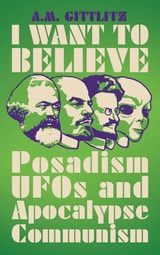
I Want to Believe
Posadism, UFOs and Apocalypse CommunismA.M. Gittlitz
Pluto Press, 2020
Advocating nuclear war, attempting communication with dolphins, and taking an interest in the paranormal and UFOs, there is perhaps no greater (or stranger) cautionary tale for the Left than that of Posadism. Named after the Argentine Trotskyist J. Posadas, the movement’s journey through the fractious and sectarian world of mid-20th century revolutionary socialism was unique. This book is a “dumpster dive” into the weird and wonderful world of the Posadists.
Although at times significant, Posadas' movement was ultimately a failure. As it disintegrated, it increasingly grew to resemble a bizarre cult, detached from the working class it sought to liberate. The renewed interest in Posadism today, especially for its more outlandish fixations, speaks to both a cynicism towards the past and nostalgia for the earnest belief that a better world is possible. Chapters include:
*Revolutionary Youth or Patriotic Youth
*The Death Throes of Capitalism
*The Origins of Posadism
*Flying Saucers, the Process of Matter and Energy, Science, the Revolutionary and Working-Class Stuggle, and the Socialist Future of Mankind
*What Exists Cannot be True
*Why Don’t Extraterrestrials Make Public Contact
*UFOs to the People
In the Introduction, A.M. Gittlitz writes, “Insurrection or first contact could come any day, Marxists and ufologists both tell us, but both are far more likely if we desire them, embracing a sentiment enigmatically expressed in a meme come before its time, a poster on the wall of rouge FBI agent Fox Mulder in the ‘90s sci-fi noir The X-Files: hovering alongside a granny image of a comically unconvincingly flying saucer and the words I WANT TO BELIEVE".
Drawing on considerable archival research, and numerous interviews with ex- and current Posadists, I Want to Believe tells the fascinating story of this most unusual socialist movement and considers why it continues to capture the imaginations of leftists today.
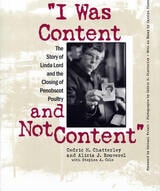
I Was Content and Not Content
The Story of Linda Lord and the Closing of Penobscot PoultryCedric N. Chatterley and Alicia J. Rouverol with Stephen A. Cole. Foreword by Michael Frisch. Photographs by Cedric N. Chatterly. With an Essay by Carolyn Chute
Southern Illinois University Press, 1999
Most studies of deindustrialization in the United States emphasize the economic impact of industrial decline; few consider the social, human costs. "I Was Content and Not Content": The Story of Linda Lord and the Closing of Penobscot Poultry is a firsthand account of a plant closure, heavily illustrated through photographs and told through edited oral history interviews. It tells the story of Linda Lord, a veteran of Penobscot Poultry Company in Belfast, Maine, and her experience when the plant—Maine’s last poultry-processing plant— closed its doors in 1988, costing over four hundred people their jobs and bringing an end to a once productive and nationally competitive agribusiness.
Linda Lord’s story could be that of any number of Americans—blue- and white-collar—effected by the rampant and widespread downsizing over the past several decades. She began working at Penobscot straight out of high school and remained with the company for over twenty years. Lord worked in all aspects of poultry processing, primarily in the "blood tunnel," where she finished off the birds that had been missed by the automatic neck-cutting device—a job held by few women. Single and self-supporting, Lord was thirty-nine years old when the plant closed. In part because she was the primary caretaker for her elderly parents, Lord did not want to leave Maine for a better job but did want to stay in the area that had been her home since birth.
The book is comprised of distinct sections representing different perspectives on Lord’s story and the plant’s demise. Cedric N. Chatterley’s gritty black-and-white photographs, reproduced here as duotones, document the final days at the poultry plant and chronicle Lord’s job search, as well as her daily life and community events. Lord’s oral history interviews, interspersed with the photographs, reveal her experiences working in poultry processing and her perspectives on the plant’s closing. Carolyn Chute’s essay reflects on her own struggles as a worker in Maine, and, more generally, on the way workers are perceived in America. Alicia J. Rouverol’s historical essay explores the rise and fall of Maine’s poultry industry and the reasons for its demise. Stephen A. Cole’s epilogue brings the story full circle when he tells of his most recent visit with Linda Lord. Michael Frisch (Portraits in Steel, A Shared Authority) contributes a foreword.
Lord’s story and the story of Penobscot’s closing brings into question the relationship of business to community, reminding us that businesses and communities are in fact integrally linked—or, perhaps more accurately, should be. Her narrative makes plain that plant closings have particular ramifications for women workers, but her experience also points to the way in which all individuals cope with change, hardship, and uncertain times to create possibilities where few exist. Perhaps most important, her story reveals some of the challenges and complexities that most human beings share.
I Will Mix Your Blood with Coal
Snapshots from the East of UkraineOleksandr Mykhed, Tanya Savchynska, and David Mossop
Northwestern University Press, 2025
In 2014, the Russian army, with support from local militants, occupied parts of Ukraine’s two easternmost regions—once the beating industrial heart of the Soviet Union—where coal extraction has since exhausted both the human population and the natural resources. In late 2016, Oleksandr Mykhed set out on a research trip to explore the deep history and contested present of the area from the perspective of a fellow countryman who’d never been there.
Mykhed brings us on a painful yet hopeful journey across the Ukrainian east, sharing conversations with locals, snippets from archival documents, and the complicated perspectives of prominent cultural figures, such as writer Serhiy Zhadan, historian Olena Stiazhkina, and philosopher Ihor Kozlovsky, who was imprisoned and tortured for nearly two years.
I Will Mix Your Blood with Coal invites us to meet generations of coal miners. To learn about the Belgian and British investors who founded the east’s industrial cities. To remember the harrowing events of the First and Second World Wars and the incalculable brutality of Soviet history. To see the activists who are even now working to improve the country. To hear sweet memories of a lost utopia that never existed. Mykhed provides a unique portrait of life in the east during the war, before the full-scale invasion that would change everything.
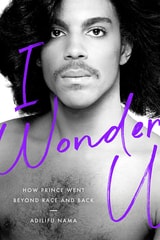
I Wonder U
How Prince Went beyond Race and BackAdilifu Nama
Rutgers University Press, 2020
In 1993, Prince infamously changed his name to a unique, unpronounceable symbol. Yet this was only one of a long string of self-reinventions orchestrated by Prince as he refused to be typecast by the music industry’s limiting definitions of masculinity and femininity, of straightness and queerness, of authenticity and artifice, or of black music and white music.
Revealing how he continually subverted cultural expectations, I Wonder U examines the entirety of Prince’s diverse career as a singer, multi-instrumentalist, songwriter, producer, record label mogul, movie star, and director. It shows how, by blending elements of R&B, rock, and new wave into an extremely videogenic package, Prince was able to overcome the color barrier that kept black artists off of MTV. Yet even at his greatest crossover success, he still worked hard to retain his credibility among black music fans. In this way, Adilifu Nama suggests, Prince was able to assert a distinctly black political sensibility while still being perceived as a unique musical genius whose appeal transcended racial boundaries.
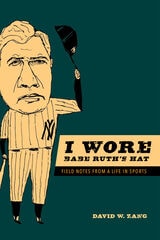
I Wore Babe Ruth's Hat
Field Notes from a Life in SportsDavid Zang
University of Illinois Press, 2015
Whether pondering his long-unbuilt replica of Connie Mack Stadium or his eye-opening turn as the Baltimore Ravens' mascot, Zang offers tales at turns poignant and hilarious as he engages with the passions that shaped his life. Yet his meditations also probe the tragedy of a modern athletic culture that substitutes hyped spectatorship for participation. As he laments, American society's increasing scorn for taking part in play robs adults of the life-affirming virtues of games that challenge us to accomplish the impossible for the most transcendent of reasons: to see if it can be done.
From teammates named Lop to tracing Joe Paterno's long shadow over Happy Valley, I Wore Babe Ruth's Hat reports from the everyman's Elysium where games and life intersect.
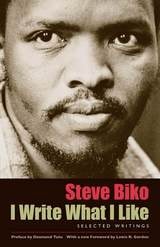
I Write What I Like
Selected WritingsSteve Biko
University of Chicago Press, 2002
I Write What I Like contains a selection of Biko's writings from 1969, when he became the president of the South African Students' Organization, to 1972, when he was prohibited from publishing. The collection also includes a preface by Archbishop Desmond Tutu; an introduction by Malusi and Thoko Mpumlwana, who were both involved with Biko in the Black Consciousness movement; a memoir of Biko by Father Aelred Stubbs, his longtime pastor and friend; and a new foreword by Professor Lewis Gordon.
Biko's writings will inspire and educate anyone concerned with issues of racism, postcolonialism, and black nationalism.
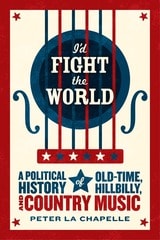
I'd Fight the World
A Political History of Old-Time, Hillbilly, and Country MusicPeter La Chapelle
University of Chicago Press, 2019
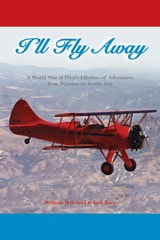
I'll Fly Away
A World War II Pilot's Lifetime of Adventures From Biplanes to Jumbo JetsWilliam Hallstead and Jack Race
University of Scranton Press, 2006
From his adventures flying for the Allies in World War II to his work as head pilot trainer for Ariana Afghan Airlines, Race has logged more than six decades in the air. I’ll Fly Away tracks his travels around the globe, encompassing his post-war job as crop duster and bush pilot, his thirty-four years as a commercial airline pilot for Pan American World Airways, his consultancy to King Hussein for Royal Jordanian Airlines, and the eight years in which he served as lead pilot for Orbis, an eye hospital on wings that served thirty-one countries. In 1989 Race notably retraced Charles Lindbergh’s 1927 20,000-mile goodwill tour, flying his Spirit of Orbis biplane to all forty-eight of the continental U.S. states.
A remarkable and wholly readable biography of an American original, I’ll Fly Away will be essential for the bookshelf of every aviation enthusiast.
I'll Take You There
Exploring Nashville's Social Justice SitesAmie Thurber
Vanderbilt University Press, 2021
I'll Take You There is written by and with the people who most intimately know Nashville, foregrounding the struggles and achievements of people's movements toward social justice. The colloquial use of "I'll take you there" has long been a response to the call of a stranger: for recommendations of safe passage through unfamiliar territory, a decent meal and place to lay one's head, or perhaps a watering hole or juke joint.
In this book, more than one hundred Nashvillians "take us there," guiding us to places we might not otherwise encounter. Their collective entries bear witness to the ways that power has been used by social, political, and economic elites to tell or omit certain stories, while celebrating the power of counternarratives as a tool to resist injustice. Indeed, each entry is simultaneously a story about place, power, and the historic and ongoing struggle toward a more just city for all. The result is akin to the experience of asking for directions in an unfamiliar place and receiving a warm offer from a local to lead you on, accompanied by a tale or two.
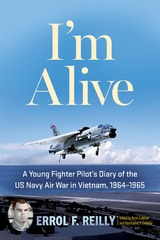
I'm Alive
A Young Fighter Pilot’s Diary of the US Navy Air War in Vietnam, 1964–1965Errol F. Reilly
University of North Texas Press, 2026
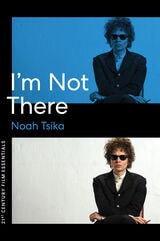
I'm Not There
Noah Tsika
University of Texas Press, 2023
An examination of director Todd Haynes and his Bob Dylan biopic.
As the first and only Bob Dylan “biopic,” I’m Not There caused a stir when released in 2007. Offering a surreal retelling of moments from Dylan’s life and career, the film is perhaps best known for its distinctive approach to casting, including Cate Blanchett and Marcus Carl Franklin, a Black child actor, as versions of Dylan though none of the characters bear his name. Greenlit by Bob Dylan himself, the film uses Dylan’s music as a score, a triumph for famed queer filmmaker Todd Haynes after encountering issues with copyright in previous projects.
Noah Tsika eloquently characterizes all the ways that Dylan and Haynes harmonize in their methods and sensibilities, interpreting the rule-breaking film as a biography that refuses chronology, disdains factual accuracy, flirts with libel, and cannibalizes Western cinema. Fitting the film’s inspiration, creation, and reception alongside its continuing afterlife, Tsika examines Dylan’s music in the film through the context of intellectual property, raising questions about who owns artistic material and artistic identities and how such material can be reused and repurposed. Tsika’s adventurous analysis touches on gender, race, queerness, celebrity, popular culture, and the law, while offering much to Haynes and Dylan fans alike.
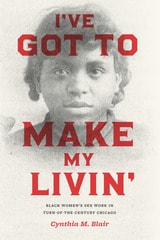
I've Got to Make My Livin'
Black Women's Sex Work in Turn-of-the-Century ChicagoCynthia M. Blair
University of Chicago Press, 2010
For many years, the interrelated histories of prostitution and cities have perked the ears of urban scholars, but until now the history of urban sex work has dealt only in passing with questions of race. In I’ve Got to Make My Livin’, Cynthia Blair explores African American women’s sex work in Chicago during the decades of some of the city’s most explosive growth, expanding not just our view of prostitution, but also of black women’s labor, the Great Migration, black and white reform movements, and the emergence of modern sexuality.
Focusing on the notorious sex districts of the city’s south side, Blair paints a complex portrait of black prostitutes as conscious actors and historical agents; prostitution, she argues here, was both an arena of exploitation and abuse, as well as a means of resisting middle-class sexual and economic norms. Blair ultimately illustrates just how powerful these norms were, offering stories about the struggles that emerged among black and white urbanites in response to black women’s increasing visibility in the city’s sex economy. Through these powerful narratives, I’ve Got to Make My Livin’ reveals the intersecting racial struggles and sexual anxieties that underpinned the celebration of Chicago as the quintessentially modern twentieth-century city.

IN SEARCH OF WORKING CLASS
ESSAYS IN AMERICAN LABOR HISTORY AND POLITICAL CULTURELeon Fink
University of Illinois Press, 1994
"Fink places American labor history in the broader context of American political historiography better than any other historian I can think of." -- James R. Barrett, author of Work and Community in the Jungle: Chicago's Packinghouse Workers, 1894-1922