Results by title
200 books match the query 'Indians of Mexico' and 16 start with i
Idolatry and the Construction of the Spanish Empire
Mina García Soormally
University Press of Colorado, 2018
Contrasting readings of evangelization plays and chronicles from the Indies and legislation and literature produced in Spain, author Mina García Soormally places theoretical analysis of state formation in Colonial Latin America within the historical context. The conquest of America was presented, in its first instances, as a virtual extension of the Reconquista, which had taken place in Spain since 711, during which Spaniards fought to build an empire based in part on religious discrimination. The fight against the “heathens” (Moors and Jews) provided the experience and mindset to practice the repression of the other, making Spain a cultural laboratory that was transported across the Atlantic Ocean.
Idolatry and the Construction of the Spanish Empire is a wide-ranging explication of religious orthodoxy and unorthodoxy during Spain’s medieval and early modern period as they relate to idolatry, with analysis of events that occurred on both sides of the Atlantic. The book contributes to the growing field of transatlantic studies and explores the redefinition that took place in Europe and in the colonies.
In the Maw of the Earth Monster
Mesoamerican Ritual Cave UseEdited by James E. Brady and Keith M. Prufer
University of Texas Press, 2005
As portals to the supernatural realm that creates and animates the universe, caves have always been held sacred by the peoples of Mesoamerica. From ancient times to the present, Mesoamericans have made pilgrimages to caves for ceremonies ranging from rituals of passage to petitions for rain and a plentiful harvest. So important were caves to the pre-Hispanic peoples that they are mentioned in Maya hieroglyphic writing and portrayed in the Central Mexican and Oaxacan pictorial codices. Many ancient settlements were located in proximity to caves.
This volume gathers papers from twenty prominent Mesoamerican archaeologists, linguists, and ethnographers to present a state-of-the-art survey of ritual cave use in Mesoamerica from Pre-Columbian times to the present. Organized geographically, the book examines cave use in Central Mexico, Oaxaca, and the Maya region. Some reports present detailed site studies, while others offer new theoretical understandings of cave rituals. As a whole, the collection validates cave study as the cutting edge of scientific investigation of indigenous ritual and belief. It confirms that the indigenous religious system of Mesoamerica was and still is much more terrestrially focused that has been generally appreciated.
Indian Assimilation in the Franciscan Area of Nueva Vizcaya
William B. Griffen
University of Arizona Press, 1979
Indian and Nation in Revolutionary Mexico
Alexander S. Dawson
University of Arizona Press, 2004
Traditionally, scholars have seen Indigenismo as an elitist formulation of the "Indian problem." Dawson instead explores the ways that the movement was mediated by both elite and popular pressures over time. By showing how Indigenismo was used by a variety of actors to negotiate the shape of the revolutionary state—from anthropologist Manual Gamio to President Lázaro Cárdenas—he demonstrates how it contributed to a new "pact of domination" between indigenous peoples and the government.
Although the power of the Indigenistas was limited by the face that "Indian" remained a racial slur in Mexico, the indígenas capacitados empowered through Indigenismo played a central role in ensuring seventy years of PRI hegemony. In studying the confluence of state formation, social science, and native activism, Dawson's book offers a new perspective for understanding the processes through which revolutionary hegemony emerged.
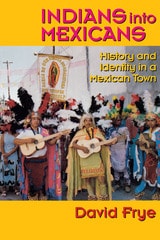
Indians into Mexicans
History and Identity in a Mexican TownBy David Frye
University of Texas Press, 1996
The people of Mexquitic, a town in the state of San Luis Potosí in rural northeastern Mexico, have redefined their sense of identity from "Indian" to "Mexican" over the last two centuries. In this ethnographic and historical study of Mexquitic, David Frye explores why and how this transformation occurred, thereby increasing our understanding of the cultural creation of "Indianness" throughout the Americas.
Frye focuses on the local embodiments of national and regional processes that have transformed rural "Indians" into modern "Mexicans": parish priests, who always arrive with personal agendas in addition to their common ideological baggage; local haciendas; and local and regional representatives of royal and later of national power and control. He looks especially at the people of Mexquitic themselves, letting their own words describe the struggles they have endured while constructing their particular corner of Mexican national identity.
This ethnography, the first for any town in northeastern Mexico, adds substantially to our knowledge of the forces that have rendered "Indians" almost invisible to European-origin peoples from the fifteenth century up to today. It will be important reading for a wide audience not only in anthropology and Latin American studies but also among the growing body of general readers interested in the multicultural heritage of the Americas.
Indians of North America
Harold E. Driver
University of Chicago Press, 1969
For this second edition, Harold Driver made extensive revisions in chapter content and organization, incorporating many new discoveries and interpretations in archeology and related fields. He also revised several of the maps and added more than 100 bibliographical items. Since the publication of the first edition, there has been an increased interest in the activities of Indians in the twentieth century; accordingly, the author placed much more emphasis on this period.
Indians of the Rio Grande Delta
Their Role in the History of Southern Texas and Northeastern MexicoBy Martín Salinas
University of Texas Press, 1990
Indians of the Rio Grande Delta is the first single-volume source on these little-known peoples. Working from innumerable primary documents in various Texan and Mexican archives, Martin Salinas has compiled data on more than six dozen named groups that inhabited the area in the sixteenth through the eighteenth centuries. Depending on available information, he reconstructs something of their history, geographical range and migrations, demography, language, and culture. He also offers general information on various unnamed groups of Indians, on the lifeways of the indigenous peoples, and on the relations between the Indian groups and the colonial Spanish missions in the region.
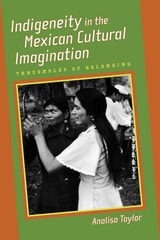
Indigeneity in the Mexican Cultural Imagination
Thresholds of BelongingAnalisa Taylor
University of Arizona Press, 2009
The book focuses on representations of indigenous peoples in post-revolutionary literary and intellectual history by examining key cultural texts. Using these analyses as a foundation, Analisa Taylor links her critique to national Indian policy, rights, and recent social movements in Southern Mexico. In addition, she moves beyond her analysis of indigenous peoples in general to take a gendered look at indigenous women ranging from the villainized Malinche to the highly romanticized and sexualized Zapotec women of the Isthmus of Tehuantepec.
The contradictory treatment of the Indian in Mexico’s cultural imagination is not unique to that country alone. Rather, the situation there is representative of a phenomenon seen throughout the world. Though this book addresses indigeneity in Mexico specifically, it has far-reaching implications for the study of indigenaety across Latin America and beyond. Much like the late Edward Said’s Orientalism, this book provides a glimpse at the very real effects of literary and intellectual discourse on those living in the margins of society.
This book’s interdisciplinary approach makes it an essential foundation for research in the fields of anthropology, history, literary critique, sociology, and cultural studies. While the book is ideal for a scholarly audience, the accessible writing and scope of the analysis make it of interest to lay audiences as well. It is a must-read for anyone seeking a deeper understanding of the politics of indigeneity in Mexico and beyond.
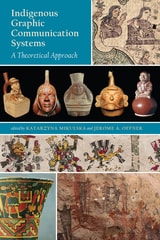
Indigenous Graphic Communication Systems
A Theoretical ApproachKatarzyna Mikulksa
University Press of Colorado, 2025
By examining case studies from across the Americas, the authors pursue an enhanced understanding of Native American graphic communication systems and how the study of graphic expression can provide insight into ancient cultures and societies, expressed in indigenous words. Focusing on examples from Central Mexico and the Andes, the authors explore the overlap among writing, graphic expression, and orality in indigenous societies, inviting reevaluation of the Western notion that writing exists only to record language (the spoken chain of speech) as well as accepted beliefs of Western alphabetized societies about the accuracy, durability, and unambiguous nature of their own alphabetized texts. The volume also addresses the rapidly growing field of semasiography and relocates it more productively as one of several underlying operating principles in graphic communication systems.
Indigenous Graphic Communication Systems reports new results and insights into the meaning of the rich and varied content of indigenous American graphic expression and culture as well as into the societies and cultures that produce them. It will be of great interest to Mesoamericanists, students, and scholars of anthropology, archaeology, art history, ancient writing systems, and comparative world history.
The research for and publication of this book have been supported in part by the National Science Centre of Poland (decision no. NCN-KR-0011/122/13) and the Houston Museum of Natural Science.
Contributors:
Angélica Baena Ramírez, Christiane Clados, Danièle Dehouve, Stanisław Iwaniszewski, Michel R. Oudijk, Katarzyna Szoblik, Loïc Vauzelle, Gordon Whittaker, Janusz Z. Wołoszyn, David Charles Wright-Carr
Indigenous Intellectuals
Knowledge, Power, and Colonial Culture in Mexico and the AndesGabriela Ramos and Yanna Yannakakis, eds.
Duke University Press, 2014
Contributors. Elizabeth Hill Boone, Kathryn Burns, John Charles, Alan Durston, María Elena Martínez, Tristan Platt, Gabriela Ramos, Susan Schroeder, John F. Schwaller, Camilla Townsend, Eleanor Wake, Yanna Yannakakis
Indigenous Interfaces
Spaces, Technology, and Social Networks in Mexico and Central AmericaEdited by Jennifer Gómez Menjívar and Gloria Elizabeth Chacón; Foreword by Arturo Arias
University of Arizona Press, 2019
Indigenous Interfaces provides the first thorough examination of indigeneity at the interface of cyberspace. Correspondingly, it examines the impact of new media on the struggles for self-determination that Indigenous peoples undergo in Mexico and Central America. The volume’s contributors highlight the fresh approaches that Mesoamerica’s Indigenous peoples have given to new media—from YouTubing Maya rock music to hashtagging in Zapotec. Together, they argue that these cyberspatial activities both maintain tradition and ensure its continuity. Without considering the implications of new technologies, Indigenous Interfaces argues, twenty-first-century indigeneity in Mexico and Central America cannot be successfully documented, evaluated, and comprehended.
Indigenous Interfaces rejects the myth that indigeneity and information technology are incompatible through its compelling analysis of the relationships between Indigenous peoples and new media. The volume illustrates how Indigenous peoples are selectively and strategically choosing to interface with cybertechnology, highlights Indigenous interpretations of new media, and brings to center Indigenous communities who are resetting modes of communication and redirecting the flow of information. It convincingly argues that interfacing with traditional technologies simultaneously with new media gives Indigenous peoples an edge on the claim to autonomous and sovereign ways of being Indigenous in the twenty-first century.
Contributors
Arturo Arias
Debra A. Castillo
Gloria Elizabeth Chacón
Adam W. Coon
Emiliana Cruz
Tajëëw Díaz Robles
Mauricio Espinoza
Alicia Ivonne Estrada
Jennifer Gómez Menjívar
Sue P. Haglund
Brook Danielle Lillehaugen
Paul Joseph López Oro
Rita M. Palacios
Gabriela Spears-Rico
Paul Worley
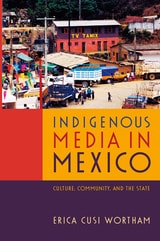
Indigenous Media in Mexico
Culture, Community, and the StateErica Cusi Wortham
Duke University Press, 2013
Drawing on her in-depth ethnographic research among indigenous mediamakers in Mexico, Wortham traces their shifting relationship with Mexican cultural agencies; situates their work within a broader, hemispheric network of indigenous media producers; and complicates the notion of a unified, homogeneous indigenous identity. Her analysis of projects from community-based media initiatives in Oaxaca to the transnational Chiapas Media Project highlights variations in cultural identity and autonomy based on specific histories of marginalization, accommodation, and resistance.
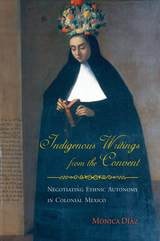
Indigenous Writings from the Convent
Negotiating Ethnic Autonomy in Colonial MexicoMónica Díaz
University of Arizona Press, 2010
While colonial sources that refer to indigenous women are not scant, documents in which women emerge as agents who actively participate in shaping their own identity are rare. Looking at this minority agency—or subaltern voice—in various religious discourses exposes some central themes. It shows that an indigenous identity recast in Catholic terms was able to be effectively recorded and that the religious participation of these women at a time when indigenous parishes were increasingly secularized lent cohesion to that identity.
Indigenous Writings from the Convent examines ways in which indigenous women participated in one of the most prominent institutions in colonial times—the Catholic Church—and what they made of their experience with convent life. This book will appeal to scholars of literary criticism, women’s studies, and colonial history, and to anyone interested in the ways that class, race, and gender intersected in the colonial world.
Intermediate Elites in Pre-Columbian States and Empires
Edited by Christina M. Elson and R. Alan Covey
University of Arizona Press, 2006
This is the first volume to consider how individuals subordinate to imperial rulers helped to shape specific forms of state and imperial organization. Taking a broader scope than previous studies, it is one of the few works to systematically address these issues in both Mesoamerica and the Central Andes. It considers how these individuals influenced the long-term development of the largest civilizations of the ancient Americas, opening a new window on the role of intermediate elites in the rise and fall of ancient states and empires worldwide.
The authors demonstrate how such evidence as settlement patterns, architecture, decorative items, and burial patterns reflect the roles of intermediate elites in their respective societies, arguing that they were influential actors whose interests were highly significant in shaping the specific forms of state and imperial organization. Their emphasis on provincial elites particularly shifts examination of early states away from royal capitals and imperial courts, explaining how local elites and royal bureaucrats had significant impact on the development and organization of premodern states.
Together, these papers demonstrate that intricate networks of intermediate elites bound these ancient societies together—and that competition between individuals and groups contributed to their decline and eventual collapse. By addressing current theoretical concerns with agency, resistance to state domination, and the co-option of local leadership by imperial administrators, it offers valuable new insight into the utility of studying intermediate elites.
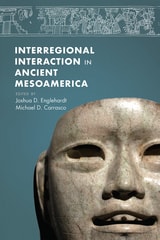
Interregional Interaction in Ancient Mesoamerica
Joshua Englehardt
University Press of Colorado, 2019
Archaeologists have long recognized the crucial role of interregional interaction in the development and cultural dynamics of ancient societies, particularly in terms of the evolution of sociocultural complexity and economic systems. Recent research has further expanded the archaeological, art historical, ethnographic, and epigraphic records in Mesoamerica, permitting a critical reassessment of the complex relationship between interaction and cultural dynamics. This volume builds on and amplifies earlier research to examine sociocultural phenomena—including movement, migration, symbolic exchange, and material interaction—in their role as catalysts for variability in cultural systems.
Interregional cultural exchange in pre-Columbian Mesoamerica played a key role in the creation of systems of shared ideologies, the production of regional or “international” artistic and architectural styles, shifting sociopolitical patterns, and changes in cultural practices and meanings. Interregional Interaction in Ancient Mesoamerica highlights, engages with, and provokes questions pertinent to understanding the complex relationship between interaction, sociocultural processes, and cultural innovation and change in the ancient societies and cultural histories of Mesoamerica and will be of interest to archaeologists, linguists, and art historians.
Contributors: Philip J. Arnold III, Lourdes Budar, José Luis Punzo Diaz, Gary Feinman, David Freidel, Elizabeth Jiménez Garcia, Guy David Hepp, Kerry M. Hull, Timothy J. Knab, Charles L. F. Knight, Blanca E. Maldonado, Joyce Marcus, Jesper Nielsen, John M. D. Pohl, Iván Rivera, D. Bryan Schaeffer, Niklas Schulze
Irrigation and the Cuicatec Ecosystem
A Study of Agriculture and Civilization in North Central OaxacaJoseph W. Hopkins III
University of Michigan Press, 1984