Results by title
403 books match the query 'Journalism' and 14 start with i
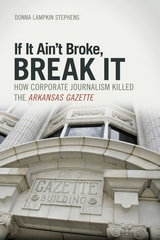
If It Ain't Broke, Break It
How Corporate Journalism Killed the Arkansas GazetteDonna Lampkin Stephens
University of Arkansas Press, 2015
Whereas the Heiskell/Patterson family had been committed to quality journalism, Gannett was focused on the bottom line. The corporation shifted the Gazette’s editorial focus from giving readers what they needed to be engaged citizens to informing them about what they should do in their leisure time. While in many ways the chain trivialized the Gazette’s mission, the paper managed to retain its superior quality. But financial concerns made the difference in Arkansas’s ongoing newspaper war. As the head of a privately held company, Hussman had only himself to answer to, and he never flinched while spending $42 million in his battle with the Pattersons and millions more against Gannett. Gannett ultimately lost $108 million during its five years in Little Rock; Hussman said his losses were far less but still in the tens of millions.
Gannett had to answer to nervous stockholders, most of whom had no tie to, or knowledge of, Arkansas or the Gazette. For Hussman, the Arkansan, the battle had been personal since at least 1978. It is no surprise that the corporation blinked first, and the Arkansas Gazette died on October 18, 1991, the victim of corporate journalism.
Immersion
A Writer's Guide to Going DeepTed Conover
University of Chicago Press, 2016
In immersion reporting—a literary cousin to ethnography, travel writing, and memoir—the writer fully steps into a new world or culture, participating in its trials, rites, and rituals as a member of the group. The end results of these firsthand experiences are familiar to us from bestsellers such as Nickel and Dimed and Behind the Beautiful Forevers. But in a world of wary strangers, where does one begin?
Conover distills decades of knowledge into an accessible resource aimed at writers of all levels. He covers how to “get into” a community, how to conduct oneself once inside, and how to shape and structure the stories that emerge. Conover is also forthright about the ethics and consequences of immersion reporting, preparing writers for the surprises that often surface when their piece becomes public. Throughout, Conover shares anecdotes from his own experiences as well as from other well-known writers in this genre, including Alex Kotlowitz, Anne Fadiman, and Sebastian Junger. It’s a deep-in-the-trenches book that all aspiring immersion writers should have in hand as they take that first leap into another world.
Immigration, Diversity, and Broadcasting in the United States 1990—2001
Vibert C. Cambridge
Ohio University Press, 2004

Impolite Periodicals
Reading for Rudeness in the Eighteenth CenturyEmrys D. Jones
Bucknell University Press, 2026
With an afterword by Manushag N. Powell.
Published by Bucknell University Press. Distributed worldwide by Rutgers University Press.
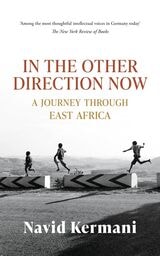
In the Other Direction Now
Dispatches from East AfricaNavid Kermani
Haus Publishing, 2026
More than a travelogue: a work of human depth and understanding that has much to teach those interested in contemporary global affairs and postcolonial realities.
Navid Kermani is an acclaimed writer already well known in the English-speaking world for his books Upheaval: The Refugee Trekthrough Europe and Along the Trenches: A Journey through Eastern Europe to Isfahan. His new book, In the Other Direction Now, continues his thoughtful documentation of global peripheries. Visiting southern Madagascar, the Comoros, Mozambique, Tanzania, Kenya, Ethiopia, and Sudan, Kermani examines how global fault lines converge, from postcolonial neglect and the devastating impact of climate change to the rising and often nefarious influence of China and the consequences of the Ukraine War.
Reflective, astute, and intellectually rigorous, Kermani’s empathetic yet unflinching perspective does not aim to interpret Africa for us, but to learn from it in all its variousness and multiplicity. Music emerges as a unifying thread—Christian hymns, Sufi dances, and Sudanese jazz become symbols of resilience and transformation, providing cultural links that bind communities across conflict, faith, and history and offering a counterpoint to colonial clichés and Western ignorance. These specific, grounded accounts of people and places contextualize global inequalities not as a product of some intrinsic African deficiency but as part of interconnected systems shaped by the Global North as much as by local governance and the legacy of colonialism.
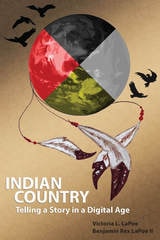
Indian Country
Telling a Story in a Digital AgeVictoria L. LaPoe
Michigan State University Press, 2017
Insider Histories of the Vietnam Era Underground Press, Part 1
Ken Wachsberger
Michigan State University Press, 2011
This enlightening book offers a collection of histories of underground papers from the Vietnam Era as written and told by key staff members of the time. Their stories (as well as those to be included in Part 2, forthcoming) represent a wide range of publications: counterculture, gay, lesbian, feminist, Puerto Rican, Native American, Black, socialist, Southern consciousness, prisoner's rights, New Age, rank-and-file, military, and more. The edition includes forewords by former Chicago Seed editor Abe Peck, radical attorney William M. Kunstler, and Markos Moulitsas, founder of the Daily Kos, along with an introductory essay by Ken Wachsberger.
Wachsberger notes that the underground press not only produce a few well-known papers but also was truly national and diverse in scope. His goal is to capture the essence of "the countercultural community."
A fundamental resource for anyone seeking a deeper understanding of a dramatic era in U.S. history.
Insider Histories of the Vietnam Era Underground Press, Part 2
Ken Wachsberger
Michigan State University Press, 2011
This enlightening book offers a collection of histories of underground papers from the Vietnam Era as written and told by key staff members of the time. Their stories, building on those presented in Part 1, represent a wide range of publications: countercultural, gay, lesbian, feminist, Puerto Rican, Native American, Black, socialist, Southern consciousness, prisoners’ rights, New Age, rank-and-file, military, and more. Wachsberger notes that the underground press not only produced a few well-known papers but also was truly national and diverse in scope. His goal is to capture the essence of “the countercultural community.” This book will be a fundamental resource for anyone seeking a deeper understanding of a dramatic era in U.S. history, as well as offering a younger readership a glimpse into a generation of idealists who rose up to challenge and improve government and society.
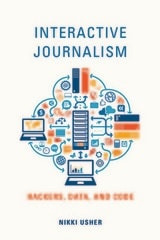
Interactive Journalism
Hackers, Data, and CodeNikki Usher
University of Illinois Press, 2016
Nikki Usher brings together a comprehensive portrait of nothing less than a new journalistic identity. Usher provides a history of the impact of digital technology on reporting, photojournalism, graphics, and other disciplines that define interactive journalism. Her eyewitness study of the field's evolution and accomplishments ranges from the interactive creation of Al Jazeera English to the celebrated data desk at the Guardian to the New York Times' Pulitzer-endowed efforts in the new field. What emerges is an illuminating, richly reported profile of the people coding a revolution that may reverse the decline and fall of traditional journalism.

Intertextuality and the 24-Hour News Cycle
A Day in the Rhetorical Life of Colin Powell's U.N. AddressJohn Oddo
Michigan State University Press, 2014

Into the Field
A Foreign Correspondent's NotebookBy Tracy Dahlby
University of Texas Press, 2014
Tracy Dahlby is an award-winning journalist who has reported internationally as a contributor to National Geographic magazine and served as a staff correspondent for Newsweek and the Washington Post. In this memoir of covering a far-flung swath of Asia, he takes readers behind the scenes to reveal “the stories behind the stories”—the legwork and (mis)adventures of a foreign correspondent on a mission to be the eyes and ears of people back home, helping them understand the forces and events that shape our world.
Into the Field centers on the travel and reporting Dahlby did for a half-dozen pieces that ran in National Geographic. The book tours the South China Sea during China’s rise as a global power, visits Japan in a time of national midlife crisis, and explores Southeast Asia during periods of political transition and tumult. Dahlby’s vivid anecdotes of jousting with hardboiled sea captains, communing with rebellious tribal chieftains, enduring a spectacular shipboard insect attack, and talking his way into a far place or out of a tight spot offer aspiring foreign correspondents a realistic introduction to the challenges of the profession. Along the way, he provides practical advice about everything from successful travel planning to managing headstrong local fixers and dealing with circumstances that can range from friendly to formidable. A knowledgeable, entertaining how-to book for observing the world and making sense of events, Into the Field is a must-read for student journalists and armchair travelers alike.
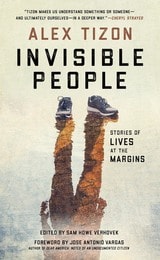
Invisible People
Stories of Lives at the MarginsAlex Tizon
Temple University Press, 2021
“Somewhere in the tangle of the subject’s burden and the subject’s desire is your story.”—Alex Tizon
Every human being has an epic story. The late Pulitzer Prize–winning writer Alex Tizon told the epic stories of marginalized people—from lonely immigrants struggling to forge a new American identity to a high school custodian who penned a New Yorker short story. Edited by Tizon’s friend and former colleague Sam Howe Verhovek, Invisible People collects the best of Tizon’s rich, empathetic accounts—including “My Family’s Slave,” the Atlantic magazine cover story about the woman who raised him and his siblings under conditions that amounted to indentured servitude.
Mining his Filipino American background, Tizon tells the stories of immigrants from Cambodia and Laos. He gives a fascinating account of the Beltway sniper and insightful profiles of Surfers for Jesus and a man who tracks UFOs. His articles—many originally published in the Seattle Times and the Los Angeles Times—are brimming with enlightening details about people who existed outside the mainstream’s field of vision.
In their introductions to Tizon’s pieces, New York Times executive editor Dean Baquet, Atlantic magazine editor in chief Jeffrey Goldberg, Pulitzer Prize winners Kim Murphy and Jacqui Banaszynski, and others salute Tizon’s respect for his subjects and the beauty and brilliance of his writing. Invisible People is a loving tribute to a journalist whose search for his own identity prompted him to chronicle the lives of others.

Iron in the Pines
The Story of New Jersey's Ghost Towns and Bog IronPierce, Arthur
Rutgers University Press, 1966
With warmth and accuracy, Arthur D. Pierce tells the story of the years when iron was king, and around it rose a rustic feudal economy. There were glass factories, paper mills, cotton mills, and brickmaking establishments. Here, too, were men who made those years exciting: Benedict Arnold and his first step toward treason; Charles Read, who dreamed of an empire and died in exile; Revolutionary heroes and heroines, privateers, and rogues. The author's vivid pictures of day-to-day life in the old iron communities are based upon careful research. This book proves that the human drama of documented history belies any notion that fiction is stranger than truth.
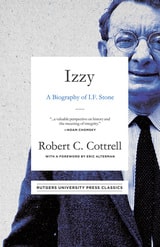
Izzy
A Biography of I. F. StoneRobert C. Cottrell
Rutgers University Press, 2020