527 books match the query 'Labor' and 13 start with i

cover of IN SEARCH OF WORKING CLASS: ESSAYS IN AMERICAN LABOR HISTORY AND POLITICAL CULTURE

IN SEARCH OF WORKING CLASS

ESSAYS IN AMERICAN LABOR HISTORY AND POLITICAL CULTURE

Leon Fink

University of Illinois Press, 1994

These nine essays by a prominent scholar in American labor history self-consciously evoke the tensions between the worker as historical subject and the historian as outside observer. Encompassing studies of labor culture, strategy, and movement building from the late nineteenth century to the present, In Search of the Working Class also connects the trials of the early labor economists to the conceptual challenges facing today's academic practitioners.
"Fink places American labor history in the broader context of American political historiography better than any other historian I can think of." -- James R. Barrett, author of Work and Community in the Jungle: Chicago's Packinghouse Workers, 1894-1922
 
[more]
cover of Illegible Will: Coercive Spectacles of Labor in South Africa and the Diaspora

Illegible Will

Coercive Spectacles of Labor in South Africa and the Diaspora

Hershini Bhana Young

Duke University Press, 2017
In Illegible Will Hershini Bhana Young engages with the archive of South African and black diasporic performance to examine the absence of black women's will from that archive. Young argues for that will's illegibility, given the paucity of materials outlining the agency of black historical subjects. Drawing on court documents, novels, photographs, historical records, websites, and descriptions of music and dance, Young shows how black will can be conjured through critical imaginings done in concert with historical research. She critically imagines the will of familiar subjects such as Sarah Baartman and that of obscure figures such as the eighteenth-century slave Tryntjie of Madagascar, who was executed in 1713 for attempting to poison her mistress. She also investigates the presence of will in contemporary expressive culture, such as the Miss Landmine Angola beauty pageant, placing it in the long genealogy of the freak show. In these capacious case studies Young situates South African performance within African diasporic circuits of meaning throughout Africa, North America, and South Asia, demonstrating how performative engagement with archival absence can locate that which was never recorded.
[more]
cover of Immigrants Unions & The New Us Labor Mkt

Immigrants Unions & The New Us Labor Mkt

Immanuel Ness

Temple University Press, 2005
In recent years, New Yorkers have been surprised to see workers they had taken for granted—Mexicans in greengroceries, West African supermarket deliverymen and South Asian limousine drivers—striking, picketing, and seeking support for better working conditions. Suddenly, businesses in New York and the nation had changed and were now dependent upon low-paid immigrants to fill the entry-level jobs that few native-born Americans would take. Immigrants, Unions, and the New U.S. Labor Market tells the story of these workers' struggle for living wages, humane working conditions, and the respect due to all people. It describes how they found the courage to organize labor actions at a time when most laborers have become quiescent and while most labor unions were ignoring them. Showing how unions can learn from the example of these laborers, and demonstrating the importance of solidarity beyond the workplace, Immanuel Ness offers a telling look into the lives of some of America's newest immigrants.
[more]
cover of Immigration and the Work Force: Economic Consequences for the United States and Source Areas

Immigration and the Work Force

Economic Consequences for the United States and Source Areas

Edited by George J. Borjas and Richard B. Freeman

University of Chicago Press, 1992

Since the 1970s, the striking increase in immigration to the United States has been accompanied by a marked change in the composition of the immigrant community, with a much higher percentage of foreign-born workers coming from Latin America and Asia and a dramatically lower percentage from Europe.

This timely study is unique in presenting new data sets on the labor force, wage rates, and demographic conditions of both the U.S. and source-area economies through the 1980s. The contributors analyze the economic effects of immigration on the United States and selected source areas, with a focus on Puerto Rico and El Salvador. They examine the education and job performance of foreign-born workers; assimilation, fertility, and wage rates; and the impact of remittances by immigrants to family members on the overall gross domestic product of source areas.

A revealing and original examination of a topic of growing importance, this book will stand as a guide for further research on immigration and on the economies of developing countries.

[more]
cover of Immortal Wishes: Labor and Transcendence on a Japanese Sacred Mountain

Immortal Wishes

Labor and Transcendence on a Japanese Sacred Mountain

Ellen Schattschneider

Duke University Press, 2003

Immortal Wishes is a powerful ethnographic rendering of religious experiences of landscape, healing, and self-fashioning on a northern Japanese sacred mountain. Working at the intersection of anthropology, religion, and Japan studies, Ellen Schattschneider focuses on Akakura Mountain Shrine, a popular Shinto institution founded by a rural woman in the 1920s. For decades, local spirit mediums and worshipers, predominantly women, have undertaken extended periods of shugyo (ascetic discipline) within the shrine and on the mountain's slopes. Schattschneider argues that their elaborate, transforming repertoire of ritual practice and ascetic discipline has been generated by complex social and historical tensions largely emerging out of the uneasy status of the surrounding area within the modern nation's industrial and postindustrial economies.

Schattschneider shows how, through dedicated work at the shrine including demanding ascents up the sacred mountain, the worshipers come to associate the rugged mountain landscape with their personal biographies, the life histories of certain exemplary predecessors and ancestors, and the collective biography of the extended congregation. She contends that this body of ritual practice presents worshipers with fields of imaginative possibilities through which they may dramatize or reflect upon the nature of their relations with loved ones, ancestors, and divinities. In some cases, worshipers significantly redress traumas in their own lives or in those of their families. In other instances, these ritualized processes lead to deepening crises of the self, the accelerated fragmentation of local households, and apprehension of possession by demons or ancestral forces. Immortal Wishes reveals how these varied practices and outcomes have over time been incorporated into the changing organization of ritual, space, and time on the mountainscape.

For more information about this book and to read an excerpt, please click here.
[more]
cover of Impossible Union: The Epic Story of Organizing America’s Agribusiness Workers from the Great Depression to the Cold War

Impossible Union

The Epic Story of Organizing America’s Agribusiness Workers from the Great Depression to the Cold War

Jarod Roll and Erik S. Gellman

University of Illinois Press, 2027

The United Cannery, Agricultural, Packing, and Allied Workers of America (UCAPAWA) and its successor, the Food, Tobacco, Agricultural and Allied Workers of America (FTA), organized some of the nation’s most exploited workers. Jarod Roll, Erik S. Gellman, and eleven other contributors provide a first-ever complete history of UCAPAWA-FTA that illuminates the organizations’ mission, accomplishments, and impediments while offering a new account of the potential for working-class democracy in the New Deal and World War II eras.

Workers of many racial, ethnic, and social identities united under the UCAPAWA-FTA banner. Their grassroots activism and bold national leadership fueled the union’s success despite opposition from employers, the government, and other labor groups. The union’s common sense anti-fascist ideology empowered workers to forge solidarities across their vast differences and linked workers’ rights to campaigns against racism and inequality. UCAPAWA-FTA advocated for an inclusive American democracy that can inform today’s struggles for dignity and security. This unique volume includes a special collection of essays by affiliated scholars that explore specific aspects of the union’s larger history.

Expansive and monumental, Impossible Union chronicles the labor organization that brought personhood and power to America’s marginal yet essential workers.

Additional contributors: Benjamin Makani Fortun, Dorothy Fujita-Rony, Robert Korstad, Bernadette Pérez, Michael Pierce, Charles Romney, Vicki L. Ruiz, Dan Sidorick, Dwana Waugh, John Weber, and Lane Windham
[more]
cover of Improving School-to-Work Transitions

Improving School-to-Work Transitions

David Neumark

Russell Sage Foundation, 2007
As anxieties about America's economic competitiveness mounted in the 1980s, so too did concerns that the nation's schools were not adequately preparing young people for the modern workplace. Spurred by widespread joblessness and job instability among young adults, the federal government launched ambitious educational reforms in the 1990s to promote career development activities for students. In recent years, however, the federal government has shifted its focus to test-based reforms like No Child Left Behind that emphasize purely academic subjects. At this critical juncture in education reform, Improving School-To-Work Transitions, edited by David Neumark, weighs the successes and failures of the '90s-era school-to-work initiatives, and assesses how high schools, colleges, and government can help youths make a smoother transition into stable, well-paying employment. Drawing on evidence from national longitudinal studies, surveys, interviews, and case studies, the contributors to Improving School-To-Work Transitions offer thought-provoking perspectives on a variety of aspects of the school-to-work problem. Deborah Reed, Christopher Jepsen, and Laura Hill emphasize the importance of focusing school-to-work programs on the diverse needs of different demographic groups, particularly immigrants, who represent a growing proportion of the youth population. David Neumark and Donna Rothstein investigate the impact of school-to-work programs on the "forgotten half," students at the greatest risk of not attending college. Using data from the 1997 National Longitudinal Study of Youth, they find that participation by these students in programs like job shadowing, mentoring, and summer internships raise employment and college attendance rates among men and earnings among women. In a study of nine high schools with National Academy Foundation career academies, Terry Orr and her fellow researchers find that career academy participants are more engaged in school and are more likely to attend a four-year college than their peers. Nan Maxwell studies the skills demanded in entry-level jobs and finds that many supposedly "low-skilled" jobs actually demand extensive skills in reading, writing, and math, as well as the "new basic skills" of communication and problem-solving. Maxwell recommends that school districts collaborate with researchers to identify which skills are most in demand in their local labor markets. At a time when test-based educational reforms are making career development programs increasingly vulnerable, it is worth examining the possibilities and challenges of integrating career-related learning into the school environment. Written for educators, policymakers, researchers, and anyone concerned about how schools are shaping the economic opportunities of young people, Improving School-To-Work Transitions provides an authoritative guide to a crucial issue in education reform.
[more]
cover of In Transit: Transport Workers Union In Nyc 1933-66

In Transit

Transport Workers Union In Nyc 1933-66

Joshua Freeman

Temple University Press, 2001
This history of New York transit workers from the Great Depression to the monumental 1966 transit strike shows how, through collective action, the men and women who operated the world's largest transit system brought about a virtual revolution in their daily lives. Joshua Freeman's detailed descriptions of both transit work and transit workers, and his full account of the formation and development of the Transport Workers Union provide new insight into the nature of modern industrial unionism. Freeman pays particular attention to the role of Communists and veterans of the Irish Republican Army—including TWU president Michael J. Quill—in organizing and leading the union, as well as to the Catholic labor activists who were the principal union dissidents. Freeman also explores the intense political struggles over the New York transit system. He links the TWU's pioneering role in public sector unionism to worker militancy and the union's deep involvement in New York politics. His portrait of Fiorello La Guardia's determined opposition to the TWU belies La Guardia's pro-labor reputation. By combining social and political history with the study of collective bargaining, In Transit makes a major contribution to the history of American labor, radicalism, and urban politics. Now with a new epilogue that frames the history of the union in the context of labor’s revival and recent changes in TWU’s leadership, In Transit is an intimate portrait of the politics of mass transit and public sector unionism, and one of the most detailed reconstructions to date of the social processes of industrial unionism. This book will appeal to anyone interested in New York City's subways, politics, history, and labor.
[more]
cover of Indigenous Women and Work: From Labor to Activism

Indigenous Women and Work

From Labor to Activism

Edited by Carol Williams

University of Illinois Press, 2012
The essays in Indigenous Women and Work create a transnational and comparative dialogue on the history of the productive and reproductive lives and circumstances of Indigenous women from the late nineteenth century to the present in the United States, Australia, New Zealand/Aotearoa, and Canada. Surveying the spectrum of Indigenous women's lives and circumstances as workers, both waged and unwaged, the contributors offer varied perspectives on the ways women's work has contributed to the survival of communities in the face of ongoing tensions between assimilation and colonization. They also interpret how individual nations have conceived of Indigenous women as workers and, in turn, convert these assumptions and definitions into policy and practice. The essays address the intersection of Indigenous, women's, and labor history, but will also be useful to contemporary policy makers, tribal activists, and Native American women's advocacy associations.
 
Contributors are Tracey Banivanua Mar, Marlene Brant Castellano, Cathleen D. Cahill, Brenda J. Child, Sherry Farrell Racette, Chris Friday, Aroha Harris, Faye HeavyShield, Heather A. Howard, Margaret D. Jacobs, Alice Littlefield, Cybèle Locke, Mary Jane Logan McCallum, Kathy M'Closkey, Colleen O'Neill, Beth H. Piatote, Susan Roy, Lynette Russell, Joan Sangster, Ruth Taylor, and Carol Williams.

[more]
cover of Indispensable Outcasts: Hobo Workers and Community in the American Midwest, 1880-1930

Indispensable Outcasts

Hobo Workers and Community in the American Midwest, 1880-1930

Frank Tobias Higbie

University of Illinois Press, 2003

Often overlooked in labor history, the hoboes who rode the rails in search of seasonal work nevertheless secured a place in the American imagination. Frank Tobias Higbie weaves together history, anthropology, gender studies, and literary analysis to reposition these workers at the center of Progressive Era debates over class, race, manly responsibility, community, and citizenship. Combining incisive cultural criticism with labor history, Higbie illustrates how these so-called marginal figures were in fact integral to communities and to cultural conflicts over class, masculinity, and sexuality. He draws from life histories, the investigations of social reformers, and the organizing materials of the Industrial Workers of the World to present a complex portrait of hobo life, from its often violent and dangerous working conditions to its ethic of “transient mutuality” that enabled survival and resistance on the road. 

Frank and compelling,Indispensable Outcasts examines hoboes within the sprawling story of American labor while meditating on writing history from the bottom up and the ways a fascination with personal narrative can color a historian's work.

[more]
cover of Invisibility by Design: Women and Labor in Japan's Digital Economy

Invisibility by Design

Women and Labor in Japan's Digital Economy

Gabriella Lukács

Duke University Press, 2020
In the wake of labor market deregulation during the 2000s, online content sharing and social networking platforms were promoted in Japan as new sites of work that were accessible to anyone. Enticed by the chance to build personally fulfilling careers, many young women entered Japan's digital economy by performing unpaid labor as photographers, net idols, bloggers, online traders, and cell phone novelists. While some women leveraged digital technology to create successful careers, most did not. In Invisibility by Design Gabriella Lukács traces how these women's unpaid labor became the engine of Japan's digital economy. Drawing on interviews with young women who strove to sculpt careers in the digital economy, Lukács shows how platform owners tapped unpaid labor to create innovative profit-generating practices without employing workers, thereby rendering women's labor invisible. By drawing out the ways in which labor precarity generates a demand for feminized affective labor, Lukács underscores the fallacy of the digital economy as a more democratic, egalitarian, and inclusive mode of production.
[more]
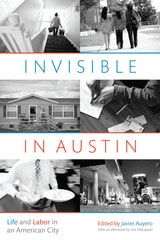
cover of Invisible in Austin: Life and Labor in an American City

Invisible in Austin

Life and Labor in an American City

Edited by Javier Auyero with an afterword by Loïc Wacquant

University of Texas Press, 2015

Austin, Texas, is renowned as a high-tech, fast-growing city for the young and creative, a cool place to live, and the scene of internationally famous events such as SXSW and Formula 1. But as in many American cities, poverty and penury are booming along with wealth and material abundance in contemporary Austin. Rich and poor residents lead increasingly separate lives as growing socioeconomic inequality underscores residential, class, racial, and ethnic segregation.

In Invisible in Austin, the award-winning sociologist Javier Auyero and a team of graduate students explore the lives of those working at the bottom of the social order: house cleaners, office-machine repairers, cab drivers, restaurant cooks and dishwashers, exotic dancers, musicians, and roofers, among others. Recounting their subjects’ life stories with empathy and sociological insight, the authors show us how these lives are driven by a complex mix of individual and social forces. These poignant stories compel us to see how poor people who provide indispensable services for all city residents struggle daily with substandard housing, inadequate public services and schools, and environmental risks. Timely and essential reading, Invisible in Austin makes visible the growing gap between rich and poor that is reconfiguring the cityscape of one of America’s most dynamic places, as low-wage workers are forced to the social and symbolic margins.
[more]
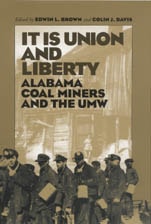
cover of It is Union and Liberty: Alabama Coal Miners, 1898-1998

It is Union and Liberty

Alabama Coal Miners, 1898-1998

Edwin L. Brown

University of Alabama Press, 1999

One union, many voices—Alabama coal miners and the century-long fight for justice.

Much of Alabama's labor history is written in its coal fields. This book records the critical contribution that District 20 of the United Mine Workers of America played in the state's labor movement through its strong stands on such issues as child labor, public education, and inter-racial unions. 

Standing at the cutting edge of social and political history, these essays cover five periods over a century of union activity: the emergence of a militant labor force during mining's formative years; the World War I era, when mine operators tried to divide black and white labor; the increasing role of the state in labor relations during the interwar years; rapid changes in the union between 1942 and 1975; and the 1977-79 strike, the largest in the United Mine Workers' history. 

Through historic photographs and depictions of living and working conditions, contributors Edwin L. Brown, Colin J. Davis, Daniel Letwin, Brian M. Kelly, Peter Alexander, Glenn Feldman, and Robert H. Woodrum portray the world that miners, both black and white, made. In a state where racial segregation was the norm,even the earliest District 20 contract proposals demanded equal pay for equal work regardless of color. It Is Union and Liberty shows that the UMW in Alabama stands apart from perceptions of southern trade unionism as exclusionary and racially fragmented. It sheds light on an important segment of the state's labor history and is a testament to District 20 on its centennial celebration.
 

[more]