Results by title
1228 books match the query 'Library & Information Science' and 80 start with i

I Found It on the Internet
Coming of Age OnlineFrances Jacobson Harris
American Library Association, 2011
I, Digital
Personal Collections in the Digital EraChristopher A. Lee
American Library Association, 2011
Impactful Community-Based Literacy Projects
Lesley S. J. Farmer
American Library Association, 2021
Foreword by Dr. Lois Bridges
Inspired by the Library of Congress Literacy Awards Program and its applicants, which have showcased and disseminated innovative literacy initiatives across the country and around the world since 2013, this book provides evidence-based practice guidelines for librarians and educators. To optimize results, the projects in this book blend early literacy benefits, fundamental reading skills, and other foundational concepts with culture- or community-specific sensitivity and leveraging. They’re adaptable based on age, audience, size, resources, and budget; and most importantly, they address social inequities and foster cross-culture interactions. Inside, readers will find
- detailed profiles of dozens of successful literacy projects, which include such activities as oral storytelling, the Parent-Child Home Program, a repository of multilingual children’s stories, accessible web readers, personal tutors, and many more;
- an overview of universal steps to literacy, explaining how people learn, generic reading skill development, human developmental issues, and habits of literacy;
- research-based factors for impactful literacy projects;
- discussion of the importance and role of literacy partners such as families, schools and universities, libraries, government agencies, nonprofit organizations, and for-profit entities;
- advice on project planning, including needs assessment, goals and objectives, literacy review, target audience, project personnel, resources, setting and timing, communication, support, implementation, and continuous assessment and improvement; and
- guidance on building capacity, empowering the community, and sustaining a culture of literacy.
Implementing Cost-Effective Assistive Computer Technology
A How-To-Do-It Manual for LibrariansJane Vincent
American Library Association, 2012
Implementing Excellence in Diversity, Equity, and Inclusion
A Handbook for Academic LibrariesCorliss Lee
American Library Association, 2022
—from the Foreword by Mark A. Puente
Academic library workers often make use of systemic, bureaucratic, political, collegial, and symbolic dimensions of organizational behavior to achieve their diversity, equity, and inclusion goals, but many are also doing the crucial work of pushing back at the structures surrounding them in ways small and large.
Implementing Excellence in Diversity, Equity, and Inclusion captures emerging practices that academic libraries and librarians can use to create more equitable and representative institutions. 19 chapters are divided into 6 sections:
- Recruitment, Retention and Promotion
- Professional Development
- Leveraging Collegial Networks
- Reinforcing the Message
- Organizational Change
- Assessment
Chapters cover topics including active diversity recruitment strategies; inclusive hiring; gendered ageism; librarians with disabilities; diversity and inclusion with student workers; residencies and retention; creating and implementing a diversity strategic plan; cultural competency training; libraries’ responses to Canadian Truth and Reconciliation Commission Calls to Action; and accountability and assessment. Authors provide practical guiding principles, effective practices, and sample programs and training.
Implementing Excellence in Diversity, Equity, and Inclusion explores how academic libraries have leveraged and deployed their institutions’ resources to effect DEI improvements while working toward implementing systemic solutions. It provides means and inspiration for continuing to try to hire, retain, and promote the change we want to see in the world regardless of existing structures and systems, and ways to improve those structures and systems for the future.
Implementing FRBR in Libraries
Key Issues and Future DirectionsAmerican Library Association, 2009
Implementing Virtual Reference Services
Beth Thomsett-Scott
American Library Association, 2013
Implementing for Results
Your Strategic Plan in ActionSandra Nelson
American Library Association, 2009
Improbable Libraries
A Visual Journey to the World's Most Unusual LibrariesAlex Johnson
University of Chicago Press, 2015
Public libraries are a cornerstone of modern civilization, yet like the books in them, libraries face an uncertain future in an increasingly digital world. Undaunted, librarians around the globe are thinking up astonishing ways of reaching those in reading need, whether by bike in Chicago, boat in Laos, or donkey in Colombia. Improbable Libraries showcases a wide range of unforgettable, never-before-seen images and interviews with librarians who are overcoming geographic, economic, and political difficulties to bring the written word to an eager audience. Alex Johnson charts the changing face of library architecture, as temporary pop-ups rub shoulders with monumental brick-and-mortar structures, and many libraries expand their mission to function as true community centers. To take just one example: the open-air Garden Library in Tel Aviv, located in a park near the city’s main bus station, supports asylum seekers and migrant workers with a stock of 3,500 volumes in sixteen different languages.
Beautifully illustrated with two hundred and fifty color photographs, Improbable Libraries offers a breathtaking tour of the places that bring us together and provide education, entertainment, culture, and so much more. From the rise of the egalitarian Little Free Library movement to the growth in luxury hotel libraries, the communal book revolution means you’ll never be far from the perfect next read.

Improving Library Services in Support of International Students and English as a Second Language Learners
Leila June Rod-Welch
Assoc of College & Research Libraries, 2019
Improving the Visibility and Use of Digital Repositories
Kenneth Arlitsch
American Library Association, 2013

In the Company of Books
Literature and Its "Classes" in Nineteenth-Century AmericaSarah Wadsworth
University of Massachusetts Press, 2006
With sections focusing on segmentation by age, gender, and cultural status, In the Company of Books analyzes the ways authors and publishers carved up the field of literary production into a multitude of distinct submarkets, differentiated their products, and targeted specific groups of readers in order to guide their book-buying decisions. Combining innovative approaches to canonical authors such as Nathaniel Hawthorne, Louisa May Alcott, Mark Twain, and Henry James with engaging investigations into the careers of many lesser-known literary figures, Sarah Wadsworth reveals how American writers responded to—and contributed to—this diverse, and diversified, market.
In the Company of Books contends that specialized editorial and marketing tactics, in concert with the narrative strategies of authors and the reading practices of the book-buying public, transformed the literary landscape, leading to new roles for the book in American culture, the innovation of literary genres, and new relationships between books and readers. Both an exploration of a fragmented print culture through the lens of nineteenth-century American literature and an analysis of nineteenth-century American literature from the perspective of this subdivided marketplace, this wide-ranging study offers fresh insight into the impact of market forces on the development of American literature.
In the Words of the Winners
The Newbery and Caldecott Medals 2001-2010American Library Association, 2011
Include
Julie Stivers
American Library Association, 2022
Include, part of a six-volume series on the Shared Foundations in AASL’s National School Library Standards, brings together a chorus of school librarians, scholars, and students representing a wide range of races, ethnicities, experiences, and identities. This book offers
- an understanding of why the concept of Include is paramount to school librarian practice, supported by key research to share and inspire the inclusion of learner and educator voices and experiences;
- an explanation of what it looks like to successfully integrate the Include Shared Foundation in terms of collection, space, and instruction;
- useable guidance that school librarians can confidently incorporate in their settings , including easy-to-implement ideas, inspiring stories, events, and transformation; and
- reflections, questions, and action steps to help readers move their practice forward.
Including Families of Children with Special Needs
A How-To-Do-It Manual for LibrariansSandra Feinberg
American Library Association, 2013
Inclusive Leadership in Academic Libraries
Edited by Annie Bélanger, John Meier, and Jennifer DeVito
American Library Association, 2026
Libraries are forever in a state of change and evolution. We are affected by social movements, cultural norms, the political climate, and economic forces. Developing skills in inclusive leadership is one step toward fostering workspaces that are diverse, equitable, and able to effectively manage through change while holding true to our values as library workers.
Inclusive Leadership in Academic Libraries offers 26 chapters in three parts that explore what inclusive leadership is, the theories underlying it, and ways to incorporate it into your daily work.
- Setting the Stage: Introduces inclusive leadership and theoretical frameworks
- Concepts and Practices: Includes chapters on the themes and theories of inclusive leadership and case studies demonstrating them
- Living Into Inclusive Leadership: Puts inclusive leadership into practice and offers examples of how it’s been done in various academic libraries
Inclusive leadership incorporates empathy, acknowledges that every person brings different perspectives and skills to the workplace, and articulates that leaders exist at all levels. Inclusive Leadership in Academic Libraries will help you incorporate effective, equitable practices throughout your library. This book is also available as an open access edition.
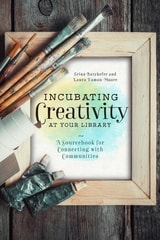
Incubating Creativity at Your Library
A Sourcebook for Connecting with CommunitiesLaura Damon-Moore
American Library Association, 2019
Creativity needs a platform. As technology consultant David Weinberger puts it, “A platform provides resources that lets other people build things.” The library is an ideal platform, and in this book Batykefer and Damon-Moore, creators of the Library as Incubator Project, share the experiences of numerous creative library workers and artists who are making it happen. Their stories will show you how to move beyond merely responding to community needs towards actively building a platform with your community. And best of all, you don’t need to start from scratch—rather, you amplify what’s already working. Filled with ideas and initiatives that can be customized to suit your library and its community, this book
- discusses the four elements (Resources, Invitations, Partnerships & Engagement, and Staff) and the two lenses (Community-Led and Evaluation) of the Creative Library platform;
- outlines six steps for surveying your community’s artistic landscape;
- gives methods for expanding partnerships and connections with individuals and organizations through exploration, hands-on learning, and engagement with the community;
- shares perspectives on the “ideal library” from several artists, with three examples of artist-in-residence programs;
- offers examples of community invitations in action, such as the Pittsburgh Fiberarts Guild workshops on creating flowers using recycled materials;
- shows how to use “orphan photos” from your archives for creative inspiration;
- advises on using qualitative evaluations to effectively “weed” your initiatives; and
- shares tips for encouraging library staff to express their creativity, turning avocations into library initiatives like Handmade Crafternoons, the Yahara Music Library, or BOOKLESS.
By building on existing elements at your library and filling in the gaps with community-driven additions, your library can be a space that cultivates creativity in both its users and staff.
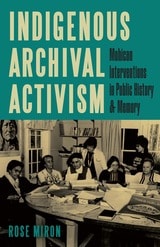
Indigenous Archival Activism
Mohican Interventions in Public History and MemoryRose Miron
University of Minnesota Press, 2024
Who has the right to represent Native history?
The past several decades have seen a massive shift in debates over who owns and has the right to tell Native American history and stories. For centuries, non-Native actors have collected, stolen, sequestered, and gained value from Native stories and documents, human remains, and sacred objects. However, thanks to the work of Native activists, Native history is now increasingly being repatriated back to the control of tribes and communities. Indigenous Archival Activism takes readers into the heart of these debates by tracing one tribe’s fifty-year fight to recover and rewrite their history.
Rose Miron tells the story of the Stockbridge-Munsee Mohican Nation and their Historical Committee, a group of mostly Mohican women who have been collecting and reorganizing historical materials since 1968. She shows how their work is exemplary of how tribal archives can be used strategically to shift how Native history is accessed, represented, written and, most importantly, controlled. Based on a more than decade-long reciprocal relationship with the Stockbridge-Munsee Mohican Nation, Miron’s research and writing is shaped primarily by materials found in the tribal archive and ongoing conversations and input from the Stockbridge-Munsee Historical Committee.
As a non-Mohican, Miron is careful to consider her own positionality and reflects on what it means for non-Native researchers and institutions to build reciprocal relationships with Indigenous nations in the context of academia and public history, offering a model both for tribes undertaking their own reclamation projects and for scholars looking to work with tribes in ethical ways.
Influencing Without Authority
Melanie Hawks
Assoc of College & Research Libraries, 2011
Influencing Without Authority
Melanie Hawks
Assoc of College & Research Libraries, 2011
Information Literacy Assessment
Standards-Based Tools and AssignmentsTeresa Y. Neely
American Library Association, 2006
Information Literacy Instruction Handbook
Christopher N. Cox
Assoc of College & Research Libraries, 2008
Information Literacy Instruction that Works
A Guide to Teaching by Discipline and Student PopulationPatrick Ragains
American Library Association, 2013
Information Literacy Programs in the Digital Age
Educating College and University Students OnlineAlice Daugherty
Assoc of College & Research Libraries, 2011
Information Literacy Programs in the Digital Age
Educating College and University Students OnlineAlice Daugherty
Assoc of College & Research Libraries, 2011
Information Literacy Standards for Student Learning
American Library Association, 1999
Information Literacy and Social Media
Empowered Student Engagement with the ACRL FrameworkMichele Santamaria
Assoc of College & Research Libraries, 2024
Information Literacy and Social Media: Empowered Student Engagement with the ACRL Framework provides librarians and non-librarian practitioners with ways to teach and learn with social media. It addresses how to broadly conceptualize information literacy teaching with social media and allay any student reluctance to using social media for academic purposes. It proposes how to map some of the ACRL threshold concepts onto specific social media platforms, including Facebook, X, Instagram, and TikTok, while providing general guidance for if and when those platforms change. There are eight concrete, cross-disciplinary lesson plans that factor in design, assessment, and student engagement. Finally, the book considers how up-and-coming platforms might empower students to be critical content creators and encourage librarians and faculty to support and create new information literacy initiatives on their campuses.
Information Literacy and Social Media demonstrates how to engage students with and through social media platforms and teach them to embrace their role as information creators through engagement with the ACRL Framework for Information Literacy for Higher Education. This is the step that they must take to truly be metaliterate in the creative and ethical ways that make information literacy an essential college competency.
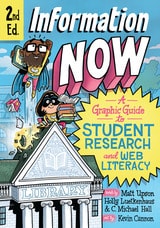
Information Now, Second Edition
A Graphic Guide to Student Research and Web LiteracyMatt Upson, Holly Luetkenhaus, C. Michael Hall, and Kevin Cannon
University of Chicago Press, 2021
This second edition of the popular guide incorporates critical analysis of information systems, asking students to think about the biases and problems in how databases and search engines are designed and used. It also addresses how different populations of people are disproportionately affected by the algorithmic biases built into information systems. And it includes revised critical thinking exercises in every chapter.
Written and revised by library professionals, Information Now is a fun and insightful tool for high school and college students, writers, and anyone wanting to improve their research skills.
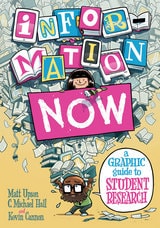
Information Now
A Graphic Guide to Student ResearchMatt Upson, C. Michael Hall, and Kevin Cannon
University of Chicago Press, 2015
Information Now is an innovative approach to information literacy that will reinvent the way college students think about research. Instead of the typical textbook format, it uses illustrations, humor, and reflective exercises to teach students how to become savvy researchers. Students will learn how to evaluate information, to incorporate it into their existing knowledge base, to wield it effectively, and to understand the ethical issues surrounding its use. Written by two library professionals, it incorporates concepts and skills drawn from the Association of College and Research Libraries’ Information Literacy Competency Standards for Higher Education and their Framework for Information Literacy for Higher Education. Thoroughly researched and highly engaging, Information Now offers the tools that students need to become powerful consumers and creators of information.
Whether used by a high school student tackling a big paper, an undergrad facing the newness of a university library, or a writer wanting to go beyond Google, Information Now is a powerful tool for any researcher’s arsenal.
Information Power
Building Partnerships for LearningAmerican Library Association, 1998
Information Services to Diverse Populations
Competent Humility for Library ProfessionalsNicole A. Cooke
American Library Association, 2026
Foreword by Cynthia Sturgis Landrum
The development of cultural competency skills and social awareness benefits LIS students, their future employers, and the library profession at large―not to mention library customers and society as a whole. Cooke's freshly updated text introduces readers to the contexts and situations that promote the development of empathy and build cultural competence. It marshals cutting edge research and relevant best practices to give readers a strong grasp of the political, social, economic, and technological divides among library patrons. It also covers outreach and library services to diverse populations, how to evaluate such services, and many other key topics. Complete with an updated syllabus, lesson plans, and exercises ready-made for course use, Cooke’s text
- demonstrates why social responsibility is a foundational value of librarianship;
- considers library services to members of marginalized racial or ethnic groups, older adults, people with mental health or physical disabilities, neurodiverse library users, refugees and immigrants, people experiencing homelessness or hunger, those growing up in or experiencing poverty, members of the LGBTQIA+ communities, and people who are incarcerated;
- features a myriad of testimonials drawn from a wide variety of settings that highlight the experiences of library and museum practitioners who are working with diverse populations;
- introduces a new model of cultural competence and cultural humility;
- authoritatively covers such essential concepts as intersectionality, privilege, marginalization, cultural competence, cultural humility, and counter-storytelling along with discussions of how they interplay in the communities that libraries serve;
- explores the impact of overwhelming whiteness of the library profession and what can be done to recruit, welcome, mentor, and retain racially and ethnically diverse library workers; and
- identifies potential employment and networking opportunities related to diversity and social justice in librarianship.
Informed Learning
Christine Bruce
Assoc of College & Research Libraries, 2011
Informed Learning
Christine Bruce
Assoc of College & Research Libraries, 2011
Informing Innovation
Tracking Student Interest in Emerging Library Technologies at Ohio UniversityChar Booth
Assoc of College & Research Libraries, 2011
Informing Innovation
Tracking Student Interest in Emerging Library Technologies at Ohio UniversityChar Booth
Assoc of College & Research Libraries, 2011
Innovative Library Workplaces
Transformative Human Resource StrategiesLisa Kallman Hopkins
Assoc of College & Research Libraries, 2024
In two parts, Innovative Library Workplaces provides the tools you need to make your workplace a good one for your employees.
- Human Resources in Libraries
- Recruiting and Hiring
- Onboarding and Training
- Salary Studies and Unions
- Work Culture and Organization
- Employee Morale
- Flexible Work Arrangements
- Strategic Planning and Reorganizing
Inquire
Lori E. Donovan
American Library Association, 2022
Inside, Outside, and Online
Building Your Library CommunityChrystie Hill
American Library Association, 2009
Inspired Collaboration
Ideas for Discovering and Applying Your PotentialDorothy Stoltz
American Library Association, 2016
Inspired Thinking
Big Ideas to Enrich Yourself and Your CommunityDorothy Stoltz
American Library Association, 2020
Inspiring Teens, Tweens, and Families to Make a Difference in the World
Programming to Advance the Sustainable Development GoalsAmanda Moss Struckmeyer
American Library Association, 2025
- programs and activities related to such topics as good health and well-being, ending poverty, peace and justice, responsible consumption and production, decent work, and clean water and sanitation;
- ideas perfect for multi-age audiences (families), tweens, and teens that can be tailored for different group sizes, programming spaces, budgets, and time frames;
- a plethora of flexible, cost-effective passive programs that patrons can engage in at any time;
- guidance on outreach opportunities for fostering partnerships with local experts and guest speakers; and
- pointers on additional and supporting resources including books, videos, and websites.
Institutional Repositories
Josh C. Cromwell
Against the Grain, LLC, 2026
Institutional Repositories manage and preserve an institution’s own content. Since their introduction over 25 years ago, Institutional Repositories have been established in universities and institutions around the world. Yet many people, even within the scholarly world, are unaware of the work that repositories carry out, and the essential role they play. Institutional Repositories is a much-needed guide to repositories, past and present. Written by a repository manager and trainer, this fully peer-reviewed book assumes no prior knowledge, and guides the reader through all the activities carried out by the repository team, including (but not limited to) ensuring green Open Access, and ensuring maximum impact for the institution’s research output, as well as providing a collective memory for the organization, often capturing content that would otherwise be lost.
- Wide-ranging, from staffing and managing the repository, to accessibility, preservation, and metadata
- Includes practical guidance for the daily tasks carried out by repository staff
- Compares national repository strategies
- With glossary of repository-related terms
Cromwell achieves something rare: a book that is comprehensive, detailed, readable, and useful all at once. He understands the benefits and untapped potential of the global network of open-access repositories, and offers practical advice for taking full advantage of this community-led infrastructure. Recommended for all institutions hosting or planning to host a repository.
Peter Suber, Director of the Harvard Open Access Project
Institutional Repositories
Clipp #44Brighid Gonzales
American Library Association, 2018
Institutions of Reading
The Social Life of Libraries in the United StatesThomas Augst
University of Massachusetts Press, 2007
Tracing the evolution of the library as a modern institution from the late eighteenth century to the digital era, this book explores the diverse practices by which Americans have shared reading matter for instruction, edification, and pleasure. Writing from a rich variety of perspectives, the contributors raise important questions about the material forms and social shapes of American culture. What is a library? How have libraries fostered communities of readers and influenced the practice of reading in particular communities? How did the development of modern libraries alter the boundaries of individual and social experience, and define new kinds of public culture? To what extent have libraries served as commercial enterprises, as centers of power, and as places of empowerment for African Americans, women, and immigrants? Institutions of Reading offers at once a social history of literacy and leisure, an intellectual history of institutional and technological innovations that facilitated the mass distribution and consumption of printed books and periodicals, and a cultural history of the symbolic meanings and practical uses of reading in American life. In addition to the editors, contributors include Elizabeth Amann, Michael Baenen, James Green, Elizabeth McHenry, Barbara Mitchell, Christine Pawley, Janice Radway, James Raven, Karin Roffman, and Roy Rosenzweig.
Instructional Design for Librarians and Information Professionals
American Library Association, 2011
Instructional Design for Teaching Information Literacy Online
A Student-Centered ApproachJanna Mattson
Assoc of College & Research Libraries, 2025
Instructional Design for Teaching Information Literacy Online: A Student-Centered Approach introduces light-hearted tips and advice with author-curated playlists and practical tips on rapidly designing online instruction. It offers scenarios, learning activities, lesson plan examples, rubrics, worksheets, and more, using the classic instructional design model ADDIE to frame the process and the universal design for learning framework, the community of inquiry model, and asset-based pedagogy to address the social and emotional needs of diverse online learners. Six parts offer a theoretical grounding, practical resources, and the enhanced confidence and skills needed to create successful learning experiences.
- Foundational Knowledge
- Analysis
- Design
- Development
- Implementation
- Evaluation
Instructional Identities and Information Literacy
Three Volume SetAmanda Nichols Hess
Assoc of College & Research Libraries, 2023
Grappling with this potentially unexpected identity comes amid a time of significant transition for higher education itself. Academic librarians must figure out how to counter mis-, dis-, and malinformation, address shrinking funding for collections while costs increase, and establish meaningful partnerships in diverse, data-driven environments. And writ large, librarianship as a profession continues to grapple with its responsibility to challenge information illiteracy across contexts, its support of systemic systems of oppression under the guise of neutrality, and its value to a society flooded with information.
In three volumes, Instructional Identities and Information Literacy uses transformative learning theory—a way of understanding adult learning and ourselves—to explore the ways librarians can meaningfully advance how we think about our identities, instructional work, and learning as transformation. Three volumes explore:
- Transforming Ourselves
- Transforming Our Programs, Institutions, and Profession
- Transforming Student Learning, Information Seeking, and Experiences
Instructional Identities and Information Literacy
Volume 1: Transforming OurselvesAmanda Nichols Hess
Assoc of College & Research Libraries, 2023
Grappling with this potentially unexpected identity comes amid a time of significant transition for higher education itself. Academic librarians must figure out how to counter mis-, dis-, and malinformation, address shrinking funding for collections while costs increase, and establish meaningful partnerships in diverse, data-driven environments. And writ large, librarianship as a profession continues to grapple with its responsibility to challenge information illiteracy across contexts, its support of systemic systems of oppression under the guise of neutrality, and its value to a society flooded with information.
In three volumes, Instructional Identities and Information Literacy uses transformative learning theory—a way of understanding adult learning and ourselves—to explore the ways librarians can meaningfully advance how we think about our identities, instructional work, and learning as transformation. Three volumes explore:
- Transforming Ourselves
- Transforming Our Programs, Institutions, and Profession
- Transforming Student Learning, Information Seeking, and Experiences
Instructional Identities and Information Literacy
Volume 3: Transforming Student Learning, Information Seeking, and ExperiencesAmanda Nichols Hess
Assoc of College & Research Libraries, 2023
Grappling with this potentially unexpected identity comes amid a time of significant transition for higher education itself. Academic librarians must figure out how to counter mis-, dis-, and malinformation, address shrinking funding for collections while costs increase, and establish meaningful partnerships in diverse, data-driven environments. And writ large, librarianship as a profession continues to grapple with its responsibility to challenge information illiteracy across contexts, its support of systemic systems of oppression under the guise of neutrality, and its value to a society flooded with information.
In three volumes, Instructional Identities and Information Literacy uses transformative learning theory—a way of understanding adult learning and ourselves—to explore the ways librarians can meaningfully advance how we think about our identities, instructional work, and learning as transformation. Three volumes explore:
- Transforming Ourselves
- Transforming Our Programs, Institutions, and Profession
- Transforming Student Learning, Information Seeking, and Experiences
Integrated Library Planning
A New Model for Strategic and Dynamic Planning, Management, and AssessmentMyka Kennedy Stephens
Assoc of College & Research Libraries, 2023
In a concise seven chapters offering illustrations, charts, sample outlines, and many tools and resources, Integrated Library Planning offers a different kind of approach to planning that is both strategic and dynamic. It is fueled by open communication, honest assessment, and astute observation. Voices at the table, near the table, and far from the table are heard and considered. Its perpetual rhythm gives space to consider new information when it emerges and freedom to make changes at a time that makes sense instead of when it is most convenient or expected.
The era of fixed-length strategic plans is coming to an end. Five-year strategic plans had already given way to three-year strategic plans, and now we find ourselves needing to plan and function when nothing is certain beyond the present moment. The components of this model might look deceptively similar to the strategic planning practices used in libraries and organizations for decades; however, when implemented as a whole, with a monthly review cycle on a rolling planning horizon and space for regular analysis of information needs and behavior, it has the potential to shatter any previous notions of planning that serve only to satisfy administrators. Integrated Library Planning can help libraries effectively navigate and become agents of change.