Results by title
283 books match the query 'Phenomenology' and 16 start with i
Idea of Phenomenology
Husserlian ExemplarismAndre de Muralt
Northwestern University Press, 1988
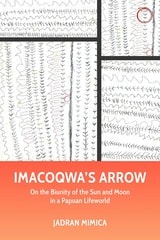
Imacoqwa’s Arrow
On the Biunity of the Sun and Moon in a Papuan LifeworldJadran Mimica
HAU, 2025
In Imacoqwa’s Arrow, Jadran Mimica draws on decades of field research to bring us a rich ethnographic account of myth and meaning in the lifeworlds of the Yagwoia of Papua New Guinea. He focuses especially on the relations of the sun and the moon in Yagwoia understandings of the universe and their own place within it. This is classic terrain in Melanesian ethnography, but Mimica does much more than add to the archive of anthropological accounts of the significance of the sun and the moon for peoples of this part of the world. With extraordinary rigor and reflexivity, he grounds his understanding of Yagwoia concepts in psychoanalytic and phenomenological methods that afford a radically new and revealing translation of these seminal themes in Melanesian mythology and its poetics. This is a major contribution to the hermeneutics of ethnographic translation and theorization.
Imagining Otherwise
Metapsychology and the Analytic A PosterioriAndrew Cutrofello
Northwestern University Press, 1997
Improvisation for the Theater
A Handbook of Teaching and Directing TechniquesViola Spolin
Northwestern University Press, 1983
In Force, Drive, Desire, Rudolf Bernet develops a philosophical foundation of psychoanalysis focusing on human drives. Rather than simply drawing up a list of Freud’s borrowings from Schopenhauer and Nietzsche, or Lacan’s from Hegel and Sartre, Bernet orchestrates a dialogue between philosophy and psychoanalysis that goes far beyond what these eminent psychoanalysts knew about philosophy. By relating the writings of Freud, Lacan, and other psychoanalysts to those of Aristotle, Leibniz, Schopenhauer, Nietzsche, Husserl, Heidegger, and, more tacitly, Bergson and Deleuze, Bernet brings to light how psychoanalysis both prolongs and breaks with the history of Western metaphysics and philosophy of nature.
Rereading the long history of metaphysics (or at least a few of its key moments) in light of psychoanalytic inquiries into the nature and function of drive and desire also allows for a rewriting of the history of philosophy. Specifically, it allows Bernet to bring to light a different history of metaphysics, one centered less on Aristotelian substance (ousia) and more on the concept of dunamis—a power or potentiality for a realization toward which it strives with all its might. Relating human drives to metaphysical forces also bears fruit for a renewed philosophy of life and subjectivity.

In Praise of Philosophy and Other Essays
Maurice Merleau-Ponty
Northwestern University Press, 1988

Inadvertent Images
A History of Photographic ApparitionsPeter Geimer
University of Chicago Press, 2018
Incarnation, Pain, Theology
A Phenomenology of the BodyEspen Dahl
Northwestern University Press, 2024
While the phenomenological tradition has carefully treated both the objective and the lived body, Espen Dahl explores a dimension of the body that does not fall neatly into either category, suggesting that philosophers should take account of the inner density of our organic, material body. By integrating the dimension of “flesh-and-blood” into the phenomenological notion of the body, Dahl argues that it is possible to reach a more adequate notion of human incarnation. The author explores the body in its subjectivity and its resistance, in activity founded on passivity, and in the ambiguous limits of its skin. The phenomenon of pain is given particular attention in this investigation, since pain is, as Dahl argues, what makes the body inescapably manifest in its otherwise hidden dimensions, including its ambiguity and vulnerability. Related to this focus, Dahl also engages with the Christian theological concerns of incarnation, pain, and hope. Phenomenologists have long drawn on this religious inheritance, particularly in what has been dubbed the French “theological turn.” In a similar manner, Incarnation, Pain, Theology: A Phenomenology of the Body draws on these theological sources while firmly holding to its philosophical commitments in methodological approach and analytic aims.
Incarnation
A Philosophy of FleshMichel Henry; Translated from the French by Karl Hefty
Northwestern University Press, 2015
After having placed the difficult problem of the incarnation in an historical perspective going back to the thought of the Fathers of the Church, he makes in this book a critical review of the phenomenological tradition that leads to the reversal of phenomenology. He then proposes to elaborate a phenomenology of the flesh which leads to the notion of a not constituted original flesh given in the "Arch-revelation" of Life, as well as a phenomenology of Incarnation.
Although the flesh is traditionally understood as the place of sin, it is also in Christianity the place of salvation, which consists in the deification of man, that’s to say in the fact of becoming Son of God, to come back to the eternal and absolute Life we had forgotten getting lost in the world, caring only about things and ourselves. In the fault, we make the tragic experience of our powerlessness to do the good we would like to do and of our inability to avoid the evil. In this way in front of the magic body of the other, that’s the anguished desire to meet the life in it that leads to the fault. In the night of the lovers, the sexual act couples two impulsive movements, but the erotic desire fails to reach the pleasure of the other where it is experienced, in a total loving fusion. The erotic relation is however doubled by a pure affective relation, foreign to the carnal coupling, a relation made of mutual gratitude or of love. That’s this affective dimension that is denied in this way of violence that is pornography, which extracts the erotic relation from the pathos of life to abandon it to the world, and which consists in a real profanation of life.
Infinite Phenomenology
The Lessons of Hegel's Science of ExperienceJohn Russon
Northwestern University Press, 2016
Infinite Phenomenology builds on John Russon’s earlier book, Reading Hegel’s Phenomenology, to offer a second reading of Hegel’s Phenomenology of Spirit. Here again, Russon writes in a lucid, engaging style and, through careful attention to the text and a subtle attunement to the existential questions that haunt human life, he demonstrates how powerfully Hegel’s philosophy can speak to the basic questions of philosophy. In addition to original studies of all the major sections of the Phenomenology, Russon discusses complementary texts by Hegel, namely, the Philosophy of Spirit, the Philosophy of Right, and the Science of Logic. He concludes with an appendix that discusses the reception and appropriation of Hegel’s Phenomenology in twentieth-century French philosophy. As with Russon’s earlier work, Infinite Phenomenology will remain essential reading for those looking to engage Hegel’s essential, yet difficult, text.
Inscriptions
After Phenomenology and StructuralismHugh J. Silverman
Northwestern University Press, 1997
In Inscriptions, Hugh J. Silverman investigates two divergent yet related philosophical movements: phenomenology from the later Husserl through Sartre and Heidegger to Merleau-Ponty, and structuralism from de Saussure through Levi-Strauss and Lacan to Barthes. This reading of the tradition culminates in an assessment of Derrida and Foucault. From this foundation, Silverman moves beyond structuralism and phenomenology, and develops his own philosophical position in the context of semiotics, hermeneutics, and deconstruction. A new preface by the author updates this classic text.
Institution and Passivity
Course Notes from the Collège de France (1954-1955)Maurice Merleau-Ponty
Northwestern University Press, 2010
Institution and Passivity is based on course notes for classes taught at the Bibliothèque Nationale de Paris. Philosophically, this collection connects the issue of passive constitution of meaning with the dimension of history, furthering discussions and completing arguments started in The Visible and the Invisible and Signs (both published by Northwestern). Leonard Lawlor and Heath Massey’s translation makes available to an English-speaking readership a critical transitional text in the history of phenomenology.
Intersubjective Existence
A Critical Reflection on the Theory and the Practice of SelfhoodOliva Blanchette
Catholic University of America Press, 2021
Introduction to Husserlian Phenomenology
Rudolf Bernet, Iso Kern, and Eduard Marbach
Northwestern University Press, 1993
Inventing Philosophy's Other
Phenomenology in AmericaJonathan Strassfeld
University of Chicago Press, 2022
Phenomenology and so-called “continental philosophy” receive scant attention in most American philosophy departments, despite their foundational influence on intellectual movements such as existentialism, post-structuralism, and deconstruction. In Inventing Philosophy’s Other, Jonathan Strassfeld explores this absence, revealing how everyday institutional practices played a determinative role in the development of twentieth-century academic discourse.
Conventional wisdom holds that phenomenology’s absence from the philosophical mainstream in the United States reflects its obscurity or even irrelevance to America’s philosophical traditions. Strassfeld refutes this story as he traces phenomenology’s reception in America, delivering the first systematic historical study of the movement in the United States. He examines the lives and works of Marjorie Grene, Alfred Schütz, Hubert Dreyfus, and Iris Marion Young, among others, while also providing a fresh introduction to phenomenological philosophy.

Investigations into the Literary Use of Language
Course Notes from the Collège de France, 1953Maurice Merleau-Ponty, Bryan Smyth
Northwestern University Press, 2026
A closely annotated translation of Merleau-Ponty’s lecture notes on literary language
Investigations into the Literary Use of Language presents an annotated translation of Maurice Merleau-Ponty’s lecture notes from one of the two courses that he gave during his inaugural year teaching at the Collège de France. In his notes from the concurrent course, The Sensible World and the World of Expression, Merleau-Ponty contends that our embodied perceptual engagement with the sensible world already involves the same spontaneity that underlies cultural expression. Approaching it from the other side, he revisits here the analysis of language that he had undertaken in the unfinished manuscript The Prose of the World.
Focusing on the work of Paul Valéry (1871–1945) and Stendhal (Marie-Henri Beyle, 1783–1842), Merleau-Ponty explores how the spontaneity of literary language sheds light on the relation between lived experience and language more broadly, and how cultural expression remains grounded in embodied perceptual experience in a way that is homologous yet irreducible to it. Specifically, Merleau-Ponty shows how Stendhal had already overcome Valéry’s skepticism concerning literary sincerity by effectively incorporating what the latter called the linguistic “implex”—in effect, language as institution—and thus achieving a “total style” of improvisational spontaneity in which the “conquering function” characteristic of the literary use of language gives shape to an immanent model of political engagement.
Is Feminist Philosophy Philosophy?
Emanuela Bianchi
Northwestern University Press, 1999