Results by title
426 books match the query 'Philosophy & Social Aspects' and 19 start with i
Idealization and the Aims of Science
Angela Potochnik
University of Chicago Press, 2017
Idealization and the Aims of Science shows just how crucial idealization is to science and why it matters. Beginning with the acknowledgment of our status as limited human agents trying to make sense of an exceedingly complex world, Angela Potochnik moves on to explain how science aims to depict and make use of causal patterns—a project that makes essential use of idealization. She offers case studies from a number of branches of science to demonstrate the ubiquity of idealization, shows how causal patterns are used to develop scientific explanations, and describes how the necessarily imperfect connection between science and truth leads to researchers’ values influencing their findings. The resulting book is a tour de force, a synthesis of the study of idealization that also offers countless new insights and avenues for future exploration.
Images of Science
Essays on Realism and EmpiricismEdited by Paul M. Churchland and Clifford A. Hooker
University of Chicago Press, 1985
Improper Life
Technology and Biopolitics from Heidegger to AgambenTimothy C. Campbell
University of Minnesota Press, 2011
Has biopolitics actually become thanatopolitics, a field of study obsessed with death? Is there something about the nature of biopolitical thought today that makes it impossible to deploy affirmatively? If this is true, what can life-minded thinkers put forward as the merits of biopolitical reflection? These questions drive Improper Life, Timothy C. Campbell’s dexterous inquiry-as-intervention.
Campbell argues that a “crypto-thanatopolitics” can be teased out of Heidegger’s critique of technology and that some of the leading scholars of biopolitics—including Michel Foucault, Giorgio Agamben, and Peter Sloterdijk—have been substantively influenced by Heidegger’s thought, particularly his reading of proper and improper writing. In fact, Campbell shows how all of these philosophers have pointed toward a tragic, thanatopolitical destination as somehow an inevitable result of technology. But in Improper Life he articulates a corrective biopolitics that can begin with rereadings of Foucault (especially his late work regarding the care and technologies of the self), Freud (notably his writings on the drives and negation), and Gilles Deleuze (particularly in the relation of attention to aesthetics).
Throughout Improper Life, Campbell insists that biopolitics can become more positive and productively asserts an affirmative technē not thought through thanatos but rather practiced through bíos.
Improvising Across Abilities
Pauline Oliveros and the Adaptive Use Musical InstrumentThe AUMI Editorial Collective
University of Michigan Press, 2024
This book, which contains wisdom from many who have been affected by their work with the instrument and the people who use it, is a representation of how music and extemporized performance have touched the lives and minds of scholars and families alike. Not only has AUMI provided the opportunity to grow in listening to others who may speak differently (or not at all), but it has been used as an avenue for a diverse set of people to build friendships with others whom they may have never otherwise even glanced at in the street. By providing a space for every person who comes across AUMI to perform, listen, improvise, and collaborate, the continuing development of this instrument contributes to a world in which every person is heard, welcomed, and celebrated.
Imre Lakatos and the Guises of Reason
John Kadvany
Duke University Press, 2001
Lakatos escaped Hungary following the failed 1956 Revolution. Before then, he had been an influential Communist intellectual and was imprisoned for years by the Stalinist regime. He also wrote a lost doctoral thesis in the philosophy of science and participated in what was criminal behavior in all but a legal sense. Kadvany argues that this intellectual and political past animates Lakatos’s English-language philosophy, and that, whether intended or not, Lakatos integrated a penetrating vision of Hegelian ideas with rigorous analysis of mathematical proofs and controversial histories of science.
Including new applications of Lakatos’s ideas to the histories of mathematical logic and economics and providing lucid exegesis of many of Hegel’s basic ideas, Imre Lakatos and the Guises of Reason is an exciting reconstruction of ideas and episodes from the history of philosophy, science, mathematics, and modern political history.

In Search of Divine Reality
Science as a Source of InspirationLothar Schäfer
University of Arkansas Press, 1997
In Search of Mechanisms
Discoveries across the Life SciencesCarl F. Craver and Lindley Darden
University of Chicago Press, 2013
In the Wake of Chaos
Unpredictable Order in Dynamical SystemsStephen H. Kellert
University of Chicago Press, 1993
Induction
Socrates to PopperJohn P. McCaskey
University of Chicago Press, 2026
Charts the historical development of induction and challenges contemporary understandings of the concept and its foundations.
The problem of induction continues to vex and beguile. How can we reliably draw universal conclusions from limited observations? In Induction, John P. McCaskey steps back and rethinks long-held assumptions, tracing the ideas of Socrates and Aristotle in ancient Greece to those of Karl Popper in the twentieth century.
This comprehensive account does not look at how people of the past answered the questions we ask today. Instead, it asks: How did they understand the very meaning of the words epagōgē in Greek, inductio in Latin, istiqrāʾ in Arabic, Induktion in German, and induction in English? McCaskey’s careful treatment of texts in their context dispels many long-standing myths, and importantly, he introduces us to a now-unfamiliar way to think about what induction is—a way in which there simply is no “problem of induction.” McCaskey reveals that the problem was one of our own making and that an accurate history may help us recover old ways—and thereby introduce new ways—to think about the whole idea. A must-read for philosophers, historians of ideas, and anyone interested in the scientific method.
Inference and Representation
A Study in Modeling ScienceMauricio Suárez
University of Chicago Press, 2024
Mauricio Suárez develops a conception of representation that delivers a compelling account of modeling practice. He begins by discussing the history and methodology of model building, charting the emergence of what he calls the modeling attitude, a nineteenth-century and fin de siècle development. Prominent cases of models, both historical and contemporary, are used as benchmarks for the accounts of representation considered throughout the book. After arguing against reductive naturalist theories of scientific representation, Suárez sets out his own account: a case for pluralism regarding the means of representation and minimalism regarding its constituents. He shows that scientists employ a variety of modeling relations in their representational practice—which helps them to assess the accuracy of their representations—while demonstrating that there is nothing metaphysically deep about the constituent relation that encompasses all these diverse means.
The book also probes the broad implications of Suárez’s inferential conception outside scientific modeling itself, covering analogies with debates about artistic representation and philosophical thought over the past several decades.

Information and Experimental Knowledge
James Mattingly
University of Chicago Press, 2021
What is experimental knowledge, and how do we get it? While there is general agreement that experiment is a crucial source of scientific knowledge, how experiment generates that knowledge is far more contentious. In this book, philosopher of science James Mattingly explains how experiments function. Specifically, he discusses what it is about experimental practice that transforms observations of what may be very localized, particular, isolated systems into what may be global, general, integrated empirical knowledge. Mattingly argues that the purpose of experimentation is the same as the purpose of any other knowledge-generating enterprise—to change the state of information of the knower. This trivial-seeming point has a non-trivial consequence: to understand a knowledge-generating enterprise, we should follow the flow of information. Therefore, the account of experimental knowledge Mattingly provides is based on understanding how information flows in experiments: what facilitates that flow, what hinders it, and what characteristics allow it to flow from system to system, into the heads of researchers, and finally into our store of scientific knowledge.
Infrahumanisms
Science, Culture, and the Making of Modern Non/personhoodMegan H. Glick
Duke University Press, 2018

Instrument of War
Music and the Making of America's SoldiersDavid Suisman
University of Chicago Press, 2024
An original history of music in the lives of American soldiers.
Since the Civil War, music has coursed through the United States military. Soldiers have sung while marching, listened to records and armed forces radio, and packed the seats at large-scale USO shows. The bugle call “reveille” has roused soldiers in the morning, and “taps” has marked the end of a long day. Whether the sounds come from brass instruments, weary and homesick singers, or a pair of heavily used earbuds, where there has been war, there has been music, too.
Instrument of War is a first-of-its-kind study of music in the lives of American soldiers. Although musical activity has been part of war since time immemorial, the significance of the U.S. military as a musical institution has generally gone unnoticed. Historian David Suisman traces how the U.S. military has used—and continues to use—music to train soldiers and regulate military life, and how soldiers themselves have turned to music to cope with war’s emotional and psychological realities. Opening our ears to these practices, Suisman reveals how music has enabled more than a century and a half of American war-making. Instrument of War unsettles assumptions about music as a force of uplift and beauty, demonstrating how it has also been entangled in large-scale state violence.
From chanting “Sound off!” in basic training to switching on a phonograph or radio or cueing up an iPod playlist during a patrol, the sound of music has long resonated in soldiers’ wartime experiences. Now we all can finally hear it.
Instrumental Lives
Musical Instruments, Material Culture, and Social Networks in East and Southeast AsiaEdited by Helen Rees
University of Illinois Press, 2024
Original and expert, Instrumental Lives brings a new understanding of how musical instruments interact with their environments and societies. Contributors: Supeena Insee Adler, Marie-Pierre Lissoir, Terauchi Naoko, Jennifer C. Post, Helen Rees, Xiao Mei, Tyler Yamin, and Bell Yung
Instrumentality
On Technical Objects and Orientations in the Later Middle AgesJ. Allan Mitchell
University of Minnesota Press, 2024
From medieval to modern, exploring instrumental attitudes toward physical gadgets, diagrams, concepts, methods, and disciplines
Opening up the instrumental condition of the human for critical reflection and renewal, Instrumentality illuminates key moments in the intellectual history of the European Middle Ages. J. Allan Mitchell reveals how, in the predigital past, we can recognize many of the operative technics, analytics, and metaphorics that continue to shape human sense and cognition today.
Exploring the diverse modalities of medieval instruments, Mitchell’s case studies encompass techniques as seemingly distinct as time-keeping mechanisms, mathematical diagrams, logical syllogisms, and the literary devices of Geoffrey Chaucer and John Gower. A cultural and intellectual history, Mitchell’s work leads readers from three-dimensional objects (physical mechanisms) to two-dimensional inscriptions (maps and diagrams) and onward to overarching disciplinary norms in the early liberal and mechanical arts. Prying loose the subtle, adaptable, and generative concept of technical objects from limiting contemporary frameworks, he shows how these instruments are indispensable to the past—and the future—of the arts and culture at large.

Intangible Materialism
The Body, Scientific Knowledge, and the Power of LanguageRonald Schleifer
University of Minnesota Press, 2009
Taking as his point of departure Norbert Weiner’s statement that information is basic to understanding materialism in our era, Ronald Schleifer shows how discoveries of modern physics have altered conceptions of matter and energy and the ways in which both information theory and the study of literature can enrich these conceptions. Expanding the reductive notion of “the material” as simply matter and energy, he formulates a new, more inclusive idea of materialism.
Schleifer’s project attempts to bridge the divisions between the humanities and the sciences and to create a nonreductive materialism for the information age. He presents a materialistic account of human bodily experience by delving into language and literature that powerfully represents our faces, voices, hands, and pain. For example, he examines the material resources of poetic “literariness” as it is revealed in the condition of Tourette’s syndrome. Schleifer also investigates gestures of the hand in the formation of sociality, and he studies pain as both a physiological and phenomenological experience.
This ambitious work explores physiological analyses, evolutionary explanations, and semiotic descriptions of materialism to reveal how aspects of physical existence discover meaning in experience.
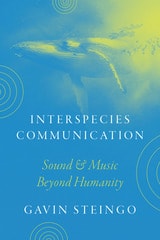
Interspecies Communication
Sound and Music beyond HumanityGavin Steingo
University of Chicago Press, 2024
In Interspecies Communication, music scholar Gavin Steingo examines significant cases of attempted communication beyond the human—cases in which the dualistic relationship of human to non-human is dramatically challenged. From singing whales to Sun Ra to searching for alien life, Steingo charts the many ways we have attempted to think about, and indeed to reach, beings that are very unlike ourselves.
Steingo focuses on the second half of the twentieth century, when scientists developed new ways of listening to oceans and cosmic space—two realms previously inaccessible to the senses and to empirical investigation. As quintessential frontiers of the postwar period, the outer space of the cosmos and the inner space of oceans were conceptualized as parallel realities, laid bare by newly technologized “ears.” Deeply engaging, Interspecies Communication explores our attempts to cross the border between the human and non-human, to connect with non-humans in the depths of the oceans, the far reaches of the universe, or right under our own noses.
Invention Of Modern Science
Isabelle Stengers
University of Minnesota Press, 2000
Is Ultimate Reality Unlimited Love?
Stephen G. Post
Templeton Press, 2014