Results by title
231 books match the query 'Revolutionary Period (1775-1800)' and 10 start with i
Imagining Deliberative Democracy in the Early American Republic
Sandra M. Gustafson
University of Chicago Press, 2011
Deliberation, in recent years, has emerged as a form of civic engagement worth reclaiming. In this persuasive book, Sandra M. Gustafson combines historical literary analysis and political theory in order to demonstrate that current democratic practices of deliberation are rooted in the civic rhetoric that flourished in the early American republic.
Though the U.S. Constitution made deliberation central to republican self-governance, the ethical emphasis on group deliberation often conflicted with the rhetorical focus on persuasive speech. From Alexis de Tocqueville’s ideas about the deliberative basis of American democracy through the works of Walt Whitman, John Dewey, John F. Kennedy, and Martin Luther King Jr., Gustafson shows how writers and speakers have made the aesthetic and political possibilities of deliberation central to their autobiographies, manifestos, novels, and orations. Examining seven key writers from the early American republic—including James Fenimore Cooper, David Crockett, and Daniel Webster—whose works of deliberative imagination explored the intersections of style and democratic substance, Gustafson offers a mode of historical and textual analysis that displays the wide range of resources imaginative language can contribute to political life.

Improbable Patriot
The Secret History of Monsieur de Beaumarchais, the French Playwright Who Saved the American RevolutionHarlow Giles Unger
Brandeis University Press, 2026
In 1776, the playwright and inventor Pierre-Augustin Caron de Beaumarchais (1732–99) conceived an audacious plan to send aid to the American rebels. What’s more, he convinced King Louis XVI to bankroll the project and single-handedly carried it out. By war’s end, he had supplied Washington’s army with most of its weapons and powder, though he was never paid or acknowledged by the United States. To some, he was a dashing hero, a towering intellect who saved the American Revolution. To others, he was a pure rogue, a double-dealing adventurer who stopped at nothing to advance his fame and fortune. In fact, he was both, and more: an advisor to kings, an arms dealer, and an author of some of the most enduring works of the stage, including The Marriage of Figaro and The Barber of Seville. Now in paperback, Improbable Patriot introduces readers to an unrecognized power player in the Revolutionary War.
Incidental Architect
William Thornton and the Cultural Life of Early Washington, D.C., 1794–1828Gordon S. Brown
Ohio University Press, 2009
While the majority of scholarship on early Washington focuses on its political and physical development, in Incidental ArchitectGordon S. Brown describes the intellectual and social scene of the 1790s and early 1800s through the lives of a prominent couple whose cultural aspirations served as both model and mirror for the city’s own.
When William and Anna Maria Thornton arrived in Washington, D.C., in 1794, the new nation’s capital was little more than a raw village. The Edinburgh–educated Thornton and his accomplished wife brought with them the values of the Scottish Enlightenment, an enthusiasm for the arts, and a polished urbanity that was lacking in the little city emerging from the swamps along the Potomac. Thornton’s talents were manifold: He is perhaps best known as the original architect of the Capitol building, but he also served as a city commissioner and as director of the Patent Office, where his own experimentation in steam navigation embroiled him in a long-running dispute with inventor Robert Fulton.
In spite of their general preoccupation with politics and real estate development, Washington’s citizens gradually created a network of cultural institutions—theaters, libraries and booksellers, music venues, churches, schools, and even colleges and intellectual associations—that began to satisfy their aspirations.
Incidental Architect is a fascinating account of how the city’s cultural and social institutions were shaped by its earliest citizens.
Independence
A Guide to Historic PhiladelphiaGeorge Boudreau
Westholme Publishing, 2012
An Intimate Illustrated Tour of America’s Most Iconic Colonial City
From its beginning as a haven for English Quakers in the colony William Penn founded in 1681, the city of Philadelphia prospered, becoming a leading port in the English Atlantic World and a center of American culture and politics. Grounded in enlightenment ideals, Philadelphia attracted diverse settlers from the Old and New Worlds. By the 1760s, a cash-strapped England set its sights on taxing the American colonies to pay its debts. Philadelphia assumed roles as a center of revolutionary protests, a meeting place for colonial delegates to decide on independence and a new form of government, and, finally, the first capital of the United States of America.
Richly illustrated with both new photography and an amazing array of early American art drawn from the collections of some of America’s leading museums and archives, Independence: A Guide to Historic Philadelphia reveals the stories of the persons who experienced the early years of the new nation in America’s first capital. Based on meticulous research, Independence walks its readers through the lives of the residents and visitors of the revolutionary city, and through the streets and buildings that they knew. Famous names are here: Franklin, Jefferson, Adams, Washington. But Independence also focuses on the fascinating stories of less famous American founders. Enslaved and free, women and men, rich and poor, patriot and Tory, shaped Philadelphia’s and America’s experience in the revolutionary era, and all have their say here. In addition, this guide tells the stories of the iconic buildings and streets where America was founded. The book explores the dozens of buildings that make up Independence National Historical Park and connects these with neighboring sites that are also intimately associated with the story of America’s birth.
Independence will enrich the experience of those who travel to these historic sites, as well as offer a vivid and fascinating story for the general reader.
Indiana to 1816
The Colonial PeriodJohn D. Barnhart
Indiana Historical Society Press, 2016
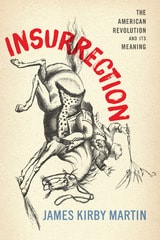
Insurrection
The American Revolution and Its MeaningJames Kirby Martin
Westholme Publishing, 2019
The Revolutionary generation believed they were living in dangerous, turbulent times. Their uprising against British imperial authority beginning in the 1760s represented an attempt to preserve their liberties in the face of what they perceived as a conspiracy from above, ultimately brought on by a tyrannical king and Parliament. The actual number of insurgents—we call them rebels or patriots—represented no more than 20 to 25 percent of the populace. Approximately the same number of persons refused to renounce their loyalty to the British Crown; and thousands of them joined British arms to crush the patriot insurrection. Not committed to supporting either side were large numbers of neutrals whose allegiance varied with their proximity to competing military forces. Once independence was secured, however, a great shift occurred. Some key Revolutionary leaders began to worry that the common people, if given too much political authority, would produce agitation from below that could destroy the delicate fabric of the newly established republic. Reckoning with this social and political disorder resulted in a series of constitutional settlements. What emerged was a more democratic system of government operating, at least theoretically, in the name of a sovereign people who had replaced the king and Parliament.
In Insurrection: The American Revolution and Its Meaning, award-winning historian James Kirby Martin discusses the causes, course, and consequences of the War for Independence. While interpretations of the Revolution and its short- and long-term meaning abound, Martin emphasizes that the insurrection against British monarchism led to more profound changes in human institutions and ideals than many of the Revolutionary leaders actually envisioned or wanted. Once unleashed, the genie of greater freedom and liberty for all could not be forced back into the bottle, no matter how much some persons would have desired.

Inventing Congress
Origins and Establishment of the First Federal CongressKenneth R. Bowling
Ohio University Press, 1999
On March 4, 1789, New York City's church bells pealed, cannons fired, and flags snapped in the wind to celebrate the date set for the opening of the First Federal Congress. In many ways the establishment of Congress marked the culmination of the American Revolution as the ship of state was launched from the foundation of the legislative system outlined in Article I of the Constitution.
Inventing Congress presents the latest scholarship on the interrelated intellectual, institutional, cultural, and political antecedents of the formation of the First Federal Congress. The first section covers the origins of the body, ranging in discussion from the question of how the founders' understanding of classical Greek and Roman republican precedent shaped their thinking, to the political lessons learned during the Continental and Confederation Congresses.
The second section concerns itself with the establishment of the First Federal Congress, examining several heretofore little-treated aspects of the most important Congress in history, including its relationship to the press, morality, the arts and sciences, and economic philosophy.
Inventing Congress represents the papers from the first two conferences sponsored by the United States Capitol Historical Society in its series, “Perspectives on the History of Congress, 1789-1801.”
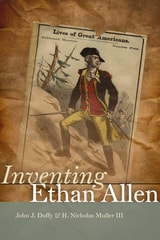
Inventing Ethan Allen
John J. Duffy and H. Nicholas Muller
University Press of New England, 2014
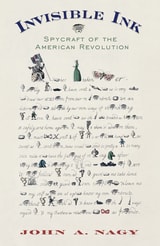
Invisible Ink
Spycraft of the American RevolutionJohn A. Nagy
Westholme Publishing, 2010
The Critical Role of Espionage During the War of Independence and the Techniques Spies Used
During the American Revolution, espionage was critical to the successes and failures of both Continental and British efforts, and those employed in cloakand- dagger operations always risked death. While the most notorious episode of spying during the war—the Benedict Arnold affair—was a failure, most intelligence operations succeeded. Spycraft was no more wholly embraced than by the American commander-in-chief, George Washington. Washington relied on a vast spy network and personally designed sophisticated battle plan deceptions and counterintelligence efforts, some surprisingly modern in form. In Invisible Ink: Spycraft of the American Revolution, award-winning author John A. Nagy briefly traces the history of spy techniques from ancient China through Elizabethan England before embarking on the various techniques used by spies on both sides of the war to exchange secret information. These methods included dictionary codes, diplomatic ciphers, dead drops, hidden compartments (such as a hollowed-out bullet or a woman’s garter), and even musical notation, as well as efforts of counterintelligence, including “Black Chambers,” where postal correspondence was read by cryptologists. Throughout, the author provides examples of the various codes and ciphers employed, many of which have not been previously described. In addition, the author analyzes some of the key spy rings operating during the war, most notably the Culper ring that provided information to Washington from inside British-controlled New York City. Based on nearly two decades of primary research, including the author’s discovery of previously unrecognized spies and methods, Invisible Ink is a major contribution to the history of conflict and technology.
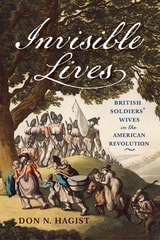
Invisible Lives
British Soldiers' Wives in the American RevolutionDon N. Hagist
Westholme Publishing, 2026
She was stabbed by her drunken husband on a storm-tossed ship in the North Atlantic. She forgave him before she died—and history never recorded her first name. Mrs. Whitlow, wife of a British soldier, is just one of the thousands of women who followed their husbands to war during the American Revolution. These women lived in the barracks and camps and endured the hardships of garrisons and campaigns in an unfamiliar and often hostile land. They faced the challenges with fortitude, proving themselves resourceful, industrious, and intrepid, but their involvement in the conflict that founded the United States has been largely lost to history. Incidents and brief mentions abound in the military writings and iconography of the era, but stories of individual lives are nearly nonexistent, which has caused this large population to be almost entirely overlooked.
Combining archival research with deeply human storytelling, Invisible Lives: British Soldiers’ Wives in the American Revolution by Don N. Hagist brings together, for the first time, the myriad glimpses of these wives to tell the larger story of how they lived, worked, suffered, and survived as women in a foreign war. Drawing on court martial proceedings, muster rolls, marriage licenses, newspaper notices, and rare surviving letters, this meticulously researched work reconstructs the lives of women who were present in every theater of the Revolutionary War. What emerges is a portrait of remarkable resilience. These women crossed oceans, survived sieges, nursed the wounded, and raised children in the chaos of an eighteenth-century war. These many moments come together to provide a more complete and invaluable picture of British soldiers’ wives and their place in the army and the surrounding society. For readers of women’s history, military history, and the American Revolution, this is an overdue and deeply moving reckoning with the lives history had left behind.