Results by title
231 books match the query 'Society' and 10 start with i
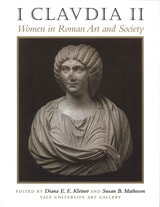
I Claudia II
Women in Roman Art and SocietyEdited by Diana E. E. Kleiner and Susan B. Matheson
University of Texas Press, 2000
I, Claudia: Women in Ancient Rome—an exhibition and catalog produced by the Yale University Art Gallery—provided the first comprehensive study of the lives of Roman women as revealed in Roman art. Responding to the popular success of the exhibit and catalog, Diana E. E. Kleiner and Susan B. Matheson here gather ten additional essays by specialists in art history, history, and papyrology to offer further reflections on women in Roman society based on the material evidence provided by art, archaeology, and ancient literary sources.
In addition to the editors, the contributors are Cornelius C. Vermeule, Rolf Winkes, Mary T. Boatwright, Susan Wood, Eve D'Ambra, Andrew Oliver, Diana Delia, and Ann Ellis Hanson. Their essays, illustrated with black-and-white photos of the art under discussion, treat such themes as mothers and sons, marriage and widowhood, aging, adornment, imperial portraiture, and patronage.

Image
Knowledge in Life and SocietyKenneth E. Boulding
University of Michigan Press, 1956
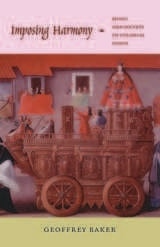
Imposing Harmony
Music and Society in Colonial CuzcoGeoffrey Baker
Duke University Press, 2008
Building on recent scholarship by social historians and urban musicologists and drawing on extensive archival research, Baker highlights European music as a significant vehicle for reproducing and contesting power relations in Cuzco. He examines how Andean communities embraced European music, creating an extraordinary cultural florescence, at the same time that Spanish missionaries used the music as a mechanism of colonialization and control. Uncovering a musical life of considerable and unexpected richness throughout the diocese of Cuzco, Baker describes a musical culture sustained by both Hispanic institutional patrons and the upper strata of indigenous society. Mastery of European music enabled elite Andeans to consolidate their position within the colonial social hierarchy. Indigenous professional musicians distinguished themselves by fulfilling important functions in colonial society, acting as educators, religious leaders, and mediators between the Catholic Church and indigenous communities.
Integrating the Rural World
Economy, Society and Politics in Central and South-Eastern Europe, 1848-1939Sorin Radu
Central European University Press, 2026
Invitation to Law and Society, Second Edition
An Introduction to the Study of Real LawKitty Calavita
University of Chicago Press, 2016
With this second edition of Invitation to Law and Society, Calavita brings up to date what is arguably the leading introduction to this exciting, evolving field of inquiry and adds a new chapter on the growing law and cultural studies movement.
Invitation to Law and Society, Second Edition
An Introduction to the Study of Real LawKitty Calavita
University of Chicago Press, 2016
Law and society is a rapidly growing field that turns the conventional view of law as mythical abstraction on its head. Kitty Calavita brilliantly brings to life the ways in which law is found not only in statutes and courtrooms but in our institutions and interactions, while inviting readers into conversations that introduce the field’s dominant themes and most lively disagreements. Deftly interweaving scholarship with familiar examples, Calavita shows how scholars in the discipline are collectively engaged in a subversive exposé of law’s public mythology. While surveying prominent issues and distinctive approaches to both law as it is written and actual legal practices, as well as the law’s potential as a tool for social change, this volume provides a view of law that is more real but just as compelling as its mythic counterpart.
With this second edition of Invitation to Law and Society, Calavita brings up to date what is arguably the leading introduction to this exciting, evolving field of inquiry and adds a new chapter on the growing law and cultural studies movement.
Invitation to Law and Society
An Introduction to the Study of Real LawKitty Calavita
University of Chicago Press, 2010
Law and Society is a rapidly-growing interdisciplinary field that turns on its head the conventional, idealized view of the “Law” as a magisterial abstraction. Kitty Calavita’s Invitation to Law and Society brilliantly brings to life the ways in which law shapes and manifests itself in the institutions and interactions of human society, while inviting the reader into conversations that introduce the field’s dominant themes and most lively disagreements.
Deftly interweaving scholarship with familiar personal examples, Calavita shows how scholars in the discipline are collectively engaged in a subversive exposé of law’s public mythology. While surveying prominent issues and distinctive approaches to the use of the law in everyday life, as well as its potential as a tool for social change, this volume provides a view of law that is more real but just as compelling as its mythic counterpart. In a field of inquiry that has long lacked a sophisticated yet accessible introduction to its ways of thinking, Invitation to Law and Society will serve as an engaging and indispensible guide.
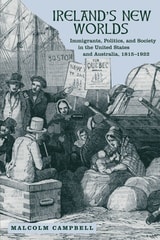
Ireland's New Worlds
Immigrants, Politics, and Society in the United States and Australia, 1815–1922Malcolm Campbell
University of Wisconsin Press, 2007
Ireland’s New Worlds is the first book to compare Irish immigrants in the United States and Australia. In a profound challenge to the national histories that frame most accounts of the Irish diaspora, Malcolm Campbell highlights the ways that economic, social, and cultural conditions shaped distinct experiences for Irish immigrants in each country, and sometimes in different parts of the same country. From differences in the level of hostility that Irish immigrants faced to the contrasting economies of the United States and Australia, Campbell finds that there was much more to the experiences of Irish immigrants than their essential “Irishness.” America’s Irish, for example, were primarily drawn into the population of unskilled laborers congregating in cities, while Australia’s Irish, like their fellow colonialists, were more likely to engage in farming. Campbell shows how local conditions intersected with immigrants’ Irish backgrounds and traditions to create surprisingly varied experiences in Ireland’s new worlds.
“Well conceived and thoroughly researched . . . . This clearly written, thought-provoking work fulfills the considerable ambitions of comparative migration studies.”—Choice
Irrigation's Impact on Society
Edited by Theodore E. Downing and McGuire Gibson
University of Arizona Press, 1974
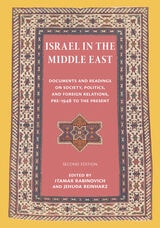
Israel in the Middle East
Documents and Readings on Society, Politics, and Foreign Relations, Pre-1948 to the PresentEdited by Itamar Rabinovich and Jehuda Reinharz
Brandeis University Press, 2007