Results by title
370 books match the query 'Spain' and 11 start with i
Iberian Empires and the Roots of Globalization
Ivonne del Valle
Vanderbilt University Press, 2019
Iberian Empires and the Roots of Globalization argues that Iberian empires cannot be viewed apart from early modern globalization. From research sites throughout the early modern Spanish and Portuguese territories and from distinct disciplinary approaches, the essays collected in this volume investigate the economic mechanisms, administrative hierarchies, and art forms that linked the early modern Americas, Africa, Asia, and Europe. Iberian Empires and the Roots of Globalization demonstrates that early globalization was structured through diverse networks and their mutual and conflictive interactions within overarching imperial projects. To this end, the essays explore how specific products, texts, and people bridged ideas and institutions to produce multiple centers within Iberian imperial geographies. Taken as a whole, the authors also argue that despite attempts to reproduce European models, early Iberian globalization depended on indigenous agency and the agency of people of African descent, which often undermined or changed these models.
The volume thus relays a nuanced theory of early modern globalization: the essays outline the Iberian imperial models that provided templates for future global designs and simultaneously detail the negotiated and conflictive forms of local interactions that characterized that early globalization. The essays here offer essential insights into historical continuities in regions colonized by Spanish and Portuguese monarchies.
Identity, Culture, And Politics In The Basque Diaspora
Gloria Pilar Totoricagüena
University of Nevada Press, 2015
Totoricagüena offers a superb quantitative study of an aspect of Basque culture that has been largely ignored by scholars—the diaspora. In doing so, she enlarges the understanding of cultural identity in general—how it is defined and preserved, how it evolves over time, and how both the politics of distant places and the most intimate family habits can shape an individual’s sense of self. Identity, Culture, and Politics in the Basque Diaspora is a major contribution to the knowledge of Basques and their persistent political and cultural traditions.
Imperial Transformations in Sixteenth-Century Yucay, Peru
Transcribed and edited by R. Alan Covey and Donato Amado González
University of Michigan Press, 2008
In Pursuit of Their Dreams
A History of Azorean Immigration to the United StatesJerry R. Williams
Tagus Press, 2007
Jerry Williams' history of Azorean immigration to the United States offers us valuable insight into the experience and culture of Portuguese immigrants and their descendants. This account fills a major gap in American immigration history and gives us a comprehensive overview of how Portuguese-Americans—now numbering close to a million people—have come to constitute a vibrant and highly visible presence within southeastern New England, the areas around San Francisco and San Diego, Hawaii, and the New Jersey/New York metropolitan area. Even though Azorean immigrants all came from similar cultural and social backgrounds, Williams shows how regionally specific opportunity structures and social hierarchies have contributed to significant differences within the Portuguese-American experience.
Starting with the whaling routes that first connected the mid-Atlantic archipelago with the ports of call in New England and California in the early 1800s, Williams lays out the complex relationship between the Azores and the US that has continued into the present. We learn how particular patterns of poverty, overpopulation and social inequality in the Azores pushed large numbers of the islands' inhabitants to leave their homes in search of better opportunities for themselves and their children. He tells the story of how the early whalers who jumped ship in New Bedford, San Francisco, or Hawaii were followed by kin and fellow villagers who had heard of plentiful jobs in New England's textile mills, gold and land in California, or agricultural work on Hawaiian plantations. Williams' account allows us to understand the importance of family and community connections throughout the immigrants' arduous transition from peasant life to industrial society.
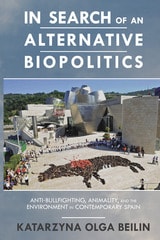
In Search of an Alternative Biopolitics
Anti-Bullfighting, Animality, and the Environment in Contemporary SpainKatarzyna Olga Beilin
The Ohio State University Press, 2015
Analyses of the synergy of press debates on bullfighting and the War on Terror, as well as media debates on King Juan Carlos’s hunt in Botswana and his resignation, reveal how the concepts structuring human/animal relations condition national biopolitics. Beilin traces a main principle, where sacrifice of some lives is deemed necessary for the sake of others, from bullfighting, through environmental destruction and immigration policies, to bioeconomy. Ultimately, In Search of an Alternative Biopolitics argues that to address ever-increasing threats of global warming and future catastrophes, we urgently need to redefine concepts structuring the human and the nonhuman realms.
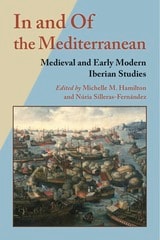
In and Of the Mediterranean
Medieval and Early Modern Iberian StudiesMichelle M. Hamilton
Vanderbilt University Press, 2014
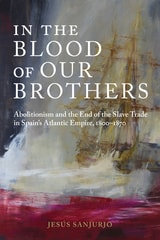
In the Blood of Our Brothers
Abolitionism and the End of the Slave Trade in Spain's Atlantic Empire, 1800–1870Jesús Sanjurjo
University of Alabama Press, 2021
FINALIST FOR THE PAUL E. LOVEJOY BOOK PRIZE
Unraveling the complex politics behind the end of the slave trade in Spain's Atlantic Empire.
Throughout the nineteenth century, very few people in Spain campaigned to stop the slave trade and did even less to abolish slavery. Even when some supported abolition, the reasons that moved them were not always humanitarian, liberal, or egalitarian. How abolitionist ideas were received, shaped, and transformed during this period has been ripe for study. Jesús Sanjurjo’s In the Blood of Our Brothers: Abolitionism and the End of the Slave Trade in Spain’s Atlantic Empire, 1800–1870 provides a comprehensive theory of the history, the politics, and the economics of the persistence and growth of the slave trade in the Spanish empire even as other countries moved toward abolition.
Sanjurjo privileges the central role that British activists and diplomats played in advancing the abolitionist cause in Spain. In so doing, he brings to attention the complex and uneven development of abolitionist and antiabolitionist discourses in Spain’s public life, from the beginning of the nineteenth century to the end of the transatlantic trade. His delineation of the ideological and political tension between Spanish liberalism and imperialism is crucial to formulating a fuller explanation of the reasons for the failure of anti–slave trade initiatives from 1811 to the 1860s. Slave trade was tied to the notion of inviolable property rights, and slavery persisted and peaked following three successful liberal revolutions in Spain.
Visit https://inthebloodofourbrothers.com/ for more information.

Indiscreet Fantasies
Iberian Queer CinemaAndrés Lema-Hincapié
Bucknell University Press, 2021
Published by Bucknell University Press. Distributed worldwide by Rutgers University Press.
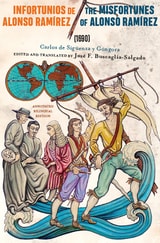
Infortunios de Alonso Ramirez / The Misfortunes of Alonso Ramirez (1690)
Annotated Bilingual EditionBuscaglia-Salgado, José F
Rutgers University Press, 2018
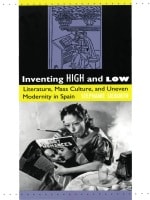
Inventing High and Low
Literature, Mass Culture, and Uneven Modernity in SpainStephanie Sieburth
Duke University Press, 1994
Choosing two historical moments of sweeping material and cultural change in Spanish history, Sieburth reads two novels from the 1880s (by Benito Pérez Galdós) and two from the 1970s (by Juan Goytisolo and Carmen Martín Gaite) as fictional theories about the impact of modernity on culture and politics. Her analysis reveals that the high/low division in the cultural sphere reinforces other kinds of separations—between social classes or between men and women—dear to the elite but endangered by progress. This tension, she shows, is particularly evident in Spain, where modernization has been a contradictory and uneven process, rarely accompanied by political freedom, and where consumerism and mass culture coexist uneasily with older ways of life.
Weaving together a wide spectrum of diverse material, her work will be of interest to readers concerned with Spanish history and literature, literary theory, popular culture, and the relations between politics, economics, gender, and the novel.

Islamic Spain, 1250 to 1500
L. P. Harvey
University of Chicago Press, 1990
"Harvey not only examines the politics of the Nasrids, but also the Islamic communities in the Christian kingdoms of the peninsula. This innovative approach breaks new ground, enables the reader to appreciate the situation of all Spanish Muslims and is fully vindicated. . . . An absorbing and thoroughly informed narrative."—Richard Hitchcock, Times Higher Education Supplement
"L. P. Harvey has produced a beautifully written account of an enthralling subject."—Peter Linehan, The Observer